


























Quick Field Data
- UNESCO Inscription: 1991 (Cultural heritage property in the town of Rauma, Satakunta region, western Finland)
- Scale & Footprint: 29 hectares encompassing approximately 600 privately owned wooden buildings, narrow courtyards, and outbuildings within the 19th-century municipal toll boundaries
- Access & Ticketing: Old Rauma is an active, open-access residential and commercial town quarter; check the official site for historic house museum admission, guided walking tours, and the annual Lace Week schedule
- Arrival Logistics: Situated along Finnish national road 8 (E8) and road 12, 92 kilometres north of Turku and 50 kilometres south of Pori, with long-distance coach links from Savila and Rauma bus station
Franciscan Origins, Post-Glacial Land Uplift, and Maritime Timber Rebuilding
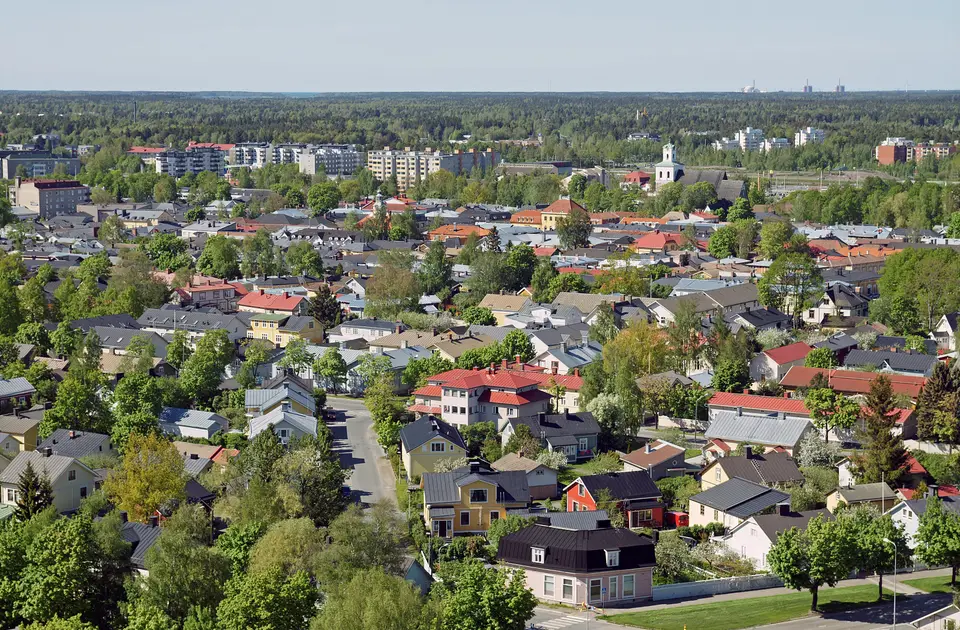
Set near the eastern shore of the Gulf of Bothnia in the Satakunta region of western Finland, Old Rauma, known in Finnish as Vanha Rauma and in Swedish as Raumo, preserves the largest and most unified historical wooden town centre in the Nordic countries. Across Finland, the UNESCO World Heritage Atlas in 1991 across 29 hectares, the historic core forms the heart of a municipality of some 38,773 to 39,000 inhabitants within a wider sub-region of nearly 64,919 to 65,000 residents, bordered by Eura, Eurajoki, Laitila, and Pyhäranta, which also shares municipal governance over Rauma's second World Heritage property, the Bronze Age burial cairns of Sammallahdenmäki. Taking its name from the Germanic word strauma, meaning "stream", Rauma grew during the 14th century around a small river harbour, a Franciscan monastery, and a Catholic church before receiving its official town charter under the rule of Sweden on 17 April 1442.
When medieval merchants and craftsmen first laid out their timber houses along the riverbank, the town sat directly on the seashore of the Gulf of Bothnia. Over the ensuing centuries, continuous post-glacial isostatic land uplift gradually raised the coastal crust, leaving Old Rauma roughly 1.5 kilometres inland from the present Baltic shoreline and docks. In 1550 the Swedish crown ordered the burghers of Rauma to abandon their homes and relocate to help populate the newly founded city of Helsinki, yet the townspeople soon returned to their coastal harbour and resumed maritime trade across the Baltic Sea.
Like other Nordic timber settlements, Rauma suffered devastating conflagrations that swept through its closely packed wooden roofs in 1640 and again in 1682, destroying virtually every secular structure in the town while sparing the stone walls of the mid-15th-century Franciscan Church of the Holy Cross. including, as residents rebuilt their homes and workshops during the 18th and 19th centuries over surviving medieval stone cellars, they retained the ancient medieval town plan intact. Until 1809 the historic wooden quarter within the old customs toll boundaries constituted almost the entire urban footprint of Rauma. Even after British and French naval squadrons attacked the harbour in 1855 during the Crimean War, the late 19th-century boom in merchant shipping propelled Rauma to its golden age: by 1897 the town boasted the largest fleet of wooden sailing ships in Finland, numbering 57 ocean-going vessels that exported timber and goods to Germany, Stockholm, and the Baltic ports.
Neo-Renaissance Timber Facades, Courtyard Gates, and Rauma Lace
What distinguishes Old Rauma from open-air architectural museums is its continuity as a lived-in commercial and residential neighbourhood where around 600 historic wooden buildings, the vast majority privately owned, still line the irregular, winding medieval street network. Built predominantly to a single storey in height using horizontal log construction, the main residential houses sit flush along the street edge to create continuous streetscapes, while behind them open narrow, enclosed private courtyards bordered by former animal sheds, granaries, storehouses, earth cellars, and workshops.
As seafaring profits flowed into the town during the late 18th and late 19th centuries, shipowners, captains, and merchants enlarged their modest log dwellings and clad the exterior walls in painted horizontal and vertical weatherboarding richly detailed in the Neo-Renaissance style. Elaborately profiled window casings, cornices, pilaster strips, and decorative wooden panels painted in warm yellows, ochres, reds, blues, and greens transformed the street facades, while between the houses craftsmen erected the town's signature carved wooden courtyard gates, which screen the private domestic yards from the public lane. Painted timber facades line every lane. Two principal commercial thoroughfares run through the southern half of the Old Town and converge on the central Market Square, where a 18th-century stone-and-timber Old Town Hall overlooks open-air market stalls, cafes, and independent boutiques.
Intimately tied to the town's maritime heritage are two intangible cultural traditions that flourished inside these wooden homes: bobbin lace-making and the distinct local dialect known as "Rauman giäl". Introduced by at least the 18th century, Rauma lace became prized across Northern Europe for its delicate geometric patterns worked on pillow bobbins by seamen's wives and daughters, a craft celebrated every summer since 1971 during the annual Lace Week, which culminates in the late-night concerts and exhibitions of Black Lace Night. Meanwhile, generations of sailors returning from overseas voyages infused the local Finnish dialect with vocabulary borrowed from Swedish, English, and German, a linguistic heritage documented in the stories of author Hj. Nortamo and preserved in local publications alongside the town's later modern reputation as the namesake of Raumism in the Esperanto cultural movement. Climatically, the coastal position along the Gulf of Bothnia moderates the humid continental Dfb regime, bringing mild maritime air in winter and cool sea breezes in summer around an annual mean temperature of 6 degrees, with recorded extremes in central Rauma reaching minus 33.6 degrees on 3 February 1966 and summer highs around 33 degrees. Today the wider municipality of 38,773 residents, where 34,909 people (90 percent) speak Finnish as their mother tongue alongside 115 Swedish speakers (0.3 percent) and speakers of 30 foreign languages including Ukrainian, Russian, Polish, Estonian, Romanian, and English among 3,725 residents of foreign background, maintains a lively cultural calendar across Old Rauma and the seaside districts. Alongside July Lace Week, the town hosts the classical music festival Festivo, Rauma Summer Jazz, the Klustermus performing arts gathering, the Blue Sea Film Festival, and Rauma Blues, while local sports culture rallies around the Rauman Lukko ice hockey club, founded in 1936 and crowned Finnish SM-liiga champions in 1963 and 2021, alongside football clubs Pallo-Iirot and FC Rauma, the Fera women's baseball team at Otanlahti, and the Rasti-Lukko orienteering club.
Walking the Medieval Lanes, Holy Cross Church, and House Museums
Travellers journeying northwest from Helsinki via Tampere and Huittinen, or driving the coastal E8 highway between Turku (92 kilometres south) and Pori (50 kilometres north), can step directly from the modern city into the pedestrian-friendly cobblestone lanes of Vanha Rauma. While post-World War II Rauma expanded outside the historic core into a major port handling nearly six million tonnes of cargo annually alongside paper mills, shipbuilding, the 1890s teacher training college now part of the University of Turku, and nearby industrial sites such as the Olkiluoto Nuclear Power Plant in Eurajoki, the 29-hectare wooden town within the old toll gates remains strictly conserved.
- Market Square, commercial streets, and Neo-Renaissance house museums: Start at the lively central Market Square to view the 18th-century Old Town Hall before walking the two main commercial streets lined with single-storey Neo-Renaissance wooden storefronts and carved courtyard gates. Step inside preserved merchant and seafarer residences, where period rooms, tiled stoves, outbuildings, and lace-making displays illustrate 19th-century domestic life above older medieval cellars, and browse local bobbin lace workshops during the July Lace Week or year-round exhibitions.
- Franciscan Church of the Holy Cross and the riverfront walk: Follow the northern lanes of Old Rauma to the small stream where the medieval town originated to visit the mid-15th-century Church of the Holy Cross, the sole surviving stone monument of the medieval Franciscan friary, whose vaulted interior preserves medieval wall paintings and a Renaissance pulpit. Nearby, trace the historic plot boundaries and narrow alleys where one-storey timber houses and backyard granaries follow the medieval street pattern that survived the fires of 1640 and 1682.
- Rauma Maritime Museum and the Bothnia archipelago islands: Walk west from Old Rauma toward the present coastline, created as land uplift shifted the sea 1.5 kilometres outward, to visit the Rauma Maritime Museum, founded in 1999 inside the historic Rauma Nautical School building to present the era of the 57-vessel sailing fleet of 1897. During summer, board a water bus from the marina docks, which berth some 2,800 pleasure craft, out into the Gulf of Bothnia to visit the Kylmäpihlaja Lighthouse hotel or the recreational islands of Reksaari and the former coastal garrison island of Kuuskajaskari, while municipal consolidations with rural Rauma in 1993, Kodisjoki in 2007, and Lappi in 2009 have united the historic wooden core of Vanha Rauma with its surrounding Satakunta hinterland.
