


























Quick Field Data
- UNESCO Inscription: 1985 (placed on the endangered heritage list in 2015), inscribed as the best-preserved fortified city of the Parthian cultural sphere and capital of the ancient Arab Kingdom of Hatra.
- Scale & Footprint: Encompasses a circular double-walled urban enclosure nearly 2 kilometres in diameter (covering roughly 300 hectares) with more than 160 defensive towers, centred on a 1.2-hectare rectangular sacred temenos.
- Access & Ticketing: Located in Nineveh Governorate in northern Iraq; check official Iraqi antiquities authorities and international travel advisories regarding site access and ongoing post-conflict restoration.
- Arrival Logistics: Situated in the semi-arid Jazeera steppe between the Tigris and Euphrates rivers, 110 kilometres southwest of Mosul, 70 kilometres west of ancient Ashur, and 290 kilometres northwest of Baghdad.
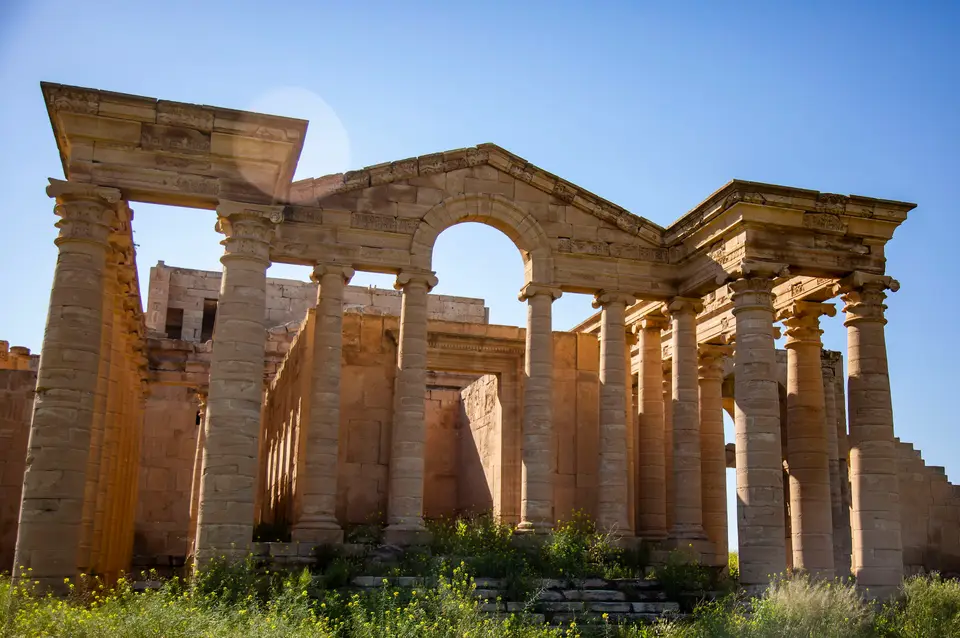
Rising out of the open semi-desert steppe of the Jazeera plain between the Tigris and Euphrates rivers in northern Iraq, 110 kilometres southwest of Mosul and 3 kilometres west of the seasonal Wadi al-Tharthar, the circular fortified city of Hatra (known in Arabic as al-Hadr) remains the grandest surviving urban monument of the Parthian era. Across Iraq, the UNESCO World Heritage Atlas in 1985 across a 300-hectare archaeological zone, Hatra evolved from a small settlement built over Assyrian foundations into a prosperous caravan metropolis and the capital of the semi-autonomous Arab Kingdom of Hatra (Araba) between the first century BC and the third century AD. Protected by a double ring of fortified walls nearly 2 kilometres in diameter and crowned at its centre by towering vaulted limestone temples that blended Hellenistic and Roman architectural forms with Mesopotamian alongside Parthian and Arabian traditions, the desert stronghold famously repulsed repeated Roman imperial sieges before falling to the Sasanian Persians in 241 AD. Stone iwans rise across the desert steppe.
Between Rome and Parthia: The Enclosure of Shamash and the Sieges of 116 and 198
Recorded in Hatran Aramaic inscriptions as Hatra (probably meaning enclosure, hedge, or fence) and on local coinage as Hatra d-Shamash (the Enclosure of the sun god Shamash), the settlement occupied a strategic frontier position along the military and caravan routes linking the Roman Empire in the west with the Parthian Empire in the east, and connecting Upper Mesopotamia down the Tigris and Euphrates to the Arabian Gulf. Together with Palmyra and Baalbek as well as Petra to the southwest, Hatra formed the northeastern anchor in a chain of wealthy Arab-controlled desert buffer cities. Early rulers documented in the more than 500 Hatran Aramaic inscriptions discovered since 1937 bore the title marya (lord), while second-century AD monarchs assumed the royal title malka d-Arab (King of the Arabs).
Because Hatra commanded the desert approaches to Mesopotamia, its formidable double defensive walls, reinforced by more than 160 towers and a deep outer ditch, were tested repeatedly during the Roman-Parthian wars of the second century AD. In 116, 117 AD, the Roman Emperor Trajan personally besieged Hatra during his Mesopotamian campaign, but desert heat and scarce water alongside fierce resistance from the ramparts forced the Roman legions to retreat. Eighty years later, in 198, 199 AD, Emperor Septimius Severus twice assaulted the circular fortress with siege engines, only to be repulsed with heavy losses as defenders hurled earthen pots filled with burning naphtha and biting insects down upon the attackers, cementing Hatra's reputation across the ancient world for military impregnability.
When the Sasanian Persian dynasty overthrew the Parthians in the early third century AD, Hatra initially defeated the Sasanian forces in 238 AD at the battle of Shahrazoor and entered a brief alliance with Rome. However, in 241 AD, the Sasanian king Shapur (Shapur I,) captured and destroyed the city, an event immortalised in later Arabic and Persian legend through the tale of Princess al-Nadirah, who allegedly betrayed her father's fortress out of love for Shapur. Never resettled after 241 AD, the ruins were surveyed between 1906 and 1911 by German archaeologist Walter Andrae (working from nearby Ashur, 70 kilometres east), excavated systematically by Iraqi archaeologists from 1951 onward, and studied from the 1980s by the Italian Archaeological Expedition of the University of Turin under R. Ricciardi Venco and a 1990 Polish mission from the University of Warsaw.
The Circular Double Ramparts, the Rectangular Temenos, and the Great Iwans
Adapted to the flat semi-arid topography of the Jazeera steppe (where average annual rainfall is roughly 257 millimetres), the urban layout of Hatra forms a nearly circular enclosure measuring roughly 2 kilometres across. An outer mud-brick wall and an inner stone-and-brick defensive curtain wall, pierced by four main fortified gates oriented toward the cardinal points and guarded by over 160 projecting towers, encircle residential neighbourhoods and courtyard houses such as Building A alongside smaller shrines dedicated to a cosmopolitan pantheon.
At the exact geometric heart of the circular city lies the vast rectangular sacred enclosure (temenos), oriented east-to-west and surrounded by its own high stone wall pierced by gates. Covering more than 1.2 hectares, an interior partition wall divides the temenos into a spacious eastern forecourt and a smaller western sacred courtyard where the principal limestone temples stand side by side. In Hatran Aramaic inscriptions, this central sanctuary complex was revered as Beit ʾElāhāʾ (the House of God), where Greek and Assyrian alongside Canaanite as well as Aramean and Arabian deities were worshipped together: chief among them the Mesopotamian sun god Shamash, the sky god Ba'al Shamayn, alongside Nergal, Hermes, Atargatis, Allat, Shamiyyah, and the syncretic deity Ashurbel.
Architecturally, the great sanctuary buildings inside the western courtyard, dominated by the Great Temple of Shamash, whose barrel-vaulted halls once soared 30 metres high, pioneered the monumental stone iwan: a lofty, three-sided barrel-vaulted hall open entirely at the front to the courtyard, flanked by smaller two-storey side rooms and backed by a square ambulatory fire or sun sanctuary behind the main iwan. Whereas earlier Mesopotamian builders worked in mud brick, Hatra's architects built in finely dressed local limestone, adorning the tall arched iwan facades and column capitals with theatrical carved stone masks, carved reliefs and frontal Parthian statues of rulers and deities dressed in embroidered tunics and trousers (sharing stylistic affinities with Kushan art).
Post-2015 Recovery, Conservation, and Field Context
Walking through the vast open courtyard of the central temenos at Hatra highlights the scale and durability of Parthian limestone architecture in the northern Mesopotamian steppe. Behind the protection of the circular double walls and more than 160 defensive towers that turned back the Roman armies of Trajan and Septimius Severus, caravan wealth enabled the Arab kings of Hatra to erect towering barrel-vaulted iwans and sculpt hundreds of frontal limestone statues honouring their diverse pantheon of gods and rulers.
After being used as the atmospheric opening location for the 1973 film The Exorcist and undergoing late twentieth-century reconstructions (some bricks bearing modern presidential stamps), Hatra faced a grave crisis between 2014 and April 2017 when militant forces occupied the area and damaged several sculpted reliefs and statues in March 2015, prompting UNESCO to place Hatra on the endangered heritage list in 2015. Following the liberation of the site in April 2017, assessments by Nineveh Governorate antiquities officials and international experts confirmed that the massive circular walls, towers, and towering stone iwans of the central temenos remained standing, allowing Iraqi and Italian conservation teams to resume structural and sculptural restoration. Examining the fortified double circuit of the circular ramparts and the vaulted stone iwans of the central temenos demonstrates how this desert capital bridged Roman, Parthian, and Arab traditions across northern Mesopotamia while enduring repeated imperial sieges.
- Coordinate all visits through official Nineveh Governorate and Iraqi antiquities authorities: Because Hatra lies in a remote semi-desert zone 110 kilometres southwest of Mosul and remains on the endangered heritage list, verify current security clearances and official site access before travelling.
- Trace the transition from the circular outer walls to the rectangular central temenos: Approaching the site across the flat steppe reveals how the 2-kilometre circular ring of double ramparts and 160 towers contrasts with the strictly orthogonal east-west walls of the central Beit ʾElāhāʾ temple enclosure.
- Examine the hybrid Roman and Parthian stone carvings on the Great Temple iwans: Inside the western sanctuary courtyard, look up at the massive limestone arch voussoirs of the 30-metre Great Temple iwans to see how classical Corinthian pilasters and acanthus mouldings frame frontal Parthian portrait masks and solar eagle emblems of Shamash.
