


























Quick Field Data
- UNESCO Inscription: 1984, designated as an exceptional expression of Imperial Roman sanctuary architecture fused with indigenous Levantine religious traditions.
- Scale & Footprint: Occupies an elevated tell and fortified acropolis at an altitude of 1,150 to 1,170 metres in the Beqaa Valley, flanked by ancient limestone quarries.
- Access & Ticketing: Visitor entry passes through the monumental eastern Propylaea staircase and ticket pavilion on the edge of modern Baalbek; check the official site for current access and safety updates.
- Arrival Logistics: Situated east of the Litani River approximately 67 kilometres northeast of Beirut at the western foot of the Anti-Lebanon mountains.
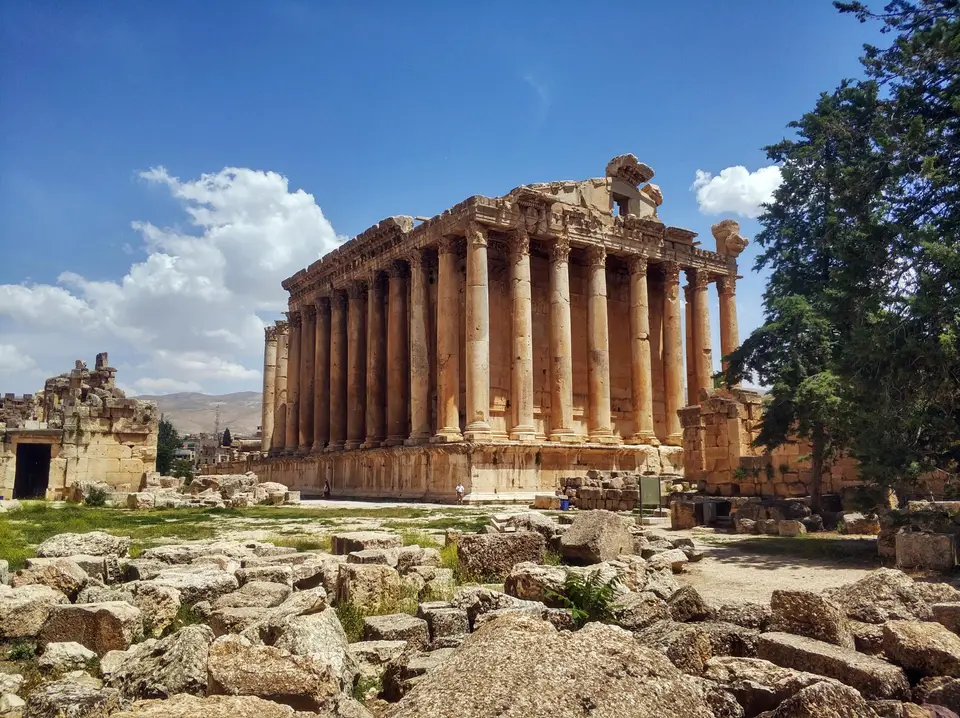
Rising above the fertile plain of the Beqaa Valley at an elevation of roughly 1,150 metres between the Lebanese mountain ranges, Baalbek preserves one of the largest and most ambitious temple complexes ever constructed in the Roman world. After 1984, the UNESCO World Heritage Atlas in 1984, the sanctuary crowns an ancient settlement mound (Tell Baalbek) where continuous human habitation stretches back at least 9,000 to 11,000 years into the Neolithic period. Known during the Hellenistic and Roman eras as Heliopolis (City of the Sun), this sacred centre blended indigenous Canaanite and Phoenician veneration of a divine triad with the monumental stone engineering of the Roman Empire, creating an architectural ensemble whose sheer scale astonished travellers from antiquity to the modern era. Six towering columns dominate the skyline.
From Canaanite Ba'al to the Roman Sanctuary of Heliopolitan Jupiter
Watered by the perennial Ras al-Ain spring and seasonal snowmelt descending from the Anti-Lebanon slopes, early Baalbek stood at a strategic watershed near the headwaters of the Litani and Orontes rivers along caravan routes linking Tyre on the Mediterranean coast with Palmyra in the interior. In Canaanite and Phoenician religion, the hilltop sanctuary honoured a local divine triad consisting of the storm and fertility god Ba'al Haddu, his consort Astarte (Atargatis), and a youthful male deity associated with Adon. Following Alexander the Great's conquest of the region in 334 BC, Hellenistic rulers renamed the town Heliopolis, equating the local sky god with Helios and Zeus.
When Emperor Augustus established the Roman veteran colony of Colonia Julia Augusta Felix Heliopolitana in the late first century BC (settling soldiers of the 5th and 8th Legions within the territory of Berytus), imperial architects launched a two-century building campaign that encased the ancient tell inside an immense artificial stone platform. Rather than imposing a standard Italian temple plan, the sanctuary layout accommodated indigenous ritual practices, including oracle consultations (famously visited twice by Emperor Trajan before his Parthian campaign), processions of a beardless golden charioteer idol borne by principal citizens with shaved heads, and open-air burnt offerings on towering stepped altars dedicated to the Romanized Triad of Heliopolis (Jupiter, Venus, and Mercury) alongside Bacchus.
Construction progressed across the reigns of Nero, Trajan, Antoninus Pius, Septimius Severus (who granted the city ius Italicum privileges in AD 193), Caracalla, and Philip the Arab in the mid-third century AD. With the triumph of Christianity in the fourth century, Emperor Constantine founded a basilica at the site and Emperor Theodosius demolished the pagan altar and parts of the Jupiter sanctuary around AD 379 to erect a large Christian basilica inside the Great Court, while eight Corinthian columns were later shipped to Constantinople under Justinian between 532 and 537 for incorporation into the Hagia Sophia. Following the Muslim conquest around AD 636, the temple acropolis was converted into a heavily fortified medieval citadel known as al-Qala', enduring sieges by Zengi in 1139 and Saladin in 1174 and 1178, twelfth-century earthquakes in 1139, 1157, and 1170, Mongol dismantling under Kitbuqa in 1260, and major Mamluk defensive reconstruction under Sultan Qalawun in the 1280s.
The Trilithon Podium, Six Columns of Jupiter, and the Temple of Bacchus
Approaching the sanctuary from the east, visitors ascend the wide staircase of the Propylaea (originally rising 6.1 metres toward a 12-column arcade between 2 flanking towers, where Latin inscriptions record that a soldier of the 1st Parthian Legion gilded the capitals with bronze in honour of Caracalla and Empress Julia Domna) to enter a mid-third-century hexagonal forecourt added by Philip the Arab. Beyond this hexagonal vestibule opens the vast rectangular Great Court, covering roughly 1.2 to 1.6 hectares and originally framed by Corinthian porticoes holding 128 polished red granite columns standing 7.08 metres high that were quarried in distant Aswan in Upper Egypt. This courtyard floor shelters two mosaic-floored lustration basins and two stone tower-altars built over three barrel-vaulted subterranean passageways measuring 5.2 metres wide and 9.1 metres high that once sheltered Roman soldiers and now house the site's museum displays.
At the western extremity of the Great Court, a broad monumental staircase climbs another 7 metres onto the podium of the Temple of Jupiter, measuring 47.7 by 87.75 metres. Originally surrounded by a peristyle of 54 Corinthian columns standing nearly 20 metres tall with architrave and frieze blocks weighing up to 60 and 100 tonnes raised 19 metres into the air, the temple suffered severe collapse during medieval earthquakes and the tremors of 1759, leaving 6 columns with their entablature still standing along the southern flank (down from 27 standing columns recorded in the sixteenth century and 9 before 1759). Supporting this elevated terrace on the north and west is an outer retaining wall built over courses of 24 monoliths weighing 300 tonnes each, topped on the west by the famous Trilithon (Three Stones): three single blocks of quarried limestone each measuring over 19 metres long, 4.3 metres high, and 3.6 metres broad, weighing approximately 800 tonnes apiece.
Immediately south of the Jupiter platform stands the second-century AD Temple of Bacchus, completed around the 190s under Septimius Severus and preserved as one of the finest sculpted Roman temples in existence. Its cella is encircled by 42 columns nearly 20 metres high supporting a coffered stone ceiling gallery decorated with finely carved reliefs. A monumental gate sculpted with Bacchic figures, vines, and an imperial eagle on its soffit (supported since the nineteenth century after the keystone slid during the 1759 earthquake) leads into a 30-metre nave and an 11-metre raised western adytum sanctuary fronted by 13 steps, while two spiral staircases hidden inside columns beside the entrance climb to the roof. Outside the citadel walls, 140 metres southeast, stands the early third-century circular Temple of Venus (converted into the church of Saint Barbara in the Christian era), while the Hajar al-Hibla quarry 800 metres from town holds three abandoned megaliths waiting in situ: the Stone of the Pregnant Woman (estimated at 1,000 tonnes), a nearby 1,200-tonne monolith, and an even larger stone block measuring 19.6 by 6 by 5.5 metres uncovered by archaeologists in 2014 and estimated to weigh 1,650 tonnes.
Eighteenth-Century Rediscovery, Enhanced Protection, and Field Logistics
Standing amid the fallen granite shafts of the Great Court and looking up at the six surviving limestone columns of the Temple of Jupiter reveals the extraordinary engineering ambition that defined Roman Heliopolis. Every stage of the sanctuary, from the quarrying and transport of 800-tonne foundation monoliths to the delicate carving of Bacchic vine scrolls and coffered stone ceilings, merged imperial architectural power with older Canaanite and Phoenician sacred traditions in the high Beqaa Valley.
In 1757, British traveller Robert Wood published carefully measured engravings in his volume on the ruins of Balbec, inspiring neoclassical architects across Britain and Europe, before German Emperor Wilhelm II's visit on 1 November 1898 launched the systematic excavations of Otto Puchstein between 1898 and 1904. In recent decades, the sanctuary has hosted the acclaimed Baalbek International Festival while requiring careful conservation monitoring after regional conflicts in 2006 and 2024, when UNESCO placed Baalbek under enhanced international protection. Walking through the subterranean galleries, temple terraces, and nearby quarry requires sturdy footwear and attention to local travel advisories.
- Follow the chronological axis from east to west: Enter through the Propylaea and hexagonal forecourt into the Great Court at floor level first, then exit through the subterranean museum tunnels to view the outer western Trilithon wall from outside the citadel moat.
- Visit the Hajar al-Hibla quarry near the southern entrance: Stop at the ancient limestone quarry 800 metres from the acropolis to see the 1,000-tonne Stone of the Pregnant Woman and the adjacent 1,650-tonne monolith still resting in their extraction trench.
- Check travel advisories and dress for high altitude: Because Baalbek sits above 1,150 metres in the continental Beqaa Valley, summer sun is intense while autumn and winter winds off the Anti-Lebanon peaks are cold.
