


























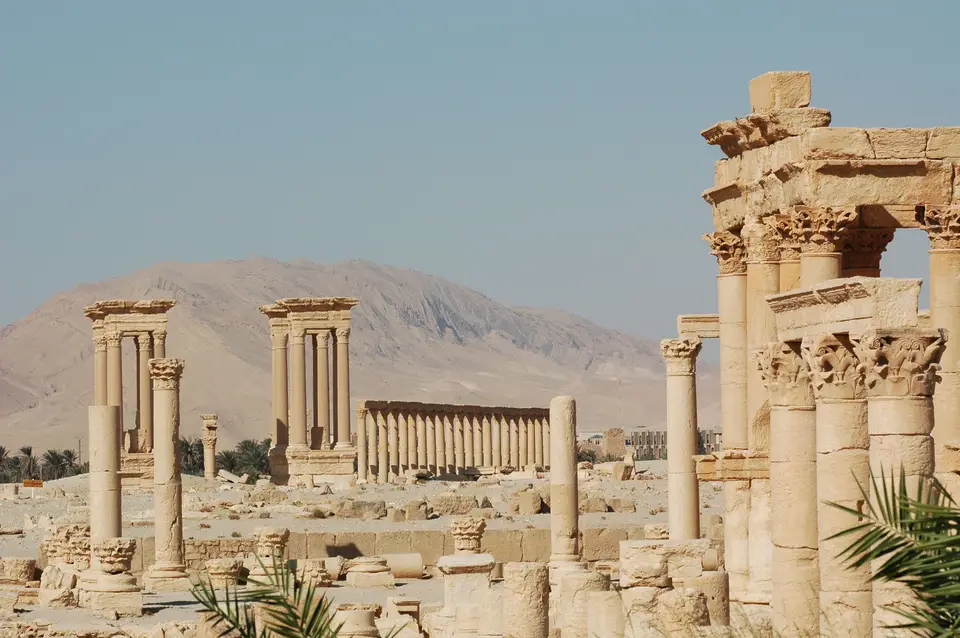
Quick Field Data
- UNESCO Inscription: 1980 · Criteria (i), (ii), (iv) · Placed on the Danger List since 2013
- Scale & Footprint: Extensive oasis archaeological zone and 2007 buffer zone in Homs province, encompassing the 1,100-metre Grand Colonnade, Temple of Ba'al, Valley of the Tombs as well as 13th-century Palmyra Castle
- Access & Ticketing: Designated a national monument in Syria with a 2007 buffer zone; the hilltop castle and parts of the ruins suffered severe damage during the Syrian Civil War and remain restricted
- Arrival Logistics: Situated in an oasis of the Syrian Desert in the province of Homs, northeast of Damascus
Caravan Oasis Geography and the Synthesis of Greco-Roman and Persian Art
Anchored by natural desert springs in the middle of the arid Syrian Desert northeast of Damascus in the province of Homs, the Site of Palmyra (known in Arabic and ancient Syrian antiquity as Tadmur) preserves the monumental limestone ruins of one of the ancient world's greatest mercantile and cultural centres. Golden limestone columns rise out of desert sand here. In 1980, the UNESCO World Heritage List in 1980 under Criteria (i), (ii) alongside (iv), with a formal protective buffer zone established in 2007 and inclusion on the List of World Heritage in Danger since 2013, the oasis stood for centuries at the strategic crossroads where caravan routes from Persia, India as well as China met the Mediterranean ports of the Roman Empire.
First recorded during the 2nd millennium BC in historical texts from the Mari archives, the desert settlement was already a flourishing desert caravan hub before passing under Roman administration during the middle of the 1st century AD within Roman Syria. Over the 1st, 2nd alongside 3rd centuries AD, Palmyrene merchants organised and protected long-distance camel caravans crossing the desert from the Euphrates and the Persian Gulf, amassing immense wealth from tariffs on silk, spices, glass as well as textiles.
That mercantile prosperity funded a monumental building boom across the 1st and 2nd centuries AD that produced a distinctive architectural and sculptural language across the entire oasis. Positioned where multiple ancient cultures converged, the oasis city laid out a monumental 1,100-metre main avenue that, together with intersecting colonnaded streets, connects the major public buildings, temples, and residential quarters. Because all the key attributes of the ancient city (including the main colonnaded street, the Roman Theatre and the Agora alongside Diocletian's Camp and the Great Temple of Ba'al, and the large-scale funerary monuments outside the walls in the Valley of the Tombs) lie within the heritage boundary and its 2007 buffer zone, Palmyra illustrates both the height of classical Roman eastern urbanism and the 17th- and 18th-century European rediscovery that influenced subsequent neoclassical architectural styles. Across the 1st and 2nd centuries AD, the art and architecture of Palmyra married Graeco-Roman techniques and classical architectural forms with local building traditions and Persian artistic influences to forge a distinctive regional style. Both the carved architectural ornament of the public buildings and the unique examples of funerary sculpture recovered from the surrounding necropolises unite Greco-Roman sculptural modelling with local elements and Persian artistic conventions, creating a visual language that later captivated European travellers who rediscovered the ruined city in the 17th and 18th centuries and influenced subsequent architectural styles.
Binding the urban layout together is the Grand Colonnade, a monumental avenue stretching 1,100 metres across the heart of the city. Flanked by rows of towering limestone columns fitted with projecting stone brackets that once held bronze statues of prominent citizens and caravan patrons, the 1,100-metre main axis intersects secondary colonnaded cross streets to link the city's principal sanctuaries and civic complexes. At the eastern end of the sacred processional route stood the Great Temple of Ba'al (Bel), dedicated in the 1st century AD as one of the most important religious sanctuaries in the ancient East, where a vast porticoed courtyard enclosed a central cella combining classical peripteral columns with eastern rooftop terraces and stepped merlons.
Monumental Archway, the Valley of the Tombs, and Fakhr-al-Din Castle
West of the Great Temple of Ba'al, visitors approached the city and the Grand Colonnade through the richly carved Monumental Archway, whose sculptural treatment represents an outstanding example of Palmyrene art and whose wedge-shaped geometry aligned the processional approach with the main colonnaded street. Along the 1,100-metre monumental axis and its secondary colonnaded cross streets stand the major public monuments and urban quarters of the oasis: the Roman Theatre, the spacious courtyard of the Agora where caravan merchants conducted business, other civic temples, and at the western edge of the city, the military quarter known as Diocletian's Camp.
Beyond the defensive city walls and the traces of the subterranean and surface Roman aqueduct that channelled spring water into the oasis, the surrounding desert hills are lined with immense necropolises, most famously the Valley of the Tombs to the west. Here, wealthy Palmyrene clans erected three types of monumental burial structures that are unique in the Roman world: multi-storey sandstone and limestone tower tombs rising like desert watchtowers, temple-like house tombs, and deep rock-cut hypogea whose subterranean galleries held hundreds of stacked burial niches (loculi) sealed by carved limestone portrait slabs of the deceased.
High on a hill of raised bedrock overlooking the ancient oasis at coordinates 34.5627417 N and 38.2571059 E rises Tadmur Castle, carrying the historic title Fakhr-al-Din al-Ma'ani Castle or Palmyra Castle. Examined in Warwick Ball's 1994 architectural study of Syria, this 13th-century Mamluk fortress combined thick, high masonry walls with a deep surrounding moat crossed solely by a single drawbridge, and took its later title from the 17th-century Druze emir Fakhr-al-Din II when Druze authority reached the Palmyra region. Rediscovered by European travellers in the 17th and 18th centuries, the ruins of Palmyra inspired a wave of neoclassical architectural publications across Europe.
During the Syrian Civil War, the site was placed on the UNESCO Danger List in 2013 and suffered catastrophic intentional destruction when ISIL (the Islamic State) seized the oasis during the May 2015 Palmyra offensive and again between December 2016 and 1 March 2017. When Syrian government forces retook the hilltop citadel in March 2016, retreating ISIS combatants detonated explosives that shattered the entrance stairway and outer masonry before the December 2016 and March 2017 battles; because the underlying 13th-century structure survived intact, Syrian antiquities director Maamoun Abdelkarim confirmed that the ruined masonry can be repaired and restored.
Field Orientation Along the 1,100-Metre Axis and Conservation Status
Because Palmyra and its 13th-century hilltop castle remain in a post-conflict recovery zone in Homs province where active stabilization, de-mining verification, and structural reconstruction are ongoing, any prospective visit requires checking official travel advisories and obtaining formal clearance from Syrian heritage authorities in Damascus.
- Eastern Sanctuary of Ba'al and the 1,100-Metre Grand Colonnade: Begin at the vast walled courtyard of the 1st-century AD Great Temple of Ba'al at the eastern edge of the oasis to examine the surviving perimeter propylaea, exterior wall segments, and monumental stone blocks around the destroyed central cella. Walk west from the position of the Monumental Archway along the 1,100-metre paved axis of the Grand Colonnade, noting the statue-bearing column consoles that line the avenue along the secondary colonnaded cross streets.
- Roman Theatre, the Agora, and Diocletian's Camp: South of the central colonnade, enter the semicircular auditorium of the Roman Theatre and walk into the adjacent rectangular courtyard of the Agora and tariff court, where caravan merchants once assembled. Continue to the western end of the transverse colonnade to inspect the monumental remains of Diocletian's Camp at the foot of the western hills.
- Valley of the Tombs and the Mamluk Castle overlook: Follow the road outside the western city wall into the Valley of the Tombs to view the surviving foundations and standing masonry of the multi-storey tower tombs and subterranean hypogea. Although the interior of the 13th-century Fakhr-al-Din al-Ma'ani Castle remains inaccessible due to the 2016 stairway demolition, the hillside vantage point beside the moat commands a sweeping desert panorama across the entire oasis and palm groves. Because the oasis of Palmyra and its 13th-century castle brings together the 1,100-metre Grand Colonnade, the 1st-century AD Great Temple of Ba'al, the Monumental Archway, the Agora, the Roman Theatre, Diocletian's Camp, the Roman aqueduct, and the funerary monuments of the Valley of the Tombs within a single desert landscape, ongoing conservation remains vital; track international heritage recovery efforts in our UNESCO World Heritage Atlas.
