





















Quick Field Data
- UNESCO Inscription: 2000 · Criteria (ii), (iv), (vi)
- Scale & Footprint: A core zone of 410 hectares and a buffer zone of 168 hectares, covering the oval historic centre inside the line of the old city ramparts
- Access & Ticketing: The streets, squares, canal banks and the Begijnhof courtyard are open to all; the Belfry, the museums and the Michelangelo chapel in the Church of Our Lady have tickets
- Arrival Logistics: Bruges station sits just outside the old centre, with at least hourly trains to other major Belgian cities and to Lille; Brussels Airport is about one hour away by train
A Port City Built on Canals and Brick
Bruges grew rich as a port in the Middle Ages. A tidal inlet called the Zwin linked the city to the North Sea, and ships brought wool, cloth and goods from across Europe. The Hanseatic League kept a trading office, or kontor, in the city. The city's Bourse opened in 1309.
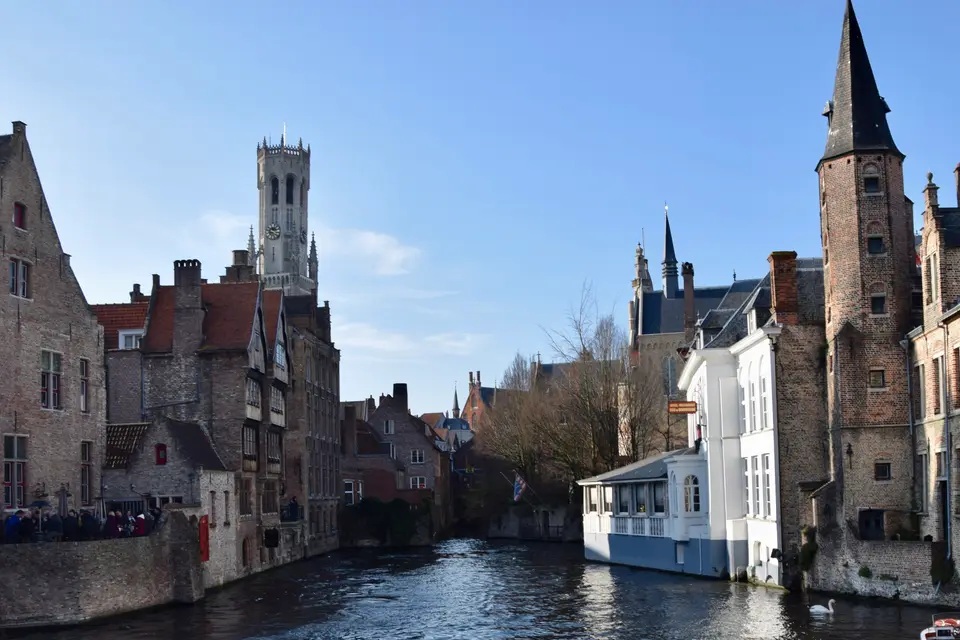
The city's wealth shaped its buildings. Brick became the main material, in a brick Gothic style that UNESCO links to exchanges with the Baltic and the rest of Europe. Merchant houses, guild halls, hospitals and churches all use this same brick. The stepped gables along the canals are its most familiar form.
The twelfth-century walls have gone, but their line still frames the city. A ring canal follows the old ramparts, and the oval centre covers about 430 hectares. Four medieval gates survive on this ring: the Kruispoort, the Gentpoort, the Smedenpoort and the Ezelpoort. Two windmills, the Koelewei Mill and the Sint-Janshuis Mill, still stand on the eastern rampart.
Inside the ring, the medieval street pattern and the network of inner canals are largely intact. Two central squares anchor the plan. The Markt was the commercial heart, under the Belfry. The Burg, a short walk away, holds the City Hall and the Basilica of the Holy Blood. Most sights lie within a walk of these two squares.
From the Flemish Primitives to Bruges-la-Morte
In the fifteenth century Bruges was the home of the painters now called the Flemish Primitives. Jan van Eyck and Hans Memling worked here, and UNESCO names this artistic role as part of the site's value. Their paintings remain in the city. The Groeninge Museum holds works by Jan van Eyck, and the Old St John's Hospital houses a museum devoted to Memling.
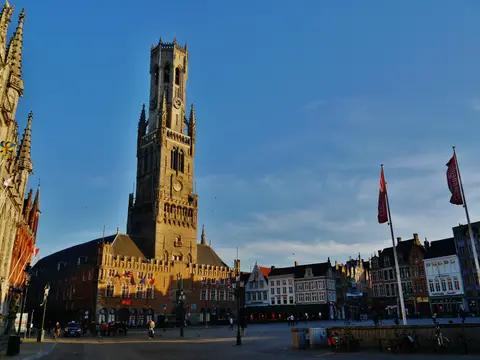
The Belfry on the Markt was built in phases between the thirteenth and fifteenth centuries. A stone tower is thought to date from around 1240, and the octagonal top was added between 1482 and 1486. The tower is 83 metres high and holds a carillon of 47 bells, 26 of them from the eighteenth century. It is also listed by UNESCO, together with other belfries in Belgium and France, since 1999.
On the Burg, the Basilica of the Holy Blood keeps a relic said to have been brought back after the Second Crusade by Thierry of Alsace. Every year more than 1,600 residents take part in the procession that carries it through the streets. A few streets south, the brick spire of the Church of Our Lady rises 115.6 metres. Inside is a Madonna and Child believed to be the only sculpture by Michelangelo that left Italy in his lifetime.
From around 1500 the Zwin began to silt up, and ships could no longer reach the city. Trade moved to Antwerp, and Bruges became poor and quiet. This decline protected it. The city largely missed nineteenth-century industry, so the medieval plan was not cleared. In 1892 Georges Rodenbach's novel Bruges-la-Morte described the still, half-empty city, and nineteenth-century restorers added a Neo-Gothic layer that UNESCO counts as part of the town's history.
Walking the Canals, Squares and Begijnhof Today
Bruges is a living city of about 118,000 people, but the historic centre is compact and best seen on foot. About half of its buildings are listed or recorded as heritage, and strict building rules protect the skyline of towers. Day visitors fill the Markt and the canal bridges, so the quieter streets away from the centre reward a slower walk.
- Start at the Markt and the Burg: Begin on the Markt, where a statue honours Jan Breydel and Pieter de Coninck, leaders of the uprising of 1302. Climb the Belfry first, before the queue builds. Then walk to the Burg to see the City Hall and the Basilica of the Holy Blood. From there, walk to the canal at the Rozenhoedkaai for a view back to the Belfry.
- Book the Belfry and Choose Your Interiors: The Belfry has 366 steps on a single spiral staircase used in both directions, and there is no lift. Visitor numbers per time slot are limited, so the city recommends booking a slot in advance. Then choose one museum for the painters: the Groeninge for Jan van Eyck or the Old St John's Hospital for Memling. Visit the Church of Our Lady for the Michelangelo Madonna.
- Time the Begijnhof and Move On: The Ten Wijngaerde Begijnhof, founded in the thirteenth century, is quietest early in the day. It is also part of the separate UNESCO listing of the Flemish Begijnhofs. In the evening, walk the ramparts past the gates and windmills. Compare other merchant cities in our UNESCO World Heritage Atlas, or continue by train to Brussels, our closest city guide.
