





















Quick Field Data
- UNESCO Inscription: 1997 · Criteria (ii), (iv)
- Scale & Footprint: 113 hectares with a buffer zone of 2,253 hectares since 2008, including view corridors that reach out to sea
- Access & Ticketing: The streets, squares and Toompea viewpoints are free; the Town Hall tower, St Olaf's tower, wall towers and museums have tickets
- Arrival Logistics: Passenger ferries cross from Helsinki in about two to three and a half hours, and Balti jaam is the city's main railway station
Upper Town and Lower Town on the Baltic
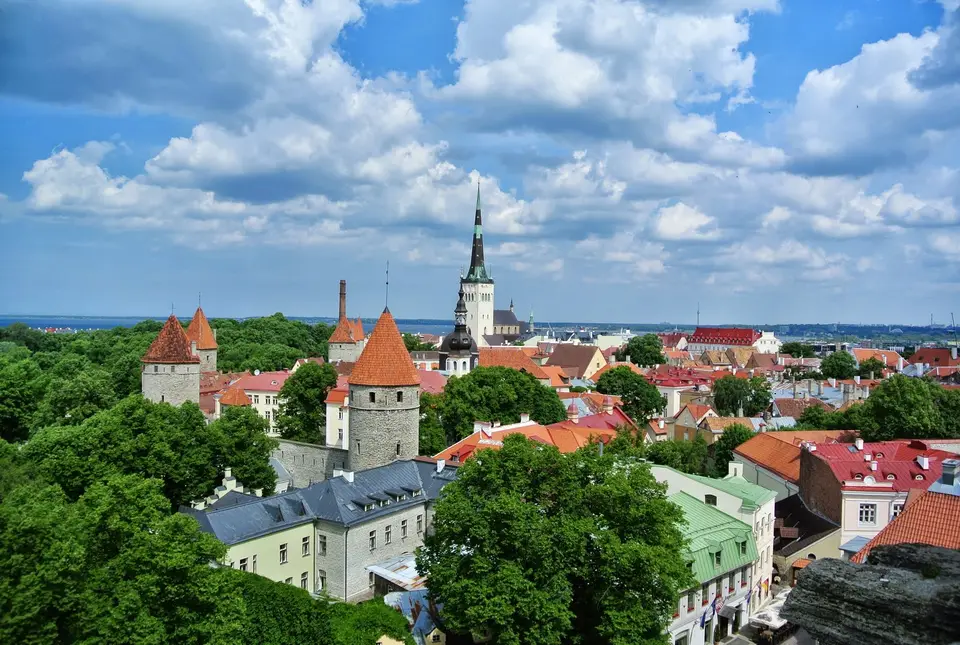
Tallinn grew in two parts with two different masters. The upper town, Toompea, sits on a high limestone hill. A fortress stood there from around 1050. The lower town spread out at the foot of the hill towards the harbour. UNESCO describes how the two parts share one system of walls, yet kept separate roles for centuries.
Toompea was the seat of power. In 1219 King Valdemar II of Denmark conquered Tallinn and northern Estonia. The castle on the hill became the base of the rulers. Today Toompea Castle houses the Riigikogu, the Estonian parliament. The hill also holds St Mary's Cathedral, the Lutheran Dome Church, and the Russian Orthodox Alexander Nevsky Cathedral.
The lower town belonged to merchants and craftsmen. In 1248 the Danish king granted the town Lübeck law. In 1285 it joined the Hanseatic League as its northernmost member. The merchants built warehouses, guild halls and churches, all within the town walls.
UNESCO stresses how much of this plan survives. Building plots from the thirteenth and fourteenth centuries are almost intact. The streets keep their medieval layout, and many still have their medieval names. Long sections of the town wall still stand at their full height, in places more than 15 metres.
Town Hall, St Olaf's and the Walls
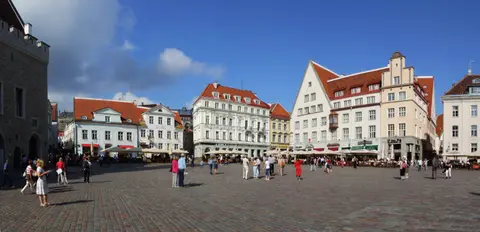
The Town Hall on the main square was completed in 1404 after major works from 1402. It is described as the oldest town hall in the Baltic Sea region and Scandinavia. On its spire stands Old Thomas, a weather vane in the shape of a warrior first placed there in 1530. The figure there today is an exact copy of the original.
St Olaf's Church was first mentioned in 1267. Its tower is about 123.7 metres high, making it the tallest church building in Estonia. Lightning has struck the tower about ten times, and the whole church has burned three times. Each time it was rebuilt.
The town walls were once guarded by 66 defence towers, and large sections of the defences survive. Fat Margaret, a former defensive tower, now houses the Estonian Maritime Museum. Kiek in de Kök is another of the best-known towers. The Great Guild Hall holds the Estonian History Museum.
The Old Town was damaged in the Second World War. In the Soviet air raid of 9 and 10 March 1944, about a tenth of its buildings were destroyed. In 1966 the Old Town became a protected conservation area, the first in the former Soviet Union.
In 2008 the World Heritage area was enlarged from 60 to 113 hectares. It now also includes the seventeenth-century fortifications around the Old Town and the green belt of the nineteenth century. The buffer zone reaches out to sea to protect the skyline of spires seen from the water. UNESCO notes that high-rise plans outside the zone remain a risk to that skyline.
The setting matters too. Around the Old Town are theatres and schools from the late nineteenth and early twentieth centuries, and suburbs of wooden houses. After independence some wooden quarters suffered from unclear ownership and poor repairs. UNESCO notes that they are now valued and that measures are in place to protect them.
Walking the Old Town Today
The Old Town is a living district, with homes, shops, churches and the seat of parliament. It is compact enough to see on foot in a day. The cobbled lanes are steep in places, so wear sensible shoes.
- Start on Town Hall Square: Begin at the Town Hall and its square. Walk down Pikk street past the Great Guild Hall towards Fat Margaret and the old harbour gate. Then turn back and climb one of the two lanes up to Toompea. On the hill, see Toompea Castle, St Mary's Cathedral and the Alexander Nevsky Cathedral close together.
- Climb a Tower for the Skyline: The Town Hall tower has 115 narrow steps to a balcony 34 metres above the ground, with room for one person at a time on the stairs. St Olaf's tower has a viewing platform at 60 metres. On Toompea, the viewing terraces look over the red roofs of the lower town towards the sea.
- Pick the Season and Plan Onward Travel: Summer brings long days and the biggest crowds, so walk early in the morning. Winter days are short and cold but quiet. Ferries link Tallinn with Helsinki several times a day. Explore other Hanseatic towns in our UNESCO World Heritage Atlas, and cross to Helsinki, our closest city guide.
