Quick Field Data
- UNESCO Inscription: 1994 · Criteria (i), (iv), extended in 2000 for Jokhang Temple and in 2001 for Norbulingka
- Scale & Footprint: 60.5 hectares across three Lhasa sites at roughly 3,700 metres altitude, uniting Potala Palace on Marpo Ri, the 2.51-hectare Jokhang Temple complex and the 36-hectare Norbulingka gardens
- Access & Ticketing: Daily visitor numbers at Potala Palace are capped at 2,300 under timed entry permits managed by local regulations, while roof access remains closed to protect timber and rammed-earth structures
- Arrival Logistics: Reached via Lhasa Gonggar International Airport (LXA), 44 kilometres from the city, or overland by the Qingzang railway into Lhasa station
Marpo Ri Fortifications and the White and Red Palaces
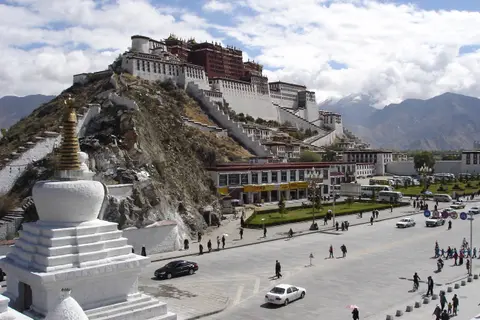
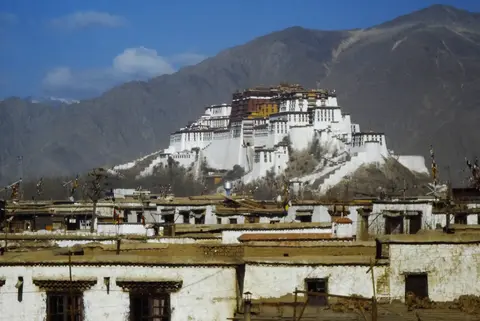
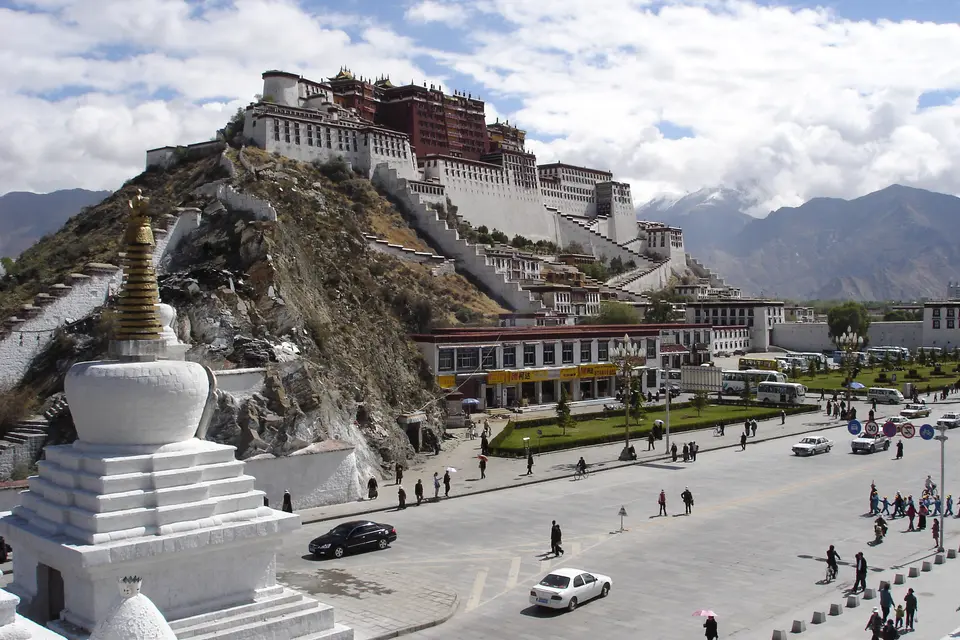
Rising from Marpo Ri (Red Mountain) in the centre of the Lhasa Valley at an altitude of 3,700 metres, the Potala Palace commands the urban basin from a rocky ridge between Drepung and Sera monasteries and the historic quarter around Barkhor Square. Named after Mount Potalaka, the Buddhist abode of Avalokitesvara, the complex extends 400 metres east to west and 350 metres north to south. Its stepped facade climbs 13 storeys to a height of 119 metres above the bedrock of Marpo Ri and more than 300 metres above the surrounding valley floor, making its silhouette visible across the basin.
Construction on this scale did not begin in a vacuum. Two chapels preserved in the northwest corner of the present palace, Phakpa Lhakhang and Chogyel Drupuk, a recessed meditation cave, mark the seventh-century palace attributed to King Songtsen Gampo around 637. When Ngawang Lozang Gyatso, the Fifth Dalai Lama, sought a fortified administrative seat in 1645, his spiritual adviser Konchog Chophel, the Thirty-fifth Ganden Tripa of the Gelug school, recommended Marpo Ri for its central strategic position. External structural shells rose in just 3 years, allowing the Dalai Lama and his administration to move into the White Palace (Potrang Karpo) in 1649, while interior halls, murals and ritual furnishings required 45 years to finish. Between 1690 and 1694, builders added the crimson Red Palace (Potrang Marpo) high on the western crest, followed by the Kalachakra Mandala in the 1690s and the Yamantaka Mandala in 1751.
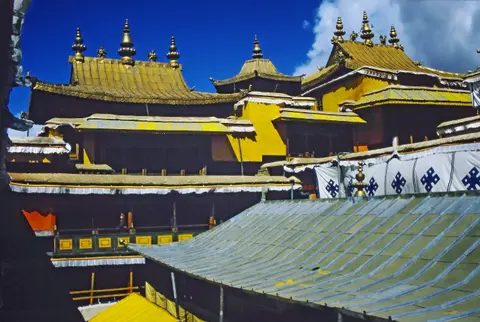
The resulting dzong-style edifice relies on inward-sloping stone and rammed-earth masonry engineered for seismic resilience in the Himalayan foothills. Lower outer walls average 3 metres thick and widen to 5 metres at the base, where molten copper was poured directly into the bedrock foundations to brace against earthquakes. Lime washes produce the stark white, crimson red and ochre yellow bands across the elevations, pierced by straight ranks of framed upper windows and flat terraced roofs crowned with gilded canopies. Inside, more than 1,000 rooms, 10,000 shrines and roughly 200,000 statues fill ceremonial halls, private quarters and monastic colleges.
Functional division separates state administration from funerary and liturgical space. The White Palace holds the main ceremonial assembly hall with the throne of the Dalai Lama, beneath private residential apartments and an audience chamber on the highest level. On the lower southern frontage, builders prepared broad walls where monumental thangkas depicting Tara and Sakyamuni were unfurled during the Sertreng Festival on the 30th day of the second Tibetan month. Higher to the west, the Red Palace houses the gilded burial stupas of successive Dalai Lamas together with 698 murals, nearly 10,000 painted scrolls, sutras, porcelain, jade, carpets and historical archives, extending further west to the private monastic precinct of Namgyel Dratshang. During the 1959 uprising, artillery shells struck palace windows, though Premier Zhou Enlai intervened in 1966 to shield the complex from physical demolition during the Cultural Revolution, even as store rooms lost many movable treasures. Major state restorations followed between 1989 and 1994 and again from 2002 using traditional materials, backed by municipal height rules capping new structures near the palace at 21 metres.
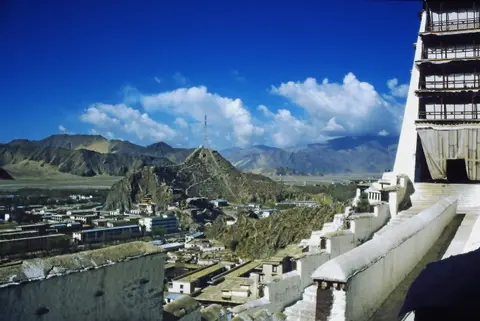
Jokhang Temple Monastery and Barkhor Pilgrimage Circuit
Standing 1,000 metres east of Marpo Ri, the Jokhang Temple Monastery forms the spiritual anchor of old Lhasa and entered the World Heritage listing in 2000. Historically called Rasa Trulnang Tsuklakhang when the capital was still known as Rasa, the monastery was founded in the seventh century under Songtsen Gampo. Construction dates variously around 640 and 652 after a lake-bed marsh was infilled. Tradition links its foundation to the king's two diplomatic marriages: Queen Bhrikuti of Nepal brought the Akshobhya statue known as Jowo Mikyo Dorje. Tang Princess Wencheng brought the youthful Jowo Shakyamuni statue in 640, originally placed in Ramoche Temple before being transferred into the Jokhang sanctum for safekeeping. Nepalese and Indian craftsmen shaped the earliest timber-and-stone compound, originally laid out across two floors with eight rooms for scriptures and sculpture, later expanded repeatedly until a major refurbishment under the Fifth Dalai Lama in 1610.
Covering 2.51 hectares within central Barkhor Square, the monastery follows a classic courtyard plan: an entrance porch opens onto an inner courtyard and central Buddhist hall ringed on all four sides by monks' quarters and storehouses. Over 3,000 statues of Buddhas, deities and historical figures fill the chapels beneath painted wall cycles illustrating religious and political episodes. Outside the north and south gates stand two stone doring pillars enclosed by protective brick walls since 1985. One carries a March 1794 Qing smallpox-prevention edict, while the older 5.5-metre monument preserves the bilingual Tibetan and Chinese Tang-Tubo Peace Alliance Treaty of 821 to 822 under King Ralpacan and Emperor Muzong, defining mutual borders and non-aggression.
Religious life around the Jokhang suffered severe ruptures across centuries. Anti-Buddhist repression under King Tresang Detsan forced monks to conceal the Jowo image underground, and after the 1792 Gorkha conflict Qianlong restricted Tibetan pilgrims from travelling abroad, elevating the Jokhang as a domestic pilgrimage focus often equated with India's Vajrasana. In 1966 Red Guards halted worship for a decade, turning rooms into barracks and stores before restorations ran from 1972 to 1980. Today pilgrims again trace the Barkhor circuit around the temple exterior, passing four stone sankang incense burners in a walk taking roughly 20 minutes. A roof fire on 17 February 2018 caused temporary closure, though the sanctuary reopened the following day with officials reporting intact relics.
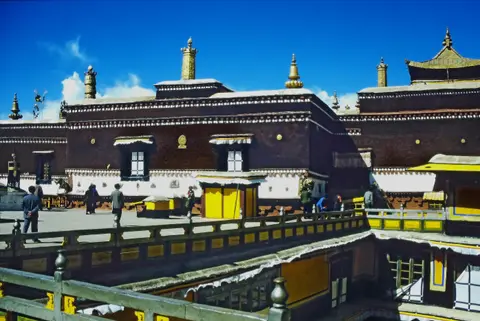
Norbulingka Summer Gardens and Seasonal Pavilions
Two to three kilometres west of the Potala Palace along the bank of the Kyichu (Lhasa) River, Norbulingka shifted the administrative centre out of stone fortifications each summer from the 1780s until March 1959. Added to the UNESCO ensemble in 2001, the 36-hectare walled garden sits at 3,650 metres altitude on ground that was scrub and marshland before the Seventh Dalai Lama, Kelsang Gyatso, began using a healing spring there in the 1740s and initiated palace building in 1755. His successor, the Eighth Dalai Lama Jampel Gyatso, completed the park and original summer residence in 1783, planting fruit trees, poplars and evergreens gathered across Tibet plus flower beds of roses, hollyhocks, petunias, marigolds and chrysanthemums.
Visitors move through five distinct walled compounds divided between an inner yellow-walled enclosure reserved for the Dalai Lama and an outer belt where royal relatives and cabinet officials resided. To the left of the entry gate stands the three-storey Kelsang Phodang, built under the Seventh Dalai Lama with Buddha chapels, reading rooms and a restored throne chamber. Looking opposite rises the two-storey Khamsum Zilnon pavilion, where folk operas played during the annual Shoton (Yogurt) Festival in early August. Further northwest lie the Chensil Phodrong, the 1922 Golden Phodron and the Lake Palace of Tsokyil Phodrong, where three small palaces occupy linked islands inside an artificial lake. On the northern margin sits Takten Migyur Phodrong, the two-storey New Palace built between 1954 and 1956 with traditional Tibetan flat roofs, gardens, fountains and 301 historical wall paintings.
Across the grounds, Norbulingka preserves some 30,000 Tibetan cultural relics with personal rooms of the Fourteenth Dalai Lama, who slipped out of the summer palace dressed as an ordinary Tibetan during a dust storm on 17 March 1959 to trek across the Himalayas into exile. Renamed People's Park after 1966 and damaged during mid-century conflict, Norbulingka underwent major central restoration works starting in 2003 to repair Kelsang Phodang, the Kashak cabinet offices, garden walls and lakes. At the east gate, two stone Snow Lions draped in white khatas still frame the entrance to what remains Lhasa's largest historic landscaped park.
Potala Ensemble Access Zones and Visitor Rules
Because the three inscribed monuments play distinct civic, monastic and park roles across Lhasa, entry procedures differ sharply between Marpo Ri's restricted interiors, the active pilgrimage halls of Barkhor Square and Norbulingka's open woodland paths.
| Complex Zone | Key Highlights | Access & Ticket Rule |
|---|---|---|
| Potala Palace White & Red Interiors | Ceremonial throne hall, 5th to 13th Dalai Lama gilded stupas, Chogyel Drupuk cave, 698 murals and monastic chapels | Strict 2,300-visitor daily quota; timed entry tickets required in advance; palace rooftops remain permanently closed |
| Potala South Forecourt & Chagpo Ri Foothill | Rammed-earth perimeter walls, stepped stone ascent ramps, Zhol pillar district and broad valley views | Walk-in plaza access around the base; security screening required at palace gates before climbing the eastern staircases |
| Jokhang Temple & Barkhor Square | Jowo Shakyamuni sanctum, timber courtyard porticoes, 821 to 822 Alliance Treaty pillar and four stone sankang burners | Active monastic site; outer Barkhor clockwise circuit open to pedestrians; inner shrine entry subject to regulated pilgrim and visitor queuing |
| Norbulingka Gardens & Palaces | Kelsang Phodang, Khamsum Zilnon opera pavilion, Tsokyil Lake Palace islands and 1956 Takten Migyur New Palace | Ticketed park entry covering garden paths and museum palace interiors; select historic storehouses remain closed for conservation |
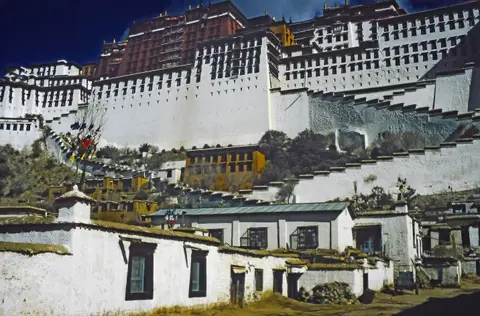
Three Architectural Details to Spot Across Lhasa's Sacred Ensemble
First, examine the lower masonry batter of Potala Palace as you climb the zigzagging stone approach from the south courtyard. Where the whitewash meets the bedrock of Marpo Ri, the stone wall slopes deliberately inward while thickening toward 5 metres at the footing, a Tibetan structural signature designed to direct earthquake shock into copper-poured foundation trenches rather than shearing vertical corners.
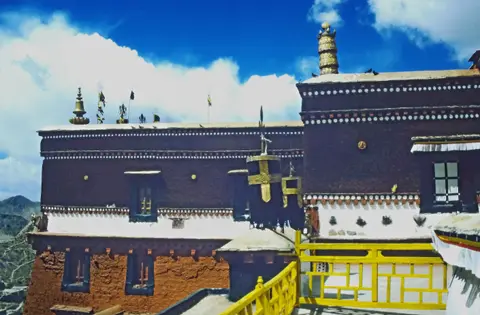
Second, step inside the timber colonnade of Jokhang Temple and look toward the carved wooden door frames and roof brackets above the central courtyard. Nepalese and early Tibetan joinery shows clearly in the multi-tiered floral lintels and gilded rooftop finials, contrasting with the tall, rough-hewn stone pillars flanking the outer Barkhor gates where generations of pilgrims have rubbed stone from the 1794 hygiene tablet.
Third, walk past the east gate Snow Lions at Norbulingka toward the Tsokyil Lake Palace in the southwest garden sector. Three short stone bridges tie three miniature islands into one summer retreat, while inside the 1956 New Palace nearby, traditional flat Tibetan parapet beams sit above 301 painted narrative panels tracing mid-twentieth-century Tibetan history.
Seasonal Timing and Overland Connections from Lhasa
Planning around altitude and daily entry caps makes a decisive difference at 3,700 metres. Following the opening of the Qingzang railway on 1 July 2006, visitor arrivals climbed by 30 percent, frequently reaching peak volumes above 6,000 people a day between July and September. As a result, the 2,300 daily permits for Potala Palace routinely sell out by mid-morning in high summer. Scheduling an early acclimatisation day around Norbulingka's lower 3,650-metre woodland before climbing Potala's long stone staircases eases altitude fatigue. Early August also brings the traditional Shoton festival gatherings and operas back to Khamsum Zilnon.
Allow a dedicated half day for the White and Red Palaces, another morning for the Jokhang interior and clockwise Barkhor walk, and a quieter afternoon under Norbulingka's poplars 3 kilometres west. Travellers arriving via Lhasa Gonggar International Airport (LXA), 44 kilometres outside the city, can pair Lhasa's high-plateau heritage with other Asian mountain and monastic monuments in our UNESCO World Heritage Atlas. Many also continue overland south across the Himalayan passes toward Kathmandu, 604 kilometres away, whose Newar craftspeople helped shape the Jokhang's earliest woodwork.