Quick Field Data
- UNESCO Inscription: 1997 · Criteria (ii), (iv), (v)
- Scale & Footprint: 136.5 hectares at 2,400 metres altitude across three component settlements: Dayan Old Town with Black Dragon Pool, Baisha (8 kilometres north) and Shuhe (4 kilometres northwest)
- Access & Ticketing: Open pedestrian lanes in Dayan, Baisha and Shuhe require preservation passes or individual entrance tickets at walled monuments such as Mu Mansion, Black Dragon Pool and Baisha's mural halls
- Arrival Logistics: Served by Lijiang Sanyi International Airport (LJG), 26 kilometres from the old town
Highland Tea-Horse Crossroads and Multi-Ethnic Timber Craft
Positioned at 2,400 metres above sea level on a highland basin in northwest Yunnan, the Old Town of Lijiang sits at a strategic crossroads linking Sichuan, Yunnan and Tibet through narrow mountain passes. For more than 1,000 years, and intensively since the twelfth century where the southern Silk Road meets the Ancient Chama (Tea and Horse) caravan roads, mule trains carried brick tea, salt, silver and textiles across western China. Over 800 years of economic exchange turned the Lijiang basin into a living meeting ground for Naxi (Nakhi), Han, Tibetan and Bai communities whose crafts remain fused in the town's timber frames, arched gateways and religious murals.
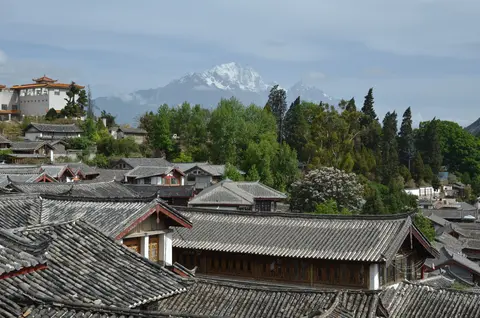
Unlike walled Chinese administrative capitals laid out on strict orthogonal grids, Dayan developed organically without defensive ramparts, wrapping rows of two-storey, grey-tiled houses along the contours of Lion Hill with northern mountains acting as a windbreak above eastern and southern plains. Local Naxi builders adopted a timber-and-mud-brick construction style learned from Ming-dynasty settlers from Nanjing, refining it for highland earth tremors and sloped alleys. Even today, master carpenters erect complex mortise-and-tenon house frames strictly from memory without paper blueprints or drawings. Houses blend Han and Tibetan (Zang) design across screen walls, courtyards, arched doorways and carved roof beams showing pottery, musical instruments, flowers and birds. Even modest farming households traditionally pooled savings to commission carved four-season flower-and-bird wooden window panels, crafted largely by ethnic Bai artisans.
Intangible cultural heritage endures beside the carved timber facades. Naxi ritual specialists known as dongba recorded liturgy and sacred lore in the logographic dongba script, still studied at the local research institute. Meanwhile, elder Nakhi musicians continue to perform Dongjing classical music learned from Ming visitors from Nanjing centuries after the tradition vanished across much of central China. They play for admission fees in Dayan and voluntary donations in Shuhe and Baisha. At street corners in Dayan, Hakhi women in traditional Nakhi attire still lead residents of all ages in evening circle dances. Similar Tibetan and Bai dance gatherings take place in private gardens and Nongjiale courtyards. They also convene at festival grounds outside Tibetan temples including Wenfeng Si on Wenbifeng Mountain, Zhiyun Si near Lashi Hai Lake and Fuguo Si on Jade Dragon Mountain.

Dayan Old Town, Baisha Murals and Shuhe Water Villages
Greater Lijiang, embracing Dayan and the two villages to the north, joined the World Heritage list on 4 December 1997, less than two years after a devastating earthquake shook the basin on 3 February 1996. Regional and municipal authorities repaired damaged traditional dwellings in strict accordance with UNESCO guidance and national protection laws for historic cultural cities. Under the World Cultural Heritage Management Bureau of the Old Town of Lijiang, they enacted the Conservation Master Plan, Manual on Repairing Folk Residences, Manual on Environment Protection and Business Development Plan. Boundaries and buffer zones have been adjusted iteratively to curb uncontrolled commercial sprawl around the historic perimeter while preserving traditional building skills across Naxi communities.
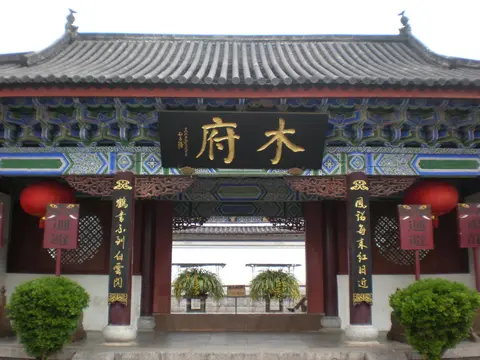
Dayan Old Town functions as the Ming-era commercial heart, preserving the historic Lijiang Junmin Prefectural Government Office. It also retains Yizi Pavilion and Guabi Tower from the former Mujia (Mu Mansion) compound, while Yuquan architectural structures sit integrated into nearby parkland. Narrow stone lanes wind from central market squares across dozens of bridges toward quiet slope-hugging residential quarters, though former Tibetan and Bai enclaves within Dayan have mostly relocated away from dense tourist lanes. Since World Heritage inscription, surging domestic and international tourism reshaped Dayan's social composition without altering its historic timber silhouettes. Soaring property rents and rising food and housing costs prompted 90 to 95 percent of original Nakhi families to rent out their courtyard dwellings to outside businesses and move into the new town. Consequently, over 90 percent of residential land has converted into guesthouses, restaurants and craft shops.
To trace earlier urban roots and quieter village life, the listing extends north to two distinct housing clusters linked culturally with Dayan. Eight kilometres north of Dayan sits Baisha, established earlier during the Song and Yuan dynasties with houses aligned along a north-south axis around a terraced central square. Its historic religious complex holds halls and pavilions containing more than 40 murals dating from the early thirteenth century. Combining Naxi daily motifs and Bai artistic conventions, those works depict Buddhism, Taoism and Confucianism coexisting in harmony. Four kilometres northwest of Dayan lies Shuhe, a smaller foothills caravan village along clear spring channels. Historic stone alleys, courtyards and quiet waterways preserve the domestic pace that commercial rents have largely displaced inside central Dayan. Here, Dongjing ritual music can still be heard for local donations rather than fixed concert tickets.
Jade Spring Park, Black Dragon Pool and Canal Engineering
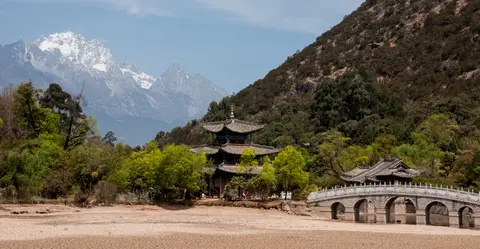
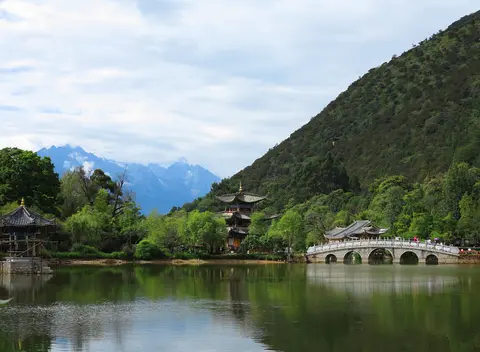
Water shapes Lijiang's plan as fundamentally as timber joinery. Meltwater and perennial springs rising off Yulong Snow Mountain (Jade Dragon Snow Mountain) to the northwest flow across farmland and villages. Those waters gather inside Heilong Pool (Black Dragon Pond) within Jade Spring Park (Yu Quan Gong Yuan) at the foot of Elephant Hill, just a short walk north of Dayan.
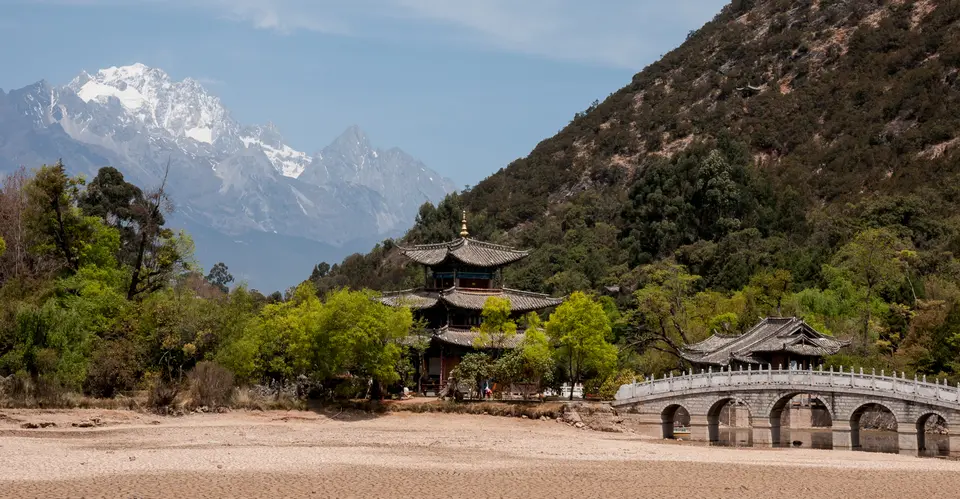
First laid out in 1737 during the second year of the Qianlong reign of the Qing dynasty, Black Dragon Pool acts simultaneously as an ecological reservoir, scenic composition and architectural reserve. Over its white marble Suocui Bridge, calm reflections frame dramatic views north toward Jade Dragon Snow Mountain. Fronting the vista stands the Moon-Embracing Pavilion (Deyue Lou), originally raised in the late Ming dynasty and reconstructed in 1963 after a 1950 fire. On the eastern side stands the 1737 Dragon God Temple (Longshen Temple), built by local Naxi communities and granted the title Dragon God of Jade Spring by the Qianlong Emperor that same year. Protected as a county cultural relics unit in 1999, the Heilongtan Scenic Area gained national elevation in 2006 and major scenic site designation in 2009. Overall, it preserves nine buildings: Wenmingfang gate, Suocui Bridge, Deyue Tower, Dragon God Temple, Guangbi Tower, Yiwen Pavilion, Wufeng Tower, Jiejie Linmen Tower and a historic stage. Five of those structures (Jiejie Linmen Tower, Wufeng Tower, Guangbi Tower, Yiwen Pavilion and Wenmingfang) were carefully moved from outlying sites for preservation. Among them is the threefold-eaved Ming Five-Phoenix Tower (Wufeng Tower), built in 1601 at Fuguo Temple 30 kilometres west and moved to Jade Spring Park in 1979. The grounds also house the Forest of Steles, holding over 50 inscriptions spanning from the Tang dynasty to the Republic of China, together with the Dongba Culture Research Institute and Dongba Culture Museum.
From Black Dragon Pool and scattered urban wells and springs, Lijiang's ancient water-supply system splits into a forked canal network threading beside main avenues and narrow side alleys. Houses, market stalls and workshops stand directly over or beside running stone channels spanned by scores of small bridges, harnessing continuous mountain flow for household washing, street cleaning and rapid fire prevention across dense wooden neighbourhoods. When climate shifts, falling water tables and booming tourism demand dried parts of Black Dragon Pool during spring months, municipal authorities declared the park a water conservation area in 2010 and overhauled supply channels so the pool stood full again by 2014.
Lijiang Heritage Clusters and Access Rules
Because the three inscribed settlements lie up to 8 kilometres apart across the Lijiang plain, visitors usually divide their time between Dayan's dense core and the quieter satellite villages north and northwest of the basin.
| Complex Zone | Key Highlights | Access & Ticket Rule |
|---|---|---|
| Dayan Old Town & Mu Mansion | Two-storey Ming and Qing timber courtyard houses, carved Bai screens, market squares and surviving Mu family pavilions | Pedestrian old-town lanes open freely; heritage maintenance pass or separate ticket required at walled complexes such as Mu Mansion |
| Jade Spring Park (Black Dragon Pool) | 1737 Dragon God Temple, white marble bridge, Deyue Lou pavilion, 1601 Wufeng Tower, 50 steles and Dongba Museum | Controlled park entry via old-town heritage receipt or gate pass; water-conservation rules restrict swimming and canal disturbance |
| Baisha Housing Cluster (8 km north) | Song and Yuan north-south terraced square and religious halls holding over 40 early thirteenth-century tri-faith murals | Village lanes open to pedestrians; separate ticketed access and photography bans apply inside the Baisha mural halls |
| Shuhe Housing Cluster (4 km northwest) | Foothill Tea-Horse caravan streets, spring canals, arched stone bridges and informal courtyard Dongjing music venues | Walk-in pedestrian settlement; conservation checkpoints operate on main approach roads during busy periods |
Three Structural Details to Notice Along Lijiang's Canals
First, look closely at the ground-floor facades of older Naxi courtyard houses along Dayan's side lanes. Builders joined mortise-and-tenon timber posts without steel nails atop cut-stone plinths that lift wooden sills away from damp cobbles, while Bai-carved wooden lattice doors fold open completely to convert parlours into market stalls. Roof timbers and gateway brackets still reflect traditional Han and Tibetan carpentry adapted without paper blueprints to highland seismic stresses.
Second, follow the stepped canal channels outside Jade Spring Park where clear stream water divides at masonry sluices into parallel street troughs. Tradition and municipal maintenance separate clean upper inlets from downstream washing basins and street-cleaning flushes, showing how the same mountain stream served fire safety and daily chores simultaneously across timber quarters without walled defensive barriers.
Third, examine the Five-Phoenix Tower at the north end of Black Dragon Pool and compare its layered curved eaves with Baisha's older halls. Relocated 30 kilometres piece by piece from Fuguo Temple in 1979, the 1601 structure marries Tibetan-influenced roof ornament with Han-style bracketed wooden eaves, visual proof of Lijiang's multi-ethnic craft convergence across centuries of Tea-Horse caravan commerce.
Dry-Season Timing and Yunnan Connections Beyond Lijiang
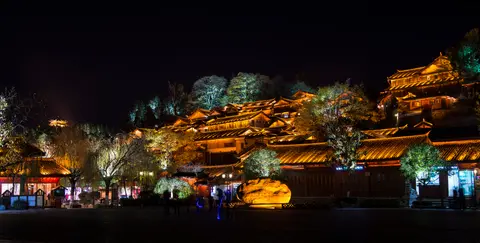
Visiting early in the morning allows travellers to walk Dayan's polished stone lanes and watch water sweep cleanly through the canals before tour groups crowd the central bridges. Spring drought has periodically lowered water levels in Black Dragon Pool, whereas late autumn and clear winter mornings frequently yield crisp reflection views toward Jade Dragon Snow Mountain across the marble bridge. Splitting time between Dayan, quieter Shuhe 4 kilometres northwest and Baisha 8 kilometres north restores the quieter village rhythm lost from Dayan's heavily commercialised central streets, where evening staged musicals and souvenir alleys differ sharply from rural canal courtyards.
Lijiang Sanyi International Airport (LJG) sits 26 kilometres from the old town, linking northwest Yunnan with regional hubs. It also provides access to nearby caravan heritage towns such as Shaxi in Jianchuan County and the dramatic gorges and ethnic villages of the Three Parallel Rivers protected areas. Giving yourself unhurried evenings inside Dayan lets you catch live Naxi Dongjing musical performances after tour-bus groups leave the Square Street lanes. You can also walk beside the Yuquan canal channels feeding Black Dragon Pool's historic timber pavilions and carved archways, appreciating how historic stone bridges stitch the water grid to surrounding hillsides. Travellers continuing an East and South China heritage circuit can explore additional mountain towns and gardens in our UNESCO World Heritage Atlas. Domestic flights also link onward toward Hong Kong, 1,499 kilometres southeast.