


























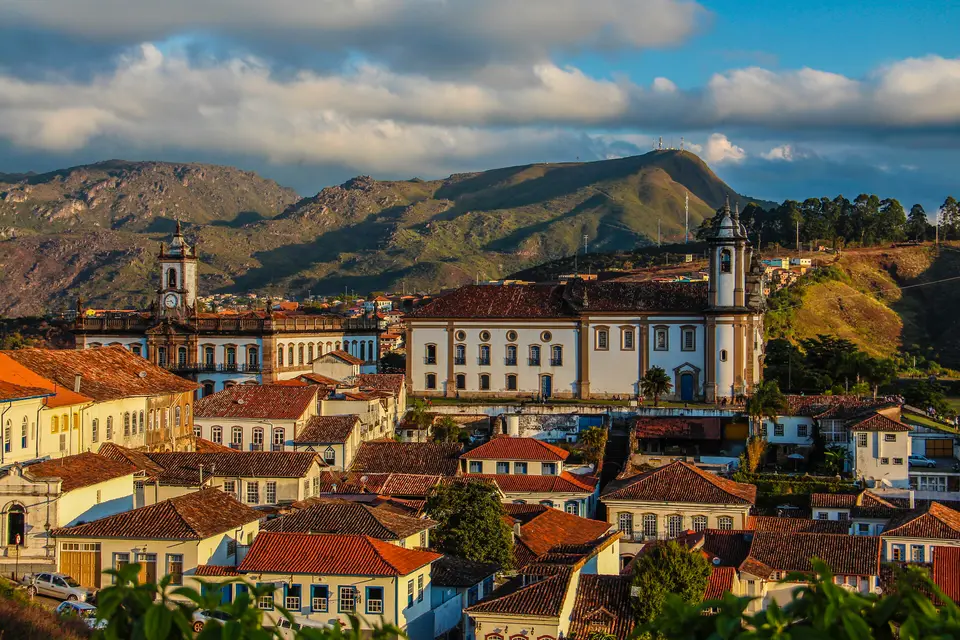
Quick Field Data
- UNESCO Inscription: 1980 · Criteria (i), (iii).
- Scale & Footprint: Preserved 18th-century colonial urban nucleus within a 1,245.865-square-kilometre municipality perched at an average elevation of 1,116 to 1,179 metres (beneath the 1,722-metre peak of Pico de Itacolomi) in the Serra do Espinhaço mountains of Minas Gerais, Brazil
- Access & Ticketing: Steep cobblestone streets alongside stone bridges and colonial squares are open to pedestrians year-round; individual entry tickets apply to the Baroque parish and brotherhood churches, the Museu da Inconfidência, the Mineralogy Museum in the School of Mines, and underground gold-mine tours
- Arrival Logistics: Located in the state of Minas Gerais 100 kilometres southeast of Belo Horizonte (and 475 kilometres north of Rio de Janeiro) along winding mountain highways following the historic Estrada Real corridor
The Eighteenth-Century Gold Rush and the Urban Pattern of Vila Rica
Draped across the steep, forested hillsides and deep ravines of the Serra do Espinhaço range at an elevation of 1,116 to 1,179 metres (3,868 feet) above sea level beneath the 1,722-metre quartzite crag of Pico de Itacolomi, the Historic Town of Ouro Preto (meaning Black Gold, formerly known as Vila Rica, or Rich Town) was the epicentre of Brazil's eighteenth-century gold rush and golden age. Recorded on the World Heritage List in 1980 during the 4th session under cultural criteria (i) and (iii) as the first site in Brazil to receive World Heritage status, the town preserves an intact Portuguese colonial urban fabric of cobblestone lanes alongside terraced two-storey houses, stone fountains, bridges, civic palaces, and gilded Baroque churches. Gold built every hillside here.
The city's origins trace directly to the discovery of alluvial gold in the mountain streams of Minas Gerais at the end of the seventeenth century. Following Manuel Borba Gato's 1695 gold strike at Rio das Velhas and the discovery between 1695 and 1696 of dark, iron-oxide-coated gold nuggets (ouro preto, or precious black gold, celebrated in the town's Latin motto Proetiosum aurum nigrum) in the Itacolomi stream later renamed Gualaxo do Sul, prospectors established scattered mining camps across the valley in 1698 while the Portuguese Crown opened the Estrada Real royal road in 1697 to control gold transport to the coast. On 8 July 1711, these camps were formally united into the municipality of Vila Rica, serving from 1720 to 1897 as the provincial capital of Minas Gerais (and receiving the official name Ouro Preto when elevated to city status on 20 May 1823).
During the height of the eighteenth-century mining boom, when 800 tons of officially registered gold were shipped to Portugal alongside vast quantities retained for local church ornamentation or circulated through contraband, Vila Rica exploded into the most populous metropolis in Brazil and one of the largest cities in the Americas: counting 40,000 inhabitants by 1730 alongside 80,000 by 1750 (more than double the contemporary population of New York and ten times the 8,000 residents of São Paulo) and reaching 100,000 at its zenith. In 1789, heavy royal taxation and republican ideals sparked the Inconfidência Mineira in Vila Rica, a pioneering pro-independence conspiracy led by intellectuals alongside poets such as Tomás António Gonzaga and the colonial officer Joaquim José da Silva Xavier (celebrated throughout Brazil as Tiradentes), who was executed by hanging as a warning to colonial rebels.
Paradoxically, it was the nineteenth-century exhaustion of the surface gold veins and the transfer of the state government in 1897 to the newly planned capital of Belo Horizonte (100 kilometres away) that saved Ouro Preto's colonial architecture. Isolated by difficult mountain roads and spared modern industrial demolition for over a century, while sustaining an active academic life after the founding of the Escola de Minas (School of Mines) on 12 October 1876 and the Federal University of Ouro Preto (UFOP), whose 10,000 students inhabit 66 federal and 250 private communal houses known as repúblicas modelled on the University of Coimbra, the historic core retained its authentic 18th-century streetscape.
The Crown Ban on Monastic Orders and the Genius of Aleijadinho
What shaped the distinctive architectural and artistic character of Ouro Preto, known to art historians as Barroco Mineiro (Minas Gerais Baroque), was a strict decree issued by the Portuguese Crown in the eighteenth century that prohibited religious orders from establishing formal monasteries or convents in the gold-mining district of Minas Gerais, lest friars smuggle untaxed gold out of the colony. Deprived of regular monastic orders, local religious life was organised instead by lay brotherhoods and third orders, stratified by social class alongside profession and racial background, ranging from wealthy Portuguese mine owners to free mulatto artisans and enslaved workers (associated in local tradition with figures like Chico Rei near Nossa Senhora da Conceição and Nossa Senhora do Rosário).
Competing fiercely across the steep valley ridges to display their civic status and devotion in a mountainous interior marked by scarce imported materials, these lay brotherhoods funded a distinctive series of parish churches and brotherhood chapels that fused European Baroque forms with local Brazilian materials, most famously the soft soapstone quarried in the surrounding hills. This artistic flowering reached its supreme expression in the partnership between two masters of colonial Brazil: the architect and sculptor Antônio Francisco Lisboa, universally known as Aleijadinho, and the painter Manoel da Costa Ataíde (Manuel da Costa Athaide), complemented in music by composer Lobo de Mesquita.
Breaking away from rectilinear Portuguese facades, Aleijadinho designed dynamic, undulating church exteriors and carved virtuoso soapstone portals alongside pulpits and altar sculptures. His architectural masterpiece in Ouro Preto, the Church of São Francisco de Assis (dedicated to St. Francis of Assisi), combines a curving two-tower facade and cylindrical soapstone relief medallion with an interior wooden ceiling painted by Manoel da Costa Ataíde. Across the valley stand the opulent golden interior of Nossa Senhora do Pilar (dedicated to Our Lady of the Pillar) alongside the elliptical twin-cylinder plan of Nossa Senhora do Rosário (honouring Our Lady of the Rosary), Nossa Senhora do Carmo (dedicated to Our Lady of Mount Carmel) beside the Museu do Oratório, Nossa Senhora da Conceição (housing the Museu do Aleijadinho), Nossa Senhora das Mercês (dedicated to Our Lady of Mercy), and the early hillside Capela do Padre Faria (known in English as Father Faria's Chapel).
Anchoring the civic power of the Portuguese Crown at the crest of the central hill is Tiradentes Square, framed at opposite ends by two monumental colonial complexes: the fortified Palácio dos Governadores (housing the 1876 School of Mines and its world-documented Mineralogy Museum displaying rare imperial topaz found only in Ouro Preto alongside gold, hematite, tourmaline, pyrite, and muscovite), and the imposing late-18th-century Casa de Câmara e Cadeia (the colonial Administrative and Prison House), which today houses the Museu da Inconfidência dedicated to the 1789 independence movement.
Walking the Steep Hillside Streets from Tiradentes Square to São Francisco
Exploring Ouro Preto (home to 74,821 residents in the 2022 census across its 12 districts) requires sturdy footwear for the steep cobblestone hill streets that plunge from the 1,179-metre ridges down to the stone bridges crossing the mountain streams. Because the historic centre is vulnerable to heavy vehicle vibrations and hillside erosion, walking between the central square and the flanking parish hills is the ideal way to experience the colonial townscape.
Plan your hillside route around Tiradentes Square alongside the masterpieces of Aleijadinho and the underground gold mines.
- Start at Tiradentes Square for the Inconfidência and Mineralogy museums: Begin at the central crest of Tiradentes Plaza to tour the former Casa de Câmara e Cadeia (now the Museu da Inconfidência), examining the colonial prison cells alongside 18th-century furniture, sculptures by Aleijadinho, and the memorial to Tiradentes and the 1789 conspirators. Cross the square to the former Palácio dos Governadores (now the UFOP School of Mines founded on 12 October 1876) to inspect the dazzling crystals alongside gold nuggets and rare imperial topaz inside the Museu de Ciência e Técnica (Mineralogy Museum), then step next door to Nossa Senhora do Carmo and the Museu do Oratório.
- Examine Aleijadinho's soapstone carvings at São Francisco and Conceição: Walk down the cobblestone slope from Tiradentes Square to the Church of São Francisco de Assis to study Aleijadinho's carved soapstone frontispiece and interior pulpits alongside Manoel da Costa Ataíde's painted wooden ceiling, browsing the open-air soapstone craft market in the square outside. Continue to the parish church of Nossa Senhora da Conceição (containing the Museu do Aleijadinho) and walk across the colonial stone bridges to the gilded interior of Nossa Senhora do Pilar and the elliptical facade of Nossa Senhora do Rosário.
- Descend into a colonial gold mine and connect via Belo Horizonte: Experience the subterranean labour that financed Brazil's golden age by touring the hand-hewn galleries of the Mina do Chico Rei near Nossa Senhora da Conceição or the vast underground caverns of the Mina da Passagem between Ouro Preto and Mariana (leased to the United Kingdom for 100 years in the early 19th century). To plan your approach along the winding mountain highways of Minas Gerais, start from our closest city guide in Belo Horizonte and explore other Latin American colonial cities in our UNESCO World Heritage Atlas.
