Quick Field Data
- UNESCO Inscription: 1991 (Ref. 574, inscribed 12 December 1991), three-part serial cultural park in Sukhothai and Kamphaeng Phet provinces, north-central Thailand; Criteria (i) and (iii).
- Scale & Footprint: 11,852 hectares across three historic cities linked by the ancient Thanon Phra Ruang road: Sukhothai (7,000 hectares), Si Satchanalai (4,514 hectares) and Kamphaeng Phet (338 hectares).
- Access & Ticketing: Administered as three coordinated historical parks by Thailand's Fine Arts Department, Ministry of Culture under the Ancient Monuments Act B.E. 2504 (1961, amended 1992); check official park gates for Sukhothai Historical Park opening hours, zone tickets and bicycle rentals.
- Arrival Logistics: Main northern air gateway is Chiang Mai International Airport (CNX), 212 kilometres north near Chiang Mai (214 kilometres). Sukhothai Airport (THS) lies 33 kilometres northeast with limited regional connections, while Don Mueang (DMK) and Suvarnabhumi (BKK) airports in Bangkok sit 356 and 385 kilometres south.
Dawn of Happiness From Khmer Outpost to Phra Ruang Capital
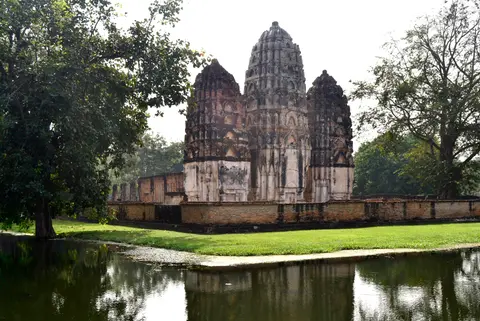
Spread across north-central Thailand's upper Chao Phraya plain, sukhothai historical park thailand preserves the thirteenth- and fourteenth-century capital of Siam's first independent kingdom. Translated literally as Dawn of Happiness, Sukhothai began as a northern Khmer outpost named Sukhodaya paired with Si Satchanalai roughly 50 kilometres north. Surviving Khmer laterite monuments inside Sukhothai Historical Park include the Ta Pha Daeng shrine, Wat Phra Phai Luang and Wat Si Sawai.
Tai independence grew gradually out of northern highland polities before seizing regional leadership across the river valley. Preceding states included Ngoenyang (centred on Chiang Saen) and Heokam (centred on Chiang Hung), while Sukhothai acted as a trade centre inside Khmer-controlled Lawo. Historians note early autonomy under Pho Khun Sri Naw Namthom around 1180 before Mon forces of Lawo under Khomsabad Khlonlampong retook control. Then, in 1239, Tai leaders Pho Khun Bangklanghao and Pho Khun Phameung reclaimed Sukhothai, installing Bangklanghao under the royal title Sri Indraditya to launch the Phra Ruang dynasty across the upper Chao Phraya (Menam, meaning mother of waters) by 1257. Older Tai titles prefixed khun (lord of a fortified muang and its villages) with pho, meaning father.
Royal expansion crested under Sri Indraditya's son King Ramkhamhaeng, revered as a founder of Siamese script, statecraft and Theravada art. Extending influence across Phrae, Muang Sua (Luang Prabang) and Supannabhum while helping Mon leader Wareru establish Martaban and Pegu free from Pagan rule, Ramkhamhaeng received monks from Sri Thamnakorn (Tambralinga) to propagate Theravada Buddhism and opened diplomatic trade missions to Yuan-dynasty China. Around 1283, he is credited with inventing the Thai alphabet recorded on the Ramkhamhaeng Stele, inscribed on UNESCO's Memory of the World Register in 2003.
Following Ramkhamhaeng's death in 1298, Sukhothai's vassal kingdoms broke away rapidly under his son Loe Thai. Uttaradit, Luang Prabang, Vientiane, the western Mon state, Lanna around Tak and southern Suphanburi asserted independence until expanding Ayutthaya forces forced Sukhothai's King Thammaracha II to submit in 1378. Later conflict saw King Naresuan forcibly relocate residents southward after the 1583 Battle of Sittaung River, and the 1765 to 1767 Burmese-Siamese War devastated old Sukhothai before King Rama I founded New Sukhothai (Thani) 12 kilometres east in 1793.
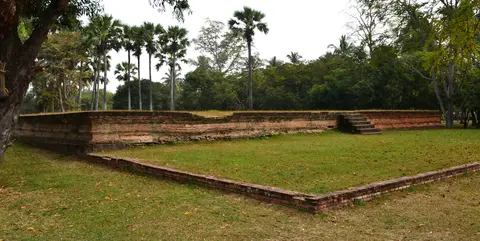
Wat Mahathat, Thanon Phra Ruang, and Sukhothai Style Hydraulics
Evaluating what to see in sukhothai historical park begins with how three sister cities shared urban geometry, water engineering, language and codified law. Across 11,852 hectares, Sukhothai (7,000 hectares) acted as political and administrative capital, Si Satchanalai (4,514 hectares) functioned as monastic spiritual hub and ceramic export centre, and Kamphaeng Phet (338 hectares) defended the southern trade frontier. Connecting all three cities ran the elevated Thanon Phra Ruang highway, flanked by dams, dykes, causeways, reservoirs and city moats that tamed seasonal floods, nourished rice agriculture and supplied daily ritual and domestic water. That hydraulic kingship tradition endured right down to the Rattanakosin period. Reading this shared infrastructure across the landscape shows how Sukhothai united dispersed valleys into one coherent state marked by egalitarian patron-client rule, codified statutes and flourishing monastery endowments.
Every one of the three towns lies completely inside its own protected national historical park perimeter matching the World Heritage boundaries. Park regulations ban through traffic and prohibit commercial building inside the monument zones except essential site conservation, shelter and interpretive signage, maintaining direct spatial relationships among temples, city walls and surrounding water dykes.
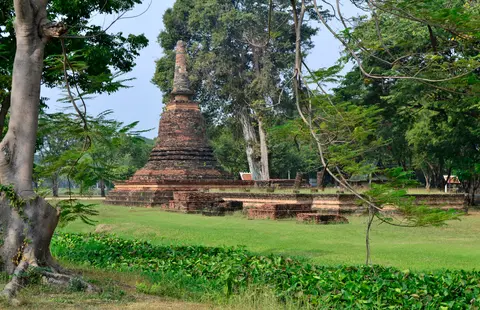
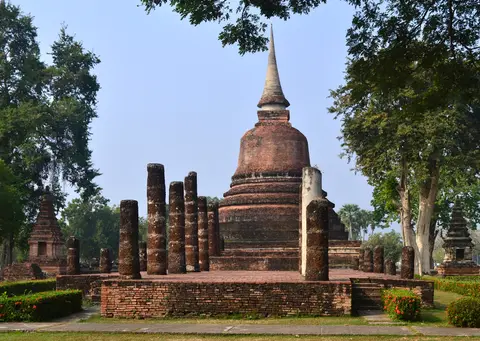
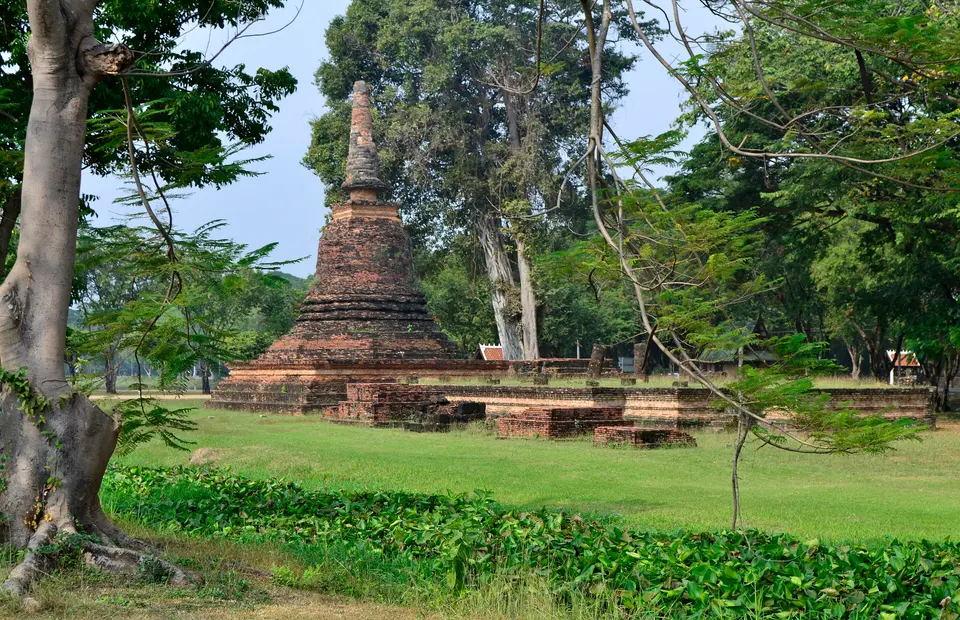
Inside Sukhothai's rectangular two-by-1.6-kilometre city walls, pierced by four central gates, stand 26 temple complexes within 193 ruins spanning 70 square kilometres. Anchoring the city centre rises Wat Mahathat (Temple of the Great Relic), founded by Sri Indraditya and expanded between 1292 and 1347 on a cosmic mandala layout. Artisans built its monuments in brick clad with carved stucco portraying idealised superhuman Buddha qualities (mahapurisalakkhana). Its 1345 lotus-bud chedi rises above 168 walking Buddhist disciples, framed by eight Haripunchai-Lanna and Khmer corner stupas, two nine-metre standing Phra Attharot Buddhas, a vihara, mandapa, ordination hall and 200 smaller stupas.
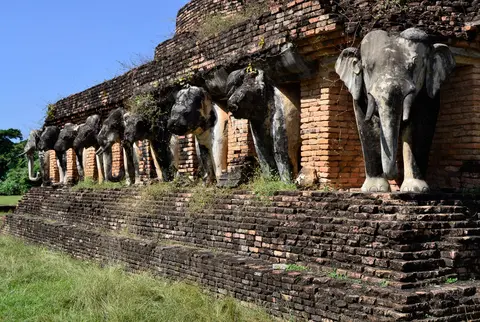
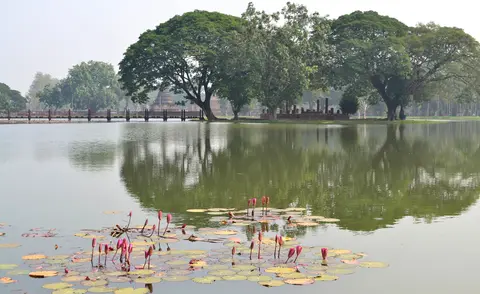
Immediately beside Wat Mahathat lies Noen Prasat (Palace Hill), a 200-by-200-metre brick royal palace terrace explored in 1833 by future King Mongkut (Rama IV). Mongkut recovered both the Ramkhamhaeng Stele and the stone Manangasila Throne (about one by 2.5 metres carved with lotus petals) and moved them to Bangkok, decades after King Rama I relocated 2,128 Buddha images including Wat Mahathat's eight-metre bronze Phra Sri Sakyamuni to Wat Suthat. Near Noen Prasat's base, archaeologists exposed twin small ponds fed by buried terracotta water pipes once linked to a city lake. On the southwest corner sits a 1.5-metre-high brick platform containing ashes and bones identified as a royal cremation site. Surrounding precincts add Wat Chang Lom's elephant-ringed chedi, Wat Chetuphon, Wat Tra Kuan, Wat Chana Songkhram and pond-framed Wat Traphang Ngoen, all easily reviewed through published sukhothai historical park photos and maps.
Sangkalok Kilns, Inscriptions, and Fine Arts Conservation
Archaeology across Sukhothai and Si Satchanalai reveals an industrial export economy matching its religious monuments. Guided by Yuan Chinese ceramic contacts, workshops produced glazed stoneware called Sangkalok pottery, dated to the Sukhothai Kingdom through thermoluminescence testing before ceramic output waned in the fourteenth century. Together with stone inscriptions detailing egalitarian patron-client rule and codified laws, surviving kiln complexes, ironwork and hydraulic dykes dated via palaeontology and palaeobotany show how rural roads, canals and dams remain actively used by local villagers today. Traditional repairs preserve original brick and stucco forms across both living worship enclosures and ancient archaeological mounds, reflecting high visitor preservation standards praised in sukhothai historical park reviews.
Public heritage protection and modern historical scholarship steadily transformed overgrown brick mounds into coordinated national parks. In 1907, Crown Prince Vajiravudh completed a two-month survey across Nakhon Sawan, Kamphaeng Phet, Sukhothai, Si Satchanalai, Uttaradit and Phitsanulok, publishing Phra Ruang City Journey to guide historians Damrong Rajanubhab and George Coedes. Gazette protection arrived on 6 June 1962 under the Act on Ancient Monuments, Antiques, Objects of Art and National Museums B.E. 2504 (amended 1992), bolstered by Thailand's Ratchaphatsadu Land Act, City Planning Act, Environmental Quality Act and Building Control Act ahead of the park's July 1988 opening and 1991 UNESCO listing.
Stewardship by Thailand's Fine Arts Department pairs strict monument preservation with curated collections and university research partnerships. Inside Sukhothai stands the Ramkhamhaeng National Museum, opened in 1964 by King Bhumibol Adulyadej and Queen Sirikit. Over 2,000 artefacts donated by Abbot Phra Ratchaprasitthikhun of Ratchathani Temple and local citizens display Buddha images and Hindu god sculptures from Wat Phra Phai Luang, Wat Mahathat, Si Satchanalai, Kamphaeng Phet, Phichit and Phetchabun. Dedicated information centres at Si Satchanalai and Kamphaeng Phet interpret Sangkalok ceramics and regional frontier fortifications, while car-free park zoning bans through traffic and national administrative reforms encourage local committees and non-governmental specialists to guide long-term site care.
Access Zones Across the Sukhothai Historical Park Triad
Dividing visits cleanly between Sukhothai's walled core, outer temple rings and its two sister cities avoids midday cycling fatigue across open plains. Check Fine Arts Department gate booths for separate zone admission tickets before crossing between precincts.
| Complex Zone | Key Highlights | Access & Ticket Rule |
|---|---|---|
| Sukhothai Central Walled Core | Wat Mahathat lotus-bud chedi, Noen Prasat palace terrace, Khmer-era Wat Si Sawai, Wat Traphang Ngoen and Ramkhamhaeng National Museum. | Car-free historic zone reached via central city gates; buy official Fine Arts Department entry tickets and museum passes at gates. |
| Sukhothai Outer North, West, and South Zones | Wat Phra Phai Luang Khmer towers, Wat Chang Lom elephant chedi, Wat Chetuphon laterite walls and ancient hydraulic reservoirs. | Linked by quiet paved rural roads ideal for rented bicycles; separate perimeter gate ticketing applies across outer ruin clusters. |
| Si Satchanalai and Kamphaeng Phet | Monastic centre and Sangkalok ceramic kilns 50 kilometres north at Si Satchanalai, plus southern frontier forts at Kamphaeng Phet. | Operated as sister historical parks by the Fine Arts Department; require dedicated intercity road transfers and park admission passes. |
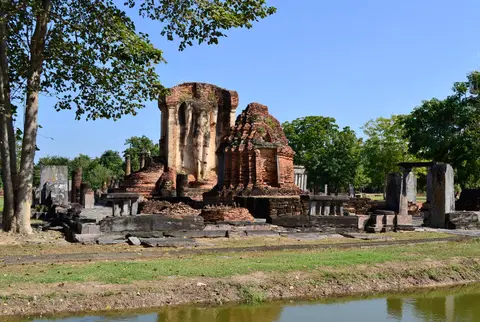
Three Architectural and Hydraulic Details Inside Sukhothai
- Lotus-Bud Chedi Profiles at Wat Mahathat: Study the tapering finial crowning Wat Mahathat's main stupa to recognise pure Sukhothai architecture. Contrast its smooth profile with the eight surrounding Haripunchai-Lanna and Khmer corner towers.
- Stucco Reliefs of 168 Walking Disciples: Walk around the central sanctuary plinth at Wat Mahathat to spot carved lime stucco figures. Rows of Buddhist disciples move forward with hands pressed together in formal greeting.
- Terracotta Water Pipes and Hydraulic Dykes: Look beside Noen Prasat's twin palace ponds and outer moats for baked terracotta water conduits. Together with earthen dykes, these channels balanced seasonal floods and urban water supply.
Bike Rentals, Opening Hours, and Routes From Bangkok or Chiang Mai
Deciding how many days in sukhothai and whether is sukhothai worth visiting depends on pairing central temple ruins with the two associated towns. Spending one full day covers Sukhothai's walled city core and Ramkhamhaeng National Museum, plus outer temples like Wat Chang Lom and Wat Phra Phai Luang. Adding a second or third day gives unhurried time for Si Satchanalai and Kamphaeng Phet. Always verify current Sukhothai Historical Park opening hours and festival lighting schedules directly at official Thai Fine Arts Department gate notices.
Because private cars stay outside park gates, sukhothai historical park bike rental stalls opposite the main entrance provide the smoothest way to pedal shaded moat paths between brick sanctuaries. Observers entering revered shrines must follow the sukhothai historical park dress code by covering shoulders and knees and removing shoes at temple platforms. During annual Loy Krathong celebrations, candlelit ponds draw large domestic and international crowds; otherwise, evening dining and sukhothai historical park night market stalls sit outside the monuments near Old Town gates or New Sukhothai 12 kilometres east.
Direct highways and regional airports link central Thailand smoothly from both northern and southern hubs. For northern routes asking how to get to sukhothai historical park from chiang mai, highway coaches run south from Chiang Mai International Airport (CNX), 212 kilometres north near Chiang Mai (214 kilometres). Travellers checking how to get to sukhothai historical park from bangkok connect northward via intercity buses or trains from Don Mueang (DMK, 356 kilometres) and Suvarnabhumi (BKK, 385 kilometres) airports. Closer Sukhothai Airport (THS) sits 33 kilometres northeast with fewer scheduled flights than Chiang Mai or Bangkok. Explore further ancient capitals across Southeast Asia in our UNESCO World Heritage Atlas.