


























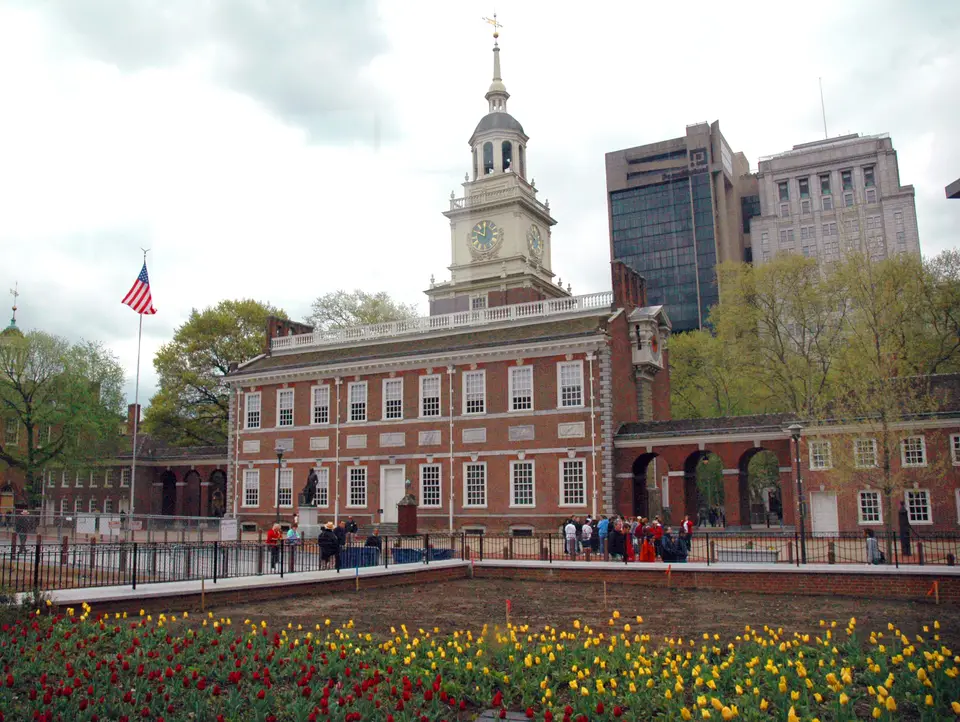
Quick Field Data
- UNESCO Inscription: Inscribed in 1979 as a Cultural heritage site under criterion (vi) at 520 Chestnut Street in Philadelphia, Pennsylvania, United States.
- Scale & Footprint: Red-brick Georgian civic building with a central bell tower and wooden steeple rising 168 feet 7 and 1/4 inches (51.391 metres), linked by arcaded hyphens to flanking wings on Independence Square.
- Access & Ticketing: Administered by the National Park Service inside Independence National Historical Park; entry requires security screening and timed guided tour reservations, so check the official site.
- Arrival Logistics: Located on Chestnut Street between Fifth and Sixth Streets in central Philadelphia, easily reached by urban rail, subway, or bus.
Colonial Pennsylvania's Georgian State House on Chestnut Street
The brick is historic. Red brick walls frame the square. Standing along Chestnut Street between Fifth and Sixth Streets in Philadelphia, Independence Hall, which was initially called the Pennsylvania State House, is the eighteenth-century civic chamber where the Founding Fathers debated, signed, and adopted both the Declaration of Independence and the federal Constitution. During the spring of 1729, colonial lawmakers received formal proposals to erect a state house in Philadelphia, which then functioned as the capital of the colonial Province of Pennsylvania. Colonial authorities allocated roughly 2,000 pounds sterling toward the building and appointed a committee comprising Thomas Lawrence, physician John Kearsley, and attorney Andrew Hamilton to choose a suitable plot alongside acquiring plans and contracting a building company. Named trustees alongside his son-in-law to be, William Allen (who later served as chief justice of the Province of Pennsylvania), Hamilton was authorised to purchase land and by October 1730 bought lots on Chestnut Street along the slightly sloping, vegetation-covered suburban outskirts of the city that had once been a camp for American Indians, acquiring the deed for Lot number 2 from surveyor David Powell by 1732.
Sharp tensions soon arose among the committee members over both architecture and location. While Kearsley, who had designed Christ Church and Saint Peter's Church in Philadelphia, had his own architectural plans and wanted the state house built on High Street (present-day Market Street), Hamilton favoured his own design on Chestnut Street, while Lawrence said nothing on the location. When disagreements escalated to require arbitration, Hamilton brought the dispute before the Provincial Assembly on 8 August 1733, showed his state house plans to the assembly three days later, and won full authority over the project and the Chestnut Street site on 14 August 1733. Working in collaboration with master builder Edmund Woolley, who drafted the working plans and constructed the building piecemeal as colonial legislative funds became available between 1732 and 1753, Hamilton created the first capitol of the Province of Pennsylvania, admired even then as the greatest ornament in the town and a model of American Georgian architecture characterized by symmetry, classical proportions, and exposed red brick with stone masonry accents.
Resting upon rubble-stone and lime-mortar foundations dug into the sandy clay soil, the exterior walls were constructed of hard-burned brick measuring 22 to 23 inches thick, while heavy timber girders and beams formed the interior framing and roof trusses secured with reinforced joints alongside iron plates and pins. The composition pairs a central building crowned by a bell tower and wooden steeple (reaching 168 feet 7 and 1/4 inches, or 51.391 metres, above the ground) with two smaller flanking wings attached via arcaded connecting corridors called hyphens. In 1752, council member Isaac Norris selected clockmaker Thomas Stretch, son of his old friend and fellow council member Peter Stretch, to construct the State House's first timepiece; erected in 1753 at the building's west end to resemble a tall grandfather clock, its 40-foot (12-metre) limestone base was capped by a 14-foot (4.3-metre) wooden case carved by cabinetmaker Samuel Harding, with dials mounted at the east and west ends linked by long rods to the central clock movement inside the building attic, though Thomas Stretch waited six years to receive pay.
The Assembly Room, Founding Charters, and Steeple Restorations
Within the ground-floor Assembly Room of the Pennsylvania State House (which housed the colonial government of Pennsylvania from 1732 to 1799) convened two revolutionary assemblies that reshaped modern political history. Throughout the American Revolutionary War, delegates of the Second Continental Congress met inside the building between 1775 and 1781, founding the Continental Army there on 14 June 1775 and adopting the Declaration of Independence on 4 July 1776. Eleven years later, between 25 May and 17 September 1787, the building hosted the Constitutional Convention, where the Constitution of the United States was debated, drafted, and ratified. Inscribed by UNESCO under criterion (vi) in 1979 (receiving 645,564 visitors in 2005), the monument is honoured worldwide because the democratic and freedom principles articulated across both founding charters profoundly influenced constitutional thinkers and lawmakers globally, serving as models for governmental charters of other nations and even the United Nations Charter.
Closely related to the acquisition of the original clock is the history of the Liberty Bell, which initially hung inside the bottom chamber of the original timber steeple. After that wooden steeple suffered severe rot and structural weakening by 1773, the Pennsylvania Assembly had it removed in 1781, covered the brick tower with a hipped roof, and lowered the Liberty Bell into the brick tower's upper chamber, where it hung until the 1850s before being exhibited on the hall's ground floor until 1976 and later moved across the street into the Liberty Bell Center on Independence Mall. During the 1824 visit of the Marquis de Lafayette, the structure gained the name Hall of Independence, and in 1828 architect William Strickland added a more elaborate steeple while Isaiah Lukens designed and installed a new clock (after the Stretch clock was removed about 1830) with an eight-day movement driving four eight-foot copper dials and striking a four-thousand-pound bell cast by John Wilbank until 1877, joined in the cupola by the Centennial Bell created for the 1876 Centennial Exposition.
While the shell of the central portion is original, the original wings and hyphens were demolished in 1812 to make way for larger structures planned by architect Robert Mills before being replaced in 1898 with reconstructions of the original wings, as the building passed through four historical periods: Pennsylvania State House (1732 to 1799), museum (1802 to 1828, when painter Charles Willson Peale displayed natural history collections, portraits, and a mastodon skeleton inside his Philadelphia Museum on the upper floor), municipal building (1818 to 1895), and historical landmark from 1898 to the present, including the 17 June 1915 convention presided over by former president William Howard Taft that formed the League to Enforce Peace and the 26 October 1918 declaration of Czechoslovak independence by Tomáš Masaryk on its steps. Restored in the 1830s under architect John Haviland and safeguarded by the 1916 National Park Service Organic Act alongside the 1948 federal law signed by President Harry S. Truman creating Independence National Historical Park and the National Historic Preservation Act of 1966 (having been listed on 15 October 1966), the interiors were restored to their eighteenth-century appearance by the National Park Service from the 1950s onward, including a summer 1973 replica of the Thomas Stretch clock and a circa 1740 musical tall case clock by Peter Stretch in the second-floor Governor's Council Chamber.
Visiting Independence Square and the Assembly Room Today
Every room tells a story. Standing before the tables of the Assembly Room while a ranger explains the 1776 and 1787 debates connects the symmetry of Georgian brick and carpentry directly to the birth of modern constitutional government.
- Entry and Route Across Independence Square: Approach through the security screening entrance on the city block of Independence Square within Independence National Historical Park, where the central hall stands flanked by Old City Hall to the east, Congress Hall to the west, and Philosophical Hall, built as the historic headquarters of the American Philosophical Society.
- Tickets, Interiors and Viewpoints: Join the ranger-led tour through the ground-floor Assembly Room and inspect the restored eighteenth-century interiors before crossing Chestnut Street to Independence Mall to view the Liberty Bell inside the Liberty Bell Center; check the official site to reserve timed tickets in advance.
- Timing and Onward Connections: Book an early morning tour slot to reduce waiting times at the security entrance, then continue your East Coast journey northward with our New York city guide or explore further historic landmarks in the UNESCO World Heritage Atlas.
