


























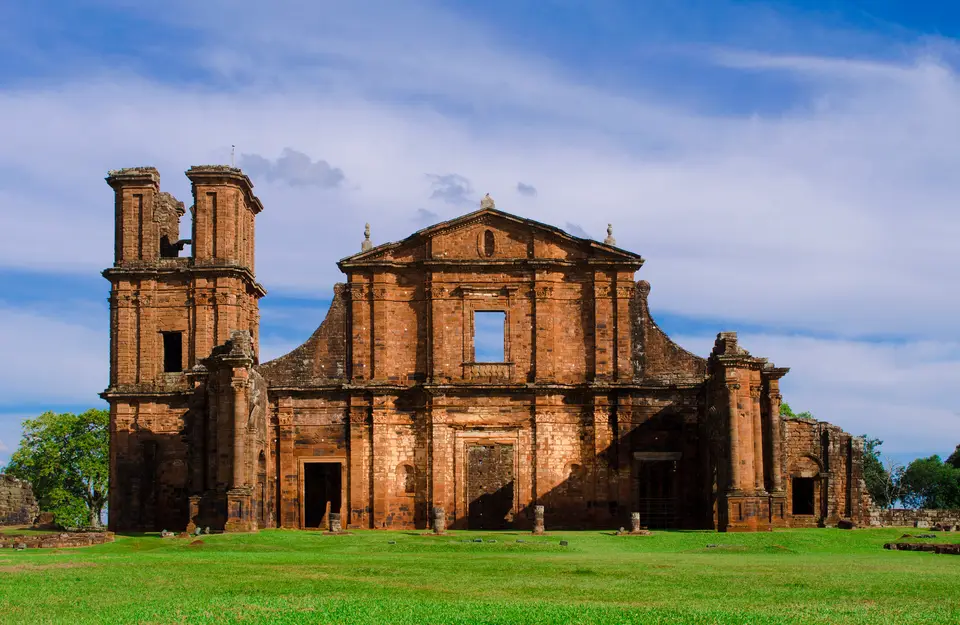
Quick Field Data
- UNESCO Inscription: 1983, extended 1984 (Cultural Criterion iv)
- Scale & Footprint: 265.78-hectare serial transnational property encompassing five mission settlements across Brazil and Argentina
- Access & Ticketing: Managed by national and provincial heritage authorities in Brazil and Misiones, Argentina; check the official site for multi-mission ticket passes
- Arrival Logistics: Distributed between the southern Misiones Province in northeastern Argentina and São Miguel das Missões in Rio Grande do Sul, Brazil
Five Redstone Ruins in the Triple Frontier Heartland of the Guaranis
Rising out of the tropical forest and red-earth hills spanning the frontier zone where modern Argentina, Brazil, together with Paraguay meet, an area known locally as the triple frontier, the Jesuit Missions of the Guaranis preserve the architectural remains of five monumental mission settlements, called reducciones de indios in Spanish and reduções in Portuguese, established during the 17th and 18th centuries by Catholic missionaries of the Jesuit Order among indigenous Guaraní communities. Protected under the UNESCO World Heritage Atlas in 1983 and 1984 under cultural criterion iv across a combined area of 265.78 hectares, this transnational serial property unites the ruins of São Miguel Arcanjo (São Miguel das Missões) in southern Brazil with four settlements in Argentina's southern Misiones Province: San Ignacio Miní, Nuestra Señora de Loreto, Santa Ana, plus Santa María la Mayor. Collectively known as the Río de la Plata missions, these settlements represent a 150-year religious, social, alongside economic experiment that sought to create an autonomous indigenous society isolated from Spanish colonists and protected from forced-labour encomiendas. Red sandstone walls still rise through the forest.
Because the Society of Jesus, formally founded in 1540, arrived in the New World around 1570 after the Dominicans and Franciscans, Jesuit missionaries looked to the frontiers of colonisation. After Bishop Lizarraga requested missionaries for Paraguay, the Spanish governor of Asunción, acting under instructions from King Phillip III in 1609, made an agreement with the Jesuit Provincial of Paraguay to found indigenous settlements along strategic stretches of the Paraná River, keeping them separated from Spanish towns while granting a 10-year crown tax holiday. Beginning in 1609 with the first reduction at San Ignacio Guazú in Paraguay, three Jesuits and their successors spent the next 22 years founding 15 missions across a territory exceeding 39,000 square miles (100,000 square kilometres) in the province of Guayrá (modern Paraná state, Brazil), gathering 40,000 Guaraní residents despite initial resistance from Guaraní shamans (who killed up to 7 Jesuits) and a severe epidemic in 1618. When Bandeirante slave-traders from São Paulo launched devastating raids on the Guayrá reductions in 1628 (and destroyed short-lived 1630s missions in Itatín in modern Mato Grosso do Sul), the Jesuits led roughly 12,000 mission survivors between 1631 and 1638 on a 500-kilometre (310-mile) exodus southwestward into Spanish territory, where they were joined by refugees from Uruguay and Tapé (in modern Rio Grande do Sul) and established 30 Río de la Plata reductions. After the Jesuits produced guns and gunpowder and raised indigenous militias, which defeated 1,500 Bandeirante slavers alongside Tupi auxiliaries in 1641 during the Battle of Mbororé and grew into an effective force of 4,000 troops with cavalry wearing European-style uniforms, the 30 missions expanded from 36,190 residents in 1641 to a peak population of 141,182 (or 141,242) in 1732 (and over 140,000 in 1740, alongside 25,000 in the Chiquitos missions of eastern Bolivia founded in 1691 and 30,000 in the Llanos de Moxos founded in 1682, whereas missions among the Chiriguanos of the Andes foothills had only 268 converts in 1767).
Urban Geometry and Baroque Craftsmanship
Although each of the five World Heritage settlements displays a distinct layout and state of conservation, all the Río de la Plata missions followed a uniform urban plan governed daily by indigenous chiefs (caciques) overseen by a minimum of two resident Jesuits, where two creole languages, Língua Geral and Nheengatu, also originated:
- The Church and Inner Square: Grouped at one end of a central grass-covered square kept cropped by sheep stood the monumental church, initially built of wood coated with stucco imitating stone Baroque architecture, and later rebuilt in dressed stone or fine wood with lofty towers, sculptures, plus altars adorned with statuary imported from Italy and Spain. Adjoining the church stood an inner stone square housing the priests' quarters, commissary, stables, armory, workshop, hospital, and store-houses.
- The Native Dwellings and Plaza: Forming the other three sides of the central square stood the dwellings of the Guaraní in long stone, adobe, or cane barracks, where each family had its own separate apartment while sharing a continuous veranda and single roof serving up to 100 families.
- Mission Agriculture and Trades: Each morning after children's hymns, Mass, together with breakfast, the community marched in musical procession with statues of saints past roadside shrines to work the communal farms and individual family gardens, reassembling at noon for the Angelus, dinner, plus siesta before working until evening rosary and frequent festivals of sham battles, fireworks, concerts, and dances. Under figures such as the Swiss Jesuit architect and composer Father Martin Schmid (1694 to 1772), indigenous craftsmen excelled as cotton weavers, carpenters, tanners, hat makers, tailors, boat builders, coopers, silversmiths, painters, turners, musical instrument makers, alongside printers producing Guaraní texts, while selling mission cattle, cowhides, and cultivated yerba mate in Buenos Aires and dividing the proceeds among a common fund, workers, and dependents.
The Five Inscribed Mission Sites Across Brazil and Argentina
Travelling between Rio Grande do Sul in Brazil and Misiones Province in Argentina allows visitors to compare the five protected components, which ranged in population from 2,000 to 7,000 residents within a wider network that also included Eastern Bolivian settlements such as San Javier, San Ignacio de Velasco, Concepción, San Miguel de Velasco, Santa Ana de Velasco, San José de Chiquitos, San Rafael de Velasco, plus Santiago de Chiquitos, alongside Nuestra Señora de los Desamparados and the 1741 Estancia del Rio de las Vacas (Calera de las Huérfanas) near Carmelo in Uruguay:
- Ruins of São Miguel das Missões (Brazil): Known as São Miguel Arcanjo among the Brazilian missions (which also included São João Batista, São Nicolau, São Lourenço Martir, São Luis Gonzaga, São Francisco de Borgia, plus Santo Ângelo Custódio), these ruins constitute the most intact and complete church structure from the period, featuring a monumental Baroque sandstone facade and bell tower.
- San Ignacio Miní (Argentina): Located in southern Misiones Province, San Ignacio Miní preserves the most complete urban layout on the Argentine side, with carved red sandstone church portals, cloisters, and residential barracks.
- Nuestra Señora de Santa Ana (Argentina): Situated in Misiones Province, Santa Ana has maintained its original rural configuration amid tropical forest, preserving stepped stairways, cisterns, and cemetery walls.
- Nuestra Señora de Loreto (Argentina): Also in Misiones Province, Loreto retains its rural configuration, expansive grassy plaza, and residential and workshop foundations.
- Santa María la Mayor (Argentina): Located in southern Misiones Province, Santa María la Mayor likewise maintains its rural configuration and stone ruins of the mission quarters.
The Guaraní War, the 1767 Expulsion, and Cross-Border Logistics
Debated ever since by philosophers (praised by Montesquieu in his 1748 L'Esprit des Lois and by Rousseau, romanticised in the 1986 film The Mission, and analysed by historians as both a "Christian communistic republic" and a system of strict regimentation), the reductions faced crisis when the 1750 Treaty of Madrid ceded the Misiones Orientales in modern Brazil to Portuguese rule. Refusing relocation across the Uruguay River, the Guaraní militia under mission-born leader Sepé Tiaraju fought the War of the Reductions (the Guaraní War) until a combined Spanish alongside Portuguese force of 3,000 soldiers suppressed the uprising in 1756, killing over 1,500 Guaraní. In 1767, King Charles III of Spain expelled the Jesuits from the Americas under the Bourbon Reforms; 78 Jesuits departed, leaving 89,000 Guaraní across 30 missions (while the Jesuit centre in Córdoba was handed to the Franciscans). Following an 1800 decree ending communal labour obligations, the missions fell into ruin by 1840 before Paraguayan President Carlos Antonio López distributed the remaining communal lands in 1848.
- Entry and Route: In Argentina, regional highways link the four settlements across southern Misiones Province; in Brazil, roads connect Santo Ângelo to São Miguel das Missões.
- Tickets and Viewpoints: Provincial passes in Misiones cover all four Argentine sites, while São Miguel das Missões and San Ignacio Miní both stage evening sound-and-light shows across the ruins; check the official site for schedules.
- Timing and Onward Connections: Combine the five Guarani missions with the sister UNESCO missions in neighbouring Paraguay, specifically Jesús de Tavarangue alongside La Santísima Trinidad de Paraná (together with San Cosme y Damian, Santa Maria de Fey, Encarnacion de Itapua, Santiago Apóstol, San Ignacio Guazú, plus Santa Rosa de Lima).
