


























Quick Field Data
- UNESCO Inscription: 1983 (extended 2008) · Criterion (x).
- Scale & Footprint: 638 hectares of protected freshwater lake alongside floating reedbeds as well as flooded willow woodlands and Danube island habitat (surrounded by a 673-hectare buffer zone) in Silistra Province, Southern Dobruja, northeastern Bulgaria
- Access & Ticketing: Strictly protected nature reserve and Ramsar wetland; public access is concentrated along the surrounding hillside observation points alongside perimeter eco-trails and the Srebarna Natural History Museum overlooking the lake
- Arrival Logistics: Situated near the village of Srebarna, 18 kilometres (11 miles) west of the Danube port city of Silistra and 2 kilometres (1.2 miles) south of the Danube River
Danube Floodplain Hydrology and the Via Pontica Migration Flyway
Set in a natural depression ringed by rolling limestone hills just 2 kilometres (1.2 miles) south of the west bank of the Danube River and 18 kilometres (11 miles) west of Silistra in the Southern Dobruja region of northeastern Bulgaria, the Srebarna Nature Reserve (Priroden rezervat Srebarna) protects one of Europe's richest freshwater wetland ecosystems. First studied by Bulgarian ornithologist Aleksi Petrov in 1911 (and re-examined by Petrov in 1940 after Southern Dobruja was returned from Romania to Bulgaria), the lake was proclaimed a national nature reserve in 1948 and designated a Ramsar wetland of international importance (Site No. 64) on 24 September 1975 before entering the World Heritage List in 1983 under natural criterion (x), with a boundary extension in 2008 bringing the inscribed reserve to 638 hectares (about 6 square kilometres) and the surrounding buffer zone to 673 hectares (5.4 square kilometres). Reeds shelter nearly 100 nesting birds.
In local Bulgarian folklore, three legends explain the poetic name Srebarna (derived from srebro, meaning silver): one recounts a khan named Srebrist who fell in battle nearby against the Pechenegs; a second speaks of a treasure boat filled with silver sunk along the shore; and the third, and most plausible to naturalists watching the reserve at dusk, attributes the name to the shimmering silvery reflections cast across the open water under a full moon. Hydrologically, Lake Srebarna is a shallow riverside (eutrophic) freshwater lake whose water depth fluctuates seasonally between 1 and three metres (3.3 to 9.8 feet). Following the 2008 boundary extension, the 638-hectare World Heritage reserve encompasses both the open water and dense reedbeds of Lake Srebarna itself as well as the restored former farmlands north of the lake alongside a belt of riverside forest plantations bordering the Danube, the Danube island of Komluka, and the aquatic channel locked between Komluka Island and the mainland shore.
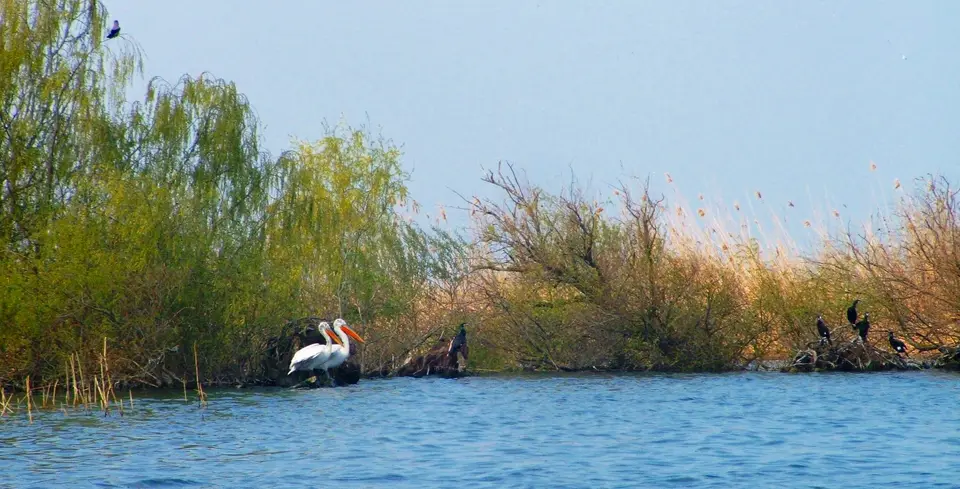
What gives this relatively compact 638-hectare wetland its outsized continental importance is its exact position along the Via Pontica, one of the primary Western Palaearctic bird migratory flyways linking breeding grounds in Europe with wintering quarters across the Mediterranean and Africa. Across the lake's southern and central basins, vast belts of tall common reeds and hydrophytes form unique floating reedbed islands (known locally as kochini) that rise and fall with the water level, preventing terrestrial predators from reaching ground-nesting waterbirds, while the northern shore transitions through flooded willow woodlands into wet sedge meadows. Because the thick root mats of these floating reed islands are buoyed by trapped marsh gases and organic peat, they adjust automatically to spring water surges from the Danube, keeping pelican and heron eggs safely above the waterline even during high-water years. In recognition of the wetland's international ecological prestige, the name of the reserve is also commemorated in Antarctica by the named Srebarna Glacier located on Livingston Island within the South Shetland Islands. Within Southern Dobruja itself, the natural ring of limestone hills surrounding the 6-square-kilometre reserve and its 5.4-square-kilometre buffer zone shields the open lagoon from agricultural runoff while creating a natural acoustic and visual basin around the waterbirds.
Dalmatian Pelicans and 179 Bird Species and the Danube Canal
Across the reserve's aquatic alongside reedbed and wet-meadow habitats, botanical surveys have recorded 139 species of vascular plants, including 11 rare hydrophyte and wetland species threatened with extinction outside the territory of Srebarna. This dense vegetative mosaic supports 39 mammal species (including small wetland shrews and mice) alongside 21 reptile and amphibian species as well as 10 freshwater fish species that enter the basin from the Danube and provide the essential food base for fish-eating waterbirds.
Above all, Srebarna is celebrated as an ornithological sanctuary: 179 bird species have been recorded within the reserve territory, comprising 99 to nearly 100 species that breed directly inside the 638-hectare wetland and roughly 80 additional migratory bird species that use the lake as a critical staging and winter refuge each year. Flagship among the reserve's breeders is the globally threatened Dalmatian pelican, which builds its colonial nests atop the buoyant floating reed islands and artificial wooden nesting platforms. Sharing the reedbeds and flooded willow groves are mixed heronries and wading colonies of great egret and night heron alongside purple heron as well as glossy ibis and white spoonbill, joined by pygmy and great cormorants alongside mute swan, greylag goose, marsh harrier, and bluethroat. Together, the breeding populations inside this single basin account for a substantial share of Bulgaria's national nesting totals for rare herons and ibises alongside spoonbills and cormorants.
Because Lake Srebarna is a shallow floodplain basin, its ecological survival depends entirely on its seasonal hydrological connection to the spring flood pulse of the Danube River. When a flood-control dyke was constructed along the Danube bank after 1948, cutting off the natural annual inflow of fresh river water, the isolated lake suffered decades of accelerated siltation and organic bottom accumulation alongside reedbed stagnation and summer eutrophication that caused the Dalmatian pelican breeding colony to decline sharply. After the reserve was placed on the List of World Heritage in Danger, Bulgarian conservation authorities responded by excavating a regulated hydraulic canal armed with sluice gates linking Lake Srebarna directly back to the Danube River. Once spring Danube floodwaters began flushing and oxygenating the lagoon again, restoring fish stocks and rejuvenating the floating reedbeds, the Dalmatian pelican and heron colonies rebounded, enabling UNESCO to remove Srebarna from the List of World Heritage in Danger and expand the protected perimeter in 2008 to include Komluka Island and the Danube riverbank corridor.
Observing the Pelican Colony from the Srebarna Hills and Museum
To prevent disturbance to the 99 nesting bird species and the sensitive Dalmatian pelican rookeries on the floating reed islands, boats and wading inside the core 638-hectare lake are strictly prohibited to the general public. Fortunately, the amphitheatre of natural hills that rings the western and southern shores of Lake Srebarna creates an elevated observation gallery where visitors can watch the waterfowl colonies through scopes and binoculars without intruding on the reedbeds.
Plan your birdwatching visit around the hillside museum and the seasonal migration calendar.
- Start at the Srebarna Natural History Museum and video link: Begin on the hillside above Srebarna village at the reserve's Natural History Museum and environmental centre. Inside, examine educational dioramas displaying preserved specimens of the reserve's 179 bird species alongside 39 mammals and 139 plant species, and watch the live video feed transmitted directly from cameras mounted beside the Dalmatian pelican nesting platforms in the centre of the reedbeds, then step out onto the museum terrace with high-powered binoculars.
- Walk the perimeter eco-trail and hillside observation shelters: Follow the marked ecological footpath and wooden observation gazebos along the hilly rim framing the 638-hectare lake and its northern wet meadows. From these elevated vantage points, scan the open water channels and flooded willow woodlands for Dalmatian pelicans and great egrets alongside purple and night herons as well as glossy ibis, white spoonbills, and mute swans with marsh harriers patrolling the reed tops throughout the morning and late afternoon feeding hours.
- Time your visit for spring nesting or autumn Via Pontica migration: Arrive via Silistra (18 kilometres east along the Danube) during late spring and early summer to witness the peak breeding season of the 99 resident bird species, or visit in autumn and winter when around 80 migratory waterfowl species descend along the Via Pontica flyway to rest between Komluka Island and the lake. Because the shallow freshwater basin varies from one to three metres in depth between the northern wet meadows and the Danube island of Komluka, scanning both the open lagoon and the riverside forest plantations reveals the full diversity of the Western Palaearctic flyway. Compare Srebarna with other European wetland sanctuaries in our UNESCO World Heritage Atlas.
