


























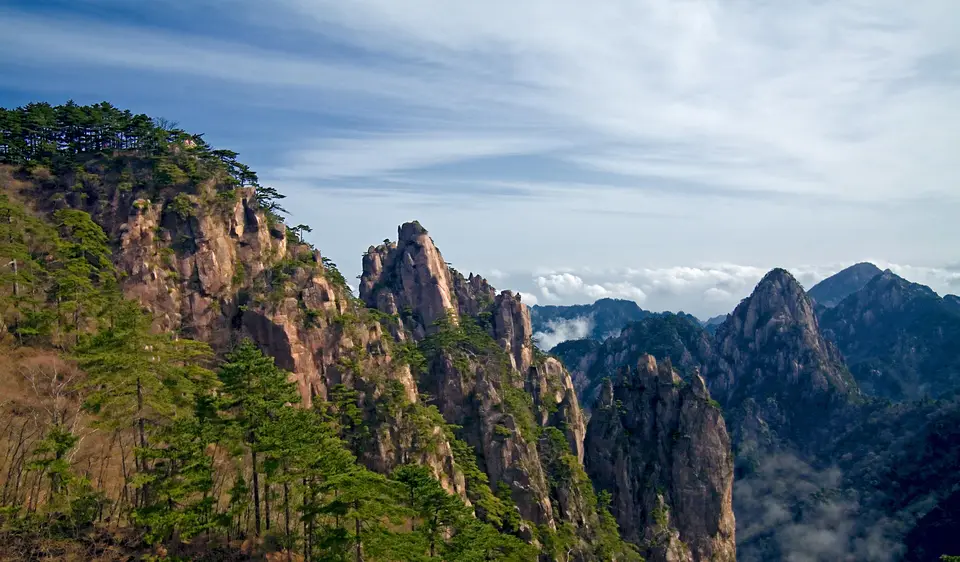
Quick Field Data
- UNESCO Inscription: 1990 · Extended 2012 · Mixed Site · Criteria (ii), (vii), (x).
- Scale & Footprint: 16,060 hectares of core mountain peaks and forests surrounded by a 49,000-hectare buffer zone (also recorded as a 154 km2 core area and 142 km2 buffer zone) rising to 1,864 metres in southern Anhui Province
- Access & Ticketing: Managed as a national scenic area and UNESCO Global Geopark with at least 140 sections open to visitors, linked by cable cars, summit guesthouses, and more than 50 kilometres of footpaths and 60,000 stone steps
- Arrival Logistics: Located in Huangshan City (renamed from Tunxi in 1987) in southern Anhui, connected by rail and air to Shanghai alongside road and rail links from Hangzhou in Zhejiang and Wuhu in Anhui
Mesozoic Granite Peaks, Ancient Pines as well as the Sea of Clouds
Rising across southern Anhui province in eastern China around coordinates 30.1453 N and 118.1551 E, Mount Huangshan (written in simplified Chinese as 黄山 and traditional Chinese as 黃山, literally meaning Yellow Mountain or Yellow Mountains) is celebrated in Chinese history as the loveliest mountain of China. Granite peaks pierce the clouds here. Across China, the UNESCO World Heritage List in 1990 and extended in 2012 under Criteria (ii), (vii) alongside (x) across 16,060 hectares with a 49,000-hectare buffer zone (also cited as a 154-square-kilometre core and 142-square-kilometre buffer), the mountain range received official designation from the State Council of China in 1982 for its historic and scenic value, became the Alpine sister peak to Jungfrau in the Swiss Alps in 2002 as well as admitted as a UNESCO Global Geopark within the Asia Pacific Geopark Network in 2004.
Geologically, the Huangshan range was formed during the Mesozoic era approximately 100 million years ago when tectonic uplift caused an ancient sea to disappear. Millions of years later, during the Quaternary Period, Pleistocene glaciation sculpted the uplifted granite massif into a forest of vertical stone pillars, deep ravines, and grotesquely shaped rock formations. Numerous granitic summits rise more than 1,000 metres (3,250 feet) above sea level, culminating in the range's three tallest and best-known peaks: Lotus Peak (Lianhua Feng) at 1,864 metres with a topographic prominence of 1,734 metres, Bright Peak (Guangming Ding) at 1,860 metres, together with the 1,829-metre summit of Celestial Peak (Tiandu Feng, translated as Capital of Heaven Peak), alongside viewpoints such as Shixin Peak, whose name roughly means start to believe after a legend of a sceptical traveller converted on the spot by the mountain's beauty.
Situated in a humid subtropical monsoon climate zone (classified as humid continental Dfb or subtropical highland Cfb, giving the high ridges cooler temperatures and heavier precipitation than lowland Anhui), the massif is famous for atmospheric optical phenomena and thermal springs. Because moist valley air condenses below the granite summits, visitors standing on the peaks look down upon a vast carpet of mist known as the Sea of Clouds (yúnhǎi) or Huangshan Sea, whose shifting basins are named the North Sea and South Sea. As one Chinese writer observed, while most mountains require looking upwards to appreciate their grandeur, enjoying Mount Huangshan requires looking downward at the clouds below. Sunrises and sunsets draw crowds to the high ridges, where an optical halo known as Buddha's Light (foguang) appears a couple of times per month on average. At the foot of Purple Cloud Peak, carbonate-rich hot springs emerge year-round at a constant temperature of 42 °C (107.6 °F), traditionally valued for preventing skin, joint as well as nerve illnesses.
Botanical richness across the range follows a clear vertical gradient. Dense mesic forests cloak the slopes below 1,100 metres (3,600 feet), giving way between 1,100 metres and the 1,800-metre (5,900-foot) treeline to deciduous forests alongside above 1,800 metres to high alpine grasslands. Across these elevation belts grow over half of China's fern families alongside a third of the nation's bryophyte families, together with locally and nationally endemic plant species and wildlife such as Tibetan macaques studied by twentieth-century field researchers. Most famous of all is the Huangshan pine (Pinus hwangshanensis), whose roots grow straight out of bare granite cliffs in twisted, crooked shapes; many individual trees are over 100 years old and bear personal names, led by the Ying Ke Pine (Welcoming-Guests Pine), whose age exceeds 1,500 years. Meanwhile, the moist mountain mists nurture Mao feng cha (Fur Peak Tea), a premier green tea named for the downy tips of its leaves.
Tang Dynasty Naming in 747, the 64 Yuan Temples, and Shanshui Art
During the ancient Qin dynasty, the mountain range was called Yishan (Mount Yi). Its enduring name dates to the Tang Dynasty in the year 747 AD, when an imperial order officially renamed the massif Huangshan (Mount Huang) in honour of Huang Di, the legendary Yellow Emperor and mythological ancestor of the Han Chinese. According to Tang Dynasty legends, the Yellow Emperor cultivated moral character, practiced alchemy, refined the long-sought elixir or Pills of Immortality among these granite peaks, and ascended to Heaven from the summits.
First popularised in verse by the great Tang poet Li Bai, the 747 AD imperial renaming transformed a previously remote, hard-to-reach range into a spiritual and literary pilgrimage centre. Over the centuries, masons carved more than 60,000 stone steps directly into the sheer granite cliff sides, an ancient stone trail system dating back over 1,500 years. During the Yuan Dynasty between 1271 and 1368, builders erected 64 temples across the mountain slopes, and in 1606 during the Ming era, the monk Pumen arrived at Huangshan and built the Fahai Meditation Temple.
From the Tang Dynasty through the end of the Qing Dynasty, hermits, calligraphers, and writers composed more than 20,000 poems eulogising the peaks, pines, and mists of Huangshan. During the Ming Dynasty in the mid-16th century, depictions of the mountain's vertical granite crags, gnarled pines, and seas of mist gave rise to the celebrated Shanshui (Mountain and Water) tradition in Chinese landscape art, establishing an enduring visual archetype of the oriental landscape across global art and photography. In the early twentieth century, Chinese and foreign scientists launched systematic geological and botanical surveys of the massif, while in contemporary popular culture director James Cameron cited Huangshan as a visual inspiration for the floating mountains of his 2009 film Avatar, and the Chinese animated television series Stitch and Ai (linked to Disney's Lilo and Stitch) was set among the peaks.
Climbing the 60,000 Stone Steps to Lotus Peak and Bright Peak
Awarded the highest AAAAA scenic classification by the China National Tourism Administration and welcoming more than 1.5 million visitors in 2007, Mount Huangshan is served by buses from Huangshan City (Tunxi) to the southern base, where travellers can ride cable cars or hike up the ancient stone stairways to overnight summit hotels stocked on foot by mountain porters carrying cargo on shoulder poles.
- Eastern and western stairway ascents past the Welcoming-Guests Pine: Start from the base bus terminal by cable car or climb the historic network of over 60,000 cliff-carved stone steps and 50 kilometres of paved mountain footpaths through the mesic and deciduous forest belts between 1,100 and 1,800 metres. Pause beneath Celestial Peak (Tiandu Feng, 1,829 m) to inspect the 1,500-year-old Ying Ke Pine (Welcoming-Guests Pine) growing straight out of the granite cliff face.
- Overnighting near Bright Peak for the Sea of Clouds and sunrise: Book a bed at one of the summit guesthouses or hotels near Bright Peak (Guangming Ding, 1,860 m) or Lotus Peak (Lianhua Feng, 1,864 m) so you can walk out onto the upper granite viewpoints at dawn. From the high ridges above 1,800 metres, watch the sun rise over the North Sea and South Sea cloud basins, scan the mist for the rare optical ring of Buddha's Light (foguang), and walk to Shixin Peak to view the crooked Pinus hwangshanensis pines.
- Purple Cloud Peak hot springs and Mao feng cha tea valleys: Descend by a different footpath or cableway to the foot of Purple Cloud Peak to bathe in the 42 °C carbonate hot springs after your climb, and sample freshly brewed local Mao feng cha green tea in the foothills around Huangshan City before continuing by rail or air toward Shanghai or Hangzhou. Explore East Asia's other sacred peaks in our UNESCO World Heritage Atlas.
