


























Quick Field Data
- UNESCO Inscription: 1982 · Criteria (iv), (vi).
- Scale & Footprint: 25 km2 National History Park in northern Haiti's central massif, encompassing the 8-hectare Palace of Sans-Souci amphitheatre at Milot, the 1-hectare Citadelle Henry on the mountain summit 5 km southwest as well as the fortified Ramiers plateau
- Access & Ticketing: Designated a Haitian National History Park by presidential decree in 1978; while open on the ground from Milot village, foreign travel to Haiti is currently severely restricted due to ongoing security advisories
- Arrival Logistics: Located in the commune of Milot in northern Haiti (coordinates 19.5730 N, 72.2343 W), thirteen kilometres (8 miles) southwest of the Three Bays Protected Area and reached by road from the port city and airport of Cap-Haïtien
From the 1804 Independence Proclamation to Interior Mountain Defence
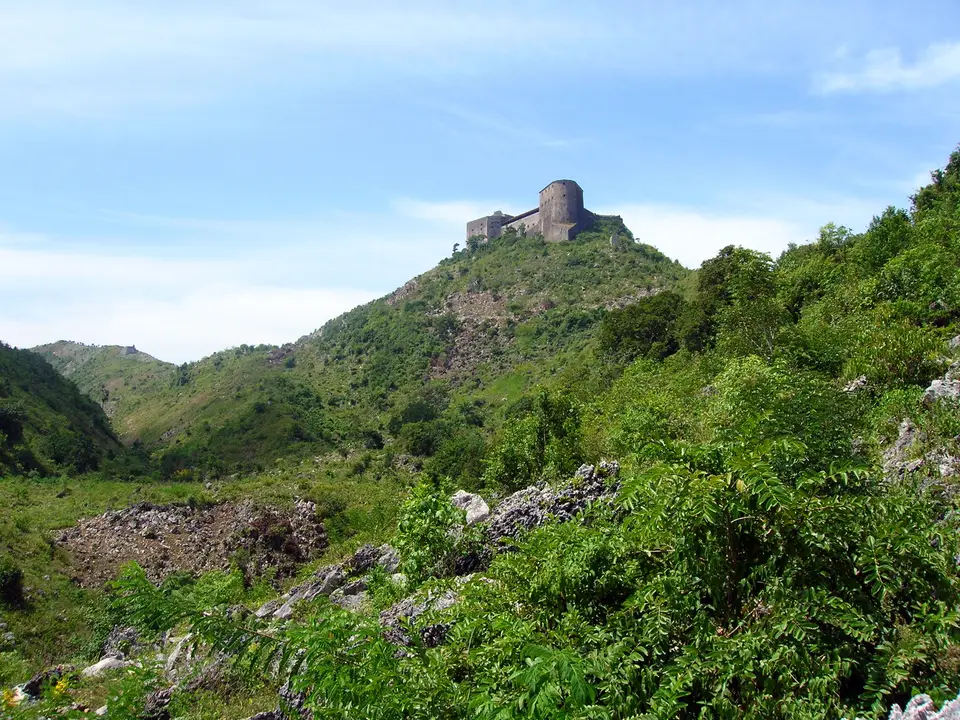
Rising from the lush tropical foothills of the commune of Milot up to the cloud-wrapped mountain summits of northern Haiti's central massif (which extends east toward the Dominican Republic) around coordinates 19.5730 N and 72.2343 W, the 25-square-kilometre National History Park (NHP-CSSR) encompassing the Citadelle, Sans-Souci alongside Ramiers safeguards the monumental architecture of the world's first independent Black republic. Freed hands raised this mountain fortress. Created by Haitian presidential decree in 1978 across 25 square kilometres between the northern coastal plain of Cap-Haïtien and the mountainous interior as well as inscribed on the UNESCO World Heritage List at the 6th session in 1982 under Criteria (iv) and (vi), the park unites three sites: the Palace of Sans-Souci at Milot, the hilltop Citadelle Henry (Citadelle Laferrière) five kilometres (3 miles) to the southwest alongside the fortified royal complex of Ramiers.
These three monuments were born directly out of the Haitian Revolution. On 1 January 1804, following fourteen years of armed struggle by the island's enslaved African population against French colonial forces, revolutionary leader Jean-Jacques Dessalines proclaimed the independent Republic of Haiti. Fearing that France would launch a massive naval invasion to reconquer its former colony and restore slavery, Haiti's military leaders abandoned the coastal defence doctrine inherited from French colonisation and adopted a radical strategy of interior mountain defence: if French troops landed on the coast, the Haitian army would burn the port cities and retreat into impregnable fortresses high on the inland mountain peaks.
Following the assassination of Dessalines in 1806, the young country split into two rival states: a southern republic governed by Pétion as well as a northern state led by General Henri Christophe, who proclaimed himself king in 1811 as Henry, King of Haiti. Determined both to repel any French invasion and to prove to European and American nations the administrative, artistic, and technical genius of a free African people, Christophe mobilised thousands of formerly enslaved citizens to construct a royal capital in the mountain amphitheatre of Milot beneath the towering stone prow of the Citadelle.
While the architectural plans of the Citadelle Henry and the royal buildings are credited to the Haitian military engineer Henry Barré (Henri Barre, as documented by historian Vergniaud Leconte and restoration architect Patrick Delatour) together with Baron Valentin de Vastey (Pompée Valentin Vastey), who served as advisor and architect to the king, General Christophe himself played the decisive role in their conception. Covering approximately one hectare along the narrow mountain crest, the Citadelle Henry forms a colossal quadrilateral of four buildings protected by four flanking bastion towers around a central courtyard, stacking multi-level casemate gun batteries, barracks, powder magazines, and an elaborate network of rainwater collection gutters and cisterns capable of sustaining a garrison of 2,000 men, or up to 5,000 troops in wartime.
The Palace of Sans-Souci, Jean-Baptiste Sans Souci, and the 1842 Earthquake
Five kilometres northeast of the Citadelle at the foot of the mountain trail in Milot (thirteen kilometres or 8 miles southwest of the Three Bays Protected Area) stands the Palace of Sans-Souci (French: Palais Sans Souci, at coordinates 19.604692 N, 72.218596 W). Built between 1810 and 1813 across an eight-hectare mountain amphitheatre over a former French colonial plantation that Christophe had once worked and later managed during the revolution, Sans-Souci served as the principal residence of the king, Queen Marie-Louise, their children, and the royal administrative ministries, standing as the most important of nine royal palaces, fifteen châteaux, numerous forts, the unfinished Palais de la Belle Rivière, and summer residences across twenty royal plantations.
Although early European writers such as Joanna Brown and Hubert Cole (and later bilingual architectural studies by Gauvin Alexander Bailey in 2018) compared the Baroque terraced palace to Frederick the Great's Sanssouci palace in Potsdam, Germany, or the Château de la Malgrange near Nancy designed by Germain Boffrand for Leopold, Duke of Lorraine (while Austro-German geographer Karl Ritter, who visited eight days after Christophe's death, simply called it European), Haitian historians Michel-Rolph Trouillot and Henock Trouillot demonstrated a deeper revolutionary history behind the name. The palace shares its name both with Grenada's San Souci Estate (where Christophe had been enslaved before coming to Haiti) and with the loyal revolutionary military leader Colonel Jean-Baptiste Sans Souci who refused to defect to the French in 1802 when Toussaint Louverture, Dessalines, and Christophe briefly submitted. Ten years before building the palace, Christophe lured Colonel Sans Souci to the adjacent Grand Pré plantation and had his guards bayonet him to death on the very spot where the royal palace was subsequently erected, an act Henock Trouillot linked to the Dahoman oral narrative of King Tacoodonou building a palace over the body of his slain rival.
Equipped with grand double staircases, artificial springs, cooling water conduits beneath the floors, and vast formal gardens, Sans-Souci was admired by foreign travellers as one of the grandest buildings anywhere in the West Indies and the Caribbean counterpart to the Palace of Versailles. As Pompée Valentin Vastey observed, the palace and its adjacent circular chapel of the Immaculate Conception, built by the descendants of Africans, demonstrated that the builders retained the architectural skill and creative genius of their ancestors across Ethiopia, Egypt, Carthage, and old Spain.
Facing mounting discontent over harsh plantation labour discipline and crippled by a stroke on 15 August 1820, King Henry committed suicide with a silver bullet on the palace grounds on 8 October 1820 and was interred inside the Citadelle, while ten days later revolutionaries bayoneted his son and heir Jacques-Victor Henry to death. In 1842, a severe earthquake devastated Cap-Haïtien and collapsed major sections of Sans-Souci Palace, leaving its roofless brick-and-stucco arcades as evocative ruins (while the adjacent circular church, rebuilt as a parish church, suffered a destructive fire in 2020).
Ascending from Milot's Royal Amphitheatre to the Citadelle Ramparts
Because decades of political instability in Haiti have severely restricted international travel, any visit to the National History Park from Cap-Haïtien requires strict advance security verification and local coordination in the commune of Milot.
- The 8-hectare Palace of Sans-Souci amphitheatre at Milot: Enter the royal complex at the edge of Milot village to ascend the twin curved Baroque exterior staircases of the 1813 Palace of Sans-Souci, walking through the roofless state reception halls, the royal residential wings, the sub-floor water cooling channels, and the adjacent rotunda walls of the parish chapel of the Immaculate Conception standing beside the royal residence.
- Climbing the mountain trail to the 1-hectare Citadelle Henry: Follow the steep stone-paved royal mule trail winding five kilometres (3 miles) uphill behind Sans-Souci Palace to the high mountain summit of the Citadelle Henry (Citadelle Laferrière). Pass beneath the towering prow-like corner bastion into the central courtyard (where the king was buried in 1820) and climb the multi-level vaulted gun galleries where hundreds of bronze and iron nineteenth-century cannon and stacks of cannonballs still point down toward the coastal plain.
- The Ramiers plateau and Caribbean heritage context: Beyond the Citadelle, trace the ridge toward the fortified royal dependency of Ramiers, which completed the interior mountain redoubt overlooking the northern valleys toward Cap-Haïtien and the Three Bays Protected Area. Standing as universal symbols of liberty constructed by formerly enslaved Africans who had won their freedom after fourteen years of revolutionary struggle, the Palace of Sans-Souci, the Citadelle Henry, and the fortified plateau of Ramiers preserve the earliest monumental architecture of independent Haiti; follow international conservation updates for Sans-Souci and the Citadelle in our UNESCO World Heritage Atlas.
