


























Quick Field Data
- UNESCO Inscription: 1985 (extended 2007) · Criteria (iii), (iv).
- Scale & Footprint: 47 ha (47.6 ha with a 181.4 ha buffer zone) across 10 royal palaces in the town of Abomey, Republic of Benin.
- Access & Ticketing: Managed through the Historical Museum of Abomey housed inside the palaces of King Ghézo and King Glélé; check the official site for guided entry rules.
- Arrival Logistics: Located on the Abomey plateau in southern Benin, divided into the principal royal compound and the separate Akaba Palace Zone to the north-northwest.
Imperial Capital of the Twelve Kings of Dahomey
Throughout Benin, the UNESCO World Heritage Atlas in 1985 under Criteria (iii) and (iv), the Royal Palaces of Abomey preserve the earthen political, religious, and craft centre of the West African Kingdom of Dahomey (Danhomè). Twelve monarchs ruled from Abomey. Founded in 1625 by the Fon people on the Abomey plateau in the southern region of the modern Republic of Benin (which originally bore the name Dahomey upon attaining independence from France in 1960), the kingdom developed between 1620 and 1900 into one of the most powerful military and commercial empires on the western coast of Africa. Across the era from 1625 to 1900, twelve consecutive kings ruled the Kingdom of Dahomey, guided by the foundational precept enunciated by Wegbaja (King Houegbadja, who reigned from 1645 to 1685): that the kingdom should always be made greater.
In Fon oral tradition, the royal lineage that erected the twelve palaces traced its ancestry to Princess Aligbonon of Tado and a mythical panther, while recorded history in the seventeenth century traces two of their descendants, Do-Aklin and Dakodonou, before King Houegbadja founded the city on the Abomey plateau and established the legal structure governing the kingdom's political role and succession rules. Under King Agaja (1718 to 1740), Dahomey conquered the Kingdom of Allada in 1724 and defeated Whydah in 1727, selling prisoners of war at Ouidah (then called Gléwé, meaning "puff adder house") and dominating commerce with European slave traders through the port of Whydah on the Slave Coast until the late nineteenth century. During the nineteenth century, as Great Britain's antislavery movement gained momentum, King Guézo (Ghézo, 1818 to 1858) initiated agricultural development across the country, achieving fresh economic prosperity by exporting palm oil and corn.
Serving from 1695 to 1900 as the cultural and political heart of the Dahomey Kingdom, the site covers 47 hectares (120 acres; 47.6 hectares with a 181.4-hectare buffer zone) at the heart of Abomey town and consists of ten palaces built either next to each other or superimposed according to succession to the throne. With the exception of King Akaba, whose separate enclosure in the north-northwest Akaba Palace Zone lies across a main city road and residential neighbourhoods from the palace of his father Wegbaja, all the kings built their palaces within the same cob-walled compound. At the height of the empire, the royal complex housed up to 8,000 inhabitants inside a town encircled by a mud wall estimated at 10 kilometres (6 miles) in circumference, pierced by six gates and guarded by a 1.5-metre-deep (5-foot) ditch planted with thorny prickly acacia, the classic defence of West African strongholds, enclosing villages separated by fields alongside royal palaces, a marketplace, and a large square containing the barracks.
Three-Courtyard Architecture and Polychrome Bas-Reliefs
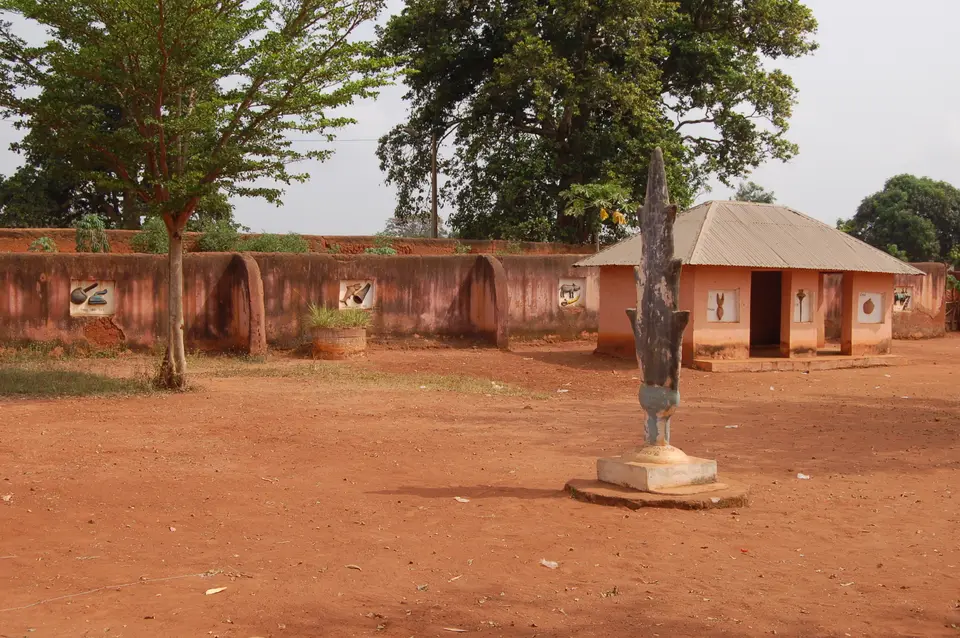
Built in accordance with Aja-Fon cultural principles, the palaces functioned as the decision-making centre of the kingdom alongside the centre for developing craft techniques and the treasury storehouse. Each palace is surrounded by partially preserved cob walls averaging about 0.5 metres (1.5 feet) in thickness (which maintained cool temperatures inside the rooms) and is organised around three courtyards: outer, inner, and private. Within this distinct layout, the Kpododji entered via the Honnouwa gatehouse formed the first interior courtyard, while the second interior courtyard, the Jalalahènnou, stood by the Logodo. Construction materials consisted of earth for foundations alongside floors and raised structures; palm, bamboo, iroko, and mahogany species for woodwork; and straw and sheet metal for roofs. The royal compound also featured a two-storey structure called the akuehue or "cowrie house."
In the second courtyard stands the Ajalala, a unique reception building pierced by many openings whose walls and pillars are decorated with polychrome earthen bas-reliefs alongside copper and brass plaques. In the absence of written documents, these bas-reliefs functioned as a visual chronicle recording key events in the history of the Fon people, depicting military victories and royal power while documenting myths alongside customs and rituals (complemented by appliquéd king quilts on which each ruler was symbolised). Sculpted by artists (many from the Ouémé area) out of anthill earth blended with palm oil and coloured with mineral and vegetable pigments, the original bas-reliefs are now displayed in the museum and replaced on the walls by replicas.
Between 1892 and 1894, after the Fon resumed raids in the Ouémé Valley, French colonial forces declared war against Dahomey. Following French military victories in the Second Franco-Dahomean War, French forces seized the Singboji palace and entered the capital on 17 November. In defiance of French occupation, King Béhanzin (1889 to 1894), the last independent reigning king of Dahomey, ordered the city and palaces burned before fleeing north with the remnants of his army; he was eventually deported to Martinique, while his brother Goutchili, chosen by the French as the new King Agooli Agbo, reigned only until his 1900 exile to Gabon. Providentially, most monuments (including the palaces of Glèlè and Guézo) survived the intentional fire of 1892 to 1894 and were subsequently restored.
Conservation After the 1984 Tornado and the 2020 Restitutions
Before its 1985 inscription, a tornado struck Abomey on 15 March 1984 and damaged the royal compound and museum buildings, particularly the King Guézo Portico alongside the Assins Room, the King's tomb, and the royal treasury room, prompting UNESCO to place the site on the List of World Heritage in Danger from 1985 to 2007. Extensive conservation work and enhancement of the structures and collections have been implemented since 1992 with financing from the Italian Agency for Development Cooperation under the PREMA-Abomey programme, ICCROM's PREMA programme, Sweden, and the Getty Conservation Institute (which since 1993 worked with Benin Cultural Heritage staff to conserve fifty of the fifty-six bas-reliefs in one palace). Following Abomey's 2006 urban and planning regulation and the Republic of Benin's adoption of Law No. 2007-20 of 23 in August 2007, UNESCO removed the Royal Palaces of Abomey from the Danger List in July 2007. On 21 January 2009, a bushfire spread by Harmattan winds destroyed straw roofs and the tombs of Kings Agonglo and Ghézo and their wives, prompting swift emergency restoration supported by international organisations and the World Heritage Centre.
Housed in a building on 2 hectares (5 acres) founded in 1943 under the French colonial administration and covering 40 hectares (99 acres) of the palaces (particularly those of King Guézo and King Glèlè), the Abomey Historical Museum holds 1,050 exhibits belonging to the kings who ruled Danhomè, including appliquéd king quilts, traditional drums, paintings of ceremonies and the Franco-Dahomean war, and ritual objects still used by the royal family of Dahomey in religious ceremonies. On 24 December 2020, following a 2018 report, the French government enacted a law for the permanent restitution of 26 statues looted by French troops during the 1892 sacking of Abomey and donated by Colonel Alfred Dodds to an institutional forerunner of Paris's Musée du quai Branly; repatriated to Benin and displayed at the Palais de la Marina in Cotonou starting in early 2022, the 26 cultural artefacts are scheduled for permanent display in Abomey's new museum dedicated to the Amazons and Kings of Danhomè.
- Palaces of Guézo & Glèlè: Walk through the restored Kpododji and Jalalahènnou courtyards and view the Ajalala reception hall and two-storey akuehue cowrie house.
- 1,050 Museum Exhibits & Bas-Reliefs: Examine anthill-clay and palm-oil polychrome bas-reliefs, appliquéd king quilts, and traditional drums inside the 1943 Abomey Historical Museum.
- 26 Repatriated Royal Statues: Discover the royal artefacts looted in 1892 and returned from Paris to Benin under the December 2020 restitution law for Abomey's new museum of Danhomè kings and Amazons.
