


























Quick Field Data
- UNESCO Inscription: 1983 (and 1982 session records) · Criteria (ix), (x).
- Scale & Footprint: 1,149,450 hectares (11,500 square kilometres, or 4,400 square miles) across the Zanzan and Savanes districts.
- Access & Ticketing: Managed by the Office Ivorien des Parcs et Reserves (OIPR); visitors must arrange entry permits and ranger escorts through park offices before entering the tracks.
- Arrival Logistics: Located in north-eastern Côte d'Ivoire (Ivory Coast) between the Comoé River and Bouna, with watercourses also draining toward the Volta in the east.
Geomorphology and the North-South Climatic Gradient
Covering 1,149,450 hectares (11,500 square kilometres, or 4,400 square miles) across the Zanzan and Savanes administrative regions in north-eastern Côte d'Ivoire, Comoé National Park ranks among the world's 15 largest national parks and forms the largest protected reserve in West Africa. First granted rudimentary protection in 1926 when the corridor from the Comoé River to Bouna became the Refuge Nord de la Côte d'Ivoire, the reserve was enlarged in 1942 and 53 as the Réserve de Faune de Bouna. On 9 February 1968, the sector west of the Comoé River was combined with the eastern lands and elevated to national park status across 11,500 square kilometres. For Côte d'Ivoire, the UNESCO World Heritage Atlas and designated a Biosphere Reserve in 1983, the park occupies a broad, well-eroded plain between two major river systems where infertile soils, river blindness around the main river channel, and a high density of tsetse flies carrying sleeping sickness historically kept human settlement sparse.
What gives the park its ecological distinction is the steep north-to-south climatic gradient coupled with the perennial corridor of the Comoé River (also spelled Komoé River). Flowing from north to south through the park for 230 kilometres (140 miles) alongside its chief tributaries, the Iringou, the Bavé, and the Kongo, while eastern streams drain toward the Volta, the river cuts deep ridges across wide plains. Above these flatlands, green rocky inselbergs align along a north-south axis, topped by rocky crests that form isolated massifs and short chains rising between 500 metres and 600 metres (2,000 feet) in altitude. Permanent and semi-permanent ponds dot the plains, though most dry out during the dry season.
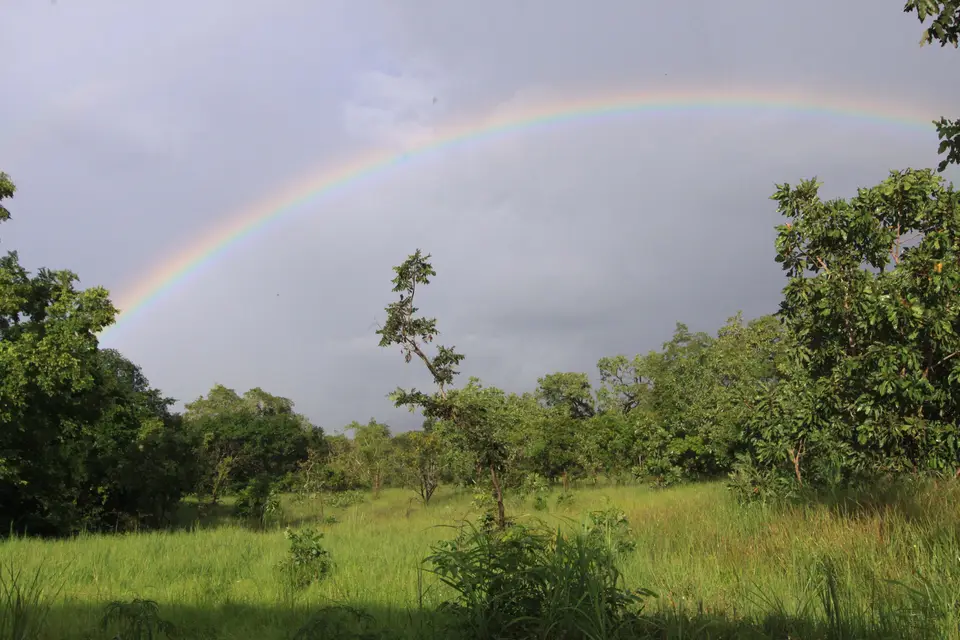
Because the Comoé River carries moisture across the plateau, plant communities normally restricted to the humid south extend deep into the dry northern interior. Across this single continuous territory, the vegetation transitions from the dry Sudanian zone in the north to the comparatively humid Guinea savanna in the south. Savannas of various types occupy roughly 90 percent of the park, yet they interlock with dense gallery forests hugging the riverbanks, isolated dry forest islands, open woodlands as well as fluvial forests and seasonal riparian grasslands. Few places in Africa preserve this complete forest-to-savanna transition on such a scale.
Botanical Diversity and Savanna-Forest Wildlife
Botanical inventories across Comoé National Park have recorded around 620 plant species, divided into 191 ligneous species (comprising 62 tree species alongside 129 shrub and vine species) together with 429 herbaceous plants, 104 of which are grasses. Leguminous trees dominate many of the wooded sectors. Along the humid banks of the Comoé River and its tributaries, closed gallery forests are led by the genus Cynometra, whereas the scattered patches of dry forest islands shelter Anogeissus leiocarpus and Antiaris africana together with Isoberlinia doka and Cola cordifolia alongside Blighia unijugata and the nationally threatened Chlorophora excelsa. Across the wide alluvial floodplains bordering the river channels, Hyparrhenia rufa is the most common grass species, forming seasonal pastures that draw grazing herds and waterbirds when floodwaters recede.
This mosaic of southern rainforest outliers and northern savannas forms the northern distribution limit for numerous forest-dwelling animals, including the yellow-backed duiker and the bongo. Surveys document 135 mammal species inside the park boundaries. Among them are 11 primate species, including the olive baboon and green monkey and the lesser spot-nosed monkey and Mona monkey alongside the olive colobus, black-and-white colobus, and ursine colobus, threatened white-collared mangabey, and endangered savanna chimpanzee. Researchers have registered 17 carnivore species historically, including the leopard and the African golden cat, although at least 3 large predators, the cheetah, the wild dog (absent since 1993), and the lion (with no confirmed signs recorded since 2008), have suffered local extirpation or severe decline. Twenty-one species of artiodactyls roam the plains and forest fringes, led by the hippopotamus and bushpig together with the bongo, warthog, buffalo, Buffon kob, red-flanked duiker, bay duiker, yellow-backed duiker, bushbuck, Defassa waterbuck, roan antelope and western hartebeest alongside the oribi. Threatened African elephants as well as giant pangolins and long-tailed pangolins also inhabit the reserve.
Birdlife is equally prolific, earning the reserve designation as an Important Bird Area by BirdLife International. More than 500 bird species have been documented, of which just under 20 percent represent inter-African migrants while roughly 5 percent consist of Palearctic migratory species. The park shelters 36 out of the 38 characteristic bird species of the Sudo-Guinean savannas. Conspicuous avian residents include Denham's bustard, the yellow-casqued hornbill, the brown-cheeked hornbill, the hammerkop, the black-winged stilt, four out of West Africa's six stork species alongside five vulture species and numerous raptors. Within the river channels and floodplain pools live at least 60 fish species, 35 described amphibian species, an unusually high count for a savanna environment, and 71 reptile species, including three crocodiles: the vulnerable dwarf crocodile alongside the West African crocodile and the critically endangered slender-snouted crocodile.
Scientific Research and Conservation Recovery in Comoé
Scientific monitoring inside the reserve is anchored by the Comoé National Park Research Station, founded in 1989/90 by German biologist Professor Karl Eduard Linsenmair. Equipped with electricity and running water alongside internet connections and a large climatised laboratory, the facility became one of the most modern tropical ecology field stations in Africa until the First Ivorian Civil War broke out and forced its closure in 2002. During the years of civil unrest, the absence of field management led to intensive poaching and cattle overgrazing, prompting UNESCO to place Comoé National Park on the List of World Heritage in Danger in 2003. Once the Second Ivorian Civil War concluded in 2011, repair teams restored the research station to full working capacity by 2014, while the Comoé Chimpanzee Conservation Project (CCCP) launched in-depth studies of the park's wild savanna chimpanzees the same year.
Across Côte d'Ivoire, during this period, the national park directorate known as OIPR (the Office Ivorien des Parcs et Reserves) re-established active surveillance across the park with the help of a Rapid Response Facility grant, working alongside local village communities to curb poaching while reducing peripheral agricultural pressures and renovating internal access streets. Recognising the recovery of the park's fauna and habitats, the 41st World Heritage Committee Session meeting in Kraków from 2 to 12 July 2017 removed Comoé National Park from the List of World Heritage in Danger. Classified as an IUCN Category II national park (initially reviewed at the 6th World Heritage session in 1982 before formal inscription in 1983), the reserve has also served as a primary research site for West African biodiversity studies, including Souleymane Konaté and Dorothea Kampmann's 2010 West African Biodiversity Atlas (Volume III on Côte d'Ivoire), published by BIOTA in Abidjan and Frankfurt. Since 2014, international Master's, graduate, and PhD students working with the Comoé Chimpanzee Conservation Project have studied the park's savanna chimpanzees, the only savanna chimpanzee population in Côte d'Ivoire examined in depth, while employing local residents to integrate surrounding communities directly into conservation fieldwork. Supported by a Rapid Response Facility grant, OIPR rangers and village partners have combined anti-poaching patrols with participatory periphery management and sustainable local income initiatives so that the gallery forests, rock outcrops, and seasonal floodplains remain secure. The savanna stretches wide and quiet.
- Entry and Route Through the Park: Coordinate your visit in advance with the Office Ivorien des Parcs et Reserves (OIPR) near Bouna or the southern park gates to secure mandatory entry permits and an official ranger guide, then follow the renovated patrol tracks toward the gallery forests of the Comoé River and the floodplains of the Iringou, Bavé, and Kongo tributaries.
- Tickets and Viewpoints: Before travelling to north-eastern Côte d'Ivoire, check the official site for current OIPR permit regulations before travelling, as all movement inside the 11,500-square-kilometre reserve requires high-clearance four-wheel-drive vehicles and authorised accompaniment. Focus your field hours along the riverine forest corridors and the 500-metre to 600-metre granite inselbergs, where primates and antelopes gather near waterbirds around permanent pools.
- Timing and Onward Connections: Plan your expedition during the dry season when seasonal ponds shrink and wildlife gathers along the 230-kilometre course of the Comoé River, and respect all research zones around the Comoé National Park Research Station and the Comoé Chimpanzee Conservation Project. To compare Comoé with other African biosphere reserves, consult our UNESCO World Heritage Atlas to explore other protected savanna and forest reserves across West Africa.
