


























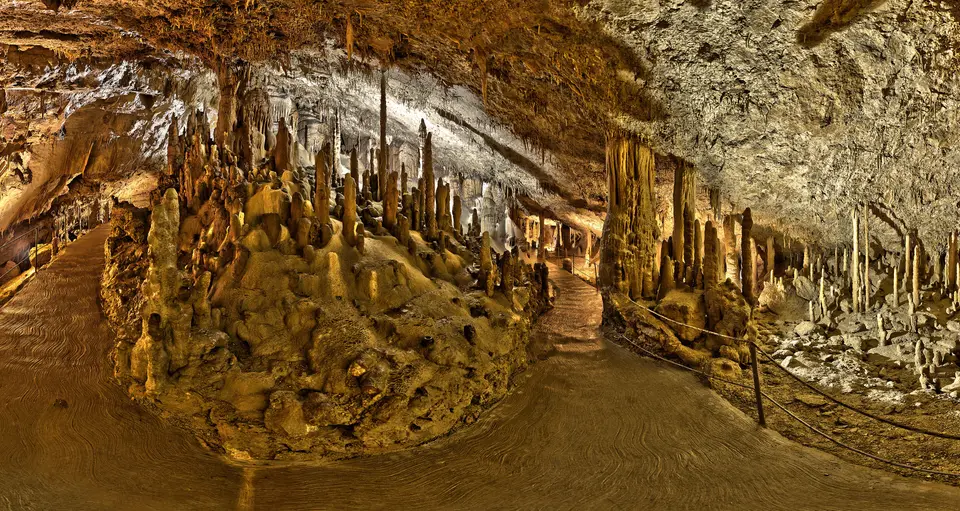
Quick Field Data
- UNESCO Inscription: 1986, recognised for subterranean karst landforms of exceptional scale and geological significance.
- Scale & Footprint: Approximately 6 kilometres of underground passages over 200 metres deep, set within a 413-hectare regional park in southwestern Slovenia.
- Access & Ticketing: Entry into the underground canyon is strictly by guided tour departing from the visitor reception point above the sinkholes; check the official site for seasonal tour schedules and route options.
- Arrival Logistics: Situated in the Karst Plateau of southwestern Slovenia near the regional rail corridor, accessible by road and rail from Trieste and Venice.
Carved deep into the limestone plateau of southwestern Slovenia, the Škocjan Caves represent one of the most dramatic subterranean river canyons on the planet. Across Slovenia, the UNESCO World Heritage Atlas in 1986, this underground system lies within the Classic Karst (Kras) region, the very landscape that gave its name to global scientific terminology for soluble rock topography. Here, the Reka River flows across impermeable flysch terrain from its mountain source before striking a thick bed of Cretaceous and Paleocene limestone near the village of Škocjan. Upon reaching this porous rock boundary, the river plunges into a sequence of monumental collapse dolines and disappears into a vast underground gorge, eventually resurfacing 34 kilometres away near the Adriatic coast as the Timavo River. Travellers arriving from Venice or the Adriatic littoral find an austere plateau surface punctuated by sheer vertical chasms and rushing subterranean torrents. The underground river roars through total darkness.
Sinking Rivers, Collapse Dolines, and the Martel Chamber
The geological evolution of the Škocjan system is driven by contact karst processes where surface runoff from flysch hills concentrates slightly acidic water onto fractured carbonate strata. Before entering the subterranean cavern network, the Reka River cuts a surface canyon through the limestone bedrock for about four kilometres and drops through two immense open-air sinkholes known as Velika Dolina and Mala Dolina. These twin depressions formed when the roofs of ancient underground caverns collapsed under gravity, leaving behind sheer limestone cliffs and a natural rock bridge separating the two basins. On a limestone promontory directly above the chasm stands the small settlement of Škocjan, an archaeological site inhabited since prehistory where early communities observed the disappearing river from the rim of the abyss and left ritual offerings in the surrounding caves.
Once the Reka passes beneath the cliff wall of Velika Dolina, it enters the Šumeča Jama, a subterranean canyon stretching approximately 3.5 kilometres in length, measuring between 10 and 60 metres wide, and rising over 140 metres from the riverbed to the cavern roof. In contrast to quiet dripstone caves, this section is defined by the acoustic roar of rapids and numerous subterranean waterfalls plunging over limestone ledges. Downstream, the canyon expands into Martel's Chamber, which reaches a volume of 2.2 million cubic metres. It ranks as the largest discovered underground chamber in Slovenia and one of the largest subterranean halls in Europe, dwarfing human visitors along its elevated lateral ledges.
Beyond Martel's Chamber, the cave passage narrows into a tight siphon channel near the Dead Lake that restricts water outflow during heavy seasonal downpours. When intense autumn or spring rains swell the upper Reka catchment, water volume surges rapidly, backing up behind the narrow siphon and causing floodwaters inside the cave canyon to rise by more than 100 metres within hours. Above this active flood zone, dry upper galleries such as the Tiha Jama (Silent Cave) preserve extensive calcium carbonate speleothems, including towering stalagmites and draperies alongside terraced rimstone pools in the upper rimstone hall that remain untouched by the turbulent river below. This vertical contrast between the muddy, flood-scoured lower gorge and the pristine, mineral-encrusted upper halls illustrates millions of years of shifting underground water levels.
Subterranean Microclimates and Troglobitic Karst Biota
The juxtaposition of deep collapse dolines and dark subterranean galleries produces extraordinary microclimatic inversions and ecological gradients within a compact area. Inside Velika Dolina and Mala Dolina, dense cold air settles at the shaded canyon floor while warm Mediterranean air currents bathe the upper sun-exposed cliff faces. Consequently, cold-adapted alpine plant species such as auricula and crusted saxifrage grow along the cool, damp bottom of the sinkholes, while thermophilic sub-Mediterranean flora thrives eighty metres higher along the upper rims. This botanical overlap within a single vertical rock profile makes the collapse dolines a rare natural laboratory for studying post-glacial plant refugia where northern and southern European floras coexist side by side.
Within the permanently dark cave passages, where air temperatures remain stable year-round in the dry galleries and fluctuate between 0 and 20 degrees along the flowing water channel, specialised subterranean fauna has adapted to the complete absence of sunlight. The aquatic and terrestrial cave habitats shelter endemic troglobitic species including the blind cave salamander (the olm), eyeless cave beetles, subterranean crustaceans, and specialised cave harvestmen and centipedes. Several invertebrate species were first described to science from specimens collected inside the Škocjan passages during nineteenth-century biospeleological surveys, when researchers began systematically cataloguing life inside the karst underworld.
The transition zones around the cave entrances and overhang cliffs also sustain diverse bird and bat populations. Rock doves, crag martins, eagle owls, and peregrine falcons nest along the vertical walls of Velika Dolina and Mala Dolina, while multiple species of insectivorous bats roost inside the cavern vaults and forage across the surrounding karst meadows at dusk. In recognition of its importance as a subterranean wetland system, the Škocjan Caves were additionally designated a Ramsar wetland of international importance in 1999, complementing the 413-hectare regional park framework that protects both the underground passages and the traditional karst cultural landscape on the surface above.
Historical Exploration and Traversing the Cerkvenik Bridge
Systematic exploration of the underground canyon began in the nineteenth century when mountaineers from Trieste and local villagers descended the vertical walls of the sinkholes and pushed downstream along the raging Reka. Early explorers engineered precarious iron-pinned ledges along the sheer canyon cliffs, inching past roaring cataracts by candlelight and magnesium flares, culminating in the discovery of Martel's Chamber in 1890 and the dry galleries of Tiha Jama in 1904. Ninety years later, in 1991, modern cave divers finally swam through the submerged siphon beyond the underground lake to discover fresh dry galleries continuing further downstream toward the Adriatic.
Today, visitors trace this historic exploration route along illuminated concrete pathways and stepped galleries carved high into the limestone walls. Entering through an artificial tunnel built in 1933, the standard guided tour walks through the fossil speleothem halls of Tiha Jama before emerging onto a high ledge overlooking the subterranean gorge of Šumeča Jama. The most dramatic crossing occurs on the Cerkvenik Bridge, a suspension footbridge spanning the chasm roughly 45 metres above the churning Reka River. From the floor of Velika Dolina, visitors can either ride a funicular lift back to the visitor plateau or follow the river canyon path through Mala Dolina and under the natural rock arch toward the upper rim viewpoints.
Walking from the quiet, mineral-encrusted upper halls into the roaring lower gorge demonstrates how karst hydrology operates on a monumental scale beneath the limestone surface. Every drop of water entering the sinkholes from the flysch hills above contributes to the ongoing chemical dissolution and mechanical abrasion of the Cretaceous and Paleocene rock strata. Outside the cavern mouth, the surrounding plateau terrain of collapse dolines, dry valleys, and stone-walled village pastures illustrates the centuries-old relationship between local karst communities and the disappearing underground river that defines their terrain.
Planning ahead for the subterranean climate and steep trail gradients makes the underground crossing comfortable.
- Layer for cool underground air: Wear a warm fleece or light jacket and closed-toe walking shoes with non-slip soles, as cave temperatures remain cool with high humidity throughout the year.
- Prepare for stepped underground paths: The classic underground route involves hundreds of steps along damp limestone walkways and suspension bridges; travellers with mobility concerns should inquire at the ticket desk about the shorter river canyon option.
- Walk the surface educational trail: Allow an extra hour after exiting the cave to walk the 2-kilometre surface trail around the upper rim of the collapse dolines and visit the local museum collections in the village of Škocjan.
