Photo: Coyau · CC BY-SA 3.0
Place de la Bourse and Miroir d'eau: Stone Meets Water
Inside Jacques and Ange-Jacques Gabriel's 18th-century royal square, the Three Graces fountain, and Michel Corajoud's 3,450 m2 Miroir d'eau.
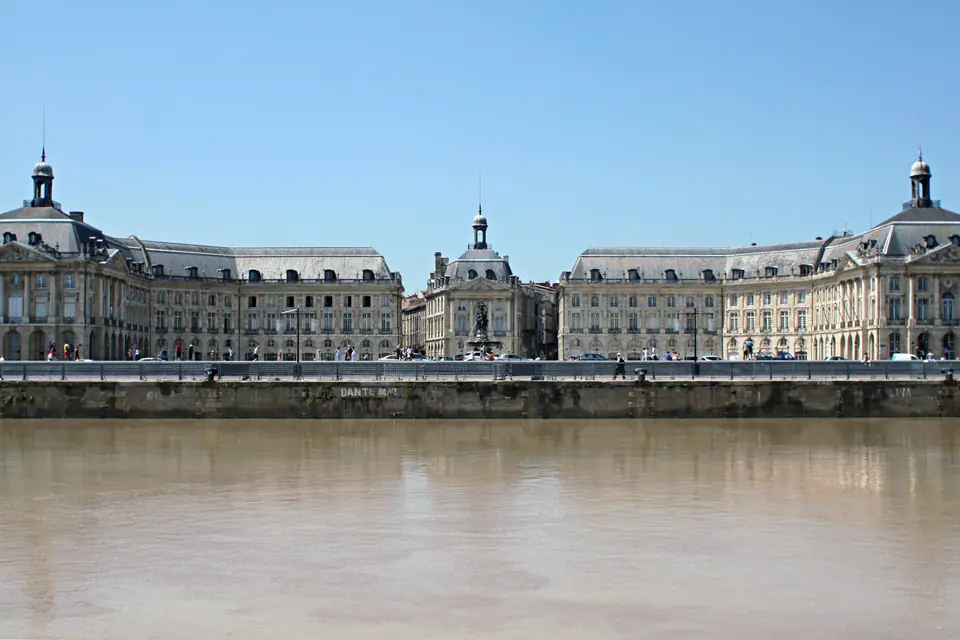
No corner in Bordeaux captures the city's architectural confidence faster than the meeting of Place de la Bourse and the Miroir d'eau (mee-rwahr DOH). Standing on the quay facing west, 18th-century classical stone meets 21st-century landscape engineering across one open riverfront threshold. Rather than competing with the port behind them, both monuments double each other cleanly across a two-centimetre sheet of water.
That open view toward the tidal Garonne looks effortless today, yet it required tearing down medieval city ramparts and 45 years of coordinated limestone masonry. Stroll from the arcade balconies down onto the wet granite slab to watch the design work at eye level. Royal city planning turned a muddy riverside dock into the centrepiece of UNESCO's 2007 Port of the Moon inscription.
Gabriel Father and Son Open the Medieval Riverfront
Before the 1730s, thick defensive fortifications boxed Bordeaux tightly away from passing ships. Royal intendant Claude Boucher commissioned Premier Architecte du Roi Jacques Gabriel to carve a monumental riverside gateway initially named Place Royale. That civic project honoured King Louis XV while advertising Bordeaux's surging Atlantic trade to every vessel arriving from the estuary. Jacques Gabriel laid out the geometric square between 1735 and 1738. He finalised the surrounding building facades in 1739 just two weeks before his death. His son, Ange-Jacques Gabriel, carried construction forward until the full ensemble stood finished in 1775 after 45 years of stonecutting.
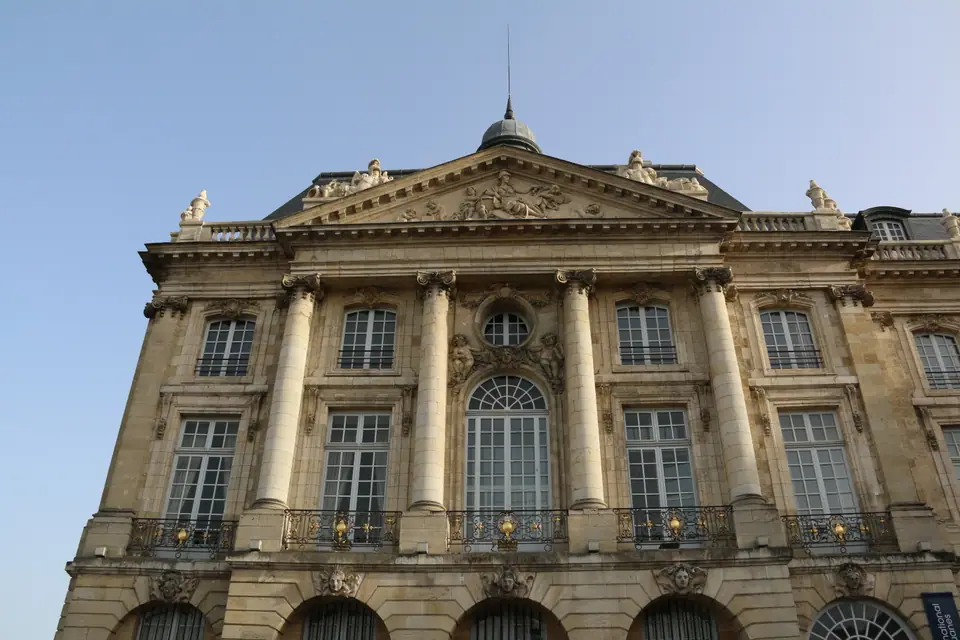
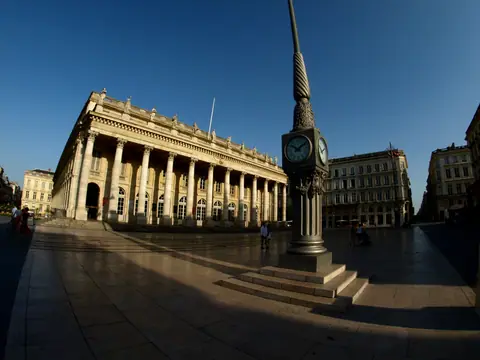
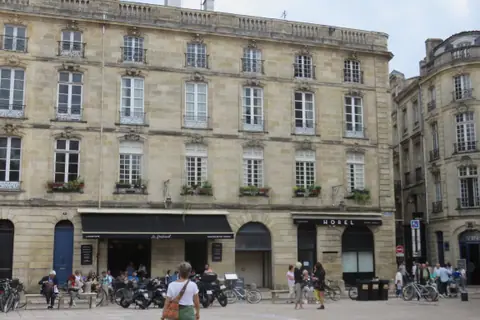
Pale Aquitaine pierre de taille limestone unites three canted wings around the open eastern river quay. On the northern flank rises the Palais de la Bourse, built for maritime merchants and still housing Bordeaux's Chamber of Commerce and Industry. Matching it symmetrically across the cobblestones stands the southern Hôtel des Fermes. Today the wing houses the Interregional Directorate of Customs plus the quiet indoor galleries of the National Museum of Customs. Step close to the ground-floor keystones to spot dozens of distinct stone mascarons. Sculptors carved expressive faces, sea gods, African and merchant portraits, and wine-trade motifs straight into the arcade arches.
Opening the walled town directly onto the Garonne transformed a crowded harbour into an architectural stage designed to impress arriving captains from the deck of every ship.
Behind the northern and southern pavilions, narrow streets lead straight back into older medieval blocks around Saint-Pierre and Rue Saint-Rémi. Passing through the western street axis reveals how abruptly formal classical symmetry gives way to crooked pre-1730 lanes. Eighteenth-century planners treated wide paved squares as civic hygiene and merchant prestige rolled into one architectural statement.
Minerva, Mercury and the Three Graces Fountain
Every sculptural relief across Place de la Bourse broadcasts commercial ambition paired with classical order. High triangular pediments sculpted by Francin and Vernet depict Minerva shielding the arts and Mercury favouring maritime commerce above tall Corinthian pilasters. Central monuments shifted repeatedly as French political regimes overturned each other across the 18th and 19th centuries. Jacques-Louis Lemoyne's original bronze equestrian statue of Louis XV fell during the French Revolution in 1792. Citizens briefly renamed the space Place de la Liberté before a short-lived Napoleonic column occupied the plinth.
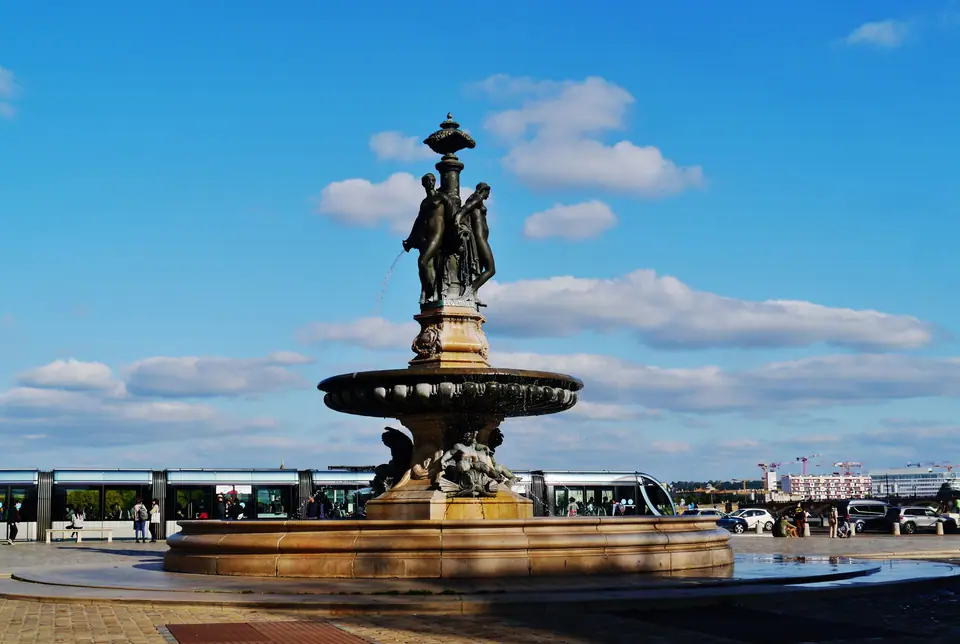
In 1869, municipal leaders settled on the current centrepiece: the bronze Fontaine des Trois Grâces, designed by Louis Visconti and sculpted by Charles Gumery. Depicting Aglaea, Euphrosyne, and Thalia poised atop a tiered Corinthian pedestal, the Three Graces face east across Alstom APS wire-free tram rails toward the water. Those clean ground-powered tracks keep sightlines clear between the fountain plinth and the Garonne embankment, linking smoothly south toward Porte Cailhau and north toward Place des Quinconces.
Notice how smoothly pedestrians weave past passing trams here. Without overhead steel poles or catenary wires slicing across the sky, photographers frame clean horizontal lines from the quay benches straight into the arcade windows behind the fountain. Early mornings bring calm light directly onto the limestone carvings before western glare hits the glass later in the afternoon.
Corajoud's Granite Mirror and Seasonal Frost Shutdowns
For decades after ocean freight shifted downstream, multi-lane car parks severed Place de la Bourse from the river. During Bordeaux's sweeping riverfront renewal in 2006, landscape architect Michel Corajoud collaborated with fountain engineer Jean-Max Llorca and architect Pierre Gangnet to replace tarmac with the Miroir d'eau. Measuring 3,450 square metres across dark granite slabs suspended atop a converted subterranean harbour warehouse and hydraulic reservoir, it ranks as the world's largest reflecting pool.
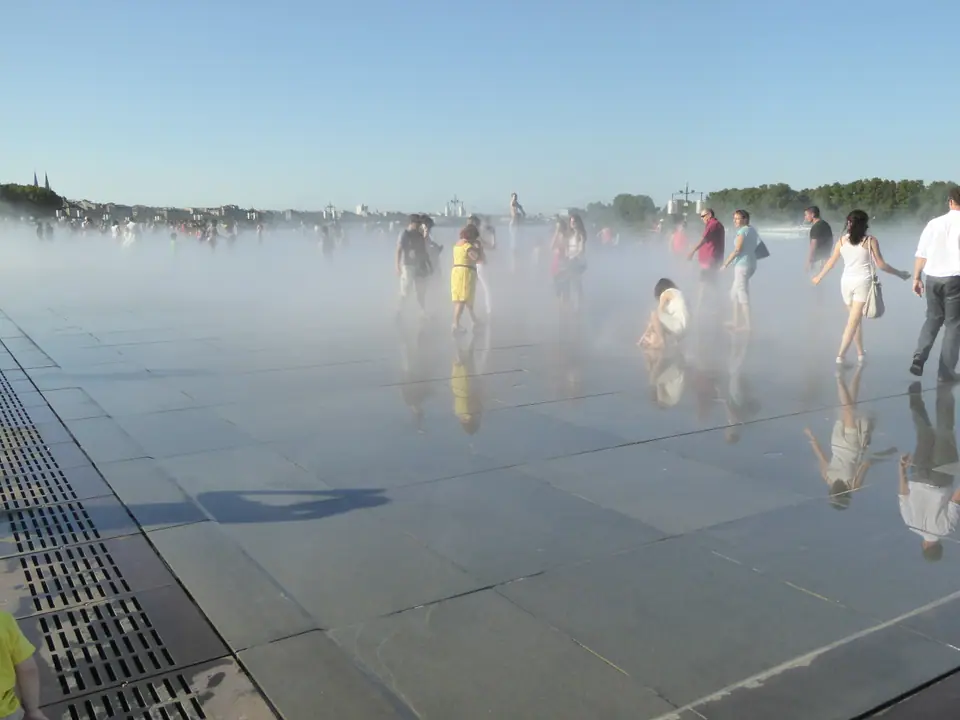
Timed underground pumps shift the surface continuously through roughly 15-minute cycles from spring through October. Water initially bubbles gently up through narrow stone joints to coat the granite under two centimetres of calm water, mirroring Gabriel's mansard roofs upside down. Once the water drains smoothly back below the slabs, rows of recessed nozzles blast fine cooling mist two metres into the air. Barefoot children and photographers disappear briefly inside cool white vapour before the calm mirror sequence restarts.
Seasonal timing matters hugely for photography and evening strolls. To prevent freezing water from cracking hydraulic pipes and stone joints, Bordeaux shuts down the Miroir d'eau every winter from roughly November through March or early April. Mid-winter visitors walk across dry open granite rather than glassy water, though wet autumn showers occasionally leave natural puddles after rain. Even dry, the vast stone apron functions as an open riverside terrace framing the Three Graces and the muddy Garonne tide beyond. Check seasonal weather timing if the full water reflection anchors your trip. Later, step two streets west into Saint-André Cathedral once afternoon shadows stretch across the river. Dusk lamps cast quiet amber warmth across Gabriel's arcades once evening commuters leave the embankment.
Where it is
- 1Place de la Bourse and Miroir d'eau
- Bordeaux–Mérignac Airport (BOD) · about 12 km from here in a straight line
- Directions in Google Maps
Stations and taxi ranks: OpenStreetMap. Airports: OurAirports. Distances are in a straight line.
Traveller tips
Real advice from people who have been to Bordeaux. Every tip is read by our team before it goes live.
No tips yet. Been here? Yours could be the first.
Thank you! Your tip will appear here after a quick review.
More in Bordeaux
Continue exploring Bordeaux with related neighbourhood, food, and planning guides