Photo: Ajepbah · CC BY-SA 3.0 de
Red Brick Canals: Speicherstadt and Kontorhausviertel
Timber-piled warehouse canals and clinker-brick Expressionist office blocks inscribed together by UNESCO.
How the Free Port Built a Canal City on Oak Piles
Vast brick warehouse islands define central Hamburg through a sharp nineteenth-century trade bargain. Hamburg agreed in 1881 to join Germany's customs union. Local traders insisted on keeping a walled duty-free Freihafen zone inside the port. Overseas cargo could then unload, sort, age and re-export without upfront import duties. Crews cleared dense working-class housing across Kehrwieder and Wandrahm islands. Construction began in 1883, early sheds opened in 1888, and the ensemble finished in 1927.
Soft river marshland could never support heavy multi-storey masonry walls directly. Engineers drove millions of vertical timber oak piles up to 12 metres deep into airless mud. Submerged wood resisted rot beneath roughly 1,500 by 250 metres of island ground. These blocks formed the world's largest historical warehouse complex on timber piles. Today, Speicherstadt (20457) holds 630,000 square metres of cool storage. Walking past its thick brick flanks shows how port trade shaped every tall gable and narrow window bay.
Walking the Fleete Canals and Wasserschloss
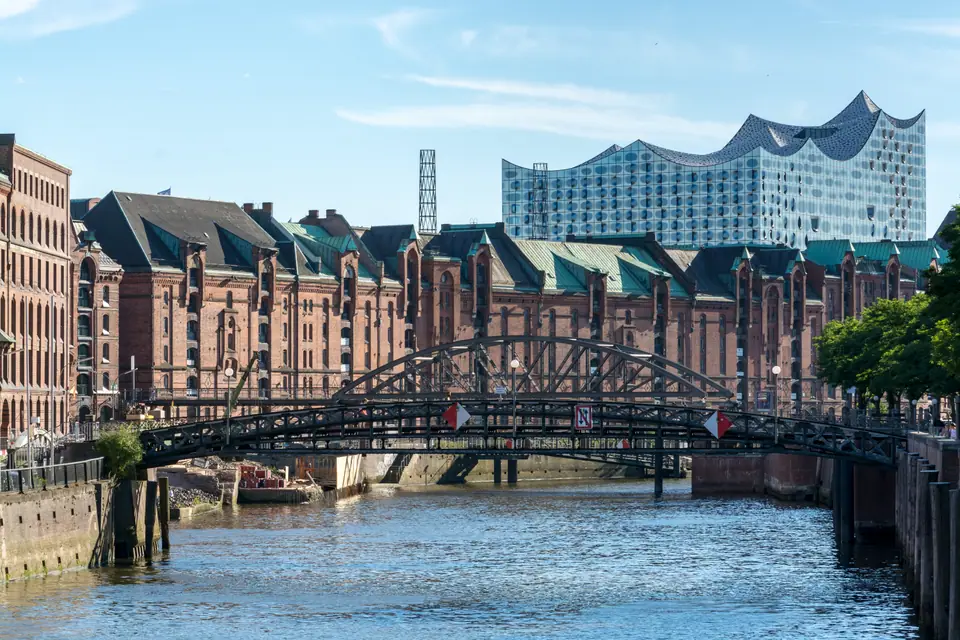
Every long Neo-Gothic brick block shows two working faces to the port. Cobblestone streets carry delivery carts along the dry front. Meanwhile, tidal canals such as Wandrahmsfleet, Holländischbrookfleet and Brooksfleet bring barges straight under rear attic hoists. Look upward along high brickwork to spot iron pulley beams jutting from stepped gables above numbered hatches. Dark wooden shutters and thick walls kept air steady for tea, coffee, cocoa, spices and Persian carpets. Carpet merchants still unfold woven rugs behind heavy iron doors along Brooktorkai today.
Sensory stops bring that trade history alive between canal bridges whenever rain sweeps across the water. Browse antique cocoa scales and sample tins inside the Speicherstadtmuseum (Am Sandtorkai 36, 20457). Sniff dried spices at Spicy's Gewürzmuseum (Am Sandtorkai 34), or warm up inside Speicherstadt Kaffeerösterei near Kehrwieder. Walkers pairing brick heritage with snacks can plan a break via our food guide. Quiet ground-level doorways open onto brick arches where coffee bales once swung off open barges.
Pause above Zollkanal on Kornhausbrücke or Poggenmühlen-Brücke near dusk while slanted sunlight warms green copper turrets. Ahead, two tidal channels converge around the 1905 to 1907 Wasserschloss (Dienerreihe 4, 20457), built for canal winch operators. Its dark reflections anchor harbour photographs away from tour buses along narrow footbridges. Level lanes lead west toward Miniatur Wunderland or south into HafenCity piers.
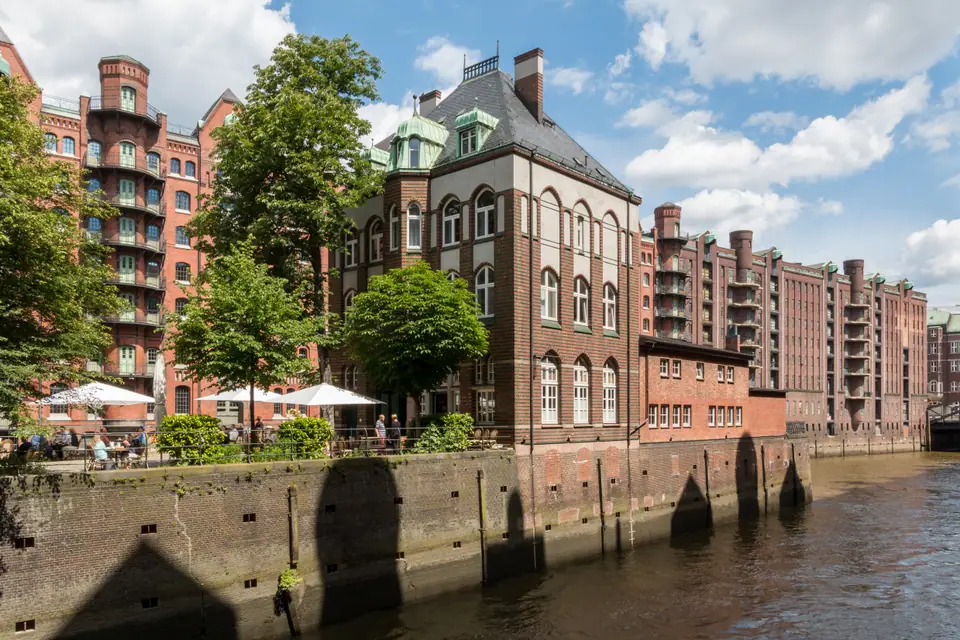
Joint 2015 UNESCO Inscription and the Kontorhausviertel
Cross north over Zollkanal and Meßberg to watch Hamburg's architecture shift gear quickly. Low water alleys give way to steep interwar canyons inside the Kontorhausviertel (20095). Nineteenth-century cholera crises and urban reforms had cleared cramped slum alleys across this hillside. City planners then laid out continental Europe's first dedicated commercial office district strictly for shipping firms, insurers and brokers.
On 5 July 2015, UNESCO inscribed both quarters jointly across 26 hectares under Reference 1467. Uniting horizontal free-port sheds with soaring clinker counting-houses preserves two halves of one port engine. Spices waited duty-free on timber piles south of the canal. Across one bridge, clerks signed shipping manifests behind tall brick office walls.
Fritz Höger's Chilehaus and Clinker Expressionism
Rising at Fischertwiete and Pumpen, the ten-storey Chilehaus commands the skyline with sharp maritime poise. Architect Fritz Höger designed it between 1922 and 1924 during German hyperinflation for saltpetre nitrate magnate Henry B. Sloman. Its sweeping curves consume roughly 4.8 million dark Oldenburg clinker bricks. Kilns over-fired North German clay until surfaces vitrified deep purple-black. That dense glaze shrugs off coastal salt and coal soot without staining.
Step across the eastern junction to inspect its knife-edge ship's-prow corner (Bugspitze). Sharp angled brickwork cuts high above bus lanes beneath recessed upper promenade terraces. Clean vertical piers rise without heavy classical ornament. Shifting North Sea cloud light sculpts each curved bay differently from morning until dusk, making repeat walks along Meßberg rewarding in overcast drizzle or bright clear skies.
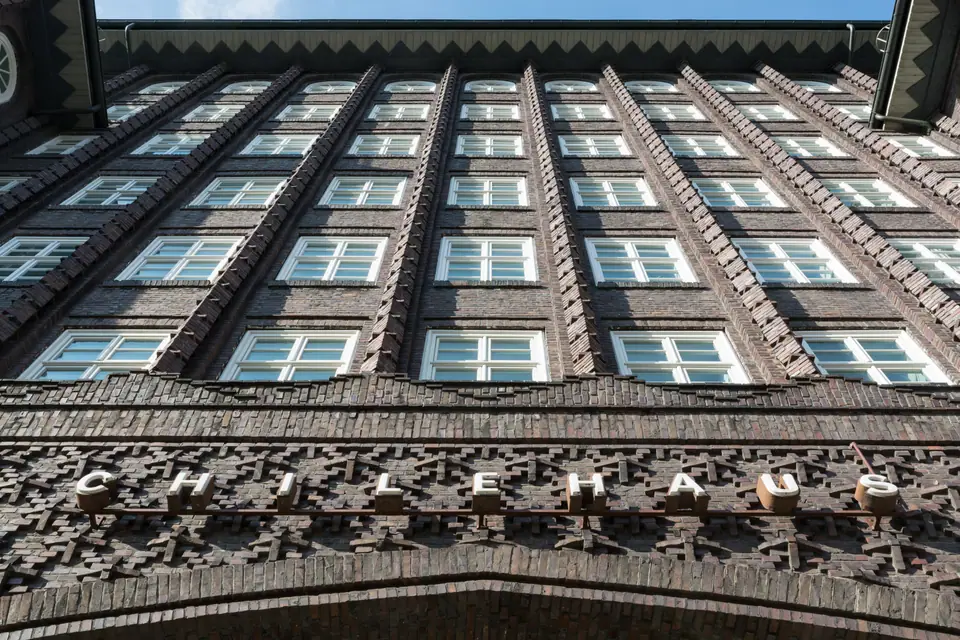
Sprinkenhof and Meßberghof Across Burchardplatz
Walk across Burchardplatz into the vast Sprinkenhof complex. Brothers Hans and Oskar Gerson built it from 1927 to 1943 with Fritz Höger around three quiet inner courtyards. Crisscrossing dark bricks wrap courtyard walls in woven diamond patterns. Gilded terracotta medallions sculpted by Ludwig Kunstmann catch soft light along the upper bays. Directly south on Meßberg rises the Gersons' 1923 to 1924 Meßberghof, formerly known as Ballinhaus. Crisp masonry bands frame broad entrances before lanes run west toward Hamburg's historic squares.
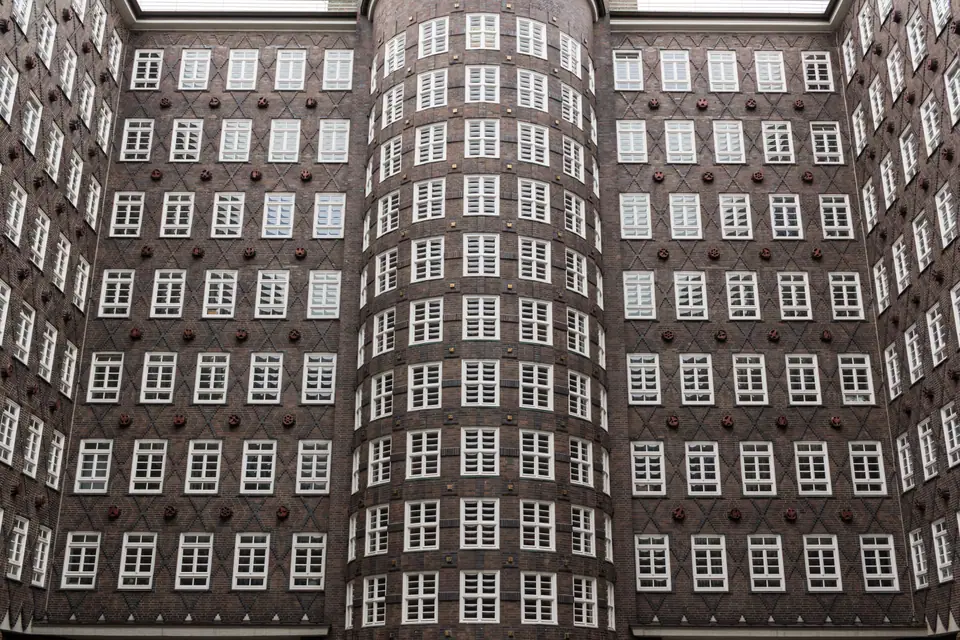
Do not just snap the famous Chilehaus prow from across the road. Walk straight through open ground arcades into Sprinkenhof's inner courtyards to watch slanted sunlight catch woven clinker textures in peaceful quiet.
Why Local Mud and Brick Unite Both Quarters
Northern coastal plains offered deep river clay yet no nearby stone quarries, so kiln-fired brick answered every maritime building era across Hamburg. Tracing that tough clay links nineteenth-century tea vaults straight into 1924 Expressionist office cliffs across a compact riverside loop. The calm walking route opens effortlessly onto modern metro stops at Meßberg once late afternoon rain moves inland from the river. Even on grey mornings, a slow stroll from central Fleete bridges turns flat port streets into a vivid open-air architecture lesson. Pack sturdy walking shoes with grippy soles for slick granite cobbles along historic port quays, narrow iron footbridges and damp stone canal steps. Quiet early morning visits let walkers inspect high brickwork cornices, terracotta medallions and green copper roof crests without crowded coach groups blocking narrow bridge railings.
Where it is
- 1Red Brick Canals
- Hamburg Helmut Schmidt Airport (HAM) · about 9 km from here in a straight line
- Directions in Google Maps
Stations and taxi ranks: OpenStreetMap. Airports: OurAirports. Distances are in a straight line.
Traveller tips
Real advice from people who have been to Hamburg. Every tip is read by our team before it goes live.
No tips yet. Been here? Yours could be the first.
Thank you! Your tip will appear here after a quick review.
More in Hamburg
Continue exploring Hamburg with related neighbourhood, food, and planning guides