Photo: John Phelan · CC BY 3.0
Santa Fe Plaza and Historic District Guide
A detailed walking guide to the historic Santa Fe Plaza, Palace of the Governors, and regional adobe architecture.
Santa Fe Plaza forms the historic heart of America's oldest capital city, surrounded by century-old adobe buildings, museums, and sacred civic spaces.
Visitors will discover a compact urban core that is exceptionally straightforward to explore on foot. Conquistador Don Pedro de Peralta settled the city in 1609 to 1610. The surrounding historic district still preserves an architectural identity shaped over centuries of Spanish, Mexican, and territorial rule. When organising your wider journey across New Mexico, consult our comprehensive Santa Fe Travel Guide: What to Know Before You Go.
As the oldest capital city in the U.S., Santa Fe also stands as the oldest European community west of the Mississippi River. The historic street pattern reflects early colonial planning around a central communal space. Today, the core combines centuries of government presence with public squares, craft traditions, and architectural conservation.
To plan your route through northern New Mexico effectively, examine our recommendations in Best Things to Do in Santa Fe.
Origins and Landmarks Around the Historic Plaza
The Plaza serves as the social anchor of downtown Santa Fe. Don Francisco Vasques de Coronado first claimed the Kingdom of New Mexico for the Spanish Crown in 1540. That claim occurred 67 years before the founding of Santa Fe.
Don Juan de Onate later served as the territory's first Governor-General. In 1598, he established his initial capital at San Juan Pueblo, 25 miles north of Santa Fe. Don Pedro de Peralta subsequently established Santa Fe as the capital in 1609 to 1610.
Historic turning points continued to alter the central square across the centuries. Santa Fe became the first foreign capital overtaken by the United States when General Stephen Watts Kearny captured it in 1846 during the Mexican-American War. Much later, New Mexico achieved formal statehood on 6 January 1912, becoming the 47th American state under President William Howard Taft.
When statehood arrived, many newcomers travelled to Santa Fe seeking its dry climate as a cure for tuberculosis. The Plaza has continuously hosted community gatherings, including the Santa Fe Fiesta. Established in 1712, that event commemorates the Spanish reconquest of New Mexico in 1692 and stands as the nation's oldest community celebration.
On the northern perimeter of the Plaza sits the Palace of the Governors. Originating in 1610, this adobe complex remains the oldest public building constructed by European settlers in the continental United States. It houses the state history museum.
Exploring the Palace of the Governors and State Collections
Along the facade of the Palace of the Governors runs a shaded portico known as the portal. Under this portal, the Portal Program offers buyers the opportunity to purchase authentic creations directly from Native American artisans. These licensed vendors represent 23 federally recognised tribes, pueblos, and nations across New Mexico.
Inside the Palace compound, researchers and visitors encounter valuable historical records. The site houses the Fray Angelico Chavez History Library and Photo Archives. This archive holds books, manuscripts, maps, periodicals, microfilm, clipping files, and historic images that document regional heritage.
The compound also houses the Palace Press, the working print shop at the Palace of the Governors. This active facility preserves and promotes regional printing and literary traditions using authentic presses. It allows visitors to observe historical craftsmanship linked to decades of regional bookmaking.
Cultural institutions spread immediately beyond the Palace walls. The Museum of New Mexico opened in 1909. Just off the downtown square at 107 West Palace Avenue sits the Plaza Building of the fine arts museum. Built in 1917, it was the state's first building dedicated to art.
For modern exhibits, the institution operates Vladem Contemporary at 404 Montezuma Avenue in the nearby Railyard area. Advance purchase of tickets is available for individual visitors and travelling groups. Check the official site for seasonal exhibition schedules and operational hours.
Cathedral Basilica of St Francis of Assisi and Sacred Sites
Just east of the main square stands the Cathedral Basilica of St Francis of Assisi. Franciscan friars built the first church on this ground in 1610 at the time of the city's founding. After destruction during the Pueblo Revolt, workers rebuilt the structure in 1714 in honour of Saint Francis of Assisi, the patron saint of Santa Fe.
The massive stone facade forms a visual contrast with the surrounding low adobe structures. Santa Fe's architectural palette began shifting when the railway arrived in 1880. Train connections accelerated the shipment of East Coast building materials into town. This influx introduced styles such as Victorian, Italianate, and California Mission Revival to local streets.
A brief walk south along the Old Santa Fe Trail leads into districts rich in historic worship sites and chapels. Downtown streets remain intimate and simple to navigate between religious landmarks and civic gardens.
The cultural district also includes entertainment landmarks near the main square. The Lensic Performing Arts Center has served as a cornerstone of downtown Santa Fe since 1931. Exploring these surrounding blocks reveals peaceful courtyards, historic doorways, and tranquil spots just yards from the main cathedral square.
Adobe Traditions and Historic District Preservation
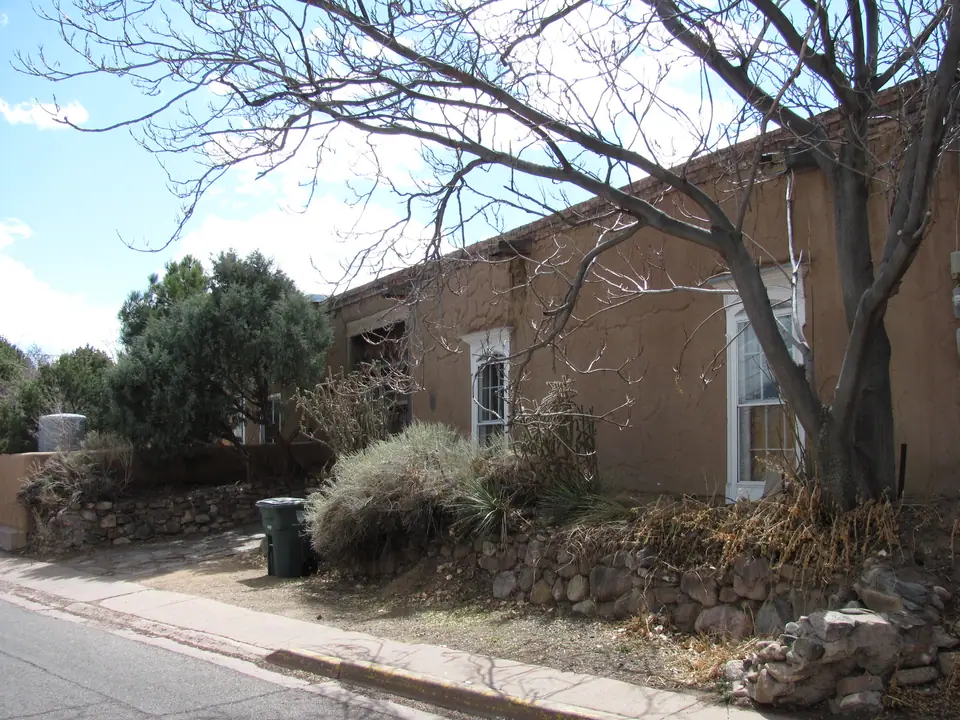
Santa Fe features low-slung, earth-coloured buildings constructed from adobe bricks. These distinctive bricks consist of a mixture of sun-dried earth and straw. No other city in the United States features as many low-slung, earth-coloured adobe buildings.
This regional method evolved from Native American building traditions. When Spanish settlers arrived in the 16th century, they encountered Pueblo Indians living in multi-story communal houses. The Spanish combined Native American construction methods with European practices, such as using wooden moulds to produce uniform adobe bricks. This combination created the Spanish Pueblo style.
Exploring downtown streets reveals hundreds of historic adobe homes built in Spanish Pueblo and Territorial styles. Visitors walking west from the square can stroll along Burro Alley. This pedestrian-only street features a bronze burro mascot at its West San Francisco entrance where fuel was once sold.
Local preservation groups defended this distinct vernacular heritage against generic building trends. In 1926, residents founded the Old Santa Fe Association to preserve ancient landmarks, historical structures, and local traditions. Because of this sustained community effort, the National Trust for Historic Preservation named Santa Fe one of its Dozen Distinctive Destinations in America for 2009.
The Roundhouse and Navigating the Historic District
A short walk south from the Plaza brings you to the New Mexico State Capitol, known as the Roundhouse. Dedicated on 8 December 1966, this 232,000 square-foot structure is the only circular state capitol building in the United States. Viewed from above, the Roundhouse resembles the Zia sun symbol featured on the New Mexico state flag.
The interior functions as a prominent cultural venue housing the New Mexico Capitol Art Collection. This collection consists of nearly 600 artworks displayed through interior public corridors and across the surrounding grounds. Outside, the 6.5-acre Clay Buchanan Memorial Gardens showcase sequoias, Russian olive trees, roses, and over 100 other kinds of New Mexico flora, interspersed with sculptures.
The Capitol welcomes visitors for self-guided tours on weekdays. The New Mexico Tourism Department is situated nearby at 491 Old Santa Fe Trail in Santa Fe. Exploring between the Roundhouse and the Plaza requires minimal effort due to the compact street grid.
Navigating the wider downtown area is straightforward without a car. The Santa Fe Pick-Up provides a free bus service that connects the Historic Plaza directly to Canyon Road. On Mondays and Tuesdays, the bus operates every 30 minutes. From Wednesday to Sunday, daytime service runs every 15 minutes, and evening service runs every 30 minutes.
If you fly into Santa Fe Regional Airport, taxis and car services operate locally, though reservations are recommended for late night arrivals. Passengers flying out should keep in mind that TSA pre-check procedures may still require normal security screenings.
Where it is
- 1Santa Fe
- Albuquerque International Sunport (ABQ) · about 94 km from Santa Fe in a straight line
- Directions in Google Maps
Stations and taxi ranks: OpenStreetMap. Airports: OurAirports. Distances are in a straight line.
Traveller tips
Real advice from people who have been to Santa Fe. Every tip is read by our team before it goes live.
No tips yet. Been here? Yours could be the first.
Thank you! Your tip will appear here after a quick review.
More in Santa Fe
Continue exploring Santa Fe with related neighbourhood, food, and planning guides