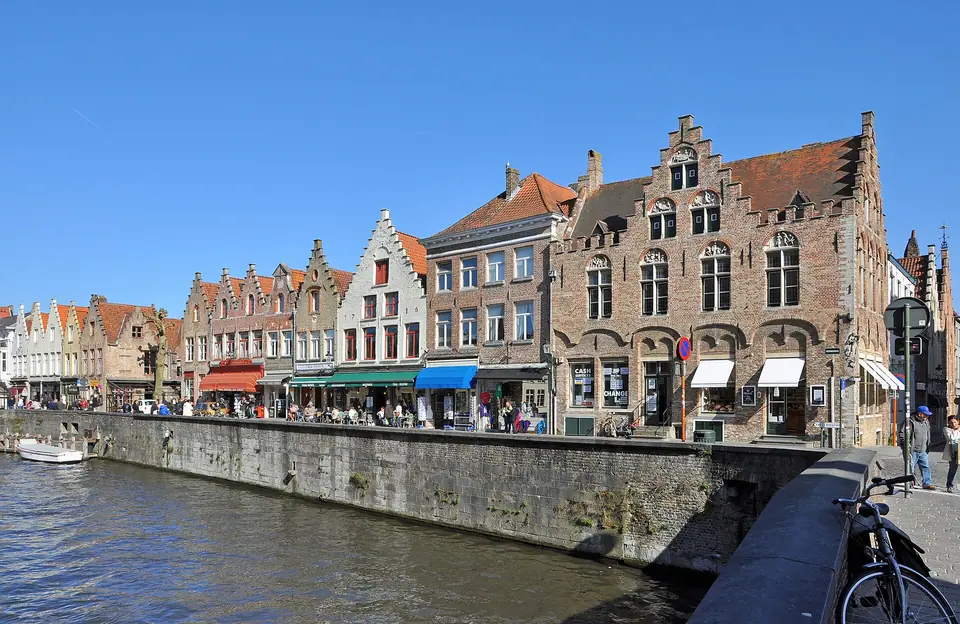
A 100-stop walking route through the UNESCO-listed medieval heart of Bruges, tracing Hanseatic merchant halls, brick Gothic churches, quiet almshouses, and canal bridges.
Zwin Tidal Port, Burgundian Court Painters and Medieval Cloth Halls
Bruges emerged in the ninth century as a coastal fortress built by Baldwin Iron Arm, first Count of Flanders, to defend against Viking raiders. Connected to the North Sea by the Zwin tidal inlet, Bruges blossomed between the twelfth and fifteenth centuries into the premier commercial and banking hub of northern Europe, where wool merchants from England and Scotland traded alongside Hanseatic League factors and bankers from Venice, Genoa, and Florence.
Under the Dukes of Burgundy, the city became the birthplace of Early Netherlandish painting led by Jan van Eyck and Hans Memling. When the Zwin channel silted up at the end of the fifteenth century, international trade shifted to Antwerp, freezing Bruges's Gothic brick townhouses, guildhalls, and canals in time until its nineteenth-century cultural revival.
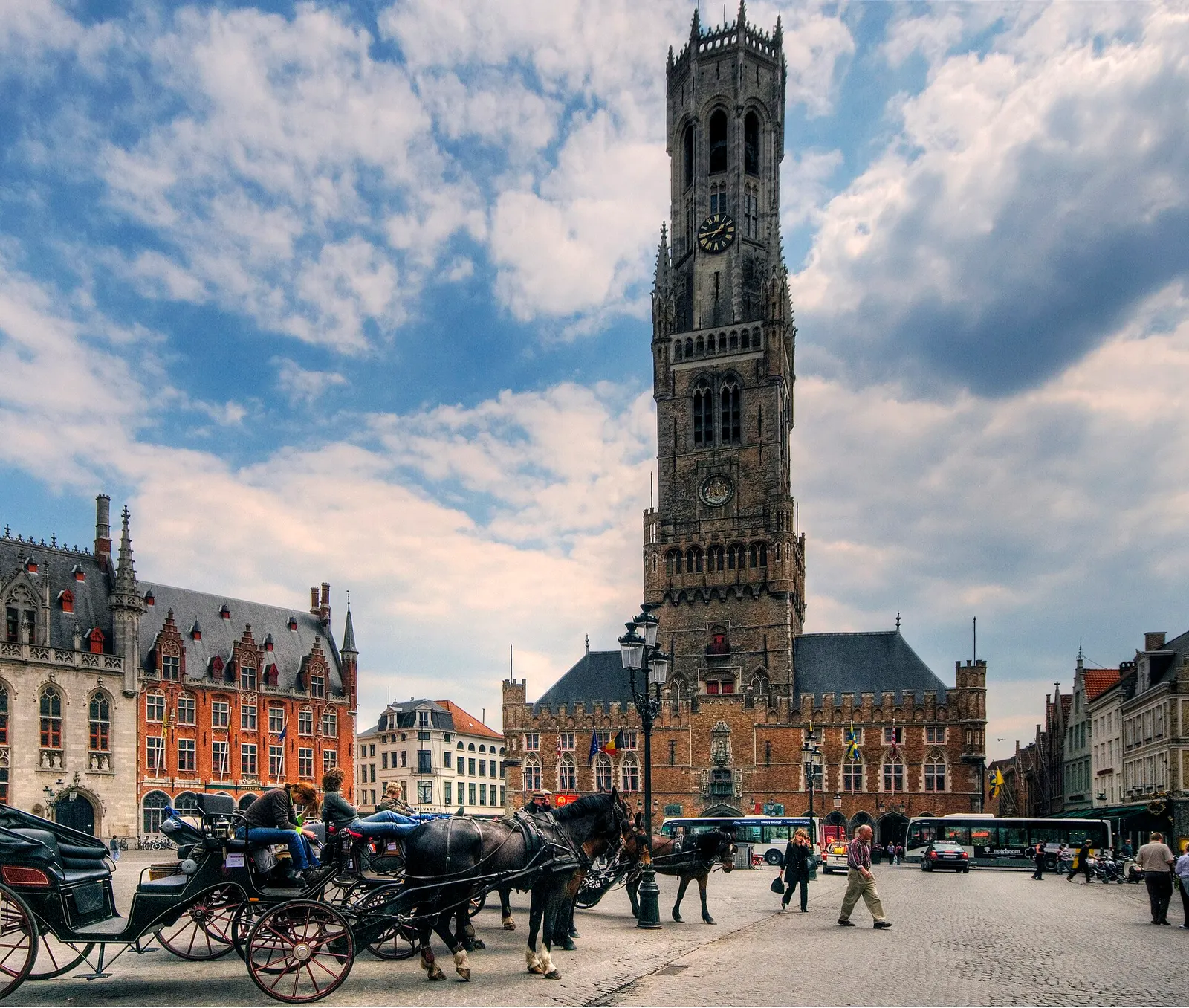
Markt, Belfry & Burg Civic Core
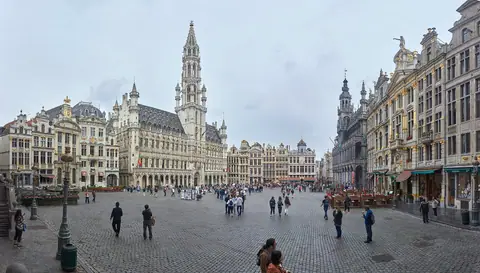
Markt, Belfry of Bruges, Provinciaal Hof, Burg Square, Stadhuis Bruges City Hall, Basilica of the Holy Blood, Liberty of Bruges Brugse Vrije, and Vismarkt
Markt
The central square has served as the commercial heart of the city since the tenth century. Flanked by ornate neo-Gothic and guild-era facades, this paved expanse previously held tournaments and grand political rallies. We observe the statue of local leaders Jan Breydel and Pieter de Coninck standing proudly in its centre.
Belfry of Bruges
Rising eighty-three metres over the central market, this medieval bell tower symbolised municipal autonomy against feudal lords. The lower halls once served as indoor market stalls for wool and cloth merchants. Ascending the spiralling stone steps reveals the complex clockwork mechanism and forty-seven bells that ring across the rooftops.
Cloth Hall
Enclosing the base of the belfry, this expansive quadrangular structure handled imported textiles during the city's commercial golden age. The interior courtyard provided a secure environment for foreign traders to inspect bales of Flemish weave. Notice the Gothic arcades and timber-framed interior roofs that survived several fires over the centuries.
Provinciaal Hof
Constructed in the late nineteenth century on the site of the former Waterhalle, this imposing civic palace reflects French and Flemish Gothic revival styles. The building originally housed the provincial council of West Flanders. Look for the ornate pinnacles, statues of historical counts, and intricate stained glass adorning the central meeting chambers.
House Craenenburg
This corner residence witnessed pivotal drama when local burghers detained Archduke Maximilian of Austria during an urban uprising. The structure was largely rebuilt in the nineteenth century with an ornate stepped gable that mirrors its medieval appearance. Today it anchors the western perimeter of the square alongside former merchant houses.
Huis Bouchoute
Dating to the late fifteenth century, this red-brick house is one of the oldest private residences preserved on the Markt. Its restrained Gothic facade displays early Renaissance transitional traits and stone cross-windows. A prominent gold compass rose and wind indicator on the parapet once aided passing merchants monitoring maritime weather.
Jan Breydel and Pieter de Coninck Monument
Erected in 1887, this bronze sculpture celebrates two guild leaders who spearheaded the resistance against French royal forces in 1302. Their efforts culminated in the Battle of the Golden Spurs outside Kortrijk. The base features relief panels depicting the uprising and armorial shields of the trade guilds that supported the rebellion.
Breidelstraat
Connecting the commercial Markt with the administrative Burg, this narrow lane has funnelled pedestrian traffic since early medieval days. Traditional shopfronts and tall brick houses with steep tiled roofs crowd the roadway. Walking along its cobblestones provides a transition between the merchant district and the fortified count's precinct.
Burg Square
Originally developed as a fortified castle complex by Count Baldwin Iron Arm, this historic plaza remains the civic heart of the city. The square presents an open-air survey of architectural history, spanning Romanesque, Gothic, Renaissance, and neoclassical facades. Government offices and religious institutions have shared this small boundary for over a millennium.
Bruges City Hall
Constructed between 1376 and 1421, this landmark is among the oldest preserved town halls in the Low Countries. Its stone facade is adorned with slender turrets, pointed windows, and carved statues representing the Counts of Flanders. Inside, the Gothic Hall boasts an intricate polychrome wooden vault and nineteenth-century historical murals.
Gothic Hall of Bruges City Hall
Located on the first floor of the city hall, this grand meeting room combines fourteenth-century timber craftsmanship with late Victorian decorative programmes. The hanging wooden ceiling features intricately carved corbels and gilded keystones depicting scenes from the New Testament. Wall paintings executed by Albrecht De Vriendt illustrate defining events in Flemish civic history.
Basilica of the Holy Blood
This religious complex comprises an intact Romanesque lower chapel and a flamboyant Gothic upper sanctuary. Tradition holds that Thierry of Alsace brought the sacred relic back from the Second Crusade, though records confirm its arrival in the thirteenth century. The upper chapel features bright neo-Gothic murals, ornate altars, and a museum of vestments.
Saint Basil Chapel
Positioned directly beneath the Basilica of the Holy Blood, this dark vaulted crypt remains almost entirely unchanged since the twelfth century. Dedicated to Saint Basil the Great, its thick stone walls and barrel vaulting exemplify pure Romanesque construction. A carved twelfth-century wooden relief of the seated Madonna and Child rests inside the right aisle.
Liberty of Bruges
The Brugse Vrije served as the regional administration governing the rural territory outside the city boundaries. The current neoclassical building was erected between 1722 and 1727, incorporating fragments of earlier medieval structures on site. Today it houses the municipal archives alongside the historic courtroom that preserves precious Renaissance timber decorations.
Chimneypiece of the Brugse Vrije
Standing inside the Alderman's Courtroom, this massive monument was designed by Lancelot Blondeel and executed by Guyot de Beaugrant. Carved from black marble and oak, it celebrates Emperor Charles V following the Treaty of Cambrai in 1529. Life-sized figures of the emperor and his royal ancestors dominate the elaborately detailed mantle frieze.
Old Civil Registry
Known locally as the Oude Griffie, this slender building was completed in 1537 to house the city court clerks. It represents one of the earliest Renaissance structures in Flanders, marked by rich ornamentation and balanced proportions. Carved stone cartouches, classic pilasters, and gilded statues representing Justice and Moses punctuate the ornate street frontage.
Blind Donkey Alley
Running between the City Hall and the Old Civil Registry, this vaulted pedestrian passage leads south toward the fish market. An overhead archway linking the two civic buildings displays decorative stonework and the municipal coat of arms. The street takes its curious name from a former medieval inn that stood along the cobbles.
Blinde-Ezelbrug
Emerging from the Blind Donkey passage, this stone bridge crosses one of the oldest waterways in the historical centre. The crossing presents sweeping perspectives of the rear brick facades of the City Hall and adjacent timbered buildings. Willow trees and stone quays along the water preserve the quiet, domestic character of ancient Bruges.
Vismarkt
Relocated from the Markt in 1745 due to complaints over fish odours, this rectangular market space is bordered by Tuscan colonnades built in 1821. Heavy grey stone slabs line the central hall, where fishmongers still sell North Sea seafood in the mornings. Surrounding houses date from the seventeenth and eighteenth centuries, now occupied by small cafes.
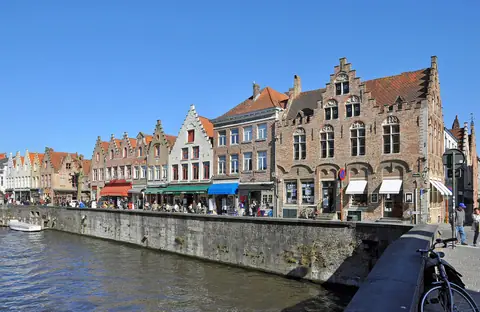
Groenerei
Tracing the southern boundary of the Vismarkt, this waterway offers one of the most classic waterside settings in the city. The name refers to the green foliage that drapes over stone embankments and centuries-old brick mansions. Looking west, visitors can admire the Peerdenbrug bridge and the distant silhouette of the belfry rising behind the trees.
Rozenhoedkaai, Groeninge & Onze-Lieve-Vrouwekerk
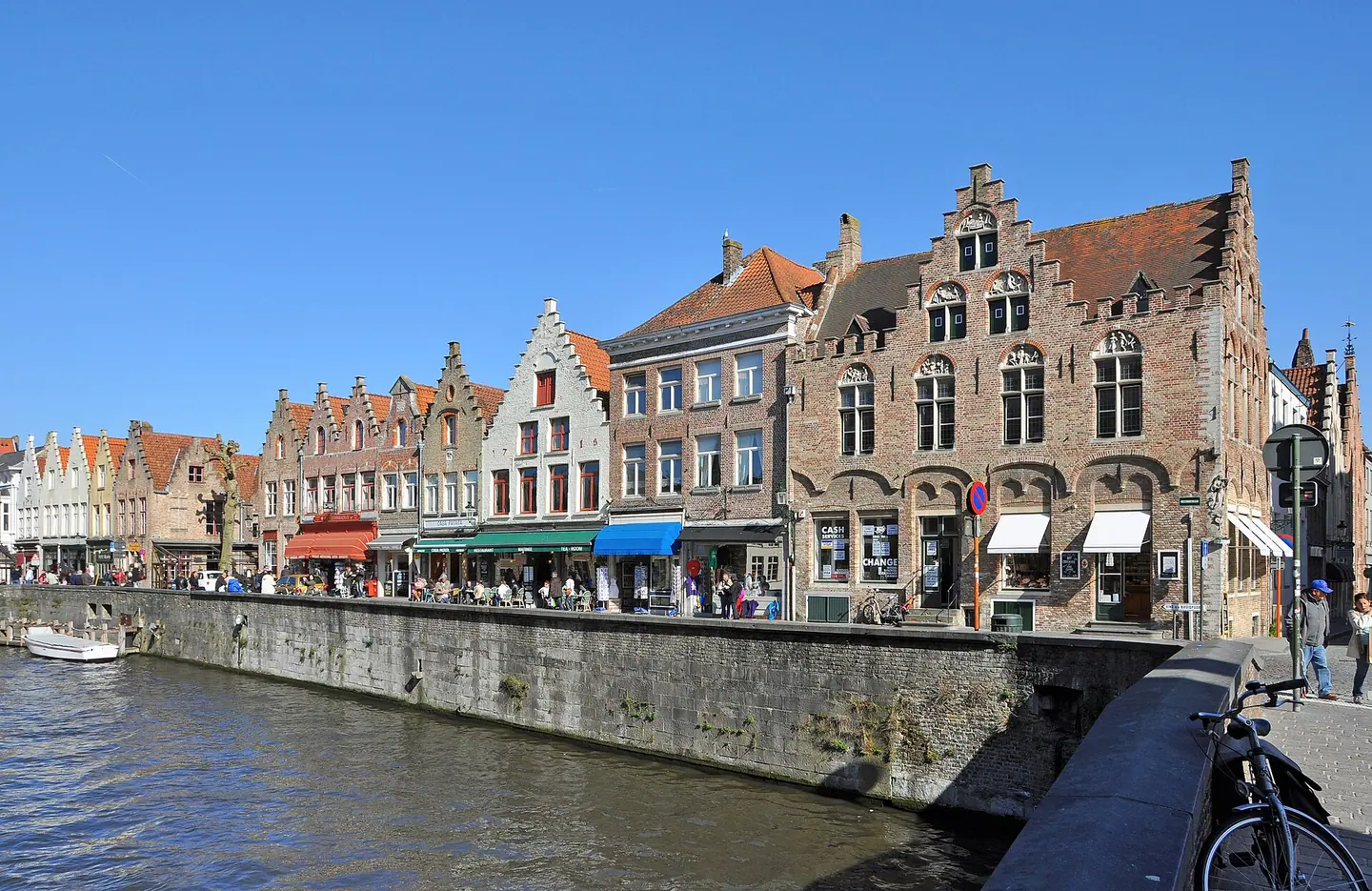
Rozenhoedkaai, Dijver Canal, Groeningemuseum, Gruuthusemuseum, Church of Our Lady Bruges, Sint-Janshospitaal, Bonifacius Bridge, and Arentshuis
Rozenhoedkaai
Named after the historic rosary vendors who traded here, this quay marks the convergence of the Dijver and Groenerei canals. The location delivers an uninterrupted panorama towards the soaring medieval Belfry across timber-framed gables and weeping willows. Visitors gather along the stone balustrade to observe passing wooden canal boats navigating the historic waterway.
Dijver Canal Promenade
The Dijver ranks among the earliest settled waterways in the city centre, lined by ancient linden trees and grand townhouses. During weekends, antiquarians set up stalls alongside the canal wall, displaying vintage books and curiosities. Walking along the cobbled path offers perspectives across Gothic facades and tranquil waters reflecting nearby museum gardens.
Groeningemuseum
Erected on the site of the medieval Eekhout Abbey, this premier fine arts museum holds an extraordinary assembly of Early Netherlandish paintings. The galleries display foundational masterpieces by Jan van Eyck, Hans Memling, and Gerard David. Particular attention should be paid to Jan van Eyck's Virgin and Child with Canon van der Paele, renowned for its luminous detail.
Arentshuis
This elegant townhouse was built during the late eighteenth century and features a stately neoclassical facade overlooking the Dijver. Inside, the upper galleries present the graphic works and oil paintings of Anglo-Belgian artist Frank Brangwyn, who donated extensive collections to the city. The ground floor displays lace decorative arts alongside temporary historical exhibitions.
Arents Courtyard
Set behind the Arentshuis mansion, this tranquil public park contains the Four Horsemen of the Apocalypse, a set of dramatic bronze statues created by sculptor Rik Poot. Shaded by ancient trees, the green space provides stone seating and picturesque vistas across nearby canal channels. It forms an atmospheric pedestrian gateway linking the Groeninge museum to the Bonifacius Bridge.
Bonifacius Bridge
Despite its convincing Gothic appearance, this charming stone footbridge was constructed in 1907. It arches delicately over the canal between the Gruuthuse courtyard and the Arents garden. From the bridge, visitors enjoy views of the overhanging timber facade of a neighbouring historic house and the towering brick spine of the Church of Our Lady.
Gruuthusemuseum
This opulent urban palace belonged to Louis de Gruuthuse, a prominent Burgundian nobleman who made his fortune from the gruit herb mix tax used in brewing. The building exhibits ornate Gothic turrets, monumental stone fireplaces, and intricate tapestries spanning several centuries. A private wooden prayer gallery inside directly connects the palace to the high choir of the neighbouring church.
Church of Our Lady, Bruges
Dating primarily from the thirteenth through fifteenth centuries, this massive church boasts a 115-metre brick tower, which remains one of the tallest brick structures in the world. The interior contains priceless religious artworks and grand Gothic vaults. Inside the choir, visitors discover the elaborate bronze and black marble Renaissance mausoleums of Mary of Burgundy and Charles the Bold.
Madonna of Bruges
Housed within the southern aisle of the Church of Our Lady, this white Carrara marble statue is the only sculpture by Michelangelo to leave Italy during his lifetime. Commissioned by the Bruges merchant family Mouscron around 1504, it portrays the Virgin Mary looking downwards while the Christ Child stands loosely supported between her knees.
Old St. John's Hospital
Operating continuously for over eight centuries, this institution treated sick pilgrims, travellers, and local paupers. The immense medieval hospital wards display massive timber roof trusses, early medical instruments, and centuries of administrative archives. Its quiet atmosphere reflects the dedication of the Augustinian nuns and monks who provided shelter and care through successive centuries.
Hans Memling Museum
Located within the ancient chapel of St. John's Hospital, this gallery contains six exquisite paintings by the German-born Flemish master Hans Memling. The central treasure is the Reliquary of Saint Ursula, a gilded wooden casket decorated with miniature oil scenes depicting the legendary martyr's pilgrimage. Memling produced several of these altar pieces specifically for the hospital brethren.
Old Hospital Pharmacy
Situated adjacent to the medieval wards, this preserved seventeenth-century pharmacy served the patients of St. John's Hospital until the 1970s. The interior retains polished oak cabinetry, Delftware drug jars, mortars, and antique scales used to prepare herbal remedies. Outside, an adjoining medicinal garden displays traditional therapeutic herbs historically cultivated by the cloistered community.
Mariabrug
Mariabrug carries road traffic and pedestrians across the canal between the hospital grounds and the Church of Our Lady. The parapet provides fine vantages across the brick buttresses of the church, the canal-side museum walls, and nearby willows. It marks a primary historical thoroughfare connecting the cathedral quarter to southern trading routes.
Gruuthuse Inner Courtyard
Entered through an imposing Gothic gatehouse on Dijver, this enclosed courtyard reveals the architectural grandeur of fifteenth-century patrician living. The facade features elaborate stone traceries and the carved personal motto of the Gruuthuse family, Plus est en vous (There is more in you). Architectural fragments and historical statues stand positioned around the peripheral brick paving.
Lanchals Chapel
Situated inside the Church of Our Lady, this chapel commemorates Pieter Lanchals, the loyal advisor to Maximilian of Austria executed by rebellious citizens of Bruges in 1488. The chapel features his stone tomb effigy, heraldic devices, and late-medieval funerary monuments. Legend suggests Maximilian ordered the city to keep white swans on its canals forever in memory of Lanchals.
Koningin Elisabethzaal at St. John
Constructed during the mid-nineteenth century, these symmetrical brick hospital wards expanded the patient capacity of St. John's beyond its medieval halls. Designed according to contemporary hygiene standards with tall arched windows, the hall now hosts cultural gatherings and temporary exhibitions. It illustrates the architectural transition of Bruges healthcare from monastic hospice to modern municipal hospital.
Hof van Watervliet
Positioned just off the Dijver on Oude Burg, this monumental late-medieval court belonged to the lords of Watervliet. The building showcases classical Flemish brick architecture, featuring decorative stone banding and traditional crow-stepped gables. Fully restored after decades of municipal use, the complex currently houses community meeting spaces and cultural societies while preserving its noble domestic exterior.
Eekhout Abbey Gate Site
Before the foundation of the Groeningemuseum, this tranquil sector formed the precinct of the venerable Eekhout Abbey, founded in the eleventh century. Today, quiet cobbled lanes such as Eekhoutstraat lead past remnant historic brick foundations and modest eighteenth-century facades. The peaceful area serves as a secluded walkway behind the busy canal quays of the neighbouring Dijver.
Nepomucenus Bridge
Spanning the canal near the junction of Dijver and Wollestraat, this stone bridge honours the patron saint of bridges and drowning victims. A fine eighteenth-century stone sculpture of Saint John of Nepomuk presides over the crossing, carved by Pieter Pepers. The location affords travellers direct sightlines towards the Rozenhoedkaai canal corner and the towering Belfry.
Diksmuids Boterhuis Memorial
This narrow waterfront facade reflects the prominent role Bruges played in regional agrarian commerce during previous centuries. Butter merchants from regional towns such as Diksmuide unloaded their goods directly from canal barges onto this paved embankment. The restored brick structure retains traditional iron ties and masonry details characteristic of seventeenth-century trade depots.
Begijnhof, Minnewater & Sint-Salvatorskathedraal
Princely Beguinage Ten Wijngaerde, Minnewater Lake, Sashuis, Poertoren, St Salvator Cathedral, Simon Stevinplein, Halve Maan Brewery, and Stoofstraat
Minnewaterpark
Created around an artificial canal basin, this green space once served as a mooring dock for trading barges arriving from Ghent. Travellers can observe mature weeping willows, open lawns and remnants of medieval fortifications. The surrounding paths provide panoramic viewpoints across the historic water gates.
Minnewater Bridge
Built in 1740, this brick three-arched bridge spans the narrow neck of the reservoir, replacing an earlier wooden drawbridge. It offers exceptional views across the canal basin towards the spires of the city centre. Local lore associates the site with the tragic romance of Minna and Stromberg.
Poertoren
Erected in 1398 by master mason Jan van Oudenaerde, this cylindrical masonry tower formed part of the second medieval city ramparts. It was subsequently repurposed to store gunpowder, giving it its enduring name. The structure stands beside the water lock, displaying rugged brickwork and defensive arrow slits.
Sashuis
Dating from the sixteenth century, this gabled brick lodge was the residence of the municipal lockkeeper. The associated sluice gates regulated the water level throughout the central canal network, feeding moat waters directly into the Reie. Its stepped gable and timber shutters reflect traditional Flemish architecture.
Begijnhof Bridge and Gateway
Constructed in 1776, this classic three-arched stone bridge crosses the canal to a monumental classical gatehouse. A carved relief above the portal depicts Saint Elizabeth of Hungary, the patron saint of beguines. The threshold marks the historic separation between the autonomous enclosure and the secular city.
Ten Wijngaerde Central Courtyard
Founded in 1245 by Margaret of Constantinople, Countess of Flanders, this serene quadrangle is encircled by whitewashed dwellings dating from the sixteenth to eighteenth centuries. Tall poplars tilt towards the morning light across a carpet of wild daffodils in early spring. Today, the complex accommodates Benedictine sisters.
Church of Saint Elizabeth of Hungary
Originating in the thirteenth century, this austere church was rebuilt following a fire in 1584, retaining its authentic Gothic proportions and timber barrel vault. The interior houses seventeenth-century paintings by Flemish masters, Baroque altars and the venerated image of Our Lady of Spermalie. The choir stalls retain their original simplicity.
Begijnhuisje Beguinage Museum
Occupying house number one beside the entrance gate, this modest museum preserves the authentic living quarters of an eighteenth-century beguine. Visitors find period furnishings, a traditional Flemish hearth, hand-bobbin lace equipment and original devotional objects. It illustrates the pious, self-supporting communal lifestyle practiced here for centuries.
Wijngaardplein
This leafy square is dotted with horse-drawn carriages waiting for passengers along the canal bank. A resident population of mute swans gathers here, continuing a tradition protected by municipal decree since 1488. Shaded outdoor terraces provide resting spots under horse chestnut trees near the water edge.
Walplein
Named after the medieval ramparts that once passed nearby, this triangular square is shaded by mature lime trees. It features outdoor cafe terraces, historic facades and a bronze fountain sculpture celebrating Flemish folklore. The square serves as the primary gathering point for brewery tours and walking excursions.
Brouwerij De Halve Maan
Operated continuously by six generations of the Maes family, this brewery preserves copper mash tuns alongside modern brewing equipment. An underground pipeline carries freshly brewed beer directly to a bottling plant outside the city centre. The rooftop provides panoramic viewpoints across the spires of Bruges.
Stoofstraat
Measuring barely two metres wide, this cobblestone lane retains the intimate scale of fourteenth-century Bruges. The name derives from the medieval hot-water bathhouses, or stoven, that once operated here before closure by municipal authorities for moral reasons. High brick boundary walls create an authentic medieval atmosphere.
Kastanjeboomstraat
This tranquil street contains charming whitewashed brick cottages and traditional stepped gables that date from the seventeenth century. Several municipal godshuizen, or almshouses, were built along this quiet corridor to house impoverished widows. The thoroughfare links the historic Walplein with the residential southern quarters.
Mariastraat
Connecting the Katelijnestraat neighbourhood with the market areas, this street has functioned as a central transit artery since the Middle Ages. It is lined with heritage townhouses, traditional chocolate ateliers and lace workshops. Travellers pass between the Old St John Hospital complex and the towering Church of Our Lady.
Heilige Geeststraat
This quiet street features classical facades and former canon residences associated with the nearby cathedral. It derives its name from the medieval Holy Ghost table, a parish charitable institution that distributed bread and fuel to the indigent. Cobblestones and discreet carriage arches define its architectural character.
Sint-Salvatorskerkhof
Once the consecrated burial ground of the parish, this open square now offers close-up views of the cathedral massive buttresses and neo-Romanesque tower. Paved walkways are framed by small historic townhouses and leafy lime trees. It provides a peaceful pedestrian route around the choir and ambulatory.
St Salvator Cathedral
Constructed in Brabantine Gothic style between the thirteenth and fourteenth centuries, this venerable church became the cathedral of Bruges in 1834. The massive 99-metre-high western tower was capped with a neo-Romanesque upper section following an 1839 fire. Inside, visitors encounter vast proportions and a rich decorative programme.
St Salvator Cathedral Treasury and Museum
Housed in the cathedral former chapter house, this museum displays masterpieces by early Netherlandish painters, including works attributed to Dirk Bouts and Hugo van der Goes. The collection includes Brussels tapestries woven in 1731, medieval croziers and ornate silver reliquaries. It illustrates the diocese deep artistic heritage.
Steenstraat
Following the alignment of a Roman road towards Aardenburg, Steenstraat represents one of the oldest paved routes in Bruges. Today it serves as a historic shopping thoroughfare linking the cathedral to the central Market Square. High-gabled merchant houses from various architectural eras overlook the pedestrian stream.
Simon Stevinplein
Formerly the site of the Old Meat Hall, this square was laid out in the early nineteenth century and planted with double rows of linden trees. A bronze statue of mathematician Simon Stevin, designed by Eugene Simonis, stands at the centre. Today, the perimeter hosts numerous chocolate shops and outdoor cafe seating.
Hanseatic Quarter, Jan van Eyckplein & Sint-Anna
Jan van Eyckplein, Poortersloge, Tolhuis, Spiegelrei, Jerusalem Church Adornes Domain, Sint-Annakerk, Lace Centre, and Potterierei
Jan van Eyckplein
Named after the Northern Renaissance master painter, this picturesque square once formed the commercial heart of the medieval port where goods were transferred from coastal vessels to city barges. A nineteenth-century statue of Jan van Eyck stands at the centre, surrounded by handsome guild buildings and merchant residences that flank the head of the Spiegelrei canal.
Poortersloge
Erected around the turn of the fifteenth century, the Burghers' Lodge provided an exclusive meeting place for affluent town merchants and the prestigious chivalric Society of the White Bear. The building features an elegant corner turret, gothic tracery, and carved stone niches, having served across the centuries as an academy of fine arts and state archive repository.
Bear of Bruges
Set into a decorative wall niche on the corner of the Poortersloge, this small stone sculpture depicts the legendary Bear of Bruges, the oldest heraldic citizen of the city. Legend states that Baldwin Iron Arm defeated a wild bear on this territory, establishing the beast as a civic emblem that continues to watch over the historic harbour district.
Tolhuis
Constructed in 1477 for the prominent customs official Pieter van Luxemburg, the Old Custom House handled maritime tariffs on incoming river freight for centuries. Its ornate stepped-gable facade features heraldic coats of arms and fine stonework, offering visitors an authentic glimpse of the administrative architecture that supported the international trade networks of Bruges.
Genoese Loggia
Dating back to 1399, this historic property served as the official consulate and commercial exchange for merchants travelling from Genoa. Its restored facade reflects the significant presence of Mediterranean trading powers in Flanders during the late Middle Ages, who traded silks, spices, and alum for northern European textiles and manufactured craft products.
Pijndershuis
Situated adjacent to the Tolhuis, this narrow stepped-gable building served as the guild headquarters for the harbour porters who unloaded wine, beer, and heavy cargo from moored trading barges. Built in the late seventeenth century, its brick facade displays relief emblems representing the tools and casks used by these essential port labourers.
Spiegelrei
The Spiegelrei formed part of the primary inner harbour of Bruges, connecting the Jan van Eyck basin with the outer rings of defensive canals. Today, the tree-lined waters reflect tranquil rows of historic townhouses, retaining intact medieval warehouses and merchant dwellings that speak to the tremendous wealth accumulated during the Hanseatic period.
Koningsbrug
This traditional stone arch bridge spans the canal between the Spiegelrei and the Spinolarei, offering fine panoramic perspectives across the historic waterfront toward Jan van Eyckplein. Originally wooden, the stone structure was rebuilt across successive centuries to accommodate passing canal barges that supplied raw materials to the workshops of the working-class Sint-Anna quarter.
Spinolarei
Named after the Genoese naval commander Federico Spinola, this quiet northern canal bank displays architectural styles ranging from fifteenth-century step-gables to eighteenth-century classical mansions. Walking along its cobblestones provides views of the back gardens and domestic outbuildings belonging to the grand merchant properties of the old foreign trading enclave.
Hof van Watervliet
Constructed during the fifteenth century as the town residence for lord Hieronymus Lauweryn of Watervliet, this imposing brick palace exhibits quintessential Flemish Renaissance details. The extensive complex includes a secluded interior courtyard, mullioned stone windows, and ornamental chimney stacks, demonstrating the lavish residential standards enjoyed by regional nobility during the Burgundian era.
Sint-Walburgakerk
Designed by the Jesuit architect Pieter Huyssens, Saint Walburga was completed in 1643 and stands as the foremost example of Counter-Reformation baroque architecture in the city. The soaring white-stone interior features dramatic vaulted ceilings, an ornate marble communion rail carved by Hendrik Frans Verbrugghen, and an elevated wooden pulpit that commands the spacious nave.
Jerusalem Church
Commissioned in the fifteenth century by the wealthy Adornes merchant family of Genoese descent, this unique church was inspired by the Church of the Holy Sepulchre in Jerusalem. The distinctive interior contains a macabre altarpiece adorned with skull motifs, fine stained glass, and an authentic replica of the tomb of Christ within an underground crypt.
Adornes Domain
This remarkable private estate has remained within the hands of the same aristocratic family since the Middle Ages. Visitors can explore the preserved domestic quarters, the peaceful central gardens, and the adjoining row of historic almshouses, which now house exhibitions documenting the international trade, diplomacy, and pilgrimages of Anselm Adornes across Renaissance Europe.
Sint-Annakerk
Rebuilt in 1624 following the destructive religious conflicts of the previous century, Saint Anne Church presents an unassuming gothic brick exterior that conceals an opulent interior. The unified single-nave hall contains dark oak panelling, an intricate choir screen, and monumental historical paintings by local master Jan Garemijn, providing an authentic seventeenth-century atmosphere.
Kantcentrum
Housed within renovated seventeenth-century buildings adjacent to the Jerusalem Church, the Lace Centre preserves the centuries-old regional tradition of bobbin lace manufacturing. The museum displays intricate historic lace samples, patterns, and tools, while the upper floor hosts regular live workshops where regional artisans demonstrate the extraordinarily complex finger techniques used in Bruges lace.
Bruges Museum of Folk Life
Set inside a charming terrace of seventeenth-century cobblers' almshouses, the Folk Museum reconstructs nineteenth-century domestic life and regional crafts. Visitors explore an old pharmacy, a confectioner's shop, a cooperage, a classroom, and a traditional working tavern, alongside a secluded cottage courtyard displaying heritage herbs and vintage Flemish recreational lawn games.
Potterierei
Running north from the city centre along the canal to Damme, this tranquil waterside avenue takes its name from the ancient potteries that operated along its banks. Today it offers quiet perspectives of historic convent gables and waterside greenery, illustrating the transition from the historic Hanseatic quays to the serene residential periphery of northern Bruges.
Our Lady of the Pottery
Established in the thirteenth century to care for sick pilgrims and elderly citizens, this venerable charitable foundation contains a rich collection of sacred art, tapestries, and silverwork. The adjoining gothic church houses a revered thirteenth-century stone statue of the Virgin Mary, which remains an active place of regional pilgrimage and religious veneration.
Gildekamer van de Vrije Schippers
Situated on the water near the corner of the Spiegelrei, this guild property was acquired by the free bargemen to administer local transport regulations along the canals. The building showcases traditional Flemish brickwork, decorative masonry anchors, and stone crests that identify the nautical profession responsible for shifting goods between the North Sea coast and regional inland markets.
Gouden-Handrei
Branching off from the Spiegelrei into the northern quietude of the Sint-Anna neighbourhood, the Golden Hand canal is one of the most serene waterways in Bruges. Flanked by ancient boundary walls, private water gates, and overgrown weeping greenery, its banks provide an intimate look at domestic life far removed from heavy tourist corridors.
Kruisvest Windmills, Medieval Gates & Quiet Almshouses
Sint-Janshuismolen, Bonne-Chiere Mill, Kruispoort, Gentpoort, Ezelpoort, Smedenpoort, Godshuizen almshouses, Astridpark, and Damse Vaart
Sint-Janshuismolen
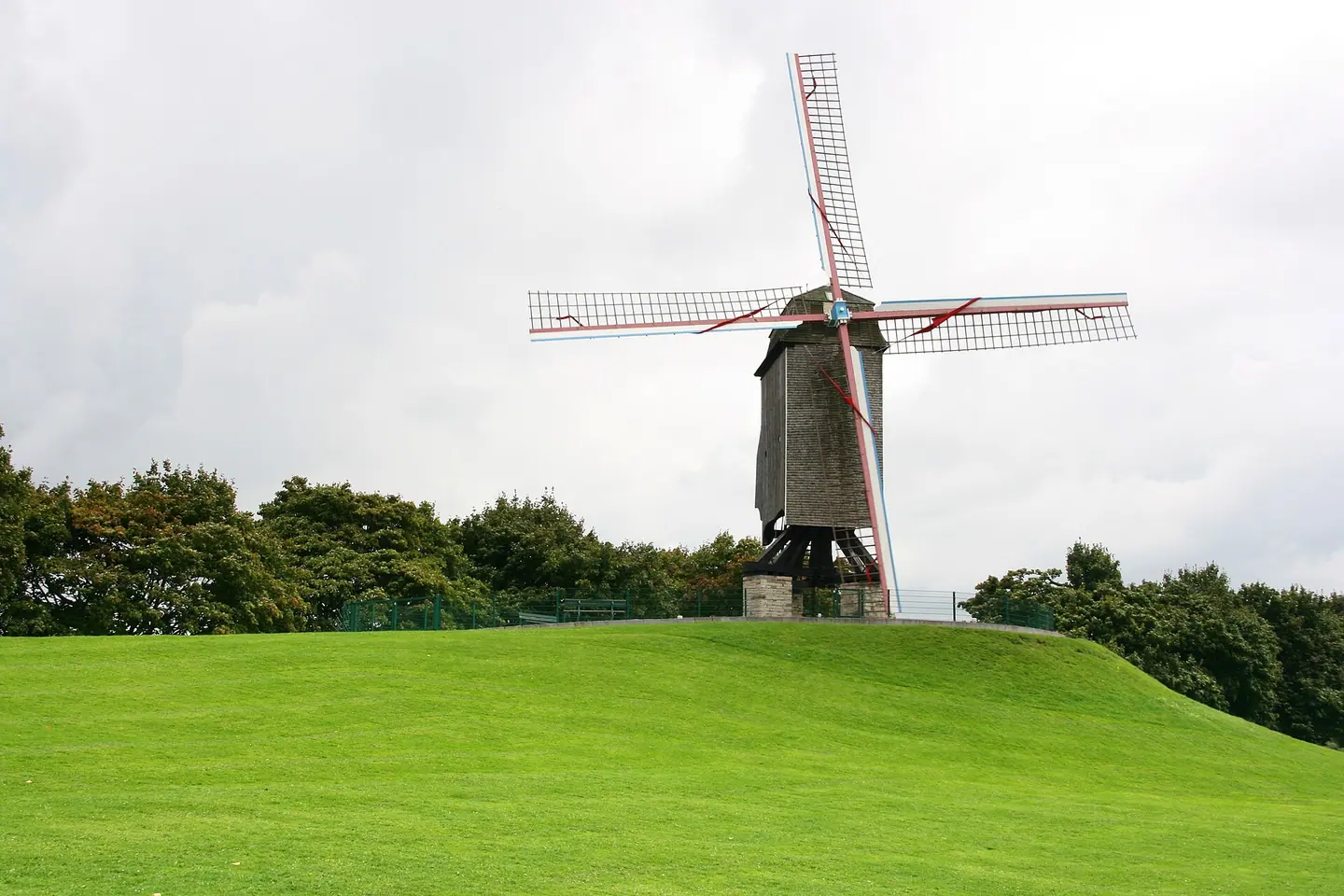
Built in 1770, this wooden post mill stands on the eastern earthworks of the city. It remains in working order, grinding grain when wind conditions allow. Visitors can climb inside the timber superstructure to examine the heavy millstones, wooden cogs and grinding apparatus positioned above the defensive canal.
Bonne-Chiere Mill
Erected on the Kruisvest in 1911, this post mill replaced an eighteenth-century predecessor blown down during a violent storm. It was transported here from Olsene in East Flanders. Set upon a raised grassy knoll, the timber mill showcases classic Flemish agricultural engineering beside the outer moat.
Kruispoort
Master masons Jan van Oudenaarde and Maarten van Leuven constructed this robust brick gatehouse between 1401 and 1406. Flanked by two heavy round towers, it withstood multiple sieges and military assaults. The structure features narrow arrow slits, portcullis grooves and a central passage that once controlled incoming road traffic.
Gentpoort
Dating from around 1400, this imposing defensive gate formed part of the second medieval fortification ring around Bruges. The building houses a municipal museum branch displaying defensive weaponry and architectural relics. Its river-facing facade displays carved stone niches, corbels and tall defensive turrets overlooking the surrounding ring canal.
Ezelpoort
Originally built in 1369 by Jan Sloevin and Joris Bruloot, this gatehouse stands surrounded by the water of the northern moat. Lower brick sections retain fourteenth-century stonework, whereas the upper portions underwent alterations in the seventeenth century. Two rounded towers frame the arched portal that historically welcomed traders travelling from Ostend.
Smedenpoort
Completed in 1367, this western portal controlled access from Gistel and the coast. Above the central archway hangs a bronze skull, replacing the preserved head of traitor François van der Straeten executed in 1691. Restored in the nineteenth century, the twin-towered brick bastion retains its atmospheric drawbridge footings and arrow loops.
Godshuizen De Vos
Founded in 1713 by the wealthy De Vos family, this enclosed residential community provided shelter for impoverished senior citizens. Whitewashed brick cottages surround a central grass lawn and flowerbed where silence was strictly enforced. A small private chapel remains attached to the row, housing modest religious artefacts from the eighteenth century.
Godshuis Sint-Jozef
Established in 1699, this quiet Godshuis provided modest homes for elderly women under the patronage of Saint Joseph. The whitewashed facades and small leaded windows open onto an internal gravel courtyard. Notice the carved stone wall tablet above the entrance, which commends the benefactors who financed its initial construction.
Godshuis De Meulenaere
Founded in 1613 by local benefactor Jan de Meulenaere, this residential row features stepped gables and a small integrated oratory. The houses flank a sheltered garden court providing respite from the city centre. A stone relief of the Holy Family decorates the exterior, marking centuries of continuous charitable housing support.
Godshuis Rooms Convent
Dating to 1330, this complex ranks among the oldest charitable residential communities in Bruges. Endowed by seven prosperous sisters, it supplied tiny individual houses for impoverished spinsters. Today, low whitewashed brick walls, blooming perimeter rose bushes and an austere courtyard chapel evoke the ascetic lifestyle of medieval civic welfare.
Godshuis Van Campen
Pieter van Campen founded this secluded charitable residence in 1436. The low brick dwellings display steep slate roofs, small chimneys and uniform green doors grouped around a tidy square. We can spot the original commemorative inscription carved into stone near the central gate, recording the founder's pious civic testament.
Godshuis Onze-Lieve-Vrouw van Blindekens
Founded in 1305 following the Battle of the Golden Spurs, this refuge provided care for blind citizens. The complex includes an adjoining Baroque chapel dedicated to Our Lady of the Blind, completed in 1652. A neat courtyard of traditional cottages stands behind the chapel, maintaining centuries of continuous community care.
Koningin Astridpark
Created on the former grounds of a Franciscan monastery, this landscaped public park opened during the mid nineteenth century. It contains mature beech trees, an ornamental lake, and a delicate wooden bandstand built in the neo-Gothic style. We find gravel pathways weaving past flowering shrubs, offering wide vistas toward neighbouring medieval church spires.
Magdalenakerk
Architect Pieter Buyck designed this prominent red-brick church between 1851 and 1853, drawing inspiration from English Gothic architecture. Positioned directly beside Astridpark, the building displays rich stained glass, polychrome timber ceiling beams and ornate stone tracery. The church interior frequently hosts contemporary community installations and reflective cultural gatherings.
Damse Vaart
Engineers dug this tranquil waterway between 1810 and 1818 under the orders of Napoleon Bonaparte to bypass maritime blockades. Flanked on both banks by tall poplar trees, the canal extends north-east from the Bruges ring canal. Today, it forms a picturesque transit route popular with cyclists and leisurely excursion boats.
Nieuwe Papegaai Mill
This wooden post mill was constructed in 1790 in Beveren-aan-den-IJzer and moved to the Kruisvest in 1970. Originally employed as an oil-pressing mill, it stands atop an open brick base that formerly housed heavy crushing vats. Its distinctive painted hull and wooden sails overlook the northern bastion ramparts.
De Kwekerij Almshouses
These modest brick cottages line a secluded residential corner near the Jerusalem Church, reflecting historic municipal efforts to house vulnerable labourers. Typical of late eighteenth-century social architecture, the structures feature whitewashed facades, slate roofs and low doors. A neat gravel pathway separates the residences from small kitchen plots.
St. George's Archers Guild
Established in the fourteenth century, the Guild of Saint George provided military defence for the city using heavy crossbows. The current guild grounds house a sixteenth-century hall containing antique weapons, trophies and portraits of former guild kings. Behind the main building lie outdoor shooting ranges where members still practise traditional target archery.
Convent of the English Sisters
English Augustinian canonesses founded this convent in 1629 after fleeing religious persecution during the English Reformation. The monastic complex features a domed Baroque chapel completed in 1739, distinguished by its polychrome marble altar. We can see rare English liturgical items, embroidered vestments and historical documents preserved inside the convent archive.
Jeruzalemkapel
The wealthy Adornes family erected this unusual Gothic chapel around 1470 following an extensive pilgrimage to Jerusalem. Its singular tower features an octagonal lantern topped by a wooden sphere representing the world. Inside, visitors encounter macabre stone carvings, authentic armorial stained glass, and a replica of Christ's Holy Sepulchre tomb.
Exploring Bruges Beyond the Main Canal Loop
Our main Bruges Medieval Canals, Belfry & Beguinage guide covers airport arrivals, neighbourhood bases and multi-day pacing to complement this walk; see also our full collection of city route guides.