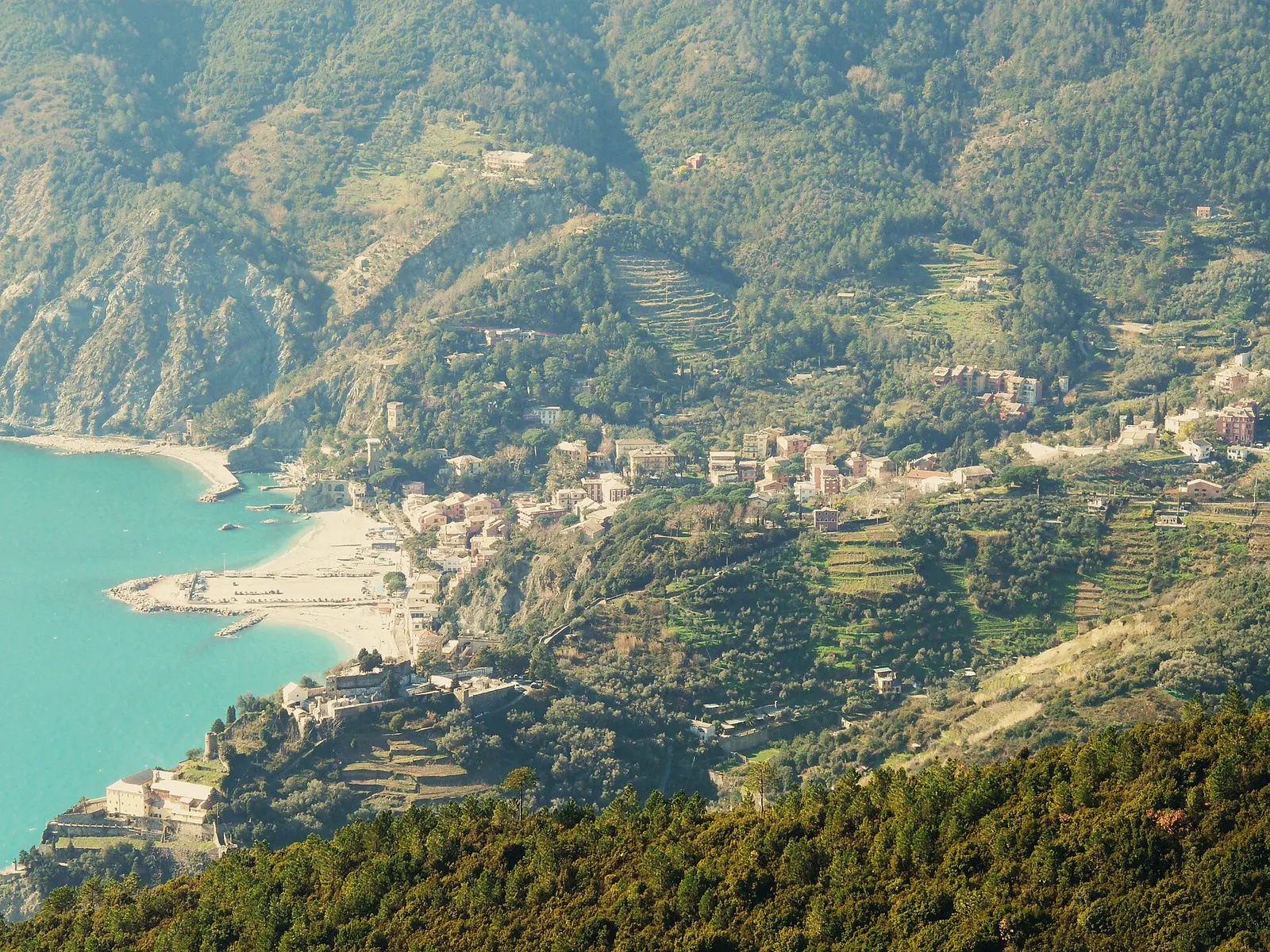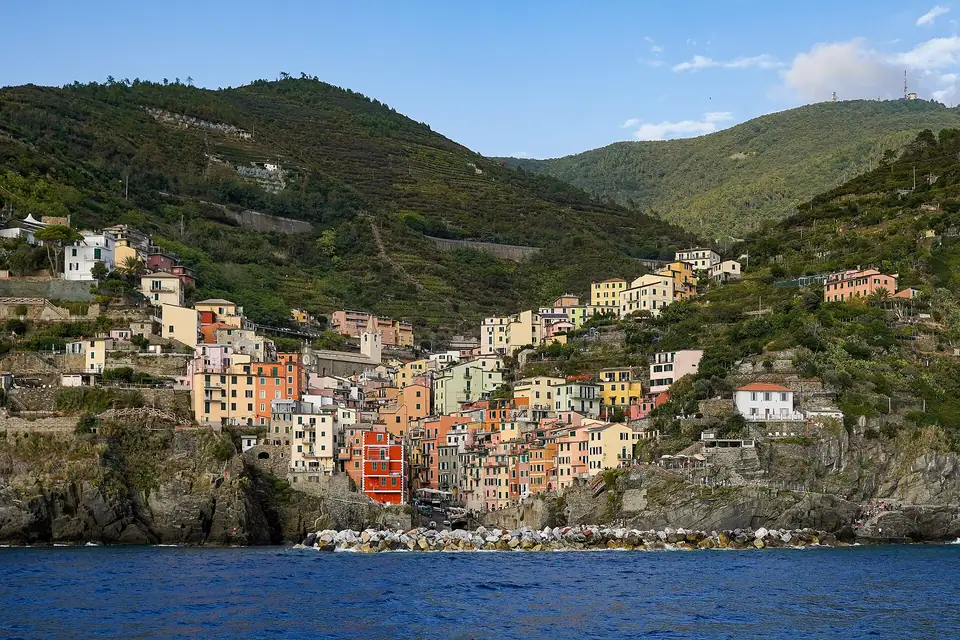
Follow ancient mule tracks connecting five pastel-washed fishing hamlets carved into the sheer maritime precipices of eastern Liguria.
Genoese Bastions, Monastic Vineyards, and the Dry-Stone Sea Cliffs
Cinque Terre’s rugged landscape was transformed during the eleventh century when agriculturalists began constructing thousands of kilometres of dry-stone walls, known as muretti a secco, turning vertical sea cliffs into terraced vineyards. Originally settled by agricultural communities retreating inland from Saracen coastal raids, the settlements expanded towards the water under the feudal Obertenghi dynasty before being integrated into the maritime Republic of Genoa during the twelfth and thirteenth centuries.
Genoese rule fortified the coast with defensive ramparts, polygonal towers, and fortified churches such as Vernazza’s Santa Margherita d'Antiochia, safeguarding local wine export networks from pirates. Retaining their isolation until the late nineteenth-century construction of the Genoa-La Spezia railway, these cliffside borghi preserved an intricate vernacular architecture defined by multi-storey tower houses, narrow carruggi, and centuries of manual viticulture overlooking the Ligurian Sea.
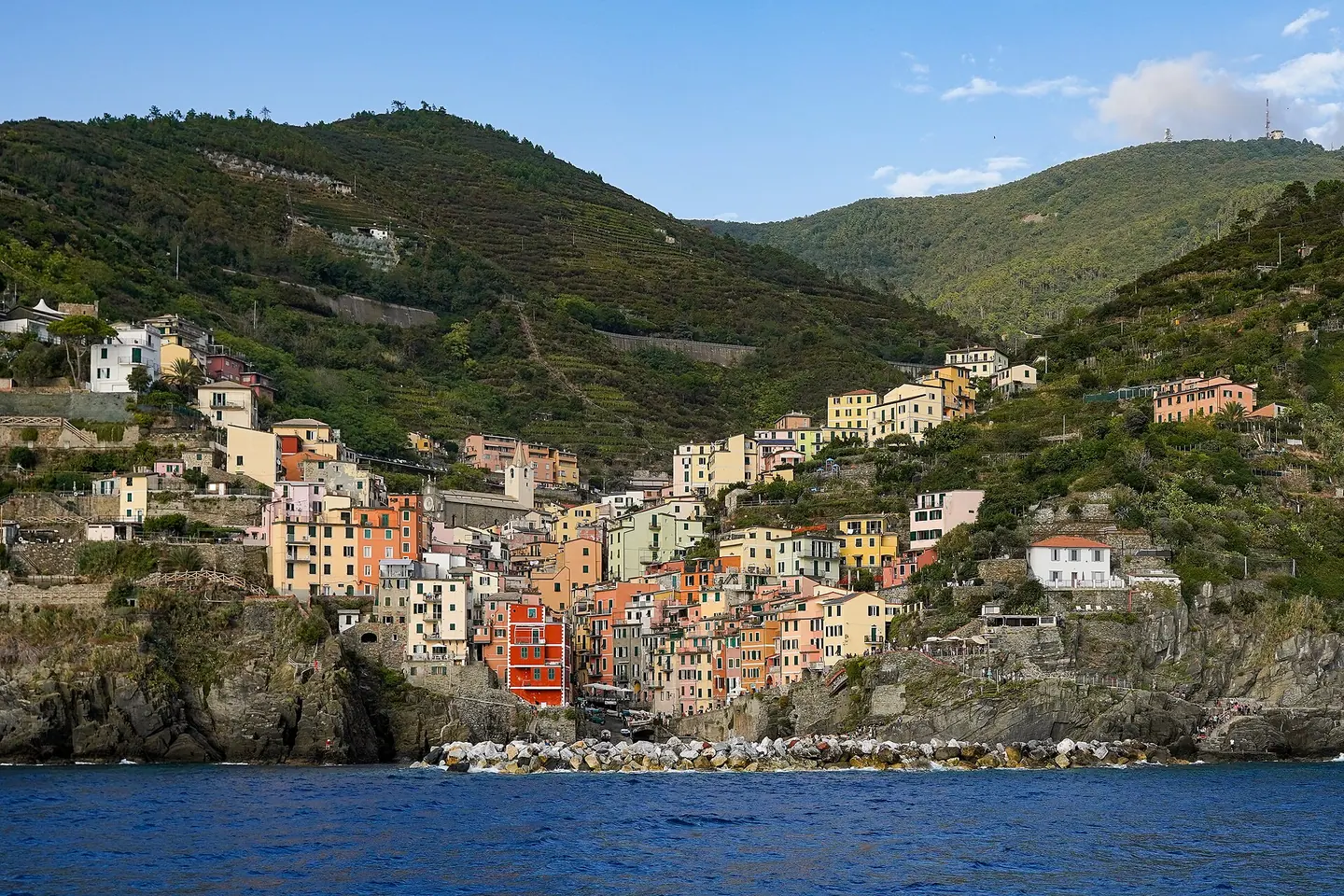
Monterosso al Mare: Fegina Shore and the Medieval Old Town
The northernmost village pairs broad pebble beaches and the ruined Aurora watchtower with narrow alleys leading to the Gothic Church of San Giovanni Battista.
Church of San Giovanni Battista
Constructed between 1282 and 1307, this parish church anchors the medieval centre with its striking facade of alternating white marble and dark green serpentine bands. The rose window displays intricate stone tracery above a relief of the baptism of Christ. Inside, we observe three aisles converging on a baroque altar framed by muted medieval stonework.
Oratorio delle Mortis et Orationis
Commonly known as the Oratory of the Black Confraternity, this seventeenth-century chapel stands beside the main parish church. Its facade and interior carvings feature skull motifs, reflecting the brotherhood's historical duty to care for the dead and shipwrecked sailors. Within the sanctuary, visitors can examine a statue of Saint Anthony Abbot and fine choir stalls.
Torre Aurora
Erected by the Republic of Genoa around the sixteenth century to ward off Barbary pirates, this stone bastion demarcates the boundary between Fegina and the old town. Positioned on the cliff of San Cristoforo, it once formed part of a defensive network of thirteen coastal towers. Today, the solid masonry structure serves as an evocative vantage point above the sea.
Il Gigante
Constructed in 1910 by the sculptor Arrigo Minerbi and architect Francesco Levacher, this colossal figure leans directly against the sheer rock face at the western edge of Fegina beach. Weighing over one hundred tonnes, the damaged statue once supported a vast seashell-shaped terrace on its shoulders. Allied bombardments and heavy sea storms shorn away its arms and trident.
Monastery of the Capuchin Friars
Founded in 1618 atop the hill of San Cristoforo, this Capuchin complex overlooks the village harbour. The church of San Francesco preserves paintings attributed to Bernardo Strozzi and Luca Cambiaso, alongside original wooden altars crafted by friars. The walled precinct includes a compact cemetery and simple cloisters that reflect Franciscan vows of poverty and contemplation.
Statue of Saint Francis of Assisi
Installed in 1962, this bronze sculpture by Silvio Monfrini stands beside the path ascending San Cristoforo hill. It depicts Francis of Assisi reaching outward with an open hand, accompanied by the tamed wolf of Gubbio. The vantage terrace around the statue offers broad vistas over the gulf toward the southern villages of the Cinque Terre.
Castello dei Fieschi
Built during the thirteenth century when the Obertenghi and later the Fieschi family governed the settlement, this fortress reinforced Genoa's maritime control. Portions of its crenellated walls and corner bastions were integrated into the municipal cemetery during the nineteenth century. Walking among the terraced burial vaults reveals ancient curtain walls surviving alongside marble epitaphs.
Oratorio di Santa Croce
Constructed in the sixteenth century for the Confraternita dei Bianchi, this smaller oratory displays a clean plaster facade with a central belfry. The interior contains a processional crucifix, historic silver lamps and devotional canvases used during patronal feasts. It played a vital role in providing mutual aid and communal care throughout Monterosso's medieval history.
Fegina Beach
Fegina represents the widest coastal strip in the Cinque Terre, stretching west from the railway station to the promontory of the Giant. A paved seaside promenade parallels the shore, lined with turn-of-the-century residences and tamarisk trees. The sea bed drops gently into turquoise waters, flanked by offshore sea stacks that shield bathers from westerly currents.
Scoglio di Monterosso
Rising abruptly from the azure surf in front of Fegina, this rugged limestone rock formation is a defining maritime landmark of the coast. Swimmers frequently use its ledges for resting, while sea birds gather along its wave-eroded crest. Its presence breaks the incoming swell, helping retain the fine gravels along this central sector of the bay.
Piazza Giuseppe Garibaldi
Positioned just inland from the historic harbour, this square forms the civic hub of Monterosso. Painted pastel facades and traditional slate roofs frame the perimeter, alongside the Town Hall building. A marble bust of Giuseppe Garibaldi commemorates his links to Liguria, while local pathways converge here before winding upward into the terraced vineyards.
Villa Montale
This early twentieth-century villa, styled in the Liberty fashion, served as the summer residence of Italian poet Eugenio Montale. The sea views and arid hillside landscapes around the house directly inspired celebrated poems in his collection Ossi di seppia. While privately owned, the property remains recognizable by its ochre facade and tiered garden near Fegina.
Santuario di Nostra Signora di Soviore
Situated high on the ridge behind Monterosso at 465 metres above sea level, Soviore is widely considered the oldest Marian shrine in Liguria. Documented as early as 1225, the complex features a Romanesque church, a stone guesthouse, and shaded courtyards lined with ancient oak trees. Pilgrims historically climbed the cobbled mule track to seek protection from drought and plague.
Sentiero Azzurro Trailhead
The coastal footpath, numbered trail 592-4, departs from the eastern perimeter of Monterosso, ascending steeply through olive groves and citrus orchards. Drystone walls line the ascent, showcasing centuries of laborious agrarian terracing cut directly into the maritime slopes. Hikers gain commanding vantage points over the village rooftops before the path traverses the rugged coastal cliffs.
Punta Mesco Viewpoint
Extending out into the Ligurian Sea, this high promontory provides clear sightlines stretching south across all five villages of the coast. The trail climbs from Fegina past Mediterranean scrub and wind-sculpted maritime pines. Approaching the headland reveals dramatic sheer cliffs where grey sandstone plunges directly into deep waters designated as a marine protected area.
Hermitage of Sant'Antonio del Mesco
Perched on the ridge of Punta Mesco, the remains of this Augustinian hermitage date from roughly 1380. Surviving masonry includes the apse of the church and parts of the barrel-vaulted living quarters used by recluse monks. Abandoned in the seventeenth century due to pirate incursions, the ruin now serves as an open-air historical site overlooking the open sea.
Porto Vecchio of Monterosso
Tucked beneath the shadow of the San Cristoforo cliff, the old port retains its role as a working haven for traditional wooden fishing craft. A stone pier extends into the sea, offering protective shelter against southern gales. Travellers boarding coastal passenger ferries can observe fishermen mending nets along the quay, set against colourful townhouses that line the waterfront.
Via Roma Street Axis
Serving as the principal spine of the old town, this car-free street follows the course of a covered stream heading inland toward lemon orchards. The alley is framed by high, pastel-hued tenements known as case-torri, designed historically to withstand naval bombardments. Archways, stone staircases, and family-run bakeries selling traditional lemon pastries line the cobbled corridor.
Cinque Terre National Park Maritime Boundary
Established in 1999 to protect local biodiversity, the marine reserve extends right up to the village waterline and the cliffs of San Cristoforo. The offshore zone safeguards dense meadows of Posidonia oceanica, which provide critical nursery grounds for sea bream, octopuses, and groupers. Restricting vessel speeds and anchoring preserves the water clarity along Monterosso's pebble shores.
Colle dei Cappuccini
Rising above the modern pedestrian tunnel that connects Fegina to the old town, this ridge offers a scenic alternative walking route. Cobbled switchbacks pass lemon groves, ancient stone benches, and low defensive parapets. The crest reveals contrasting views, separating the broad, modern beachfront of Fegina on one side from the tightly clustered medieval alleys on the other.
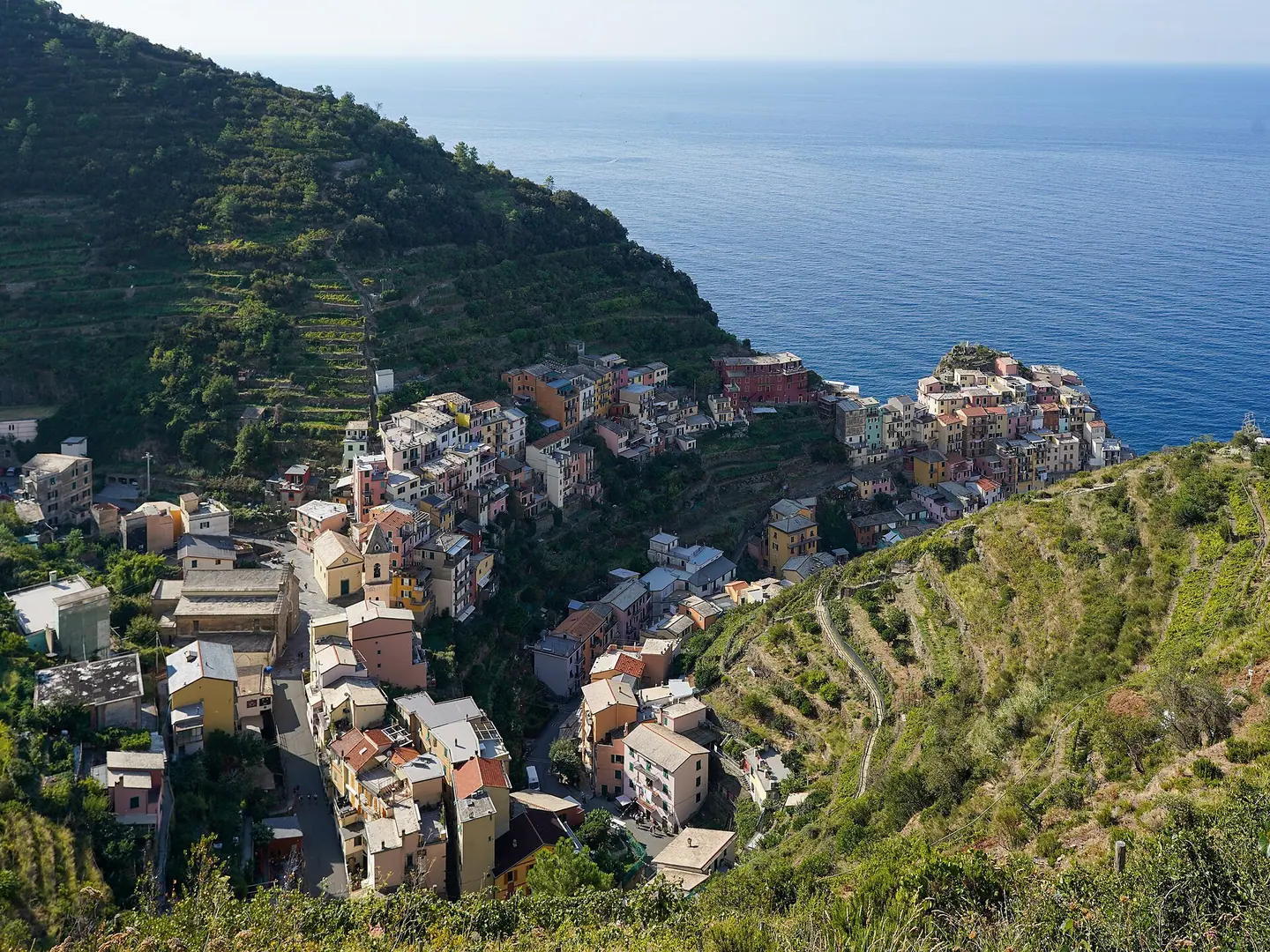
Vernazza: Natural Harbour, Doria Castle and Carruggi
Arranged around Cinque Terre's only natural deep-water haven, this fortified town features cliff-edge stone arcades and defensive bastions dating to the Genoese zenith.
Castello Doria
Constructed as a coastal defence against Saracen pirates, this fortified complex eventually passed to the Republic of Genoa and the Doria family. Its cylindrical stone keep dominates the headland, rising directly from sheer sea rocks. Visitors can climb to the upper platform for extensive panoramic views over the harbour and the terraced cliffs behind the village.
Santa Margherita d'Antiochia
Consecrated in 1318, this parish church stands directly on the cliff edge guarding the eastern flank of the harbour. The building displays typical Ligurian Gothic architecture, constructed from local dark stone with an unusual octagonal bell tower topped by a dome. Inside, wooden roof trusses and rounded arches reflect centuries of maritime devotion and structural restoration.
Belforte Tower
Standing at the base of the Doria Castle promontory, the cylindrical Belforte Tower formed a key watchpoint in the defensive perimeter established by Genoa. Constructed from rough fieldstone, it was designed to coordinate naval artillery and signal warnings along the rocky coast. The platform beneath the tower offers a direct vantage point over incoming marine swells.
Piazza Marconi
Piazza Marconi forms the social heart of Vernazza, opening onto the town's protected natural bay. Pastel-tinted merchant houses and stone arcades enclose the space, which originally served as a workplace for local fishermen repairing nets and dry-docking skiffs. Narrow alleys radiate upward from the square into the cliffside residential quarters.
Vernazza Harbour
This natural inlet provided secure anchorage for Genoese galleys during medieval campaigns along the Tyrrhenian seaboard. A stone breakwater protects traditional wooden gozzo fishing boats from southern currents, while sea cliffs shield the inlet from heavy winds. The quay affords direct views of the town fortifications and the open Ligurian Sea.
Sentiero Azzurro to Monterosso
This historic coastal mule track skirts steep maritime ridges, traversing century-old dry stone walls and coastal scrub. Used for centuries by farmers and messengers, the route reveals structural terraces carved out of rock for viticulture. The trail reaches elevated viewpoints that showcase Vernazza's castle promontory jutting boldly into the Gulf of Genoa.
Sanctuary of Nostra Signora di Reggio
Located on a high ridge above Vernazza, this sanctuary dates back to at least the eleventh century and preserves Romanesque architectural elements. Pilgrims traditionally walked the stone-paved path lined with Stations of the Cross to venerate the image of the Black Madonna. The forecourt is shaded by ancient holm oaks and cypress trees, looking out across the sea.
Via Roma
Via Roma was built over the covered riverbed of the Vernazzola stream, connecting the upper railway station to the harbour. Flanked by four-storey residential towers, it represents the primary commercial spine of the village. Masonry portals, small cantinas, and arched tunnels branch off into the vertical hillside living quarters.
Torre del Convento
Positioned upstream along the valley slope, this stone tower formed part of the secondary defensive ring built to repel overland incursions. Adjacent to the former Reformed Minor Franciscan friary, the structure demonstrates the Genoese strategy of establishing multiple vantage points. The masonry shows defensive loopholes designed for small firearms and early cross-valley signalling.
Cinque Terre National Park
Encompassing the five historical coastal settlements, this national park protects fragile ecosystems and agricultural traditions. The landscape is defined by thousands of kilometres of dry stone walls supporting terraced vineyards of Bosco and Albarola grapes. We observe how human engineering transformed vertical sea cliffs into an enduring productive agricultural environment.
Vernazza Railway Station
Constructed in the 1870s as part of the Genoa-Pisa line, the railway transformed the village from an isolated maritime enclave into an accessible town. The station platforms are built inside tunnels and elevated viaducts directly above the village stream. The engineering works remain an example of late nineteenth-century Italian coastal railway construction.
Sentiero Azzurro to Corniglia
Departing from the southern quarter of Vernazza, this section of the coastal trail ascends through steep olive orchards and dry stone walls. The path retains its traditional stone steps and narrow passing ledges cut directly into the hillside. From the upper trail, walkers obtain clear views of the castle promontory and the lower town harbour.
Punta Mesco
Punta Mesco terminates the Gulf of Genoa to the north-west, acting as a prominent navigational marker for centuries of coastal traffic. The headland features the ruins of the eleventh-century Hermitage of Saint Anthony of Mesco and an old naval semaphore station. From the promontory, travellers can look back along the entire sweep of the Cinque Terre coastline.
Church of San Pietro, Corniglia
Built in 1334 over an existing eleventh-century chapel, this church serves the neighbouring village of Corniglia. The facade features local sandstone contrasted with an intricately carved white Carrara marble rose window and a bas-relief of Saint Peter. The interior contains three naves divided by stone pillars and houses historical baroque religious artwork.
Corniglia Marina
Unlike Vernazza, Corniglia lacks a natural beach and relies on this deep rocky cove for boat moorings. Cut into steep sea cliffs, the descent requires navigating flights of stone steps that lead down to a sheltered rock platform. Deep, transparent waters and dramatic layered sea crags define this secluded maritime approach.
Church of San Giovanni Battista, Monterosso
Erected between 1282 and 1307, this church showcases the signature Ligurian Gothic style using alternating bands of white marble and dark green serpentine stone. Its central facade features a large perforated marble rose window above an arched entrance portal with a fresco. The medieval belfry was originally constructed as a military watchtower before being repurposed.
Monterosso Giant
Designed by sculptor Arrigo Minerbi and architect Francesco Levacher, this colossal figure represents the sea god Neptune supporting a terrace on his shoulders. Anchored into the cliff at Fegina beach, the sculpture suffered damage during Allied bombing in the Second World War and subsequent ocean storms. Despite the loss of his arms, the statue remains a distinctive coastal landmark.
Capuchin Monastery, Monterosso
Constructed in 1618 atop the San Cristoforo promontory, this monastery complex contains historical artworks, including a Crucifixion attributed to Flemish painter Anthony van Dyck. The peaceful cloister and simple church interior preserve the austere traditions of the Capuchin order. Its elevated terraces command expansive views across the entire gulf toward Vernazza.
San Bernardino
Perched hundreds of metres above sea level between Vernazza and Corniglia, San Bernardino developed as an agricultural outpost for hillside farmers. The local sanctuary, consecrated in the nineteenth century, contains an earlier revered image of the Virgin Mary. The hamlet offers direct trail access into the high ridge paths linking the coastal valleys.
Lardarina Staircase
Consisting of 382 brick steps across 33 flights, this zigzag staircase provides pedestrian access from the coastal railway tracks to Corniglia's cliff-top plateau. Built to overcome the vertical cliff face, the structure represents a remarkable feat of local civic engineering. Climbing the staircase provides close perspectives on the stone retaining walls and surrounding terraced lemon groves.
Corniglia: The Clifftop Promontory and Lardarina Terraces
Perched one hundred metres above the sea without direct harbour access, this quiet agricultural retreat is reached by the brick zigzag of the Lardarina stairway.
Scalinata Lardarina
Comprising 382 steps arranged over 33 flights, this red-brick stairway climbs roughly one hundred metres up the cliff face. It forms the historic pedestrian link between the seaside railway tracks and the hilltop settlement. The ascent offers views of terraced vineyards and coastal precipices.
Church of San Pietro
Erected in 1334 over an eleventh-century chapel, this parish church exhibits classic Ligurian Gothic design in local stone. Its facade features a white Carrara marble rose window crafted by the sculptor Matteo and Pietro da Campione. Inside, visitors find a baroque baptismal font and three distinct aisles.
Oratory of the Disciplinati di Santa Caterina
Positioned on Largo Taragio, this simple church was built in the eighteenth century as the seat for the local flagellant brotherhood. The interior holds an eighteenth-century ceiling fresco depicting the martyrdom of Saint Catherine of Alexandria. A small rear terrace opens directly toward the cliffs.
Largo Taragio
This shaded square operates as the civic gathering place of the promontory, flanked by pastel houses and stone cafes. At its centre stands a monument to local residents who died during the First World War. It acts as the crossroads between the parish church and the coastal cliff edges.
Belvedere di Santa Caterina
Located just behind the Oratory of Santa Caterina, this lookout platform occupies the western tip of the Corniglia headland. From here, travellers observe panoramic views of the coastal villages of Manarola and Riomaggiore to the south. The drop falls vertically into deep waters, bypassing any harbour.
Guvano Beach
Historically reached via a disused railway tunnel or steep goat tracks, this isolated cove features clear water and grey shingles. The bay was well known among naturists in the 1970s and 1980s. Landslides have largely restricted access, leaving it primarily visible from high cliffside footpaths.
Santuario di Nostra Signora delle Grazie
Set high above Corniglia in the settlement of San Bernardino, this nineteenth-century sanctuary replaced an earlier medieval hermitage. It houses a revered image of the Virgin and Child crowned in gold. The surrounding terrace provides an expansive perspective looking directly down onto the Corniglia peninsula.
Sentiero Azzurro: Corniglia to Vernazza
This section of the Sentiero Azzurro links Corniglia to Vernazza, winding along dry-stone walls and olive orchards. The footpath skirts deep valleys before climbing to the hamlet of Prevo, the highest point along the coastal trail. Centuries of manual labour maintain the stone steps and drainage gullies.
Sentiero Azzurro: Corniglia to Manarola
Historically contouring the shore between Corniglia railway station and Manarola, this trail ran beneath high maritime bluffs. Coastal erosion and rockfalls have led to extended closures, prompting hikers to take inland ridge detours. The route illustrates the fragile geology of the Ligurian coast.
Cinque Terre National Park
Established in 1999, this national park safeguards the cultural landscape carved by centuries of viticulture and olive cultivation. Thousands of kilometres of dry-stone walls prevent the steep slopes from sliding into the sea. Corniglia sits at the geographical heart of this protected UNESCO World Heritage area.
Marina di Corniglia
Reached by descending steep stone stairs from the village centre, this rocky bay serves as Corniglia's only access to sea level. The inlet lacks a conventional quay, meaning fishing boats must be hauled out of water onto land. Large boulders create an enclosed basin popular for summer swimming.
Via Fieschi
Serving as the narrow high street of Corniglia, Via Fieschi runs from the Church of San Pietro to the coastal belvedere. The street takes its name from the powerful Fieschi counts of Lavagna who controlled the village during the thirteenth century. It is flanked by tall, pastel-painted row houses.
Torre di Corniglia
These stone ruins sit on the southern verge of the promontory, dating to sixteenth-century Genoese fortifications. Built to spot and resist Ottoman corsair raids, the tower once formed part of a defensive radar network along the Ligurian coast. Its thick bases are now incorporated into residential terracing.
Prevo Hamlet
Perched 208 metres above sea level, this microscopic cluster of stone houses stands along the trail connecting Corniglia and Vernazza. The hamlet developed as a seasonal agricultural base for farmers tending elevated vineyards. Its vantage gives unhindered views along the coastline toward the Punta Mesco headland.
Spiaggia delle Spiaggione
This expansive strip of pebbles and grey sand rests immediately below the railway line south of Corniglia. Accessible depending on seasonal tides, the shore is composed of materials extracted during the excavation of rail tunnels in the nineteenth century. Rough surf frequently reshapes its shoreline profile.
Sentiero 587 Corniglia to Cigoletta
This rigorous hiking trail climbs out of Corniglia towards the central mountain ridge at the Sella Cigoletta pass. The pathway traverses ancient dry-stone wall systems supporting indigenous grape varieties used in Sciacchetrà wine. Higher sections enter deep chestnut and pine woods, leaving the sea behind.
Volastra Terraces
Spanning the amphitheatre between Corniglia and Manarola, these steep hillside terraces represent ancient Mediterranean agricultural engineering. Farmers still utilise monorail systems to haul tools and grape harvest loads up vertical slopes. The dry-stone construction plays an essential role in preventing soil erosion across the region.
Sella Cigoletta
Standing at an elevation of 611 metres, this ridge pass forms a pivotal crossroads on the Alta Via delle Cinque Terre. Historically, muleteers carried salted anchovies and wine across this point to trade for grain in the inland valleys. It remains an intersection for regional hiking trails.
Case Lovara
Set on the headland overlooking the gulf northwest of Corniglia, this rural settlement illustrates self-sufficient Ligurian farming. The Italian National Trust (FAI) restored the stone farmhouse, olive groves, and dry-stone terraces to demonstrate traditional cultivation techniques. It highlights the architectural heritage of regional agricultural life.
Punta Mesco
This dramatic sandstone promontory caps the northern horizon when viewed from Corniglia's Santa Caterina belvedere. The summit preserves the stone ruins of the fourteenth-century Hermitage of Sant'Antonio del Mesco and a defunct military semaphore station. It delineates the gulf of Levanto from the Cinque Terre coast.
Manarola: Palaeolithic Ravine and the Groppo Vineyards
Tower houses tumble down a sheer black-rock crag towards a miniature inlet famous for ancient Sciacchetrà wine pressings and dramatic sunset vantage points.
Church of San Lorenzo, Manarola
Erected in 1338 by local stone masons, this parish church displays a striking local sandstone facade. A fine rose window in white Carrara marble decorates the central portal, attributed to the masters Matteo and Pietro da Campione. Inside, visitors encounter a three-aisled interior containing a revered fifteenth-century triptych.
Manarola Bell Tower
Standing apart from the church on Piazza Papa Innocenzo IV, this square stone tower originally served a dual civic and defensive role. Constructed in the fourteenth century to scan the Ligurian Sea for Saracen pirates, it was later adapted into a bell tower. Its solid, unadorned masonry reflects early coastal military architecture.
Oratory of the Disciplinati, Manarola
Facing the parish church across the upper square, this chapel belonged to the Confraternity of the Disciplinati of the Holy Trinity. Built in the fifteenth century, the modest hall features a simple slate portal and baroque interior accents. Historically, it provided mutual aid and organised penitential processions for the village community.
Manarola Marina
Carved into sheer black cliffs, the village harbour serves as the arrival point for fishermen and coastal boats. Colourful multi-storey tower houses crowd the rocky cleft, designed historically to withstand storm surges and hostile incursions. A boat ramp cut directly into the rock allows small wooden vessels to be hauled out.
Punta Bonfiglio
Extending northwest from the harbour, this promontory offers an expansive panorama of the cliff-hung village and the open sea. A paved cemetery pathway traverses the rocks, flanked by Mediterranean macchia and dry-stone walls. A small bronze sculpture honouring local poet Eugenio Montale stands along the cliff terrace.
Manarola Cemetery
Positioned dramatically on Punta Bonfiglio, this walled cemetery houses generations of local viticulturists and mariners. Stacked burial niches line the stone perimeter, interspersed with marble memorial plaques inscribed with Ligurian family names. The terrace commands open sea breezes and inspired verses from regional poets who celebrated Cinque Terre traditions.
Via di Mezzo
Running along the bottom of the ravine, this central thoroughfare covers the canalised waters of the Groppo stream. Narrow stone alleyways, known locally as carrugi, climb steeply from both sides up into the residential cliffs. Traditional wine cellars and basements still line the flagstone pavement.
Old Water Mill of Manarola
Tucked away in the upper valley, this stone mill harnessed the flow of the Groppo torrent to grind grain and press local olives. Restored iron and wooden wheel mechanisms illustrate pre-industrial rural engineering in coastal Liguria. The surrounding stone masonry dates to the eighteenth century, demonstrating early local resourcefulness.
Ruins of Manarola Castle
Little remains of the thirteenth-century feudal castle built to defend the cove against marauding fleets. Substantial rounded stone bastions still underpin several private residences perched directly above the sea. These thick masonry foundations reveal the defensive core that once protected the settlement under the Republic of Genoa.
Groppo Hamlet
Located inland along the ravine, this historic hamlet forms the viticultural heart of the Manarola valley. Its compact stone cottages and narrow passages nestle among precipitous vineyard terraces. Groppo has long served as a pressing and cellaring centre for sweet Sciacchetrà wine.
Cantina Sociale Cinque Terre, Groppo
Established in 1973, this agricultural cooperative receives grapes harvested from thousands of dry-stone terraces across the district. It safeguards traditional production methods for white Cinque Terre DOC and amber Sciacchetrà dessert wines. The modern facility houses processing machinery, tasting halls, and exhibits outlining extreme hillside farming.
Sanctuary of Nostra Signora della Salute, Volastra
Perched on the mountain ridge high above Manarola, this stone sanctuary was founded in the twelfth century. Its Romanesque facade contains square-cut sandstone blocks, a round-arched portal, and a slender mullioned window. Pilgrims historically climbed the steep paved mule track from the coast to offer maritime ex-votos.
Volastra Village
Originally named Vicus Oleaster for its abundance of olive groves, Volastra preserves a distinctive circular layout along the ridge. Stone houses were arranged contiguously to form an outer defensive perimeter against raiders. The village remains surrounded by olive plantations and tiered vineyards connected by stepped paths.
Via dell'Amore
Blasted from sheer sandstone cliffs during railway modernisation in the 1920s, this celebrated promenade clings directly to the rock above the sea. Overhangs, tunnels, and reinforced terraces define the route, showing the challenges of coastal transit. Extensive geotechnical works and protective netting maintain cliff stability along the traverse.
Manarola Hillside Nativity Site
Covering the Colline delle Tre Croci, this terraced slope hosts one of the largest light installations in the world. Created by local artisan Mario Andreoli using recycled metals and cables, figures representing shepherds and angels illuminate the terraces in winter. By day, the steep dry-stone terraces remain actively cultivated.
Sentiero 506 (Manarola to Volastra)
This ancient stepped path climbs more than twelve hundred stone risers through vertical hillside properties. Supported by dry-stone retaining walls known as ciàn, the route was constructed entirely by hand to haul harvests from terrace to sea. Hikers encounter olive trees, rosemary shrubs, and rack-and-pinion agricultural monorails.
Piazza Papa Innocenzo IV
Serving as the civic centre of upper Manarola, this square honors Pope Innocent IV, whose Fieschi family held historical ties to the region. The paved open terrace unites the fourteenth-century church, the bell tower, and the confraternity oratory. It offers views down the Palaeolithic ravine towards the sea.
Scalinata della Palaedo
Descended via sheer rock faces south of the marina, this narrow flight of steps leads bathers and boatmen to rocky maritime shelves. Handrails and cut rock channels allow foot traffic down to the deep turquoise water. The location reveals folded geological strata characteristic of the southern Ligurian coast.
Sentiero Azzurro: Manarola to Corniglia
Following the natural contours of the coastline, this historic trail once connected the five villages for daily pedestrian trade. Low stone walls border the path, offering dramatic views across marine shallows and rocky coves. The trail showcases regional vegetation including prickly pears, agaves, and wind-sculpted maritime pines.
Presepe Viewpoint on Tre Croci
Situated atop the vineyard-terraced hill of the Three Crosses, this vantage point provides an unobstructed view over Manarola. Travellers observe the parallel tower houses descending along the narrow stream bed directly into the sea inlet. The surrounding slopes retain traditional monorail tracks used to haul laden grape bins.
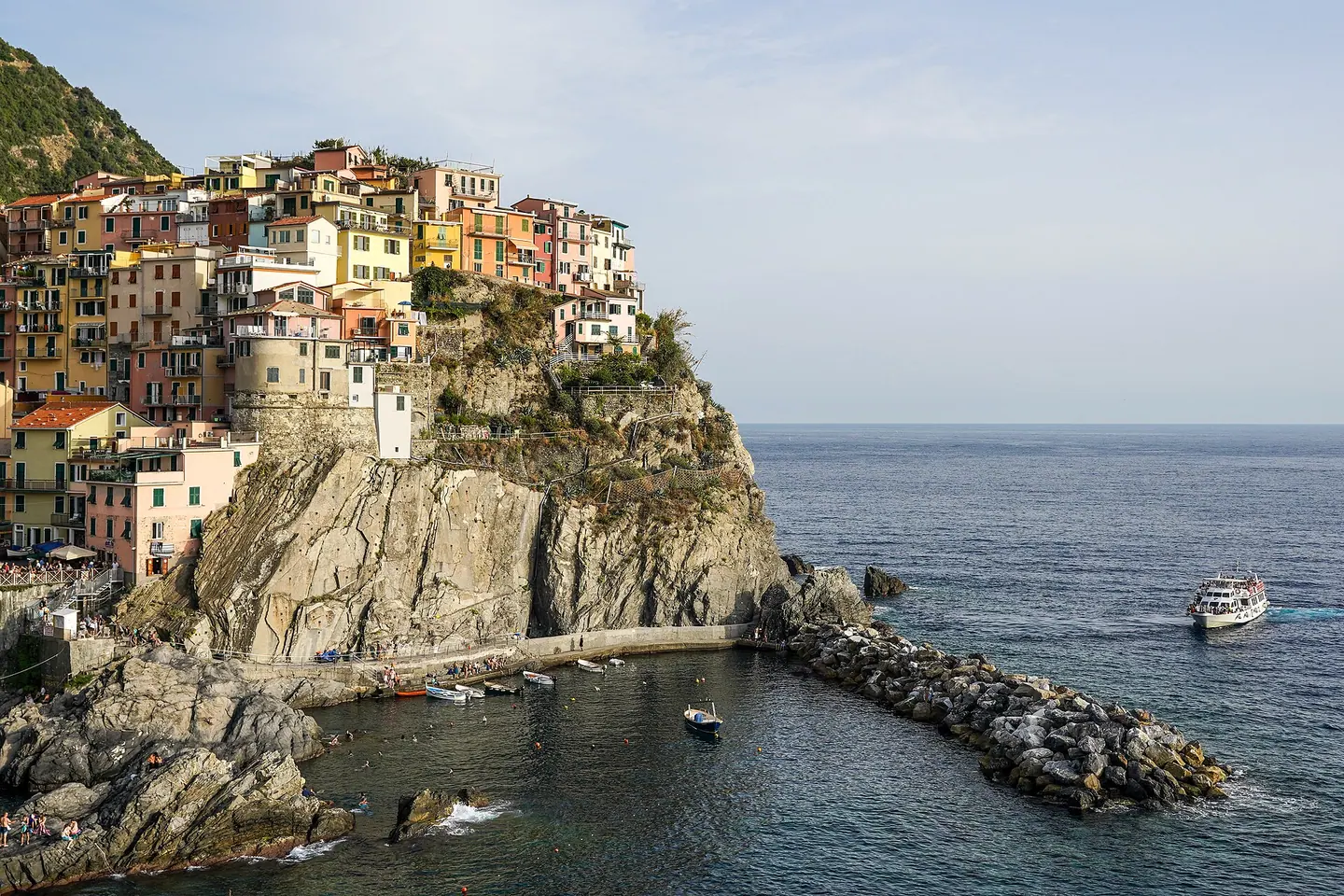
Riomaggiore: Valle dei Mulini and the Southern Marina
Vertical pastel residences line the steep course of the Rio Major stream down to a rocky boat slipway watched over by the fourteenth-century Castle of Riomaggiore.
Castello di Riomaggiore
Commissioned by the Republic of Genoa in 1260 and completed during the fourteenth century, this stone fortress served as a maritime lookout against Barbary pirates. Visitors can inspect two massive circular towers linked by curtain walls. The elevated terrace offers sweeping views across the slate roofs of the village down to the open sea.
Church of San Giovanni Battista
Bishop Antonio Fieschi founded this three-aisled basilica in 1340, though its neo-Gothic facade reflects an extensive nineteenth-century reconstruction. Look closely at the original white Carrara marble rose window and Romanesque portal reliefs. Inside, the nave holds a wooden crucifix attributed to Anton Maria Maragliano and a mechanical pipe organ installed in 1851.
Oratorio di San Rocco
Built in 1480 after the settlement survived a devastating plague, this intimate stone oratory stands beside the castle grounds. The simple gabled facade conceals an austere interior centred on an altar painting depicting Saint Roch with Saint Sebastian. Local brotherhoods historically gathered here to organise charity and religious processions for the parish community.
Marina di Riomaggiore
Enclosed by sheer rock faces, this small harbour serves as the maritime heart of the village where local fishers haul wooden gozzi boats onto dry ramps. Narrow stone staircases descend directly to the water edge, flanked by tall tower-houses that double as defensive ramparts. The sea wall provides an ideal vantage point over the crashing surf.
Oratorio di Santa Maria Assunta
Also known locally as the Church of the Disciplinati, this sixteenth-century sanctuary stands along the main village thoroughfare. Its single interior chamber displays a gilded triptych of the Madonna and Child alongside a fourteenth-century wooden statue of the Virgin Mary. The brotherhood of the Disciplinati gathered within these walls to recite liturgical offices and coordinate civic welfare.
Santuario di Nostra Signora di Montenero
First documented in 1335, this solitary sanctuary occupies a high ridge 340 metres above sea level. Reconstructed in the eighteenth century, the church preserves a venerated Marian icon said to date from the eighth century. The surrounding pine-shaded plateau affords panoramic perspectives over Palmaria Island and the entire Cinque Terre coastline.
Via dell'Amore
Constructed in the late 1920s during railway modernisation work, this paved pathway clings to sheer limestone cliffs above the Ligurian Sea. Steel netting and galleries protect travellers from rockfall while navigating the dramatic coastal topography. The route showcases Mediterranean macchia vegetation, including wild fennel, agave, and sea squill growing directly from stone crevices.
Valle dei Mulini
Following the course of the freshwater Rio Major stream, this verdant ravine once powered a network of grain and olive oil mills. Dry-stone walls sustain steep agricultural terraces cultivated with Vermentino grapes and lemon orchards. Walkers can identify weathered stone water races and mill foundations submerged beneath chestnut trees and lush riparian undergrowth.
Torre Guardiola
Erected as a coastal defence station during the early twentieth century, this stone complex crowns the rugged promontory south of the harbour. The site now serves the national park as an environmental education centre and birdwatching facility. Paved walkways wind among myrtle bushes, offering uninterrupted outlooks across the open waters of the Pelagos Sanctuary.
Spiaggia del Canneto
Accessible primarily from the sea, this untouched cove of dark shingle sits beneath towering sandstone cliffs between Riomaggiore and Portovenere. A natural cascade of cool mountain water tumbles directly onto the shore from the rocks above. Geologists note the sharply folded rock strata that expose millions of years of Apennine coastal formation.
Church of San Lorenzo
Dedicated to Saint Lawrence, this 1338 parish church features local sandstone masonry fronted by an intricate rose window carved from Carrara marble. The bas-relief in the lunette depicts the martyrdom of the patron saint. Across the piazza stands a detached fourteenth-century square bell tower, historically utilised as an armed defensive watchtower.
Manarola Harbour Slipway
Carved through dark slate formations, Manarola's boat slipway forms one of the most distinctive coastal approaches in the region. Towering multi-storey houses rise abruptly from the rock ledges, creating a tight canyon down to deep water. Winches and cables installed along the stone quayside lift gozzi vessels out of harm during stormy weather.
Punta Bonfiglio
This rocky headland protects Manarola's natural inlet from northern squalls and provides an uninterrupted view of Corniglia in the distance. A paved path winds around the bluff past the village cemetery, inscribed with verses by poet Vincenzo Cardarelli. Below, crashing waves break against dark flysch rock formations covered in salt-resistant sea crithmum.
Oratorio dei Disciplinati della Santissima Annunziata
Dating to the fifteenth century, this small religious hall sits opposite the Church of San Lorenzo. The facade displays an arched portal topped by an ancient relief of the Annunciation. Members of the local flagellant fraternity met here to distribute grain to impoverished villagers and maintain communal vineyards across the surrounding hillsides.
Santuario di Nostra Signora della Salute
Perched in the hamlet of Volastra above Manarola, this twelfth-century Romanesque shrine was constructed using finely worked fieldstone. Its facade preserves an arched portal decorated with an understated white marble lunette. Inside, a single nave covered by barrel vaulting shelters an eighteenth-century effigy of the Virgin Mary venerated by local agricultural communities.
Sentiero Azzurro: Manarola to Corniglia
Connecting the coastal settlements, this section of the Sentiero Azzurro traverses dry-stone agricultural walls that have shaped the territory for a millennium. Walkers navigate narrow stone steps alongside terraced vines trained low against coastal winds. The route displays remarkable feats of dry-stone engineering, constructed entirely without mortar by generations of peasant farmers.
Colle del Telegrafo
Rising 516 metres above sea level on the coastal ridge, this strategic pass links the Cinque Terre with the Gulf of Spezia. During the Napoleonic era, French engineers established an optical telegraph station here to transmit military messages. Today, the junction serves as a crossroads for high-altitude walking routes beneath maritime pines and sweet chestnut woods.
Lardarina Staircase
Connecting Corniglia railway station to the village centre atop its high promontory, the Lardarina comprises 33 flights containing 382 red-brick steps. Completed during the early twentieth century, the switchback design offers relief from the steep incline while providing continuous views of the Mediterranean. Agave, prickly pear, and caper bushes sprout along the supporting brick retaining walls.
Church of San Pietro
Erected in 1334 on the foundations of an eleventh-century chapel, this church exemplifies Ligurian Gothic architecture with local sandstone walls. The white Carrara marble rose window, sculpted by Matteo and Pietro da Campione, features delicate openwork tracery. Inside, visitors can observe a baptismal font dating from the twelfth century and baroque frescoes adorning the choir ceiling.
Oratorio di Santa Caterina
Standing in Corniglia's central square, this eighteenth-century oratory features an unadorned facade and a peaceful, intimate interior. Behind the altar, a raised terrace reveals a sweeping drop to the rocky shoreline below. The building remains the home of the local Confraternity of Saint Catherine, who parade its historic processional crucifixes during major liturgical feasts.
Traversing the Cliffside Mule Tracks and Coastal Carruggi
Before setting out, check local transit connections, museum booking notes and monthly weather data in our Cinque Terre city guide, and compare other walking itineraries.