A detailed walking and island route across UNESCO-listed Corfu Town (Kerkyra): Venetian kantounia alleys, French Empire Liston arcades, British neoclassical palaces, and Ionian bays.
Corinthian Paleopolis and the Unconquered Adriatic Bastion of Venice
Identified in Homer's Odyssey as Scheria, island of the Phaeacians where Odysseus washed ashore before Princess Nausicaa, Corcyra was founded as a Corinthian colony around 734 BC inside the Kanoni peninsula. Positioned at the entrance to the Adriatic Sea, Corfu served from 1386 to 1797 as the impregnable naval bulwark of the Republic of Venice, whose military engineer Michele Sanmicheli carved the Contrafossa moat and twin bastions of the Old and New Fortresses that repelled the Great Ottoman Sieges of 1537 and 1716.
Never conquered by the Ottomans, Corfu Town uniquely blends multi-storey Venetian stone tenements and vaulted lanes (kantounia) with the Napoleonic French Rue de Rivoli-style Liston arcade and British Regency limestone palaces around the green Spianada cricket ground.
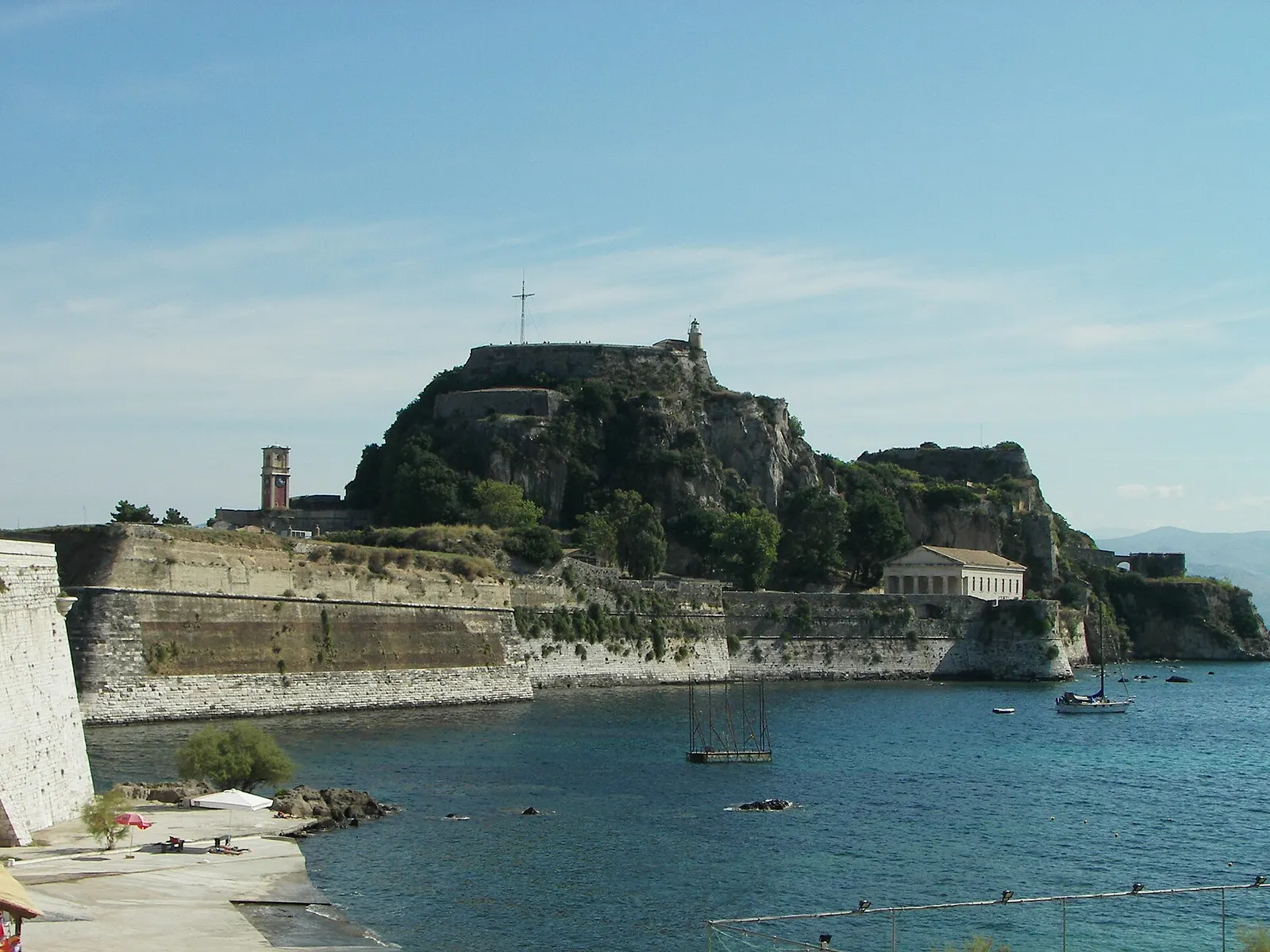
Old Fortress (Palaio Frourio), Contrafossa & Spianada
Old Fortress Iron Bridge over the Contrafossa Moat, Savorgnan and Martinengo Bastions, Church of Saint George (1840 Doric Temple-Church inside the Fortress), Mandraki Harbour, Old Fortress Lighthouse Cross Summit, Spianada Esplanade & Cricket Pitch, Maitland Rotunda, and Venetian Bandstand
Old Fortress of Corfu
Engineered across a natural promontory, this fortress originated under Byzantine rule before extensive Venetian refortification in the sixteenth century. Engineers severed the peninsula from the mainland to create a defensive island surrounded by seawater. Visitors discover centuries of military architecture, including subterranean magazines, vaulted barracks, and elevated ramparts.
Contrafossa Moat
Excavated by Venetian military architects during the 1500s, this deep seawater channel converted the fortress into an impenetrable island redoubt. It continues to provide shelter for local fishing boats and small leisure craft beneath towering stone scarps. We admire the defensive genius that used maritime hydrology to protect Corfu from Ottoman naval assaults.
Old Fortress Iron Bridge
Spanning the broad expanse of the Contrafossa, this footbridge replaced the original wooden drawbridge that once controlled all access to the citadel. Crossing it reveals the depth of the defensive ditch and the sheer height of the outer bastions. It forms the primary ceremonial approach from the town square into the fortress interior.
Savorgnan Bastion
Named after the Venetian military engineer Giulio Savorgnan, this colossal artillery platform shields the northern flank of the fortress entrance. Its thick stone revetments and embrasures were designed to sweep the northern waters with heavy cannon fire. Today it offers panoramic views towards Vidos Island and the northern coastline.
Martinengo Bastion
Designed alongside the Savorgnan bastion to create crossfire coverage across the Contrafossa, this bastion protects the southern naval approach. Its geometric design reflects the peak of Italian renaissance military theory, built using local limestone blocks. Walking the perimeter reveals stone gun emplacements and clear sightlines across Garitsa Bay.
Church of Saint George
Erected in 1840 by British military authorities, this unique garrison church resembles a classical Greek Doric peripteral temple. It originally served as an Anglican place of worship for soldiers stationed on the island before being consecrated for Orthodox rites in 1865. The grand facade features six fluted stone columns supporting a prominent pediment.
Mandraki Harbour
historic beneath the northern battlements, this protected basin originally sheltered the Venetian galley fleet during Mediterranean campaigns. Today it functions as a peaceful sailing haven, retaining its stone quays, historic slipways, and sea gates. The basin offers an atmospheric vantage point directly below the soaring rock faces of the citadel.
Old Fortress Lighthouse
Perched on the highest point of the fortress promontory, this navigational beacon marks the eastern approach to the Ionian Sea. Erected by British authorities in 1822, it remains one of the earliest modern lighthouses built in Greek waters. The surrounding terrace provides extensive views across the straits towards the Albanian coast.
Summit Cross of the Old Fortress
Standing directly adjacent to the lighthouse, this towering metal cross serves as an orientation landmark visible across the entire town. It marks the historical citadel peak where the ancient city watched for approaching hostile armadas. Reaching the summit requires ascending stone ramps and brick-lined tunnels that pass through former ammunition chambers.
English Barracks of the Old Fortress
Built during the British protectorate around 1850, this austere stone edifice spans multiple storeys to provide quarters for garrison infantry. The structure now hosts the Corfu Public Library alongside research facilities for the Ionian University. Its austere facade and repetitive arched openings dominate the central parade ground inside the fortress walls.
Historical Archives of Corfu
Located inside an elongated stone barrack block near the fortress entrance, this research institution guards centuries of diplomatic, municipal, and maritime records. The collection includes valuable Venetian-era administrative scrolls, British colonial dispatches, and private family documents. Scholars visit to consult the definitive paper record of the Ionian Islands.
Spianada
Created by the Venetians through the demolition of residential suburbs to ensure clear fields of fire, this is the largest town square in Greece. It is split into northern and southern sections, framed by aristocratic mansions, parkland, and historic civic monuments. The open space functions as the social heart of the historic settlement.
Corfu Cricket Pitch
Occupying the northern half of the Spianada, this green pitch preserves a sporting tradition introduced by British naval officers in 1823. Corfu remains the only region in Greece where cricket is widely played by local clubs. Spectators often watch weekend matches played directly against the dramatic backdrop of the Liston and Old Fortress.
Maitland Rotunda
Erected in 1821, this neoclassical pavilion commemorates the first British Lord High Commissioner of the United States of the Ionian Islands. Designed by Colonel George Whitmore, the circular structure features twenty fluted Ionic columns supporting an inscribed circular entablature. It sits at the southern end of the Spianada over a subterranean water cistern.
Venetian Bandstand
Positioned amid the gardens of the central Spianada, this circular cast-iron and stone bandstand serves the island's renowned marching bands. Corfu possesses a deep musical tradition, and the pavilion frequently hosts open-air classical concerts during holiday festivals. Its decorative balustrades and overhead canopy provide optimal acoustic resonance for brass ensembles.
Liston
Commissioned during the Napoleonic French administration by engineer Mathieu de Lesseps, this grand terraced arcade takes inspiration from the Rue de Rivoli in Paris. Shaded arches house traditional cafes and restaurants where residents gather for afternoon conversation. Its continuous stone facade defines the western perimeter of the Spianada.
Palace of St. Michael and St. George
Constructed in 1819 using Maltese limestone, this monumental palace served as the residence of the British Lord High Commissioner and the seat of the Ionian Senate. Its grand Doric colonnade closes the northern edge of the Spianada with striking architectural symmetry. Today the staterooms house an exceptional collection of East Asian ceramics, sculptures, and paintings.
Statue of Schulenburg
Sculpted by Antonio Corradini in 1718, this marble monument honours the Saxon military leader who defended Corfu during the Ottoman siege of 1716. Uniquely erected during the marshal's lifetime by decree of the Venetian Senate, it portrays him in classical Roman military dress. The statue stands guarding the entrance gate leading onto the fortress bridge.
Kapodistrias Monument
Situated at the southern tip of the Spianada gardens, this marble figure commemorates Corfu native Ioannis Kapodistrias, who became the first head of state of independent Greece. Sculpted in the nineteenth century, the monument shows the statesman holding official state documents. The surrounding palm grove provides a quiet retreat near the waterfront.
Enosis Monument
Erected in the lower Spianada, this stone monument commemorates the union, or Enosis, of the Ionian Islands with the Kingdom of Greece in 1864. Carved bronze reliefs depict the distinct crests of each of the seven Ionian islands celebrating national integration. It serves as a central gathering point during annual patriotic celebrations and parades.
The Liston, Palace of St Michael & St George & Campiello
Liston Vaulted Arcades (1807 by Mathieu de Lesseps), Palace of St Michael and St George (Museum of Asian Art), Boschetto Gardens & Durrell Brothers Busts, Faliraki Sea Bathing Terrace, Church of Panagia Mandrakina, Antivouniotissa Byzantine Icon Museum, and Campiello Venetian Wells (Kremasti Square)
The Liston
Commissioned in 1807 by imperial commissioner Mathieu de Lesseps, this grand gallery mirrors Paris's Rue de Rivoli. Its stone arches and hanging lanterns frame a promenade where Venetian aristocrats once walked exclusively. Today, we admire its multi-storey neoclassical facades and traditional cafe terraces facing the open cricket ground.
Palace of St Michael and St George
Designed by Colonel George Whitmore and completed in 1824 using imported Maltese limestone, this monumental edifice originally housed the Order of Saint Michael and Saint George. Doric colonnades define its sweeping exterior, leading visitors to vast state rooms, the Ionian Senate chamber, and formal landscaped gardens looking toward Vido Island.
Corfu Museum of Asian Art
Housed inside the Palace of Saint Michael and Saint George since 1927, this museum originated from diplomat Gregorios Manos's extensive private donation. The galleries showcase thousands of artefacts, including Chinese Shang dynasty bronzes, Japanese samurai armour, and Greco-Buddhist Gandharan sculptures. Detailed explanatory panels outline centuries of maritime trade links with the East.
Boschetto Gardens
Also known as the Garden of the People, this tranquil corner of the northern Spianada offers elevated views over the fortress moats and the Ionian Sea. Shady pathways wind through fragrant orange groves and ornamental flowerbeds planted during the British protectorate. Elegant stone balustrades provide visitors with excellent vantages over the coastline.
Durrell Brothers Busts
Erected within the leafy Boschetto Gardens, these bronze sculptures celebrate the British literary brothers who immortalised Corfu in twentieth-century literature. Gerald Durrell recorded his childhood adventures in My Family and Other Animals, while Lawrence penned Prospero's Cell. The plaques detail their enduring affection for the island and its Mediterranean wildlife.
Faliraki Sea Bathing Terrace
Known locally as Aleko's Baths, this paved seaside platform was developed during the nineteenth century as an exclusive bathing club for Greek and British nobility. Accessible via an arched gateway below the palace walls, it offers direct sea access and clear sightlines across to the Old Fortress. Historic iron railings still edge the stone platforms.
Church of Panagia Mandrakina
Rebuilt after the Second World War to replace an eighteenth-century original, this picturesque orange church serves seafaring families beside the Mandraki boat basin. Its distinctive cylindrical bell tower and terracotta dome provide a stark contrast against the grey stone curtain walls of the neighbouring fortress. Inside, marine-themed votive offerings decorate the iconostasis.
Antivouniotissa Museum
Housed within the Church of the Holy Virgin Antivouniotissa, this museum represents one of the oldest ecclesiastical monuments in Corfu. The timber-roofed single-nave structure contains remarkable works by Cretan and Heptanese painters, including Emmanuel Tzanes and Michael Damaskinos. Gilded iconostases and original stone flagstones highlight the fusion of Byzantine tradition and Western Renaissance art.
Kremasti Square
Situated in the heart of the Campiello quarter, this quiet square was engineered during the late sixteenth century to manage urban water supplies. The central cistern head features finely carved stone reliefs and historic ironwork presented by local nobleman Antonio Kokkini in 1699. Tall pastel-painted townhouses flank the square, shading the open flags.
Church of Panagia Kremasti
Dominating Kremasti Square, this historic parish church contains a celebrated stone iconostasis sculpted from local white marble. Its austere Venetian exterior conceals an interior enriched by gilded wood carvings and eighteenth-century Ionian School canvases. We notice the towering belfry that served both religious functions and civic alert duties across centuries of foreign rule.
Old Fortress Contrafossa
Excavated by Venetian military engineers during the sixteenth century, this massive moat transformed the fortress promontory into an insular citadel. A modern steel bridge now replaces the historical wooden drawbridge that once controlled entry into the stronghold. Small fishing vessels still berth in the sheltered waters between sheer limestone bastions and masonry walls.
Spianada Cricket Ground
Occupying the vast clearing between the town and the Venetian fortress, this lawn preserves the unique British sporting legacy of cricket introduced in 1823. Matches between local clubs and visiting overseas sides still take place throughout the summer months. Broad pedestrian pathways cross the grass, allowing travellers to watch matches directly opposite the Liston.
Maitland Monument
Erected in 1821 to commemorate Sir Thomas Maitland, this circular neoclassical monument stands at the southern end of the Spianada. Designed by military architect Sir George Whitmore, it features twenty fluted Ionic columns fashioned from fine Maltese stone around a circular cistern. Intricate friezes depict emblems of the seven Ionian Islands.
Kapodistrias Museum
Located in the quiet backstreets behind the coastal front, this dignified neoclassical townhouse relates to the family of Count Ioannis Kapodistrias. The exterior displays characteristic Ionian proportions with arched entrance portals and symmetrical window bays. Informative markers commemorate Kapodistrias's early life in Corfu before entering European diplomatic service and founding the modern Greek state.
Church of Saint Spyridon
Built in 1590, this single-nave church features an imposing red-domed campanile modeled after the Venetian church of San Giorgio dei Greci. Inside, a double-gilded silver sarcophagus crafted in Vienna houses the mummified remains of Saint Spyridon. The ceiling displays ornate gold leaf panelling illustrating scenes from his life and the First Ecumenical Council.
Campiello Alleyways
The Campiello quarter represents the oldest intact residential core of the city, laid out inside medieval defensive walls. Narrow stepped streets known as kantounia wind tightly past multi-storey stone buildings decorated with wrought-iron balconies and hanging washing lines. The absence of motor vehicles preserves a timeless atmosphere rooted in medieval town planning.
Banknote Museum of the Alpha Bank
Housed on Saint Spyridon Square within the original 1840 building of the Ionian Bank, this institution traces Greek fiscal history. The permanent exhibition displays an almost complete collection of modern Greek currency from 1831 to the adoption of the euro. Visitors examine rare banknotes, original plates, watermarked paper trials, and classical architectural interiors.
Metropolitan Cathedral of Corfu
Dedicated to the Panagia Spiliotissa and Saint Theodora Augusta, this three-aisled cathedral was built in 1577 on elevated foundations overlooking the old port. Its ochre facade features classical pediments and an impressive external marble staircase. The interior houses precious post-Byzantine icons alongside the silver casket containing the intact remains of the Byzantine empress.
Porta Remounda
This lively junction marks the site of the ancient Raimondo gate, an integral passage through the sixteenth-century Venetian city walls. Although the original gate was demolished during nineteenth-century urban expansions, the surrounding square retains historic stone dwellings and shaded avenues. It remains a principal meeting point linking the historical quarter with nineteenth-century neoclassical neighbourhoods.
Venetian Well of Saint Nicholas
Tucked away near the northern edge of the historic commercial district, this stone cistern demonstrates Venetian public infrastructure engineering. Carved from local limestone, the wellhead exhibits weathered relief sculptures and deep rope grooves worn by centuries of bucket-drawing. It stands as a reminder of Corfu's historical reliance on sophisticated subterranean rainwater collection networks.
Saint Spyridon Church, Town Hall Square & New Fortress
Church of Saint Spyridon (Red-Domed Campanile & Silver Reliquary of the Patron Saint), Kapodistrias Mansion, Casa Parlante, San Giacomo Venetian Loggia (Old Town Hall, 1663), Catholic Cathedral of St James and St Christopher, Banknote Museum at Plaka Square, Jewish Quarter Synagogue, and New Fortress of St Mark
Church of Saint Spyridon
Built in the 1580s, this revered basilica features an ornate red-domed campanile modelled on San Giorgio dei Greci in Venice. Inside, travellers can view the double-gilded silver sarcophagus containing the relics of Saint Spyridon, alongside an Italianate coffered ceiling adorned with gold leaf and religious panels.
San Giacomo Venetian Loggia
Erected between 1663 and 1693 as a meeting hall for Venetian nobles, this carved stone building later served as an opera house before becoming the municipal town hall. Its classical facade displays baroque relief carvings, coats of arms, and detailed busts celebrating the naval commander Francesco Morosini.
Catholic Cathedral of Saints Christopher and James
Consecrated in 1588, this cathedral was rebuilt after sustaining heavy bomb damage during the Second World War. The interior houses an impressive baroque marble altar, historical religious portraits, and the tomb chapel of the Latin archbishops who administered the island under Venetian and British governance.
Casa Parlante
Housed within a neoclassical mansion, Casa Parlante recreates daily life in nineteenth-century Corfu through animatronic figures and authentic antique furnishings. Visitors walk through the private family salon, study, and service quarters, where period decor illustrates the social traditions and domestic customs of the local Ionian aristocracy.
Banknote Museum of the Ionian Bank
Operating inside the 1840 building of the Ionian Bank, this specialised museum documents Greek monetary history through a rare collection of paper currency. Displays include the first banknotes issued by the modern Greek state in 1831, printing plates, watermarked paper samples, and early foreign currency used across the Mediterranean.
New Fortress
Constructed between 1576 and 1645 by Venetian engineer Ferrante Vitelli, this fortress guards the northern port of Corfu with thick stone ramparts and underground vaulted tunnels. A prominent relief of the Venetian Winged Lion of Saint Mark sits above the main gate, leading to battlements that overlook the old town.
Scuola Greca Synagogue
Located on Velissariou Street within the old Jewish quarter, this building was constructed in the eighteenth century and remains the island's only surviving synagogue. The sanctuary follows the traditional Venetian layout, placing the bimah directly opposite the wooden Torah ark with seats aligned facing inward along the walls.
Town Hall Square
Historically known as Piazza dei Signori, this paved square served as the social and political focal point for Venetian authorities. Framed by the San Giacomo Loggia and the Latin cathedral, the square features stone benches, ornate streetlamps, and narrow alleyways that lead into the surrounding residential quarters.
Church of Saint John the Baptist
Founded in the late fifteenth century, this single-aisled church preserves valuable post-Byzantine icons and a wood-carved iconostasis. It serves as the burial place of several prominent figures from the Greek Enlightenment and the 1821 War of Independence, including scholar Andreas Mustoxydis and several local church dignitaries.
Kapodistrias Mansion
This elegant townhouse was the birthplace and family residence of Count Ioannis Kapodistrias, who served as Foreign Minister of Russia before becoming the first head of state of independent Greece. The exterior displays classical proportions, stone pediments, and a marble plaque commemorating Kapodistrias's civic contributions to Greek sovereignty.
Old Jewish Quarter
Settled under Venetian rule, this tight network of streets between the New Fortress and Spianada is known for its multi-storey tenement houses. While the community suffered catastrophic deportations in 1944, the quarter retains narrow arches, original stone masonry, and brass memorial stones marking homes of former residents.
Saint Mark Bastion
Positioned on the seaward flank of the New Fortress, this stone bastion was engineered to repel naval bombardments during seventeenth-century Ottoman sieges. Its gun embrasures, ammunition storerooms, and angled revetments illustrate early modern military engineering, offering clear sightlines over the commercial port and the coastal sea lanes.
Porta Spilia
Porta Spilia, or the Cave Gate, was built by the Venetians in the late sixteenth century as a primary entry point between the harbour and the walled town. The stone portal features rusticated masonry and remnants of defensive parapets that once connected into the broader rampart network.
Church of the Virgin of the Strangers
Constructed in the early eighteenth century, this church was founded by Greek refugees who fled the Ottoman-occupied Peloponnese and Epirus. The interior contains an impressive carved wooden iconostasis featuring nineteenth-century icons, accompanied by a ceiling painted with depictions of early Christian martyrs by local masters.
Plaka Square
Lined with traditional cafes and municipal buildings, Plaka Square has long functioned as a lively transit nexus between the harbour and the residential old quarter. Surrounding buildings feature painted pastel facades, stone arcades, and iron balconies typical of Ionian urban design during the British protectorate.
Monument to the Victims of the Holocaust
Erected in memory of the roughly two thousand Corfiot Jews murdered in concentration camps, this striking bronze monument depicts a grief-stricken family group. Situated near the gate leading to the New Fortress, the site commemorates the mass deportations carried out by Nazi occupation forces in June 1944.
Church of Saint Spyridon of the Economists
Known locally as Agios Spyridon Saroko, this small church was historically supported by local merchants and accountants. Its compact sanctuary houses fine post-Byzantine devotional panels, silver candleholders, and an understated stone belfry that rises above the adjoining residential rooftops.
English Barracks at the New Fortress
Constructed by the British military authorities in the 1850s during the United States of the Ionian Islands protectorate, this long stone hall served as quarters for imperial garrisons. Its austere classical pediment and regular window bays contrast with the surrounding sixteenth-century Venetian military brickwork and stone gun positions.
Church of the Virgin Phaneromeni
Dating to 1689, Panagia Phaneromeni is an elegant single-nave church located near the municipal market. The interior features a gilded iconostasis carved from local walnut wood, along with valuable icons painted by Cretan and Heptanese artists who moved to Corfu following the fall of Candia.
British Gate at the New Fortress
Built during the British administration in the mid-nineteenth century, this entrance facilitated troop movements between the port and the upper fortress terraces. Cut through solid limestone ramparts, the gateway preserves iron-studded timbers and defensive slit trenches that demonstrate the layered military upgrades made to Corfu's defensive perimeter.
Garitsa Bay, Mon Repos, Kanoni, Vlacherna & Mouse Island
Archaeological Museum of Corfu (Archaic Gorgon Medusa Pediment from the Temple of Artemis), Anemomylos Windmill on Garitsa Bay, Mon Repos Palace & Park (Birthplace of Prince Philip), Basilica of Paleopolis, Temple of Kardaki, Kanoni Viewpoint, Vlacherna Monastery Causeway, and Pontikonisi Mouse Island
Archaeological Museum of Corfu
Completed in 1967, this modern museum displays pre-Roman artefacts excavated across ancient Kerkyra. Its central treasure is the colossal limestone Gorgon pediment from the Temple of Artemis, depicting Medusa flanked by mythological beasts. Visitors can also study the marble Lion of Menekrates and an array of bronze offerings discovered at Paleopolis.
Tomb of Menekrates
Discovered in 1843 near Garitsa Bay, this cylindrical stone tumulus dates from the sixth century BC. It was constructed to honour Menekrates, an ambassador representing ancient Kerkyra in Ozolian Locris. A long boustrophedon inscription winds around the upper stone blocks, forming one of the oldest preserved Greek epitaphs in the region.
Douglas Column
Standing alongside the Garitsa coastal promenade, this fluted Ionic column was erected in 1843 to commemorate Sir Howard Douglas. The British Lord High Commissioner improved local infrastructure by commissioning roads and coastal fortifications. The monument features carved reliefs and inscriptions reflecting the British protectorate era on the island.
Garitsa Bay Promenade
This sweeping crescent promenade links the edge of the Old Fortress with the suburban headland of Kanoni. Shaded by eucalyptus trees, the waterfront offers clear sightlines across the water toward the Old Fortress ramparts. Locals and travellers gather here for evening walks along the seawall, which skirts the ancient port of Alkinoos.
Anemomylos Windmill
Positioned on a rocky promontory at the southern curve of Garitsa Bay, this stone mill represents the industrial heritage of the nineteenth century. Restored to retain its cylindrical masonry and wooden mechanisms, it marks the boundary between Garitsa and the Paleopolis estate. The surrounding stone pier offers expansive views across the bay toward the citadel.
Mon Repos Palace
Erected in 1831 by British High Commissioner Sir Frederick Adam for his Corfiot wife, this villa showcases refined neoclassical balance. It later served as a summer residence for the Greek royal family and was the birthplace of Prince Philip in 1921. Today the villa houses the Paleopolis Archaeological Museum, surrounded by dense parkland.
Temple of Kardaki
Discovered accidentally in 1822 during quarrying work for a British waterworks scheme, this late archaic temple dates from around 500 BC. Unlike typical Doric structures, it lacks a frieze of triglyphs and metopes, presenting unique architectural questions. The surviving columns overlook the sea, historic within the wooded gardens of the Mon Repos estate.
Temple of Hera at Mon Repos
Situated on a high terrace within the Mon Repos estate, this temple was built in the early sixth century BC. Excavations revealed extensive terracotta roof decorations, now housed in the local museum, along with ceremonial boundary stones. The surviving foundations show the monumental scale of ancient Kerkyra's principal maritime sanctuary overlooking the Ionian Sea.
Basilica of Paleopolis
Constructed in the fifth century AD on the site of the ancient Roman forum, this five-aisled basilica was one of the largest in early Christian Greece. It suffered multiple destructions, including Saracen raids and World War II bombardment, leaving fragmented mosaic pavements, carved chancel slabs, and two surviving Corinthian marble entrance columns.
Roman Baths of Paleopolis
These excavated ruins sit opposite the main gates of Mon Repos, demonstrating the urban sophistication of Corfu under Roman imperial rule. Visitors can observe the hypocaust pillars that once circulated warm air beneath tile floors, along with drainage conduits and brick arches. The site formed an integral part of the ancient city centre of Paleopolis.
Temple of Artemis
Erected around 580 BC, this sanctuary is celebrated as the earliest known Doric building constructed entirely of limestone. While its monumental Gorgon pediment now resides in the Archaeological Museum, the surviving stone platform reveals its grand pseudo-dipteral plan. The remaining podium blocks illustrate archaic engineering techniques deployed in ancient Kerkyra.
Church of Saints Jason and Sosipater
Constructed in the late eleventh century, this cross-in-square church is Corfu's oldest standing Byzantine monument. Dedicated to the two disciples of Saint Paul who introduced Christianity to the island, it features fine cloisonne masonry incorporating ancient marble spolia. Inside, surviving eleventh-century frescoes and a carved stone iconostasis reward careful examination.
Panagia Neratziha
Panagia Neratziha preserves a rare convergence of classical defence and Christian architecture near the outskirts of Paleopolis. The stone church was erected over a fifth-century BC defensive watchtower that formed part of the ancient Kerkyra city fortifications. Surviving sections of wall exhibit polygonal masonry alongside medieval plaster and small arched windows.
Kanoni Viewpoint
Positioned at the tip of the peninsula south of town, this high vantage point takes its name from a French battery installed here in 1798. A single historical cannon remains on the paved terrace, which provides panoramic vistas across the lagoon, the island runway, and Pontikonisi. The spot offers clear perspectives of local maritime geography.
Vlacherna Monastery
Dating to the late seventeenth century, this whitewashed nunnery occupies a diminutive rocky islet joined to the mainland by a narrow pedestrian causeway. The complex contains a single-aisled chapel crowned by an open belfry, flanked by modest monks' cells and an inner courtyard. It remains an active place of pilgrimage and an enduring maritime landmark.
Kanoni to Perama Footbridge
This concrete causeway spans the narrow mouth separating the Kanoni peninsula from Perama across the Chalikiopoulos Lagoon. Originally built to assist local foot traffic and fishermen, it doubles as a popular spot for viewing low-flying aircraft landing at the adjacent runway. The bridge allows travellers to traverse the lagoon directly above tidal waters.
Pontikonisi
According to Homeric legend, this verdant islet was the Phaeacian ship that carried Odysseus home before being turned to stone by Poseidon. In reality, the tiny island is crowned by the eleventh-century chapel of the Pantokrator, enveloped by tall cypress trees. Small passenger boats convey visitors across the water from the Vlacherna jetty.
Kardaki Spring
Flowing quietly at the water's edge below the Temple of Kardaki, this perennial spring has supplied freshwater to local inhabitants since antiquity. British engineers channelled its waters into stone conduits in the 1820s to supply naval vessels and garrison troops. The freshwater basin remains visible today along the lower coastal walking trail of Mon Repos.
British Cemetery Corfu
Established in 1814 for garrison soldiers, naval seamen, and British officials of the Ionian Islands protectorate, this quiet garden cemetery contains several hundred marked graves. The grounds are famous for their remarkable collection of wild orchids, which bloom during spring amid classical tombstones. It provides a peaceful historical record of nineteenth-century colonial administration.
Old Harbour of Alkinoos
Garitsa Bay marks the approximate basin of ancient Kerkyra's primary commercial harbour, known historically as the Port of Alkinoos. Extensive classical breakwaters and quay structures still lie submerged beneath the coastal waters, recorded through modern maritime archaeological surveys. The shoreline today features a gentle promenade backed by stone villas and eucalyptus groves.
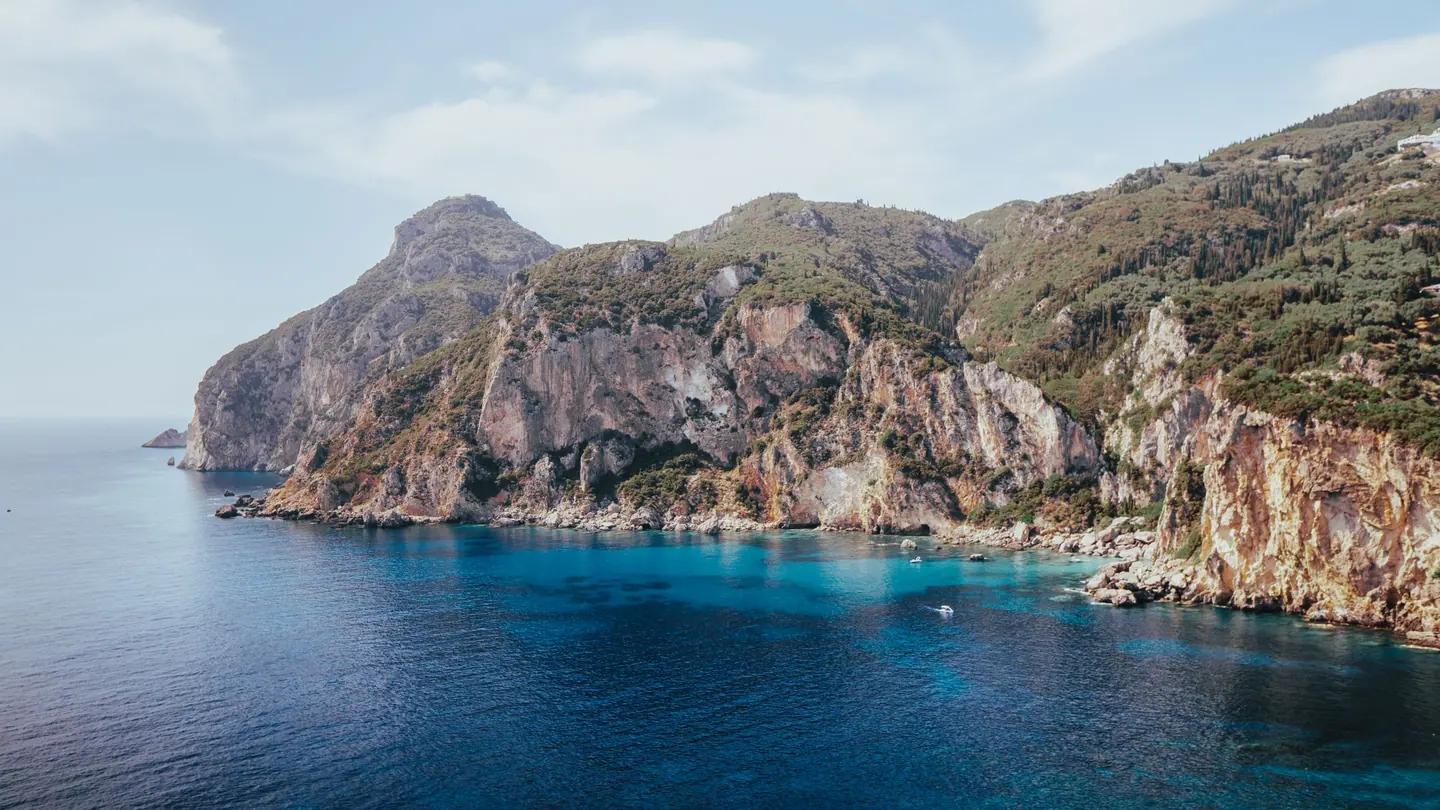
Achilleion Palace, Paleokastritsa, Angelokastro & Kassiopi
Achilleion Palace of Empress Elisabeth (Sisi) of Austria in Gastouri, Dying Achilles & Triumphant Achilles Statues, Kaiser’s Bridge, Benitses Roman Baths, Pelekas Kaiser’s Throne, Paleokastritsa 13th-Century Monastery & Emerald Coves, Angelokastro Byzantine Cliff Castle, Old Perithia, and Kassiopi Castle
Achilleion Palace
Commissioned in 1890 by Empress Sisi, this grand Pompeian-style residence honours her obsession with classical Greek mythology and Achilles. Visitors can inspect frescoed reception halls, ornate reception rooms, and sweeping terraced gardens overlooking the Ionian Sea. The property later served as a military hospital and a high-stakes casino.
Statue of the Dying Achilles
Forming the emotional focal point of the lower palace gardens, this 1884 white marble masterpiece portrays the Greek hero attempting to extract the mortal arrow from his heel. Empress Sisi personally selected the piece, identifying closely with Achilles' tragic vulnerability. The work remains an exceptional example of late nineteenth-century romantic neoclassicism.
Statue of Triumphant Achilles
Standing over eleven metres tall atop its pedestal, this colossal bronze statue was installed in 1909 by Kaiser Wilhelm II to replace the melancholic atmosphere left by Empress Elisabeth. Cast by Johannes Götz, the towering warrior faces north toward Corfu Town clad in hoplite armour, spear raised defiantly above the palace terrace.
Peristyle of the Muses
This elegant courtyard colonnade features statues of the nine muses alongside busts of ancient Greek philosophers and poets. Designed to resemble an ancient Athenian stoa, the terrace offers shaded vistas over the eastern coastline. The detailed ceiling frescoes above the walkway depict mythological scenes painted by Italian artist Galoppi.
Kaiser's Bridge
Built by Kaiser Wilhelm II in the early twentieth century, this stone bridge formerly spanned the coastal road to link the Achilleion gardens directly to his private imperial yacht. The central stone arch was dismantled during the Second World War to allow military vehicle clearance, leaving the picturesque stone abutments directly beside the sea.
Roman Baths of Benitses
Uncovered behind the coastal village of Benitses, these preserved ruins reveal a sophisticated Roman bathhouse dating from the third century AD. Surviving structures display brick heating chambers, hypocaust pilings, and geometric floor mosaics. The site demonstrates the enduring appeal of Corfu's sheltered eastern shoreline as an ancient recreation retreat.
Kaiser's Throne
Perched on a craggy summit above Pelekas, this stone lookout was a favourite retreat for Kaiser Wilhelm II, who ascended here regularly to watch the sunset over the western Ionian Sea. The platform commands uninterrupted 360-degree views across the central Ropa Valley, Corfu Town's fortresses, and the western cliffs.
Church of the Panagia in Pelekas
Situated in the central square of historic Pelekas village, this church serves as the community's spiritual heart. Built in classic Ionian style, it features an imposing single-nave hall, ornate gilded wood iconostasis, and an elevated stone bell tower. The interior houses revered local icons dating from the eighteenth and nineteenth centuries.
Monastery of Paleokastritsa
Perched high on a rocky promontory above turquoise bays, this active monastery was established in 1228, though its current buildings date primarily from the eighteenth century. The complex contains whitewashed courtyards, a richly decorated church with post-Byzantine icons, an ancient olive press, and a small ecclesiastical museum preserving precious clerical vestments.
Paleokastritsa Harbour and Grottoes
Renowned in antiquity as a plausible location for the Homeric city of the Phaeacians, this natural harbour encompasses six distinct coves backed by pine-covered limestone cliffs. The surrounding headlands conceal marine grottoes hollowed by the sea, including the famous Blue Eye cavern, where clear turquoise waters reveal intricate subterranean rock formations.
Angelokastro
Erected in the thirteenth century by the Despotate of Epirus, this clifftop stronghold was one of the most critical defensive citadels on the Ionian Sea, repelling Ottoman sieges in 1537 and 1571. Visitors climb a steep winding pathway to explore ancient vaulted cisterns, defensive gatehouses, and the rock-hewn Church of the Archangel Michael.
Church of Saint Kyriaki at Angelokastro
Tucked inside an ancient natural cave near the summit of Angelokastro, this tiny hermitage chapel features surviving traces of eighteenth-century frescoes painted directly onto the stone. The chapel served as a sanctuary for castle defenders during prolonged maritime sieges, preserving rock-cut graves that predate the medieval fortifications.
Old Perithia
Established in the fourteenth century as a refuge from pirate raids along the coast, this historic settlement contains roughly 130 stone houses arranged beneath Mount Pantokrator. Abandoned during the mid-twentieth century as coastal tourism grew, the village remains an atmospheric open-air museum of Venetian civil architecture surrounded by eight historic churches.
Church of Saint James the Persian in Old Perithia
Standing prominently at the approach to Old Perithia, this distinguished red-accented church boasts a monumental belfry supported by a vaulted archway. Inside, visitors can observe remarkable post-Byzantine wall paintings and an authentic wooden icon screen. The building remains the most prominent of the eight historical chapels enclosing the settlement.
Kassiopi Castle
Dominating the headland above Kassiopi, this fortress traces its roots to the sixth century AD, serving as a defensive linchpin overlooking the maritime channel between Corfu and modern Albania. The site retains formidable perimeter walls, ruined rectangular bastions, and a massive central gatehouse, having withstood numerous assaults before being deliberately slighted by the Venetians.
Church of Panagia Kassopitra
Constructed on the foundations of an ancient temple dedicated to Zeus Kassios, this church has been an important maritime shrine for centuries. Rebuilt by the Venetians in 1590 after Ottoman destruction, the interior preserves a famed miracle-working icon of the Virgin Mary, a rare double altar serving both Orthodox and Catholic rites, and fine frescoes.
Mount Pantokrator Summit Monastery
Positioned at 906 metres above sea level, this historic monastery was first established in 1347, though the present stone structure was largely rebuilt in the late seventeenth century. The chapel interior is adorned with rich Orthodox iconography and a silver-leaf iconostasis. From the terrace, panoramic views extend across the entire island and mainland Greece.
Agios Georgios Pagon Bay
Carved into the northwestern coastline between dramatic headlands, this expansive crescent bay provided safe anchorage for merchant and fishing vessels over centuries. The surrounding slopes retain traditional terraced olive groves that date from the Venetian agricultural decrees, preserving a tranquil historic maritime landscape far from urban expansion.
Afionas Village and Porto Timoni Viewpoint
One of Corfu's oldest traditional settlements, Afionas is characterized by narrow stone alleys, whitewashed cottages, and flowering courtyards. A foot trail leads southwest from the village toward the double-sided bay of Porto Timoni, an ancient harbour where archaeologists have uncovered prehistoric flint tools and stone fortifications dating back to the classical period.
Krini Village and Angelokastro Gateway
Dating to the Byzantine period, Krini developed as the supply and garrison settlement directly supporting Angelokastro fortress. The village features authentic Ionian architecture, stone-paved lanes, and traditional olive storage houses. Its elevated public square offers uninterrupted views over the western coastal cliffs and the path leading to the fortress gates.
Walking the Campiello Lanes and Garitsa Bay in Corfu
Before setting out, check local transit connections, museum booking notes and monthly weather data in our Corfu city guide, and compare other walking itineraries.