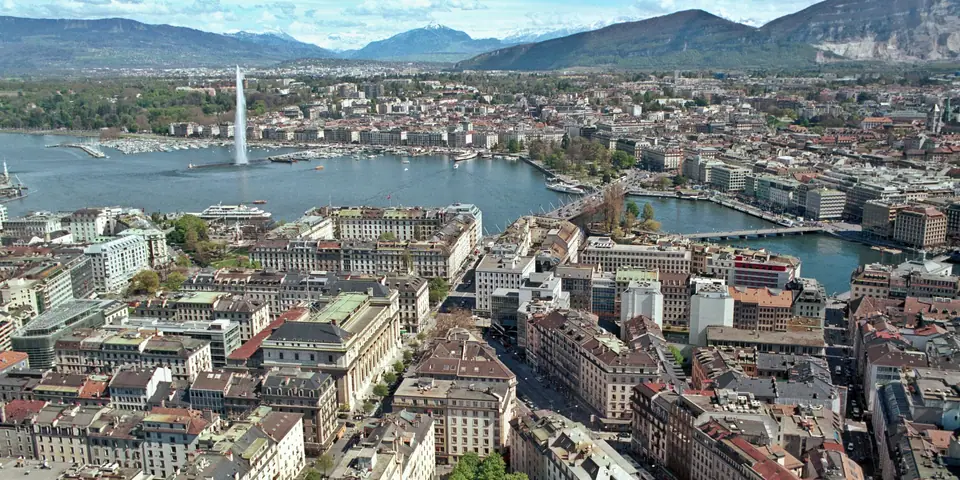
A detailed route from the hilltop Vieille Ville where the Rhône leaves Lake Geneva to the Jet d’Eau, Sardinian Carouge, the International Red Cross, and the United Nations.
Allobroges Oppidum, Calvin’s Republic, Watchmakers and the Red Cross
First described by Julius Caesar in 58 BC when he destroyed the wooden bridge over the Rhône at the Allobroges hilltop oppidum of Genava to block the Helvetii migration, the city became an early Christian bishopric in the fourth century and capital of the Kingdom of Burgundy. In 1536 Geneva proclaimed an independent republic and welcomed French theologian John Calvin, earning the title Protestant Rome and triumphing over the Duke of Savoy's night attack (L'Escalade) in December 1602.
Home to Jean-Jacques Rousseau and world haute horlogerie watchmaking, Geneva became the global seat of humanitarian diplomacy in 1863, 1864 when Henry Dunant founded the Red Cross and the First Geneva Convention was signed inside the Alabama Room of the Hôtel de Ville.
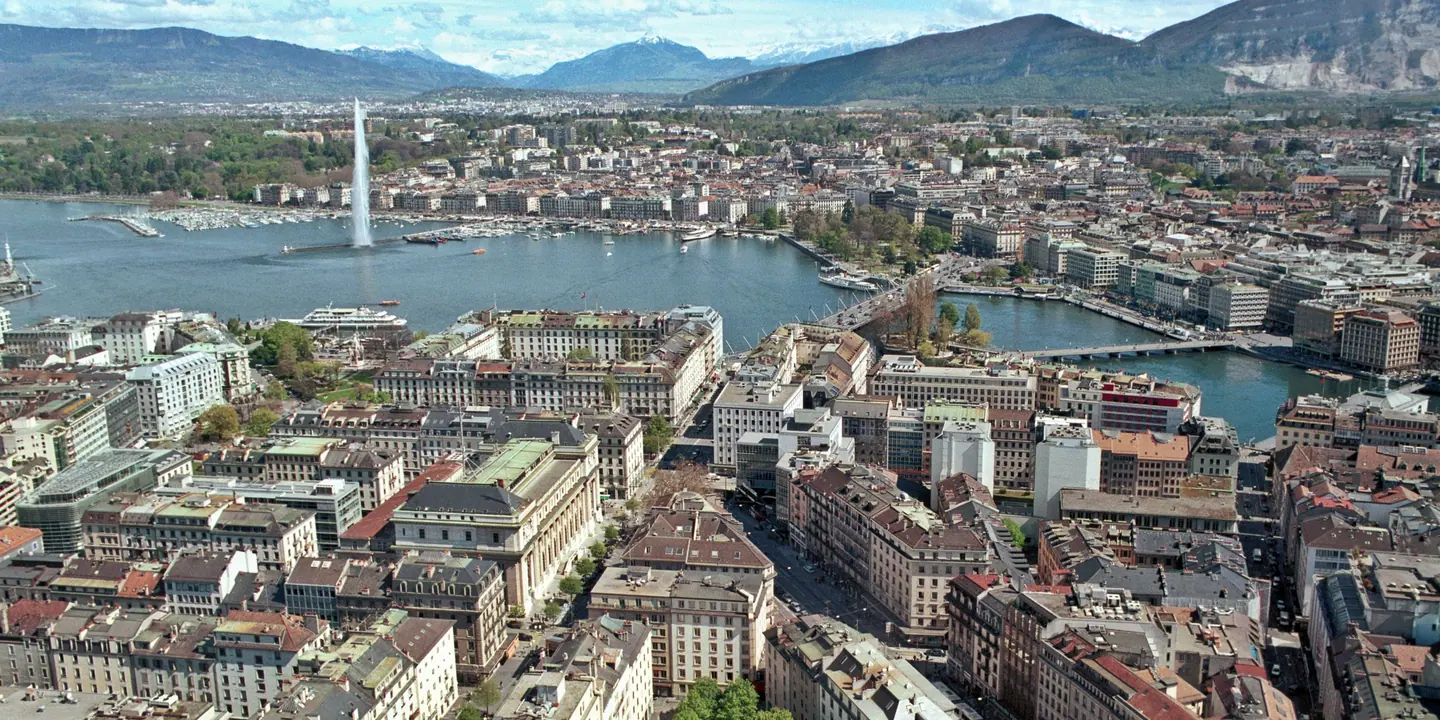
St Pierre Cathedral, Bourg-de-Four & Hilltop Vieille Ville
St Pierre Cathedral Tower Panorama & Archaeological Site Under the Cathedral, Chapel of the Maccabees, Calvin Auditorium, Place du Bourg-de-Four, Hôtel de Ville & Alabama Room, Old Arsenal Cannons & Mosaics, Maison Tavel (1334 oldest house), and Grand-Rue No. 40 Rousseau Birthplace
St Pierre Cathedral
Begun in the twelfth century, this cathedral combines Romanesque arches with Gothic vaulting and an eighteenth-century neoclassical portico. John Calvin preached here for decades, establishing Geneva as a major theological centre. Inside, visitors can inspect the plain wooden chair attributed to Calvin beside austere nave pillars stripped of pre-Reformation ornamentation.
Cathedral Towers Panorama
Ascending the stone spiral stairs of the north and south towers brings visitors above the Old Town roofs. The open-air wooden galleries offer expansive vistas stretching over Lake Geneva, the Jet d'Eau, and distant Alpine ridges. The historic bells, including the four-tonne bell cast in 1407, hang prominently within the belfry.
Archaeological Site of St Pierre Cathedral
Excavations beneath the cathedral floor reveal layers of urban occupation dating back to the Allobroges tribe. Walkways suspend visitors over early Christian baptisteries, fourth-century mosaics, and the crypt of an ancient bishop's palace. Informative displays explain how Roman grain warehouses and burial chambers evolved into Geneva's primary ecclesiastical complex.
Chapel of the Maccabees
Constructed between 1400 and 1405 by Cardinal Jean de Brogny, this chapel represents high Gothic artistry inside St Pierre. After serving as a salt warehouse and lecture hall during the Reformation, it underwent nineteenth-century restoration in the neo-Gothic style. The ceiling features painted musician angels against a deep blue field, complemented by carved woodwork.
Calvin Auditorium
Erected in the fifteenth century on the foundations of a fifth-century sanctuary, this compact Gothic church initially served as the Church of Notre-Dame-la-Neuve. During the Reformation, Calvin used it for biblical lectures, and Scottish reformer John Knox ministered to English-speaking refugees here. Today it continues to host international Reformed church services.
Place du Bourg-de-Four
This irregular square occupies the site of the ancient Roman forum and cattle market outside the city fortifications. Surrounded by tall sixteenth to eighteenth-century tenement houses, the space is anchored by an eighteenth-century marble fountain adorned with flowers. Cobblestone pavements and traditional café terraces define the pedestrian perimeter today.
Geneva City Hall
Dating from the sixteenth and seventeenth centuries, the Hôtel de Ville displays distinctive Renaissance facades and an interior courtyard. A famous spiralling cobbled ramp allowed civic magistrates to ride on horseback directly up to council chambers on the upper floors. The complex has hosted Genevan political debates and diplomatic assemblies for centuries.
Alabama Room
Situated on the ground floor of the Hôtel de Ville, this historic hall witnessed the 1864 signing of the original Geneva Convention, founding the Red Cross. In 1872, an international arbitration tribunal met here to settle the diplomatic Alabama Claims dispute between the United States and Britain. The preserved furnishings reflect nineteenth-century international diplomacy.
Old Arsenal
Constructed as an open grain granary in the early seventeenth century, this vaulted portico later served as a military artillery store until 1877. Five historic bronze cannons stand in a row under the stone arches, guarded by colourful twentieth-century wall mosaics by Alexandre Cingria depicting key events in Geneva's history, including Julius Caesar's arrival.
Maison Tavel
Rebuilt after a severe fire in 1334, Maison Tavel stands as the oldest surviving private residence in Geneva, complete with medieval battlements and carved stone corbels. Inside, six floors of exhibits trace daily domestic life and civic history from the Middle Ages onward. The attic houses the Magnin relief map, a large copper and zinc model of the city in 1850.
Jean-Jacques Rousseau Birthplace
The philosopher Jean-Jacques Rousseau was born in this tall townhouse on 28 June 1712, where his father operated a watchmaking workshop. The building now functions as the Maison de Rousseau et de la Littérature, hosting audio installations exploring his political and educational thought. The narrow facade reflects typical eighteenth-century domestic architecture of the upper Old Town.
Grand-Rue
Grand-Rue is one of the best-preserved medieval streets in Geneva, following the high ridge of the hill above the lake. Its tall facades hide internal courtyards, spiral staircases, and historic workshops formerly inhabited by goldsmiths and engravers. A stroll along the street reveals classical doorways, heraldic emblems, and small independent bookshops.
Palais de Justice
Located on the southern flank of Place du Bourg-de-Four, this imposing structure served as a convent for the Poor Clares until the Reformation drove them to Annecy in 1535. The building subsequently became a general hospital before its nineteenth-century conversion into Geneva's primary law courts. Its classical colonnaded facade reflects administrative authority.
Statue of Philibert Berthelier
Erected near the base of the Old Town slopes, this monument commemorates Philibert Berthelier, who fought to protect Geneva's civic liberties against the Duke of Savoy. Beheaded in 1519 for his defiance, Berthelier became an enduring symbol of Genevan sovereignty. The statue captures the statesman in dignified renaissance attire.
Treille Promenade
Positioned atop the old city ramparts south of City Hall, this tree-shaded promenade dates from the sixteenth century. It is known for its green chestnut trees and the 120-metre wooden bench installed in 1767, which spans the length of the terrace. From here, visitors enjoy views across the Bastions Park and towards Mount Salève.
Tour Baudet
Integrated into the southwest corner of the City Hall complex, this fourteenth-century tower remains a fortified symbol of Genevan municipal authority. The tower houses the council room where the State Council of the Republic and Canton of Geneva convenes. Its heavy masonry walls contrast with the lighter Renaissance facades added during later renovations.
Rue de l'Hôtel-de-Ville
Connecting Place du Bourg-de-Four to the City Hall, this gently sloping street was the administrative heart of old Geneva. Notable seventeenth and eighteenth-century stone residences flank the pavement, showcasing wrought-iron balconies and arched carriage gates. Several buildings house foreign consular offices, municipal archives, and government departments.
Terrasse Saint-Pierre
This open stone terrace sits directly before the classical portico of St Pierre Cathedral on the highest elevation of the hill. Flanked by mature trees and period lampposts, it provides a quiet viewpoint overlooking the red-tiled roofs of the lower town. Archaeologists identified early Roman temple foundations beneath these perimeter flagstones.
Rue des Granges
Historically inhabited by Geneva's patrician families, Rue des Granges is widely considered the city's most aristocratic residential street. Behind high stone carriage portals lie quiet private courtyards and neoclassical hôtels particuliers built from French Molasse sandstone. The street preserves an elegant atmosphere distinctly separated from the commercial districts down the hill.
Passage des Degrés-de-Poules
This steep flight of covered and uncovered stone stairs winds upwards from the historic Place du Bourg-de-Four directly to the south entrance of St Pierre Cathedral. Its name derives from an old French phrase referencing chicken steps. The narrow passage illustrates how medieval Genevans navigated the steep terrain between marketplace and cathedral.
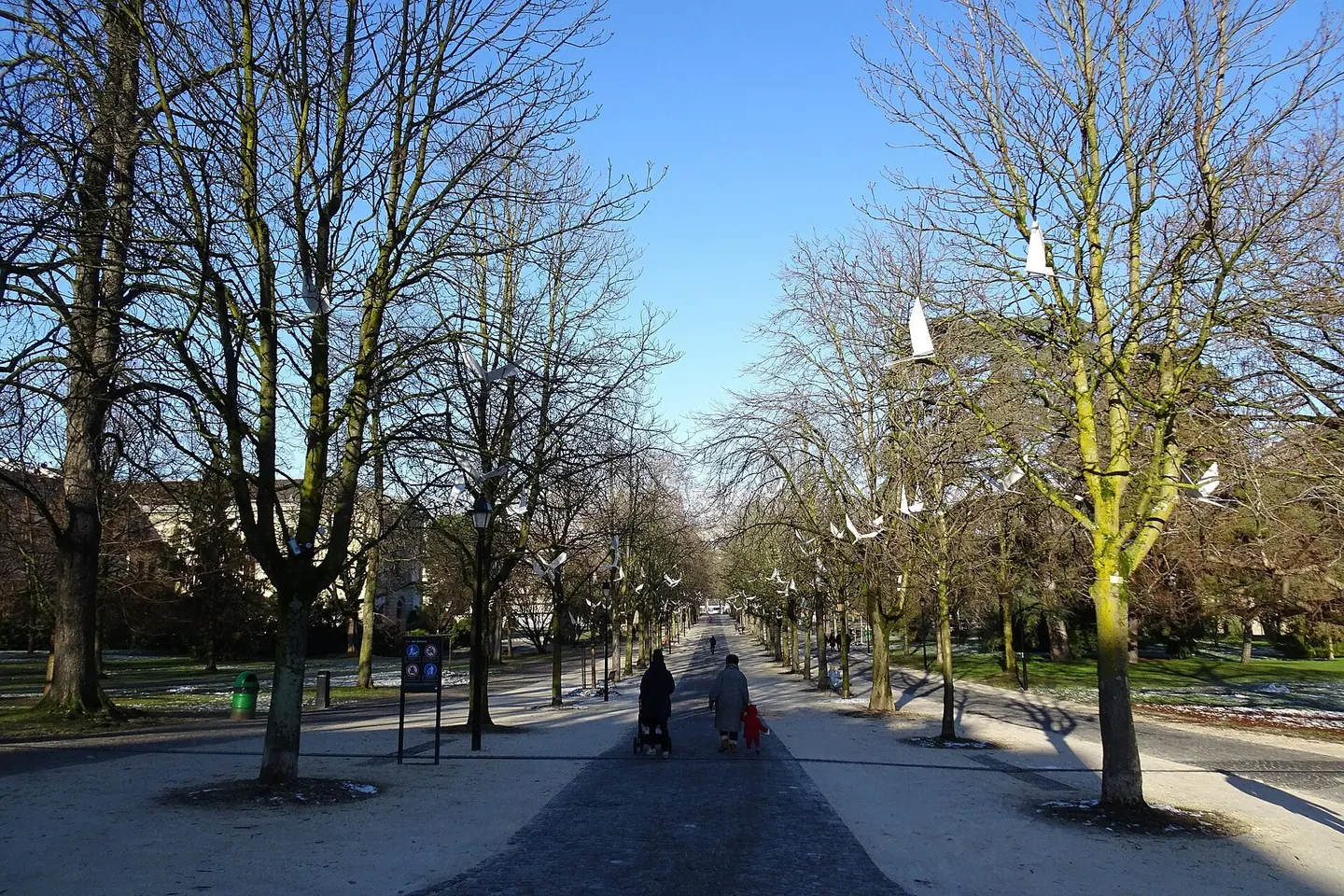
Promenade de la Treille, Bastions Park & Art Museums
Promenade de la Treille (World’s Longest Wooden Bench, 120m), Place de Neuve, Grand Théâtre de Genève, Rath Museum, Parc des Bastions, Reformation Wall Monument International de la Réformation, Palais Eynard, and Musée d’Art et d’Histoire MAH
Promenade de la Treille
Dating from the sixteenth century, this shaded promenade once formed part of the city fortifications. Visitors come to rest on the famous 120-metre wooden bench, installed in 1767, and inspect the official chestnut tree whose first spring bud traditionally heralds the changing season.
Parc des Bastions
Established on the site of Geneva's former botanic garden, this expansive park features tree-lined avenues and historic statues. Near the northern gate, travellers can observe residents playing on oversized outdoor chessboards, surrounded by mature trees that shield the lawns from city traffic.
Reformation Wall
Built into the old defensive ramparts in 1909, this grand stone monument marks the fourth centenary of John Calvin's birth. The central bas-relief depicts Calvin alongside William Farel, Theodore Beza and John Knox, carved beneath the historic motto of Geneva, Post Tenebras Lux.
Palais Eynard
Constructed between 1817 and 1821 for the financier Jean-Gabriel Eynard, this stately palace reflects Florentine neoclassical architectural traditions. The building borders Parc des Bastions, featuring a colonnaded facade and ornate interior reception rooms reserved for official civic receptions and meetings of the administrative council.
Place de Neuve
Positioned just outside the perimeter of the ancient city ramparts, this square acts as the cultural heart of Geneva. An equestrian statue of General Guillaume-Henri Dufour stands in the centre, encircled by prestigious nineteenth-century performance halls, fine art venues and the entrance to Parc des Bastions.
Grand Théâtre de Genève
Opened in 1876, this opera house mirrors the Second Empire styling of the Palais Garnier in Paris. The building underwent extensive reconstruction following a major fire in 1951, preserving its classical facade adorned with statues representing tragedy, music, dance and comedy.
Musée Rath
Designed by architect Samuel Vaucher and opened in 1826, this temple-like building features a monumental Corinthian portico. Originally founded with funds bequeathed by General Simon Rath, the institution now hosts temporary cultural and historical exhibitions managed by the Musée d'Art et d'Histoire.
Conservatoire de Musique de Genève
Founded in 1835 by François Bartholoni, this institution occupies a fine neoclassical building erected between 1856 and 1858. As the oldest music conservatory in Switzerland, the hall boasts exquisite acoustic performance spaces and ornate stonework framing its central entrance on the square.
Musée d'Art et d'Histoire
Completed in 1910 by Marc Camoletti, this massive museum occupies a full city block in the Les Tranchées quarter. The collections span fine art, regional archaeology, decorative pieces and weaponry, highlighted by Konrad Witz's famous 1444 altarpiece, The Miraculous Draught of Fishes.
Eglise Russe
Built between 1863 and 1866 in the Muscovite style, this church features five striking gilded domes that rise above the surrounding residential quarter. The interior is decorated with intricate nineteenth-century frescoes, marble iconostases and historic icons donated by prominent members of the imperial Russian diaspora.
Maison Tavel
Rebuilt by the Tavel family after a fire in 1334, this fortified townhouse exemplifies medieval domestic architecture with its turrets and limestone facade. Inside, the museum illustrates local urban history, culminating in the Relief Magnin, a detailed three-dimensional copper and wood model of pre-1850 Geneva.
St. Pierre Cathedral
Constructed over centuries beginning in the twelfth century, this cathedral displays a prominent eighteenth-century neoclassical portico. Inside, visitors can view John Calvin's simple wooden chair, while the north and south towers provide panoramic views across the rooftops towards Lake Geneva.
Auditoire de Calvin
Constructed on fifth-century Christian foundations, this modest Gothic chapel was acquired by the city during the Reformation. Calvin and John Knox preached and lectured here, transforming it into an influential theological school and a sanctuary for refugee Protestant congregations from across Europe.
Geneva City Hall
Seat of the cantonal government, this complex features a sixteenth-century cobbled spiral ramp designed to allow equestrian access directly to the upper chambers. The historic Alabama Room on the ground floor hosted the signing of the first Geneva Convention in 1864.
Tour Baudet
Dating to 1455, this fortified stone tower represents the oldest intact element of the Geneva municipal complex. The tower's council room contains historic tapestries and stained glass, having accommodated meetings of the Republic's governing bodies continuously for more than five hundred years.
Ancien Arsenal
Originally built as an open grain granary in the fifteenth century, this stone loggia was later converted into an arms depot. Today, several seventeenth- and eighteenth-century bronze cannons line the covered arcade beneath colourful wall mosaics that illustrate critical chapters of Genevan civic history.
Statue of Jean-Jacques Rousseau
Situated on a tiny wooded island at the outflow of Lake Geneva, this bronze monument was sculpted by James Pradier in 1835. The statue commemorates the Enlightenment philosopher Jean-Jacques Rousseau, seated pensively with scroll and pen amidst poplars that evoke his resting place in Ermenonville.
Victoria Hall
Erected between 1891 and 1894 by the British consul Daniel FitzGerald Pakenham Barton, this hall pays tribute to Queen Victoria. The lavishly gilded auditorium features red velvet stalls and an intricate ceiling fresco, serving as a primary performance space for the Orchestre de la Suisse Romande.
Bâtiment d'art contemporain
Occupying a 1950s precision engineering laboratory in the Plainpalais district, this industrial brick complex houses the MAMCO and the Centre d'Art Contemporain. The open post-industrial spaces retain exposed concrete beams and raw floors, hosting innovative installations by international artists.
Plainpalais
Created by draining marshland alongside the Arve river, this seven-hectare open plain serves as a venue for open-air markets, circuses and carnivals. The northern corner features a bronze sculpture of Frankenstein's monster, commemorating Mary Shelley's gothic novel, which set pivotal scenes on this very ground.
Rhône Bridges, Horlogerie, Jet d’Eau & Lake Geneva Rade
Pont des Bergues & Rousseau Island, Cité du Temps, Pont du Mont-Blanc, English Garden & Flower Clock L’Horloge Fleurie, Jet d’Eau (140-Metre Water Plume), Bains des Pâquis Pier & Lighthouse, Brunswick Monument, and Parc de la Perle du Lac & History of Science Museum
Pont des Bergues
Constructed in 1834, this stone and iron footbridge spans the Rhône where Lake Geneva narrows into the river. It offers open vistas across the harbour and connects directly to Île Rousseau via a central branch. Travellers often pause here to observe swans gathering near the old sluices.
Île Rousseau
Originally an armed bastion defending the waterway in the sixteenth century, this small island was later dedicated to the Geneva-born philosopher Jean-Jacques Rousseau. At its centre stands a bronze statue sculpted by James Pradier in 1835. Poplar trees provide shaded paths overlooking the calm river currents.
Pont de la Machine
Erected in the 1840s, this structure once housed the mechanical pumps that supplied domestic water to the city centre. Today, the pedestrian walkway retains its distinctive iron frame while functioning as an exhibition venue and information pavilion. Visitors cross over the churning waters of the regulated Rhône outlets.
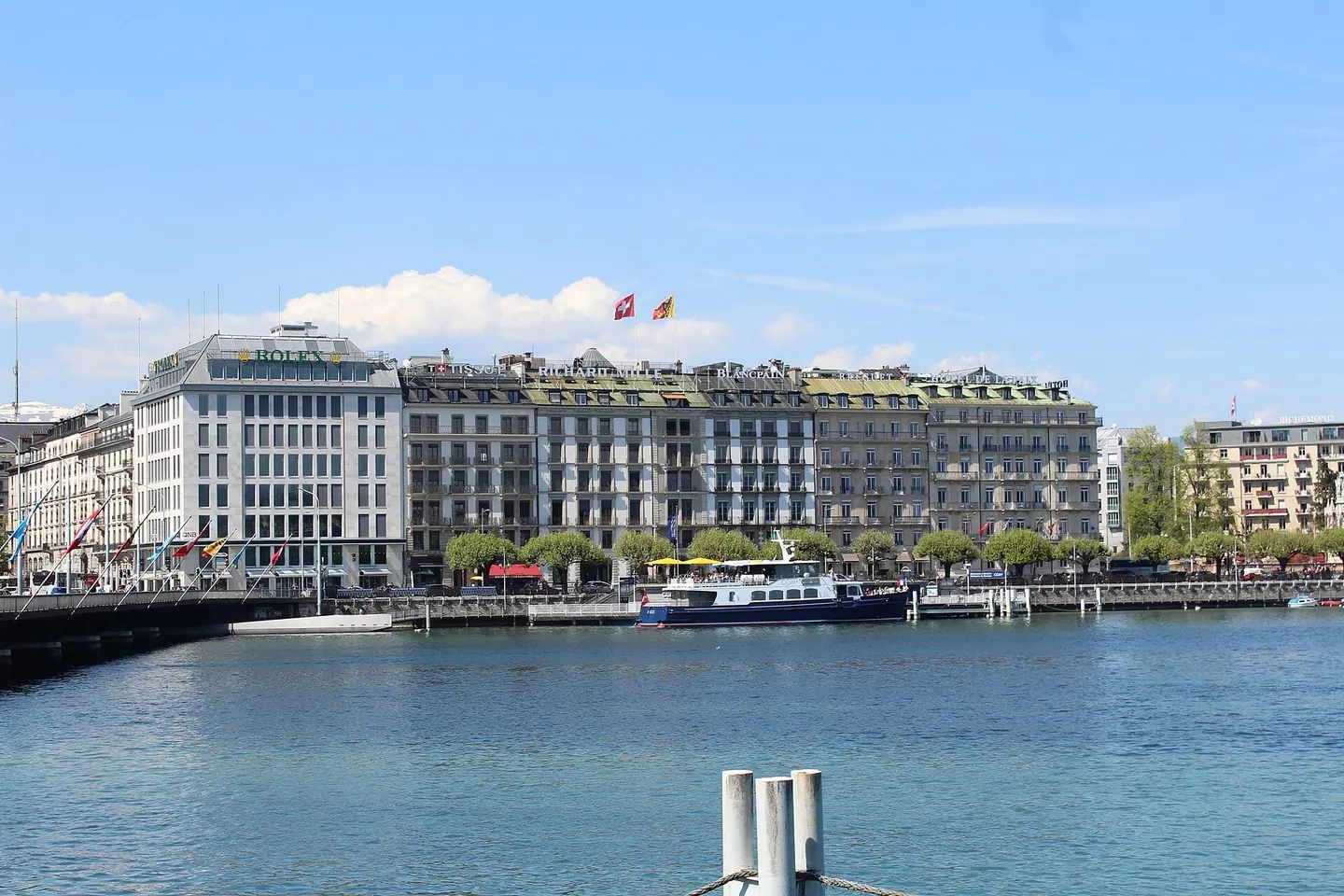
Pont du Mont-Blanc
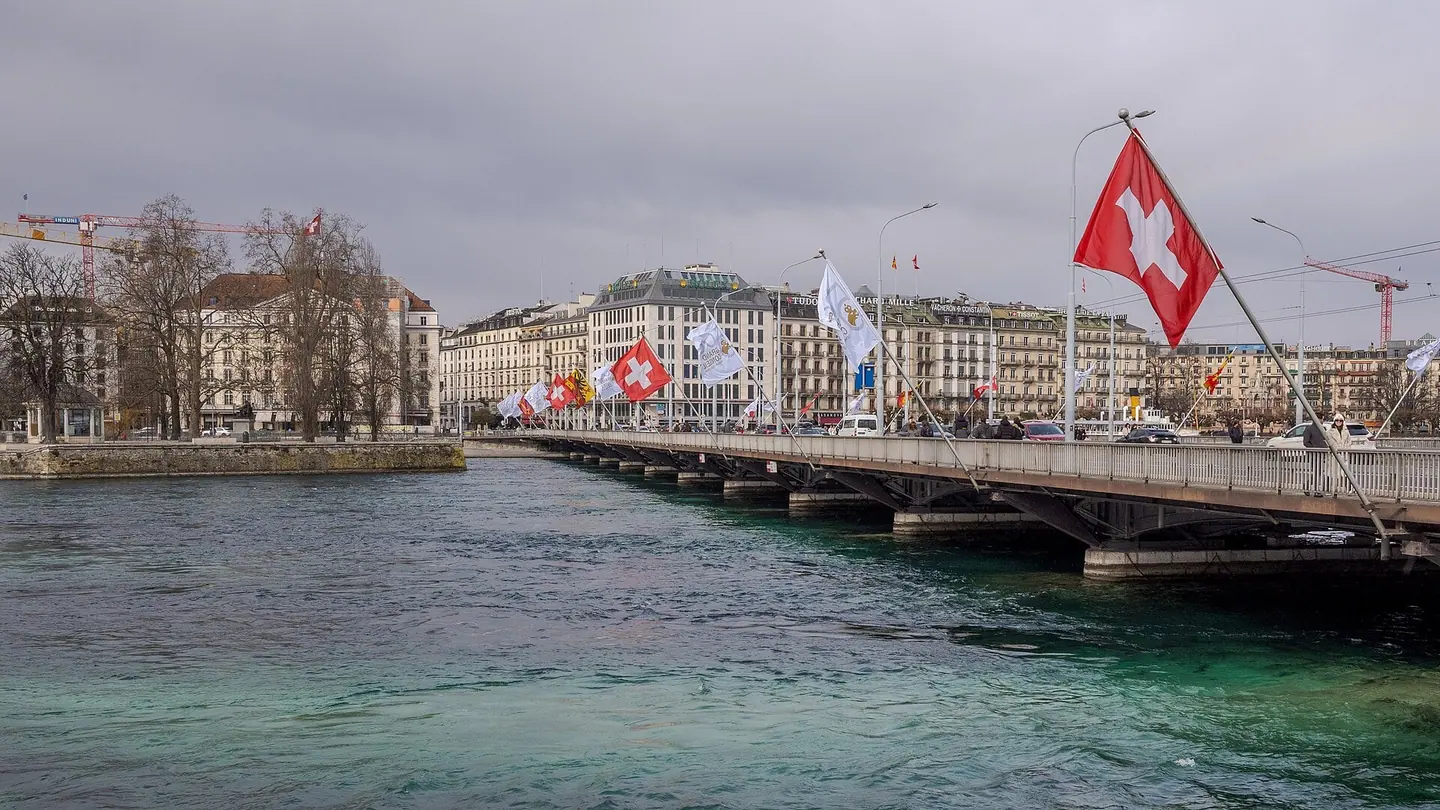
Dating back to 1862 and rebuilt in the 1960s, this wide bridge marks the geographical entrance to Lake Geneva's harbour basin. Lines of cantonal banners flutter along its parapets during national celebrations and diplomatic summits. On clear mornings, the snow-draped peak of Mont Blanc is visible in the distant south.
L'Horloge Fleurie
Created in 1955 inside the English Garden, this functional outdoor timepiece features thousands of flowering plants that change across the seasons. Its mechanical workings, connected via satellite signal, drive long metal hands that sweep across terraced floral beds. The monument directly honours the centuries of regional watchmaking excellence.
Jardin Anglais
Established in 1854 on reclaimed land along the quayside, this park exemplifies nineteenth-century landscape design with winding pathways and mature specimen trees. It houses a classical bandstand alongside fountains and monumental sculptures. Promenaders frequently gather along its perimeter railings to admire boat traffic on the open water.
Monument National
Unveiled in 1869, this bronze monument stands at the edge of the Jardin Anglais facing the harbour. Sculpted by Robert Dorer, it depicts two proud female figures symbolising Geneva and Helvetia standing arm in arm. The sculpture commemorates the formal entry of the Republic of Geneva into Switzerland in 1815.
Jet d'Eau
Originally installed as a hydraulic safety release valve in 1886, this landmark was relocated to its current jetty in 1891. Powerful electric pumps shoot 500 litres of water per second to an altitude of 140 metres. The plume forms a visible landmark across the city and casts fine mist over nearby piers.
Bains des Pâquis
Constructed in the 1870s and rebuilt in the 1930s, this public bathhouse extends directly into the harbour waters from the right bank. The complex features timber sun decks, outdoor swimming pens, and traditional saunas frequented throughout the seasons. The pier also hosts a community café serving refreshments beside the lake.
Phare des Pâquis
Erected in 1894 at the far tip of the Pâquis jetty, this slender white beacon guides watercraft entering the port from open waters. The tower features classic marine stonework topped by a painted lantern room. Visitors walk the length of the granite pier to look back across the city skyline.
Brunswick Monument
Erected in 1879 inside the Jardin des Alpes, this grand tomb honours Charles II, Duke of Brunswick, who bequeathed his fortune to Geneva. Modelled directly on the Scaliger Tombs of Verona, the monument showcases pointed arches, carved heraldry, and marble gargoyles. An equestrian statue crowns the multi-tiered hexagonal canopy.
Rotonde du Mont-Blanc
This curved platform along Quai du Mont-Blanc provides clear perspectives over passing paddle steamers and private yachts. Lined with plane trees and carved balustrades, it serves as a central meeting place along the north shore. A bronze plaque marks the area near where Empress Elisabeth of Austria was fatally attacked in 1898.
Parc Mon Repos
Once a private aristocratic country seat, this peaceful park features neoclassical pavilions and vast sloping lawns descending toward the shoreline. Shaded alleys are flanked by centenarian beech and cedar trees planted in the early 1800s. Travellers walk the broad paths to explore quiet courtyards away from vehicular traffic.
Musée d'Histoire des Sciences de la Ville de Genève
Housed within Villa Bartholoni, an elegant 1830 mansion with frescoed ceilings, this museum displays historic scientific instruments. The collection includes brass astrolabes, antique microscopes, and apparatus used by Swiss naturalists Horace-Bénédict de Saussure and Marc-Auguste Pictet. The surrounding lawns of Perle du Lac offer views towards the Alps.
Parc de la Perle du Lac
Named by the wife of poet François Le Fort, this landscaped green space contains mature arboreal specimens and ornate flowerbeds. Gravel paths weave between decorative ponds and sloping lawns that host summer cultural events. Its waterfront perimeter allows uninterrupted views across the water towards the distant Dents du Midi.
Patek Philippe Museum
Occupying a restored industrial Art Deco building, this institution displays four centuries of European timekeeping history. The galleries present enamelled pocket watches, automata, complex music boxes, and historic timepieces designed by Genevan artisans since the sixteenth century. A specialised library houses extensive archives on horological arts.
Cité du Temps
Located within the historic pump station building, this gallery regularly hosts temporary artistic displays and design showcases. Large glass windows allow visitors to watch the swift waters of the Rhône rushing directly beneath the structure. It links the historic banking district with the commercial retail boulevards of the right bank.
Tour de l'Île
This robust stone tower is the sole remnant of a thirteenth-century fortress built by the Bishop of Geneva to defend the strategic river crossing. Incorporated into modern bridge infrastructure, it stands beside contemporary municipal offices and small squares. A bronze plaque commemorates Julius Caesar's destruction of the original wooden bridge in 58 BC.
Quai Gustave-Ador
Stretching along the southern shore of the lake basin, this broad promenade is shaded by rows of mature trees. It offers front-row perspectives of the Jet d'Eau and provides pedestrian access to moored passenger ferries. Imposing late-nineteenth-century apartment buildings flank the eastern side of the thoroughfare.
Pierres du Niton
Emerging from the shallow water of the harbour, these two natural granite stones were deposited during the last ice age by the Rhône glacier. The higher stone serves as the official national datum for all topographic height measurements throughout Switzerland, fixed by engineer Guillaume-Henri Dufour in 1845. Bronze markings commemorate this surveying role.
Plainpalais, Patek Philippe Museum & Sardinian Carouge
MAMCO Contemporary Art Museum, Patek Philippe Museum (Five Centuries of Watchmaking), Musée d’Ethnographie de Genève MEG, Jonction Confluence of the Clear Rhône and Grey Arve Rivers, and Carouge 18th-Century Turinese Arcaded Town across the Arve
MAMCO Geneva
Housed in a decommissioned 1950s machine manufacturing plant, this modern art institution opened in 1994. The vast galleries retain original concrete beams and expansive floorplates, displaying pioneering post-1960 conceptual, minimal, and kinetic works. Visitors can observe site-specific installations and frequently rotated temporary displays that transform the industrial heritage interior.
Centre d'Art Contemporain Genève
Sharing the historic industrial complex with MAMCO, this dynamic exhibition space was founded in 1974 as Geneva's premier venue for avant-garde art. It operates without a permanent collection, focusing instead on emerging artists, international project commissions, and the Biennale of Moving Images. The stark white halls highlight innovative video, sculpture, and performance.
Patek Philippe Museum
Occupying a restored 1920s industrial building in the Plainpalais district, this museum showcases the mastery of Swiss and European horology. The collection spans sixteenth-century enamelled pocket watches, complex musical automata, and significant antique timepieces crafted by Patek Philippe since 1839. An extensive horological library and artisan workshops demonstrate traditional enamelling and engraving skills.
Musée d'Ethnographie de Genève
Founded in 1901 by anthropologist Eugène Pittard, the institution moved into its striking contemporary premises designed by Graber Pulver Architekten in 2014. The exterior features an aluminium-clad facade evoking woven textures, while the subterranean galleries preserve over 80,000 artefacts from five continents. Key exhibits include intricate ceremonial masks, Amazonian featherwork, and Oceanic navigational charts.
Plaine de Plainpalais
Covering roughly eleven hectares, this large open esplanade was reclaimed from swampy floodplains outside the city ramparts in the seventeenth century. Bordered by towering plane trees, it functions as Geneva's premier civic gathering place, hosting twice-weekly flea markets and major circuses. A prominent concrete skate park occupies the northern corner alongside pedestrian walkways.
Frankenstein's Monster Statue
Erected in 2014 by the contemporary artists collective KLAT, this life-sized bronze figure stands on the eastern side of Plainpalais. It marks the fictional location where Mary Shelley's creature first appeared after escaping victor Frankenstein's laboratory during the stormy summer of 1816. The gaunt, ragged depiction serves as a dark tribute to Geneva's romantic literary heritage.
Cimetière des Rois
Established in 1469 as a burial ground for plague victims, this peaceful wooded precinct became the city's resting place for distinguished civic and cultural leaders. Shaded pathways wind past the simple graves of theologian John Calvin, writer Jorge Luis Borges, and child psychologist Jean Piaget. Sculpted tombstones and mature yew trees give the cemetery a solemn character.
Théâtre de Carouge
Founded in 1958, this acclaimed municipal playhouse underwent a comprehensive reconstruction completed in 2021 by Pont12 Architectes. The complex features an elegant brick and glass facade that dialogues harmoniously with the low-rise historic streetscape. Two state-of-the-art auditoriums host contemporary European drama, classical French theatre, and experimental productions throughout the season.
Musée de Carouge
Located inside the eighteenth-century Maison Montanier, this intimate museum explores the origins of Carouge as an Enlightenment planned city. King Victor Amadeus III of Sardinia commissioned Italian architects to construct the town to rival Geneva in trade and craftsmanship. The exhibits showcase local faience pottery, architectural blueprints, period furniture, and paintings of early tradespeople.
Église Sainte-Croix de Carouge
Designed by Piedmontese architect Placido Valfrè and built between 1777 and 1780, this classical church anchors the town's monumental civic axis. Its facade features four massive Tuscan columns supporting a pediment, while the later onion-domed bell tower was added in 1826. Inside, the barrel-vaulted nave displays marble altars and a remarkable carillon of bells.
Place du Marché de Carouge
This expansive public square reflects the classical grid layout established by Piedmontese urban planners in the late eighteenth century. A central stone fountain with a carved marble basin provides a focal point, shaded by symmetrical rows of plane trees. The square hosts historic farmers' markets and remains surrounded by low-rise Sardinian houses with interior courtyards.
Place de Sardaigne
Named after the historic kingdom that created the modern town, this quiet square reflects the Mediterranean domestic architecture imported during the late 1700s. The surrounding houses feature typical carriage gates leading to hidden garden courtyards where craftsmen and blacksmiths once worked. Cobbled footpaths and street lamps echo the town's distinct southern European heritage.
Pointe de la Jonction
At this narrow peninsula tip, the turquoise waters emerging from Lake Geneva collide with the chalky, sediment-rich grey waters of the Alpine Arve river. The two streams flow side by side for hundreds of metres before fully blending, creating a striking two-tone aquatic boundary. Shaded public benches and viewing platforms make it a popular spot for walkers.
Viaduc de la Jonction
Constructed in 1945 to connect the railway network between Cornavin and La Praille, this monumental reinforced-concrete viaduct towers over the river confluence. A pedestrian walkway runs alongside the railway tracks, providing elevated panoramic perspectives across the meeting of the two rivers. The surrounding riverbanks feature public parks, willow trees, and summer swimming platforms.
Usine de Chavanne
Dating back to the late nineteenth century, these brick and cast-iron industrial buildings along the Rhône once powered municipal hydraulic services. Today, the complex forms part of Geneva's alternative arts network, housing independent artist studios, music halls, and community workshops. The weathered facade and riverfront promenades demonstrate the working-class industrial history of the Jonction quarter.
Pont des Acacias
Linking Plainpalais with the industrial and commercial district of Les Acacias, this multi-span bridge offers views over the rapid currents of the Arve. Built in modern concrete and steel, it accommodates Geneva's expanding tramway network. Pedestrians can observe the seasonal flow of grey meltwater originating high in the Mont Blanc massif.
Pont de Carouge
Erected between 1811 and 1816 over the Arve, this robust stone bridge was commissioned during the Napoleonic administration to replace earlier wooden crossings. Its ashlar masonry arches sustained vital commerce between Protestant Geneva and Catholic Carouge. Today, stone balustrades frame views of the fast-flowing river, providing an entry threshold into the old town.
Fontaine de Carouge
Carved from Jura limestone, this classical fountain was installed in 1790 to supply fresh drinking water to the burgeoning merchant community. The central column is adorned with sculpted water-spouting masks and topped by an ornamental urn, flowing into a broad octagonal basin. It remains an enduring gathering place during market mornings.
Église du Sacré-Cœur, Geneva
Constructed in the late nineteenth century to serve Geneva's growing Roman Catholic population, this substantial red-brick basilica displays rounded arches and carved stone mouldings. The interior features high timber roof trusses, an ornate central altar, and stained glass windows depicting biblical scenes. Following a fire in 2018, the building has undergone careful restoration.
Promenade des Bastions
Laid out in the early nineteenth century on the city's former defensive ramparts, this wide tree-lined promenade borders the southern approach to the Old Town. Shaded avenues of mature chestnuts run past oversized ground chessboards, nineteenth-century greenhouses, and the monumental Reformation Wall. The green lawns provide a tranquil link between Plainpalais and the historical university quarter.
International Geneva: Palais des Nations, Red Cross, CERN & Salève
Place des Nations Broken Chair Sculpture, Palais des Nations UN European Headquarters & Ariana Park, International Red Cross and Red Crescent Museum, Ariana Museum of Ceramics and Glass, Conservatory and Botanical Garden, CERN Science Gateway by Renzo Piano, and Mont Salève Cable Car
Place des Nations
Redesigned in granite by architect Christian Drevet, this broad ceremonial square acts as the civic stage of international Geneva. Scores of choreographed water jets rise intermittently across its paving, aligned with national embassies and international agencies. Travellers assemble here to photograph political assemblies and gaze down the ceremonial Avenue de la Paix.
Broken Chair
Erected by Swiss artist Daniel Berset in 1997 for Handicap International, this 12-metre-high sculpture stands on three intact legs while the fourth is shattered midway up. Constructed from five and a half tonnes of wood, it protests against the use of landmines. The work remains an evocative symbol facing the entrance of the Palais des Nations.
Palais des Nations
Constructed between 1929 and 1938, this monumental neoclassical complex was designed collaboratively by prominent architects including Le Corbusier and Julien Flegenheimer. It served as headquarters for the League of Nations before becoming the UN European base. Inside, the Human Rights and Alliance of Civilizations Room features an extraordinary stalactite-like ceiling created by Miquel Barcelo.
Ariana Park
Bequeathed to the City of Geneva by Gustave Revilliod in 1890, this 45-hectare parkland retains mature century-old trees and peaceful rolling lawns. Peacocks freely wander the grounds around the grand diplomatic wings, maintaining a tradition begun during the estate ownership. The park presents sweeping vistas down towards Lake Geneva and the distant Jura mountains.
International Red Cross and Red Crescent Museum
Located beside the headquarters of the International Committee of the Red Cross, this institution presents interactive exhibitions created by designers from three continents. The permanent exhibition, The Humanitarian Adventure, explores themes of defending human dignity, restoring family links, and reducing natural risks. The archives preserve the prisoner-of-war index cards from the First World War.
International Committee of the Red Cross Headquarters
Perched on the Pregny hillside, the headquarters overlooks the UN quarter from the former Carlton Hotel building, adapted for administrative purposes. Founded in 1863 following Henry Dunant's experiences at the Battle of Solferino, the organisation coordinates international neutral assistance in conflict zones. Visitors can appreciate the solemn modernist extensions designed to house secretariats and humanitarian archives.
Ariana Museum
Built between 1877 and 1884 by collector Gustave Revilliod to honour his mother, this palatial museum blends neoclassical and neo-baroque styles under a lofty vaulted glass dome. It holds over twenty-thousand ceramic, stoneware, porcelain, and glass artefacts spanning seven centuries. The collection covers European faience alongside significant imports from imperial China and Japan.
Conservatory and Botanical Garden of the City of Geneva
Established at this lakeside location in 1904, the living museum spans 28 hectares and preserves sixteen thousand plant species. The historic wrought-iron Winter Garden glasshouse houses tropical flora, while specialised rockeries cultivate alpine varieties from mountain ranges across the globe. Its herbarium remains among the largest scientific plant collections on the continent.
Villa Barton
Constructed in the mid-nineteenth century, this refined historic manor house sits directly on the shores of Lake Geneva inside Parc Barton. Once the residence of British aristocrat Alexandra Peel Barton, the building now hosts the Geneva Graduate Institute. The surrounding grounds are notable for towering sequoias planted during the Victorian era.
Maison de la Paix
Designed by French architect Eric Ott, this curved structure consists of interconnected glass pavilions shaped like undulating flower petals. Opened in 2013, it houses the Geneva Graduate Institute alongside humanitarian foundations specialising in mine clearance, demobilisation, and human security. Large glazed atriums permit natural light to flood through lecture halls and specialist libraries.
World Health Organization Headquarters
Completed in 1966 to a design by Swiss architect Jean Tschumi, this linear glass-and-concrete landmark stands as a triumph of post-war corporate modernism. The main slab rests upon heavy reinforced concrete pilotis, housing the international executive body that directs pandemic response. A lower conference block contains distinctive murals gifted by participating sovereign member nations.
International Labour Organization Building
Designed by an international consortium of architects including Pier Luigi Nervi, this eleven-storey curved office building opened in 1974. Its concave facades are clad in thousands of prefabricated concrete sunscreens that regulate internal light. The interior spaces feature extensive works of art and murals donated by trade unions and governments worldwide.
CERN Science Gateway
Inaugurated in 2023, this striking educational complex incorporates elevated steel tubes echoing the subterranean tunnels of the Large Hadron Collider. Designed by Renzo Piano Building Workshop, the complex runs on solar energy generated by extensive photovoltaic canopies. Inside, visitors encounter interactive particle physics laboratories, hands-on science workshops, and multimedia auditorium presentations.
Globe of Science and Innovation
Originally built for the Swiss national exposition Expo.02 in Neuchatel, this 27-metre-high timber sphere was reassembled at CERN in 2004. Constructed from Swiss spruce and Douglas fir, its outer shell evokes the shape of the Earth. The interior serves as a public hub for permanent physics exhibitions, scientific conferences, and community dialogues.
Statue of Shiva Nataraja at CERN
Unveiled in 2004, this two-metre bronze statue was presented to CERN by the Department of Atomic Energy of India. It depicts the Hindu deity Shiva as Nataraja, dancing within a ring of flames to represent the perpetual cycle of cosmic creation and destruction. Plaques nearby feature physicist Fritjof Capra's reflections connecting particle physics to cosmic dance symbolism.
Villa Moynier
Erected in 1847, this handsome neoclassical mansion once served as the home of Gustave Moynier, co-founder of the International Committee of the Red Cross. Located within Parc Moynier, it enjoys unimpeded views of Mont Blanc across the water. The villa currently serves as the headquarters for the Geneva Academy of International Humanitarian Law and Human Rights.
Villa La Perle du Lac
Built in 1829 in the style of an Italian villa, this residence sits in the centre of one of Geneva's most beloved waterfront parks. Today it accommodates the History of Science Museum, displaying nineteenth-century astrolabes, microscopes, and barometers used by Swiss scientists. The terrace provides tranquil viewpoints towards the southern tip of the lake.
Parc de Mon Repos
Laid out during the late eighteenth and early nineteenth centuries, this landscaped municipal park was formerly the private retreat of wealthy Genevan patriciates. It contains mature exotic trees, winding gravel walkways, and an orangery overlooking the water. In the early twentieth century, the park hosted meetings and secretariats of the embryonic League of Nations.
Mont Saleve Cable Car
Located just across the French border, this cableway climbs over six hundred vertical metres up the sheer limestone cliffs of Mont Saleve in less than five minutes. First engineered in 1932 by Swiss pioneer Auguste Chevalley, the system was thoroughly renovated with modern panoramic cabins and upper terminals. The summit station reveals broad panoramas over Geneva and the Alps.
Mont Saleve Summit Viewpoint
Reaching an elevation of nearly fourteen hundred metres, this rocky plateau is affectionately regarded as the balcony of Geneva. From the limestone cliff edges, travellers can observe the lake basin, the Jet d'Eau, and on clear days, the glaciated massif of Mont Blanc to the southeast. The ridge provides miles of marked trails across alpine meadows and beech woods.
Mouettes Yellow Water Taxis and Rhône Walks in Geneva
Our main Geneva guide covers airport arrivals, neighbourhood bases and multi-day pacing to complement this walk; see also our full collection of city route guides.