An evocative cultural itinerary tracing a millennium of Silla royal tombs, sacred mountain sanctuaries, and preserved vernacular timber quarters in Gyeongju.
Millennium of the Golden Kingdom: The Silla Dynasty and Sacred Topography
Founded in 57 BC as the seat of the Silla Kingdom, Gyeongju, originally known as Seorabeol, served as the uninterrupted centre of royal administration for nearly a millennium. Following the unification of the Korean Peninsula in the seventh century, the metropolis burgeoned into an imperial capital planned around cosmological axes, where aristocratic clans erected monumental tumuli that sealed gold crowns and maritime glass beads imported via the Silk Road.
The eighth century marked a golden age of Mahayana Buddhist patronage, reshaping the surrounding topography into an open-air pantheon. Master stone masons sculpted the subterranean rotunda of Seokguram Grotto and engineered the intricate stone ashlar podiums of Bulguksa. Although the dynastic seat was razed during later Mongol and Japanese invasions, Gyeongju’s sacred Namsan ridgelines and grass-covered royal burial grounds remain peerless monuments of East Asian antiquity.
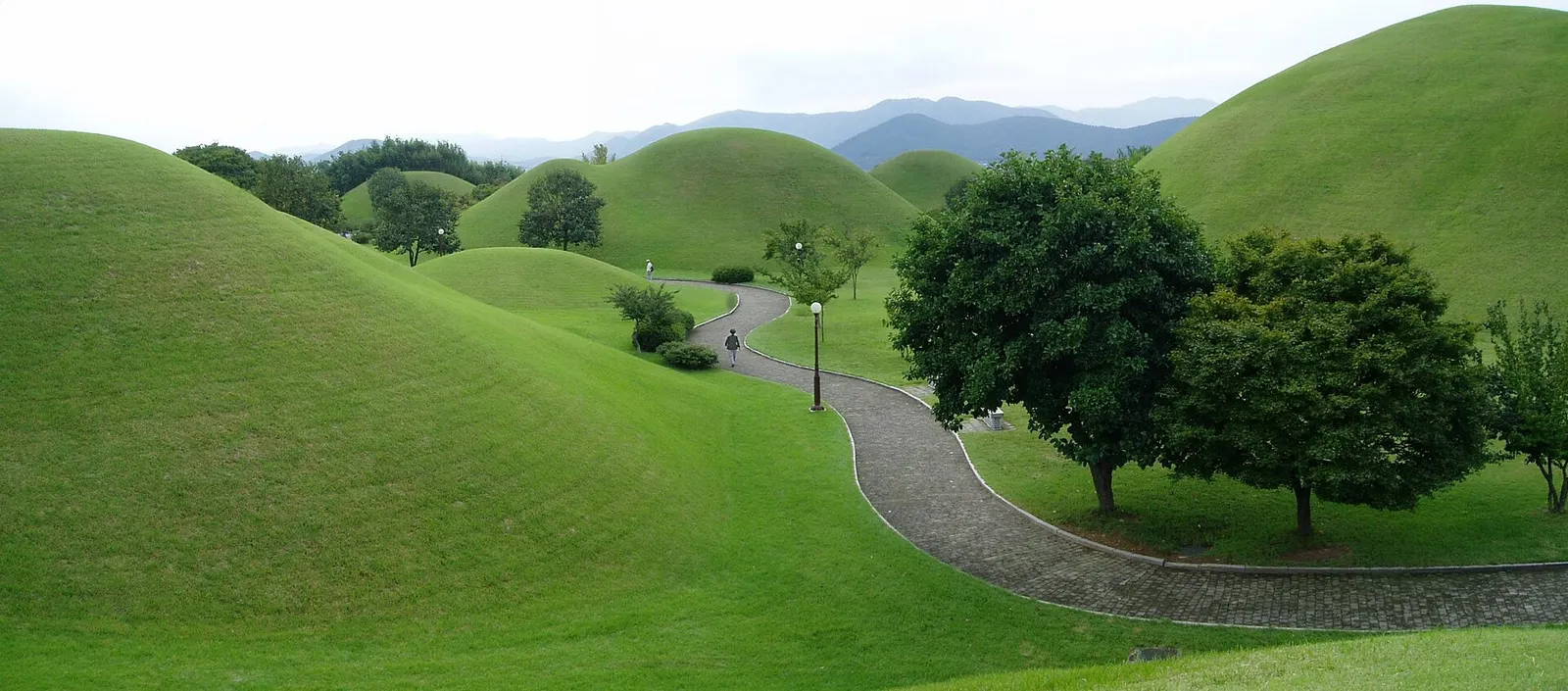
Daereungwon Royal Tumuli and the Historic Core
Towering grassy burial mounds shelter the enigmatic gold relics of Silla sovereigns beside the stone astronomical tower of Cheomseongdae.
Daereungwon Royal Tomb Complex
This landscaped necropolis preserves thirty earthen burial mounds belonging to rulers and nobility of the Silla Kingdom. Pathways wind between pine groves and rolling hills, offering visitors a clear view of the unique wooden chamber and stone mound tomb construction. The park serves as the focal point of the historic district.
Cheonmachong Tomb
Famed as the Tomb of the Heavenly Horse, this fifth-century burial mound is the only tumulus in the complex open to interior inspection. Archaeologists uncovered over eleven thousand artefacts here, including a pure gold crown and a painted birch-bark saddle flap depicting a flying horse, replicas of which are displayed inside.
Hwangnamdaechong
Measuring one hundred and twenty metres in length, this dual mound is the largest ancient tomb in Gyeongju. Excavations revealed that the southern peak held a king while the northern mound contained his queen, yielding Roman glassware and elaborate gilt-bronze ornaments that demonstrated extensive prehistoric maritime trade networks across Eurasia.
Cheomseongdae
Erected during the reign of Queen Seondeok in the seventh century, this granite tower is the oldest surviving astronomical observatory in East Asia. The structure comprises twenty-seven stone tiers that mirror lunar months and days of the solar year. Travellers can examine its cylindrical form and square south-facing central window.
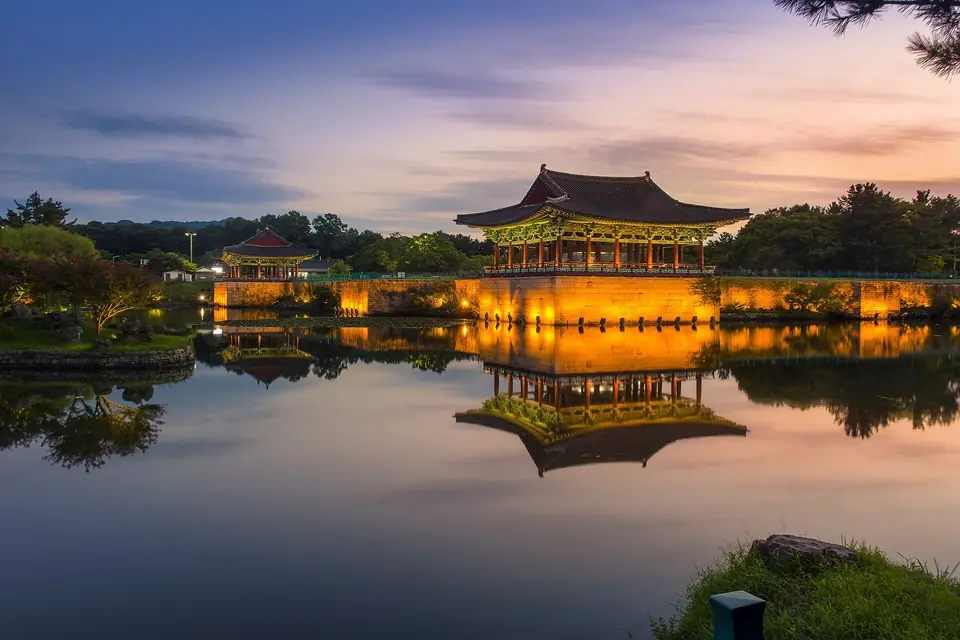
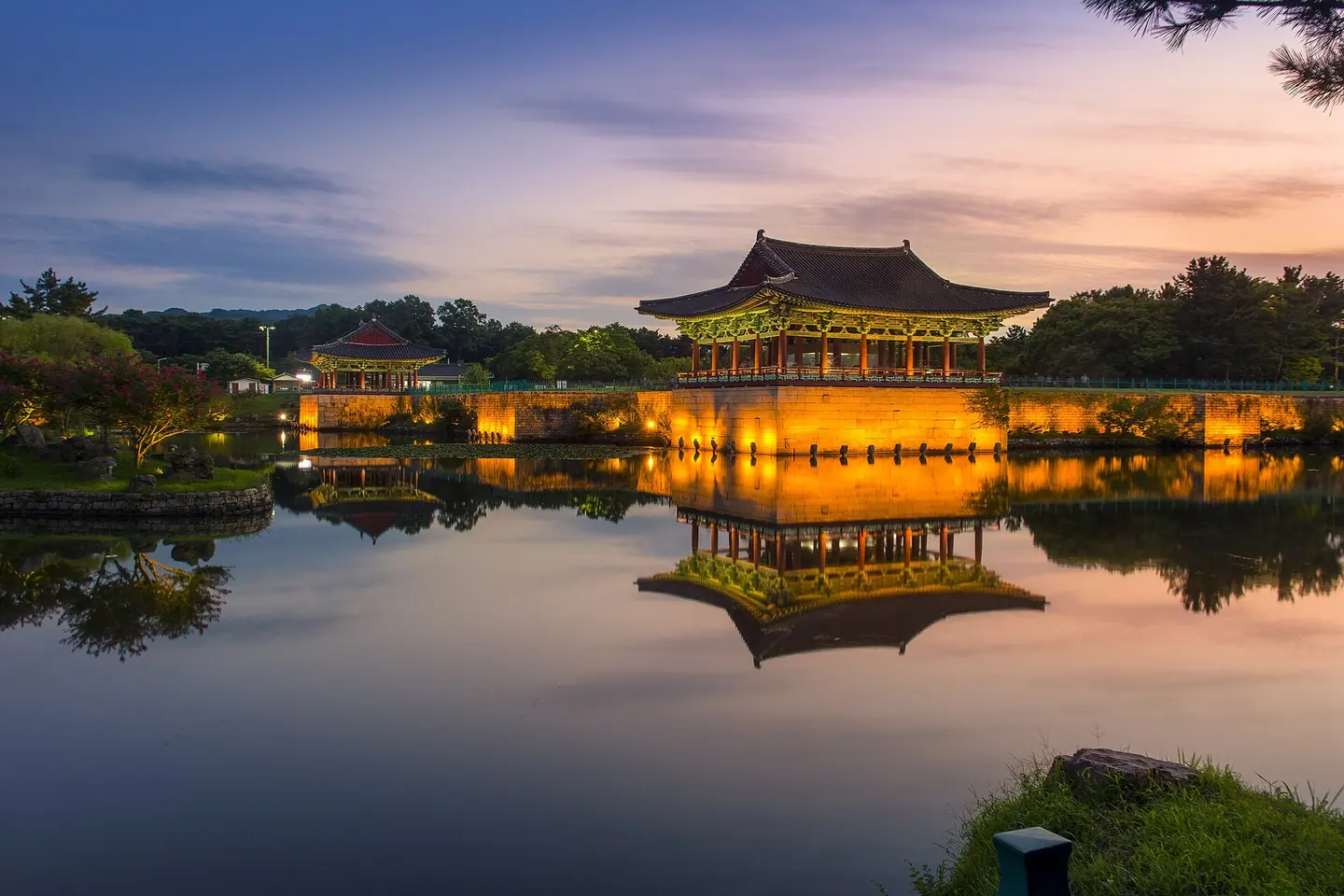
Donggung Palace and Wolji Pond
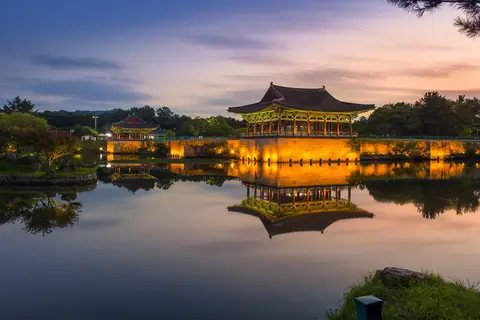
Commissioned by King Munmu in 674 following the unification of the Korean peninsula, this royal estate hosted banquets and national celebrations. Three reconstructed pavilions stand beside Wolji, an irregular artificial pond shaped to simulate endless coastal landscapes. The perimeter path offers exceptional architectural views when illuminated in the evening.
Wolseong Fortress
Also designated as the Half Moon Fortress due to its curving topography, this elevated site accommodated the main royal residence for centuries. Although the timber pavilions have long disappeared, the earthen ramparts remain surrounded by native woodland and ongoing archaeological digs revealing foundation stones, moat defensive works, and thousands of inscribed wooden tablets.
Gyeongju Seokbinggo
Positioned atop the northern rampart of Wolseong, this rectangular stone vault was constructed in 1738 to store river ice for official use. The architecture features an arched granite ceiling with five ventilation shafts and an inclined floor system designed to drain meltwater. Visitors can look down through iron grates into the chamber.
Woljeonggyo Bridge
Spanning the Namcheon south of the royal palace, this covered wooden bridge was reconstructed following thorough excavation of its stone foundations and historical texts. The twin gatehouses on either bank contain interpretive displays showcasing architectural joinery techniques. The red columns and decorative brackets illustrate Unified Silla period design.
Gyeongju Gyochon Traditional Village
Located adjacent to Woljeonggyo, this residential quarter preserves the heritage of the Choe family, renowned for sustaining generational wealth while maintaining social philanthropy. The neighbourhood contains timber hanok houses, traditional craft workshops, and the production site of Gyodong Beopju, an indigenous rice wine brewed using historic family methods.
Gyeongju Hyanggyo
Founded during the Goryeo dynasty on the former site of the Silla national academy, Gukhak, this educational compound retains its classic layout. The Daeseongjeon shrine houses memorial tablets dedicated to Confucius and Korean scholars, while the Myeongnyundang lecture hall showcases traditional timber framing. The grounds feature centuries-old ginkgo trees.
Gyerim Forest
This leafy sanctuary between Daereungwon and Wolseong is celebrated in regional lore as the birthplace of Kim Al-ji, progenitor of the Silla royal line. An engraved Joseon stele records the legend beneath a canopy of aged zelkova and willow trees. A small stream wanders through the quiet, shaded perimeter.
Nodong-dong and Noseo-dong Tombs
Positioned just north of Daereungwon across the modern street grid, these two adjoining groups include notable tumuli such as Bonghwangdae and the Tomb of the Golden Bell. Bonghwangdae is striking for mature trees growing directly out of its summit. The surrounding park allows travellers to inspect massive mounds without ticket barriers.
Gyeongju National Museum
This extensive museum complex houses the finest treasures excavated from the city, including shimmering gold crowns, jewellery, and earthenware vessels. Galleries are organized chronologically and thematically across several pavilions. The open-air courtyard exhibits carved stone lanterns, Buddhist stelae, and ancient pagoda foundations salvaged from abandoned regional temples.
Bell of King Seongdeok
Housed within an open pavilion on the grounds of the Gyeongju National Museum, this twenty-ton bronze bell was cast in 771. Its outer surface displays low-relief carvings of apsaras, celestial beings kneeling on lotus cushions holding incense burners. The hollow sound pipe and dragon loop at the top showcase sophisticated acoustic casting.
Hwangnyongsa Site
Once the centre of state Buddhism, Hwangnyongsa housed a legendary nine-storey wooden pagoda destroyed by Mongol forces in 1238. Today, expansive foundation stones and granite column bases mark the scale of the original prayer halls across the open fields. The adjacent history gallery exhibits an intricate scale model of the lost pagoda.
Bunhwangsa Temple
Established in 634 under Queen Seondeok, Bunhwangsa preserves the oldest dated pagoda of Silla origin. The structure was constructed from dark andesite stones carved into the likeness of fired brick, with carved stone guardians flanking the ground-level doors. A granite octagonal well within the courtyard dates to the same early medieval era.
Jungang Market
Operating as a lively trade hub west of the tumuli district, this market features alleys lined with regional vendors. Stalls offer regional specialties such as seasoned buckwheat noodles, flat dumplings, and traditional rice cakes. The market provides an authentic contrast to the quiet ancient monuments, exposing the everyday culinary traditions of modern Gyeongju.
Tomb of King Michu
Enclosed by a whitewashed wall and an ornate wooden gate inside Daereungwon, this mound marks the resting place of King Michu, who ruled in the late third century. Local legend records that spirit warriors emerged from this tumulus with bamboo leaves in their ears to repel invading forces. A stone memorial altar stands before the mound.
Bonghwangdae
Rising twenty-two metres in height, Bonghwangdae is the tallest single tumulus in central Gyeongju. Situated in the Nodong-dong cluster, its grassy slopes are home to centuries-old zelkova and weeping willow trees whose roots are embedded in the soil. Benches around its base provide perspectives of its vast scale amidst the urban surroundings.
Poseokjeong Site
Constructed along the base of Namsan mountain south of the city core, this site retains an abalone-shaped granite water channel built for aristocratic diversions. Silla nobles floated wine cups along the current, challenging guests to compose poems before the cups completed the circuit. Dense bamboo groves and pine forests enclose the stone structure.
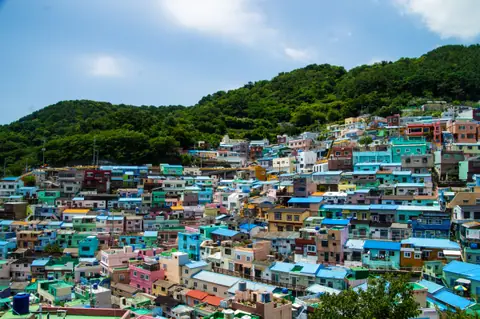
Hwangnidangil Heritage and Cafe District
Traditional mid-century hanok houses now shelter artisanal roasteries, craft boutiques, and microbreweries along narrow tiled alleyways.
Daereungwon Tomb Complex
Flanking Hwangnidangil, this expansive walled park holds twenty-three burial mounds constructed for Silla monarchs and nobility. Visitors wander tree-lined pathways around monumental earthen barrows, including Hwangnamdaechong and Cheonmachong. The surrounding tranquil grounds provide an immediate historical contrast to the adjacent cafe district.
Cheonmachong
Built during the fifth or sixth century, this royal tomb takes its name from a birch-bark saddle flap depicting a flying horse recovered within. The interior chamber functions as an educational museum displaying accurate replicas of golden crowns, belts, and jewellery. The cross-section reveals traditional stone-and-earthen mound architecture.
Cheomseongdae
Constructed in the seventh century, this bottle-shaped stone tower ranks among East Asia's oldest surviving scientific structures. The masonry consists of 362 granite blocks, reflecting the days of the lunar year, arranged around a central observation window. Broad meadows surround the monument, offering pleasant footpaths toward neighbouring ruins.
Gyerim
This leafy grove of gnarled zelkova and willow trees is celebrated as the mythical birthplace of Kim Al-ji, the progenitor of the royal Silla Kim dynasty. A Joseon-era stone monument erected by King Sunjo commemorates the founding legend within the forest canopy. Shaded paths connect the site smoothly to nearby palace grounds.
Wolseong Fortress
Also designated the Half Moon Fortress, this elevated earthen ridge served as the primary administrative seat for Silla rulers across several centuries. Archaeological digs continuously uncover building foundations, drainage networks, and moat boundaries. Visitors walk along the undulating crest for elevated views across the historical basin.
Seokbinggo
Constructed in 1738 on the northern slope of Wolseong, this vaulted granite cellar was engineered to preserve ice throughout the warm summer months. Its arched interior features stone vents and an inclined floor to drain meltwater efficiently. Guests can inspect the exterior grass cover and peer through the iron entrance grate.
Woljeonggyo
Originally built during the reign of King Gyeongdeok, this covered bridge was meticulously rebuilt using extensive archaeological research and traditional joinery. Two-storey gate pavilions stand at each end, housing exhibition rooms that detail historical carpentry and timber assembly techniques. Evening illumination reflects elegantly across the calm waters below.
Gyeongju Gyochon Traditional Village
Bordering the southern edge of Hwangnidangil, this neighbourhood celebrates the heritage of the Gyeongju Choe clan, famed for twelve generations of philanthropy. Low-walled stone alleys lead past tiled hanok residences, artisanal workshops, and tea houses. The area offers insight into Confucian domestic values and classical Joseon residential planning.
Gyeongju Hyanggyo
Occupying grounds that once housed Silla's state academy, this Joseon educational centre trained local scholars for imperial civil service examinations. The complex follows an axial arrangement, featuring the Daeseongjeon ancestral shrine and the Myeongnyundang lecture hall. Courtyards display century-old ginkgo trees and manicured masonry typical of Confucian school grounds.
Gyeongju National Museum
This national institution houses thousands of Silla relics unearthed across the Gyeongju basin. Visitors view royal golden regalia, glazed roof tiles, and ancient stoneware across several specialised galleries. Outdoors, landscaped paths display carved stone stupas, stone lanterns, and monumental Buddhist guardian statues.
Bell of King Seongdeok
Housed within an open pavilion on the museum grounds, this bronze masterpiece was completed in 771 to honour King Seongdeok. The exterior surface displays low-relief carvings of kneeling celestial maidens offering incense amidst swirling clouds. The hollow acoustic tube on top historically generated a distinctive resonance across the valley.
Donggung Palace and Wolji Pond
Established in 674 by King Munmu, this royal compound served as the crown prince's residence and hosted official state banquets. Three restored wooden pavilions fringe an artificial lake containing landscaped islets designed to reflect classical Buddhist paradises. The site gained renown when thousands of wooden slips and pottery fragments were excavated here.
Bonghwangdae
Standing at the northern perimeter of the central tumuli group, this imposing mound reaches twenty-two metres in height. Unlike manicured burial mounds nearby, centuries-old zelkova and weeping willow trees grow directly atop its earthen slopes. Open plaza spaces around its base often host local open-air cultural gatherings.
Geumgwanchong
Discovered accidentally during house construction in 1921, this fifth-century burial site yielded the first genuine Silla gold crown ever recorded. A sleek modern glass-and-steel exhibition hall now encloses the preserved excavation pit. Travellers inspect original stone reinforcement layers and interpretive displays illustrating royal burial customs.
Seobongchong
Excavated in 1926, this tomb took its name from a golden crown decorated with three distinctive phoenix figures. The mound is part of the central Noseo-dong cluster and retains its restored earthen silhouette. Surrounding walkways permit close inspection of the tumulus profile amid surrounding domestic townscapes.
Hwangnyongsa
Commissioned in the sixth century, this immense temple complex once housed an eighty-metre wooden pagoda before burning during Mongol invasions in 1238. Vast grassy clearings now preserve carved stone foundation plinths and column bases. A research centre nearby features an accurate timber scale model of the lost pagoda.
Bunhwangsa
Founded in 634 under Queen Seondeok, Bunhwangsa was home to the renowned Buddhist scholar Wonhyo. Its central feature is a three-tiered pagoda built from dark andesite stones carved into the shape of kiln-fired bricks. Stone lions guard each corner, while granite guardian figures flank the entrance doors.
Namgansaji Stone Well
Located on the gentle lower slopes of Namsan south of Hwangnidangil, this octagonal stone well supplied water to the ancient Namgansa temple. Carved from solid granite blocks, the well mouth illustrates sophisticated stone-cutting craftsmanship. The quiet rural surroundings retain several stone pagodas and foundation remnants.
Poseokjeong
Set amid a grove of pine and zelkova trees, this carved granite conduit provided the setting for aristocratic Silla banquet games where wine cups floated along running water. It was also here that King Gyeongae met his death during a sudden enemy raid in 927. The site retains deep historical resonance.
Gyeongju Jungang Market
A brief walk north of Hwangnidangil brings visitors to this expansive covered market where vendors sell local agricultural goods, dried fish, and street food. The grid of narrow indoor aisles retains traditional trading practices alongside modern stalls. The market remains an authentic reflection of everyday civic life in Gyeongju.
Donggung Palace and Wolji Pond Waterfront
The reconstructed royal banqueting pavilions glow across an artificial pleasure lake engineered to reflect the moonlit night sky.
Donggung Palace and Wolji Pond
Created under King Munmu in 674, this secondary palace compound hosted state banquets for visiting foreign dignitaries. Three reconstructed pavilions stand on wooden platforms along the water edge, illuminating beautifully against the lake after dusk. Archaeologists excavated thousands of Silla relics here, including fine gilt-bronze Buddhist statuettes and wooden slips.
Gyeongju National Museum
Situated south of the lake, this institution displays thousands of exquisite artifacts discovered throughout the ancient capital. Visitors can examine the intricate gold ornaments of royal tombs alongside the colossal eighth-century Divine Bell of King Seongdeok. The Wolji Pond gallery exhibits everyday pottery, wooden architectural fragments, and game pieces dredged from the waters.
Banwolseong
Serving as the primary royal seat for centuries, this elevated fortress derives its name from its distinctive half-moon topography. Dense pine groves and grass ramparts now cover the earthen defensive berms that sheltered palace halls. Walking tracks skirt the moat traces, leading visitors past stone building foundations toward Wolji Pond.
Seokbinggo
Engineered in 1738, this arched limestone chamber demonstrates advanced passive cooling technology from the late Joseon era. Blocks of winter ice were packed into the deep pit and insulated with rice straw to preserve food supplies through summer. Overhead ventilation ducts regulate internal air temperatures, visible above the grassy vault.
Cheomseongdae
Commissioned by Queen Seondeok, this bottle-shaped stone tower is the oldest surviving astronomical observatory in East Asia. Its 27 tiers of cut granite correspond to astronomical cycles, featuring a central square window facing south. Visitors find it illuminated in the evening, situated just west of the palace waterfront.
Woljeonggyo
Originally built during the Unified Silla period to connect Banwolseong with southern districts, the crossing was reconstructed in 2018. Two-storey gate pavilions stand at either end of the columned wooden corridor spanning the stone piers. The upper floors house exhibition spaces displaying bridge relics and architectural blueprints.
Gyerim
This quiet forest of ancient zelkova and willow trees is celebrated as the legendary birthplace of Kim Alji. A memorial monument erected in 1803 stands within the grove, detailing the myth of the golden box discovered here. The grove offers a shaded corridor between Banwolseong and the western tomb clusters.
Hwangnyongsa
Spanning a vast field east of Wolji Pond, this former state monastery once contained an eighty-metre wooden pagoda destroyed by Mongol invaders in 1238. Huge stone foundation plinths remain in place across the gravel grounds, indicating the colossal scale of the original halls. An adjacent history centre provides scale models and architectural reconstructions.
Bunhwangsa
Established in 634 during Queen Seondeok's reign, this temple complex retains three tiers of an ancient andesite pagoda carved to resemble fired brick. Stone guardian lions sit at the corners of the pedestal, flanking niche shrines guarded by carved relief deities. The peaceful courtyard also features a Silla-period stone well shaped like an octagonal lotus.
Daereungwon
This landscaped park encloses twenty-three tumuli belonging to ancient Silla monarchs and high-ranking courtiers. Serene gravel footpaths wind between the grassy hills, creating an evocative landscape within the city centre. The mounds use wooden burial chambers sealed beneath deep layers of river boulders and packed earth.
Cheonmachong
Excavated in 1973, this famous tomb inside Daereungwon revealed more than ten thousand funerary treasures, including a delicate birch-bark saddle flap depicting a flying horse. The mound's interior is open to the public, displaying an authentic cutaway view of the stone-cairn wooden chamber. Visitors can inspect replicas of the gold crown and jade girdle found inside.
Hwangnam-dong
Located just west of the royal tombs, this district contains hundreds of preserved hanok residences. Strict building regulations have protected its low-rise urban character, allowing visitors to walk narrow historic alleyways framed by curved tiled roofs. Many properties have been repurposed into traditional tea rooms, artisan craft shops, and independent bakeries.
Gyeongju Gyochon Traditional Village
Centred around the ancestral estate of the Gyeongju Choe clan, this preserved village offers insights into Joseon noble life. The extensive timber compound features open wooden verandas, expansive courtyards, and storehouses for grain distribution to the poor. Demonstrations of traditional crafts, embroidery, and local rice-wine brewing take place regularly.
Gyeongju Hyanggyo
Occupying a site used for education since Silla times, this state-run school trained local scholars in classical Confucian philosophy. The compound follows a traditional plan, placing the Daeseongjeon shrine at the rear and lecture halls at the front. Ancient ginkgo trees shade stone courtyards that still host commemorative ceremonies.
Geumgwanchong
Discovered by accident during domestic building work in 1921, this fifth-century tomb produced the first Silla gold crown ever unearthed. A modern protective pavilion shelters the excavated burial cairn, allowing visitors to observe the original boulder foundation. Modern interpretation displays explain the complex excavation history and metallurgy of the grave goods.
Noseo-dong Tombs
This cluster of monumental burial mounds borders the northern edge of the historic burial zone. Prominent among them is Seobongchong, known for a gold crown topped with miniature phoenix figures, and Eunryeongchong, which yielded silver bowls. Unlike Daereungwon, this field is unenclosed, allowing neighbours to stroll directly around the grassy slopes.
Tomb of King Naemul
Resting quietly near the fringe of the Gyerim forest, this tumulus is attributed to King Naemul, who institutionalised the hereditary royal succession of the Kim clan. Measuring roughly twenty-two metres in diameter, the simple rounded mound lacks exterior stone fencing, reflecting early Silla funerary architecture. The setting among tall pine trees provides a calm atmosphere.
Bae-dong Triad Buddha
Located on the gentle western slopes of Namsan, these three stone sculptures date from the early seventh century. The central standing Sakyamuni is flanked by Avalokiteshvara and Mahasthamaprapta, each rendered with soft robes and gentle, serene smiles. The carvings represent an important stylistic transition from rigid archaic art into mature Silla sculpture.
Namsan
Rising just south of the city, this granite mountain functioned as a vast natural sanctuary throughout the Silla era. Hundreds of stone Buddhas, relief carvings, pagodas, and temple platforms remain scattered across its forested peaks and valleys. Hiking trails connect these sacred sites, offering panoramic viewpoints over the historic capital basin below.
Poseokjeong
Set beside an ancient stream at the base of Namsan, this carved granite conduit is all that remains of a royal summer retreat. Silla nobles sat around the circulating current, reciting poetry before floating wine cups drifted past. It was also the tragic site where the kingdom met its effective end during a surprise invasion in 927.
Bulguksa Terraces and the Tohamsan Slopes
Granite staircases, twin pagodas, and timber shrines ascend Mount Toham to manifest the terrestrial realm of the Pure Land.
Bulguksa
Constructed under Prime Minister Kim Daeseong during the Unified Silla era, this head temple represents the earthly manifestation of the Buddha land. Visitors cross stone bridges and ascend granite terraces to explore wooden halls rebuilt after sixteenth-century conflicts. The site preserves several national treasures that reflect the engineering mastery of ancient Korean stonemasons.
Dabotap
Erected around 751 on the eastern side of Bulguksa's central courtyard, this pagoda stands ten metres tall with complex stonework that mimics wooden joinery. Its octagonal bamboo-shaped bamboo pillars, lotus carvings, and square platforms depart boldly from standard Korean pagoda conventions. One surviving stone lion sits upon the upper platform, guarding the relic shrine.
Seokgatap
Facing Dabotap across the Daeungjeon courtyard, this three-tiered granite monument exemplifies the restrained elegance of classic Silla stonemasonry. During restoration works in 1966, craftsmen discovered the Mugujeonggwang Daedaranigyeong, one of the oldest surviving woodblock-printed texts in the world. Its clean proportions and unadorned surfaces deliberately contrast with the elaborate carvings of its neighbour.
Cheongungyo and Baegungyo
These twin granite staircases, known as the Blue Cloud and White Cloud Bridges, form the monumental entrance to the main worship precinct. Built in 751, the thirty-three steps symbolise the stages of spiritual ascent required to reach the Buddhist realm. Underneath the steps, an arched passage demonstrates Silla vaulting techniques that have survived major earthquakes.
Yeonhwagyo and Chilbogyo
Positioned west of the central entrance, the Lotus Flower and Seven Treasures Bridges lead directly to Geungnakjeon, the Hall of Supreme Bliss. The lower bridge features subtle lotus petals carved onto each stone riser, designed for pilgrims entering the Pure Land. Though smaller than Cheongungyo, their delicate masonry remains exceptionally well preserved from the eighth century.
Daeungjeon of Bulguksa
Standing directly behind the twin pagodas, this central timber sanctuary houses images of Shakyamuni flanked by Dipankara and Maitreya. The current structure dates from the late Joseon period, resting upon original Silla foundation stones that survived the Imjin War. Intricate bracket systems beneath the eaves support the heavy multi-gabled tiled roof.
Geungnakjeon
This wooden pavilion accommodates the gilded bronze image of Amitabha Buddha, created during the Unified Silla period to symbolise Western Paradise. Behind the signboard hanging above the entrance, observant visitors can spot a small wooden wild boar carving tucked between structural beams. The surrounding terrace offers a quiet space away from the main worship quadrangle.
Birojeon
Situated in the upper reaches of the Bulguksa complex, Birojeon shelters a gilt-bronze seated Vairocana Buddha designated as a national treasure. The statue displays the characteristic Mudra of Knowledge, with the right hand clasping the raised index finger of the left hand. Reconstruction efforts in the 1970s restored the hall along its ancient stone foundation.
Gwaneumjeon
Occupying the highest accessible platform within Bulguksa, this hall honours Avalokiteshvara, the Bodhisattva who hears the cries of the world. Rebuilt in 1973 based on historic records, the shrine contains an altar flanked by traditional Buddhist scroll paintings. Looking south from the front balustrade, travellers gain an elevated view across the roofs of neighbouring temple pavilions.
Museoljeon
Located immediately behind Daeungjeon, Museoljeon literally means the hall where no words are spoken, reflecting the Buddhist truth beyond verbal discourse. Despite its name, historic masters including Uisang expounded the Avatamsaka Sutra to monks here during the eighth century. The present timber hall spans thirty-two bays and serves as a gathering place for monastic ceremonies.
Seokguram
Carved into the upper slopes of Mount Toham, this cave temple was designed by Kim Daeseong concurrently with Bulguksa. Inside the circular granite rotunda, a monumental seated Buddha carved from white granite looks out towards the East Sea. Bas-reliefs of bodhisattvas, arhats, and Hindu deities line the antechamber, demonstrating Silla mastery of stone sculpture.
Tohamsan
Rising to 745 metres, Mount Toham formed an essential natural barrier that guarded the Silla capital from coastal incursions. The mountain was revered as one of the kingdom's five sacred peaks where royal ceremonies and state protection rituals were conducted. Forest paths lined with pine trees link Bulguksa at the base to the high ridgelines.
Gyeongju Folk Craft Village
Established along the western approach to Mount Toham, this planned settlement accommodates master craftspeople specialising in ceramics, metalwork, and wood carving. The workshops are arranged within traditional tiled-roof buildings where artisans replicate Silla pottery and Joseon lacquerware. Visitors can observe artisans firing earthenware in kilns and browse locally produced folk goods.
Silla Arts and Science Museum
Situated within the Folk Craft Village, this private museum illuminates the technical ingenuity of ancient Silla builders and scholars. Detailed cutaway models explain the ventilation and humidity control systems originally built into the Seokguram grotto. Exhibits also showcase early astronomical instruments, metal casting techniques, and architectural joinery without metal nails.
Tomb of King Wonseong
Historically designated as Gwaereung, this royal tomb commemorates King Wonseong, who instituted civil service examinations in the late eighth century. The perimeter displays carved stone zodiac figures, while the approach road features dynamic stone statues of civil officials, military commanders, and lions. Scholars note that the military guards exhibit Central Asian facial features, evidencing Silk Road connections.
Tomb of King Sinmun
This large earthen tumulus marks the resting place of King Sinmun, who strengthened the royal authority following the unification wars. Large rectangular stone blocks support the bottom circumference of the mound to prevent soil erosion during heavy rains. The site sits on low hills west of Tohamsan, surrounded by groves of indigenous red pine trees.
Tomb of King Hyoso
Resting near the western slopes facing Mount Toham, this round earthen mound belongs to King Hyoso, who ruled during a period of agricultural prosperity. The base of the tomb uses unworked natural boulders rather than polished dressed blocks, characteristic of early eighth-century royal construction. The quiet surrounding park features centuries-old pine trees framing the grassy burial perimeter.
Tomb of King Seongdeok
King Seongdeok oversaw a cultural renaissance that saw the casting of the great Bell of King Seongdeok and architectural flourishes across Gyeongju. His tomb features retaining stones carved with the twelve oriental zodiac signs, several of which remain visible in relief. Weathered granite statues of guardian warriors and lions stand in adjacent fields marking the ritual path.
Neungji-tap
Believed to be the site where King Munmu's body was cremated before his ashes were scattered into the sea, Neungji-tap stands as a stepped stone monument. The lower tiers display relief carvings of the twelve zodiac deities clad in military attire. Reconstructed from scattered stones discovered on the hill, the site illustrates seventh-century Buddhist funerary customs.
Bowon Temple Site
Scattered foundation stones, granite lanterns, and stone water basins mark the remains of satellite monastic cloisters that once served the Bulguksa complex. Hiking trails threading through oak and bamboo woods lead past abandoned stone cisterns and moss-covered stupas dating to the Unified Silla period. The ruins offer quiet insight into the extensive religious community that once inhabited the mountain.
Sacred Namsan Valley and Rock-Carved Buddhas
Winding pine-scented mountain trails reveal dozens of weathered stone reliefs, hidden pagodas, and secluded temple hermitages.
Bae-dong Stone Buddha Triad
Dating from the early seventh century, this triad represents Amitabha flanked by Avalokiteshvara and Mahasthamaprapta. The rounded child-like facial features and heavy robes illustrate early Silla Buddhist sculpture before Unified Silla formalisation. We observe detailed lotus pedestals and intricate necklaces preserved on the granite surfaces.
Samboolsa Temple
Samboolsa sits at the western base of Mount Namsan, serving as a peaceful gateway to the Samneung valley trail. The temple compound preserves small timber halls surrounded by ancient pine groves that screen the complex from town. Hikers pause here before climbing upward past weathered granite carvings.
Samneung Royal Tombs
These three adjacent earthen burial mounds house the remains of eighth and ninth-century Silla rulers, including King Adalla, King Sindeok, and King Gyeongmyeong. The surrounding grove of contorted pine trees creates an evocative natural colonnade. Morning mist frequently settles between the mounds, attracting landscape photographers and heritage walkers.
Samneung Valley Headless Stone Buddha
Found along the primary trail of Samneung Valley, this seated sculpture dates to the eighth century. Though the head was lost centuries ago, the torso retains extraordinarily delicate drapery folds falling over crossed legs. The preservation of the robes allows visitors to appreciate the refined carving skill of late Silla craftsmen.
Samneung Valley Carved Rock Buddha
This large rock-carved Buddha emerges from a sheer rock face rising along the mountain trail. Completed during the late Silla period, the figure displays deep, expressive carving around the head paired with lighter incisions across the lower garments. The elevated position overlooks dense pine canopy covering the valley below.
Samneung Valley Line-Carved Bodhisattva
Unlike the raised high-relief sculptures nearby, this Bodhisattva was rendered through shallow linear incisions upon a massive flat boulder. The artwork depicts an attendant deity holding a lotus blossom with fluid, calligraphic draughtsmanship. Light conditions during late afternoon highlight the faint lines cut into the weathered rock surface.
Sangseonam Hermitage
Situated just below the mountain crest, Sangseonam provides a resting place for pilgrims ascending the Samneung trail. The modest shrine buildings cling directly to steep stone ledges, offering extensive panoramas across the Gyeongju plain. A prominent carved relief of the Buddha stands on the rock cliff immediately above the prayer hall.
Geumobong Peak
Rising to 468 metres, Geumobong represents the primary geographical reference point across Mount Namsan. While tree cover partly encloses the true summit, stone trail markers converge here from northern, western, and eastern ravines. Travellers cross this junction when navigating between the Samneung trail and the eastern Yongjang valley.
Yongjangsa Temple Site
Yongjangsa was one of the grandest religious foundations on the mountain during the eighth century, later serving as the residence of philosopher Kim Si-seup. Stone retaining walls step down the ravine, anchoring a three-storey stone pagoda and a seated stone Buddha. The complex integrates natural bedrock directly into its architectural layout.
Yongjangsa Site Three-Storey Stone Pagoda
This graceful granite pagoda uses an entire mountain spur as its foundational base, transforming the cliff into an integral structural platform. Built in the eighth century, its balanced tiers taper gently against the sky, visible from deep within the valley below. It represents a classic example of Silla masons blending architecture with wild geology.
Yongjangsa Site Seated Stone Buddha
Resting beside the temple terrace, this seated figure is famous for its distinctive pedestal composed of three stacked circular stone tiers. Although the head was destroyed, the chest and waist retain full, realistic contours with flowing monastic dress. The unique pedestal design is unmatched across other Buddhist remnants in South Korea.
Sinseonam Hermitage Rock-Carved Bodhisattva
Chiselled into a sheer precipice beneath Chilbulam, this late eighth-century relief portrays a Bodhisattva seated upon a cloud support. The figure holds an incense burner with one foot lowered in a relaxed, contemplative posture. The sheer drop below gives the impression that the deity is floating above the valley floor.
Chilbulam Hermitage
Chilbulam takes its name from seven Buddhist carvings dating from the Unified Silla period. The monument consists of a standing triad cut into a vertical rock wall behind a massive square stone pillar bearing four seated Buddhas. The courtyard remains an active open-air worship area maintained by resident Buddhist nuns.
Namsan Bupheungsa Temple Site
This remote temple site retains remnants of stone platforms, foundations, and dispersed architectural fragments historic among dense scrub. Legend connects the location to early state-level Buddhist patronage during the reign of King Beopheung. The isolation of the site ensures quiet surroundings far from the popular western hiking tracks.
Poseokjeong Pavillion Site
Built during the Silla era, this abalone-shaped granite water conduit allowed wine cups to float past seated aristocrats during poetry gatherings. The site gained tragic notoriety in 927 when King Gyeongae was surprised and captured here by Later Baekje invaders. Mature zelkova and pine trees shade the stone channel today.
Najeong Well
According to the Samguk Sagi, this well is where a divine white horse knelt before disappearing, leaving behind an egg from which Bak Hyeokgeose emerged. Archaeological excavations revealed remains of early hexagonal stone foundations and ritual structures dating across several centuries. A commemorative stone stele marks the landscaped enclosure.
Changrimsa Temple Site Three-Storey Pagoda
Perched on a high shoulder above the western foothills, this reconstructed three-storey pagoda represents the only standing monument from the ancient Changrimsa complex. The stone levels display classic Unified Silla proportions, featuring crisp corner pillars cut in relief. Visitors reach the terrace along a quiet trail lined with bamboo thickets.
Borisa Temple Stone Seated Buddha
Situated on the northeastern slope of Mount Namsan, this ninth-century sculpture is the most intact seated stone Buddha in Gyeongju. The statue features an intact halo adorned with miniature relief Buddhas and swirling flames. The facial expression remains completely undamaged, reflecting supreme serenity over the eastern valley.
Tapgok Valley Rock-Carved Buddhas
Often referred to as the Pagoda Valley, this site features a massive nine-metre-high granite block carved on all four faces. The intricate compositions include seated Buddhas, soaring apsaras, monks, lions, and two monumental multi-storey pagodas etched into the rock. The eastern face preserves an elaborate depiction of the Buddhist paradise.
Bulgok Valley Seated Stone Buddha
Carved into a natural granite overhang on the eastern flank of Namsan, this early seventh-century statue is known locally as the Grandmother Buddha due to its soft, maternal features. The shallow cavern acts as a natural protective grotto for the figure, whose hands are tucked discreetly into wide sleeves. It remains one of the earliest examples of rock-cut sanctuaries in Korea.
Traversing the Open-Air Museum: Practical Steps for the Ancient Capital
For neighbourhood accommodation notes, seasonal weather tables and airport transfer details, consult our Gyeongju destination guide, or browse other city and regional walking routes across the atlas.