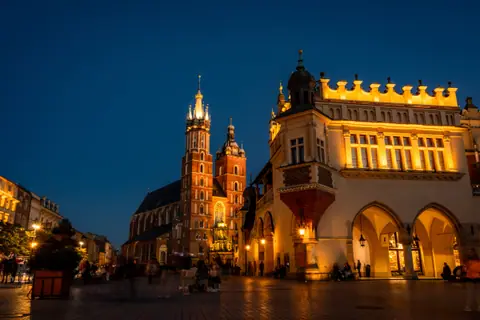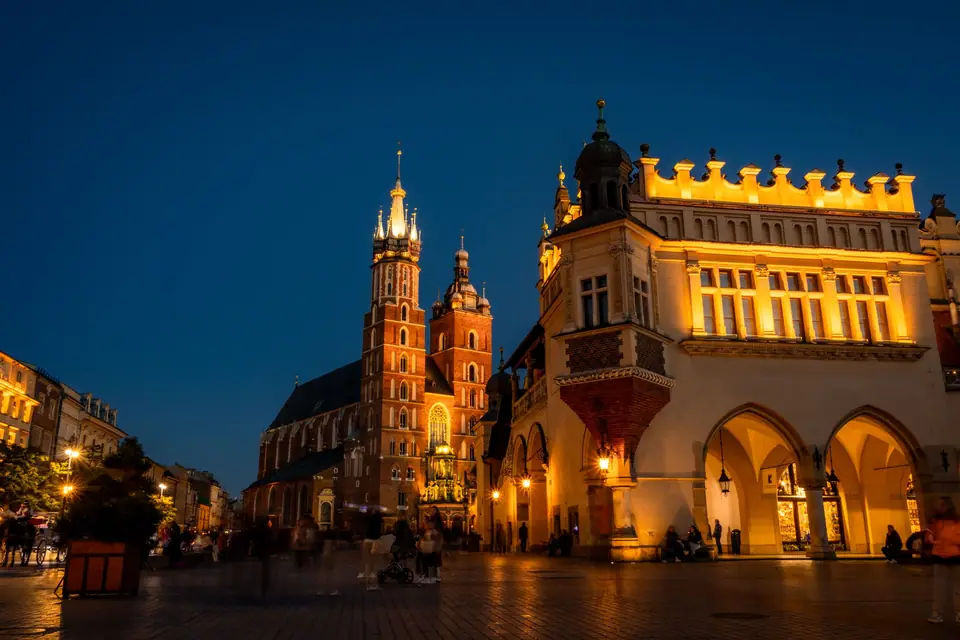
A 100-stop walking route along Krakow’s Royal Road from the medieval Barbican and Rynek Główny to Wawel Hill, historic Kazimierz synagogues, and the Wieliczka Salt Mine.
Magdeburg Law Grid, Jagiellonian Renaissance and Kazimierz Courtyards
Rooted in the legendary stronghold of Prince Krakus atop the limestone bluff of Wawel Hill overlooking the Vistula River, Krakow became the royal capital of Poland in 1038 under Casimir the Restorer. After the Mongol raids of 1241, Duke Bolesław V the Chaste granted the city Magdeburg Law in 1257, laying out Europe's largest medieval market square (Rynek Główny) and founding Jagiellonian University in 1364.
During the sixteenth-century Polish Golden Age under the Jagiellonian kings Sigismund I the Old and Sigismund II Augustus, Italian architects transformed Wawel Castle into a Renaissance arcaded palace while nearby Kazimierz flourished as one of Europe's greatest centres of Jewish learning and culture.
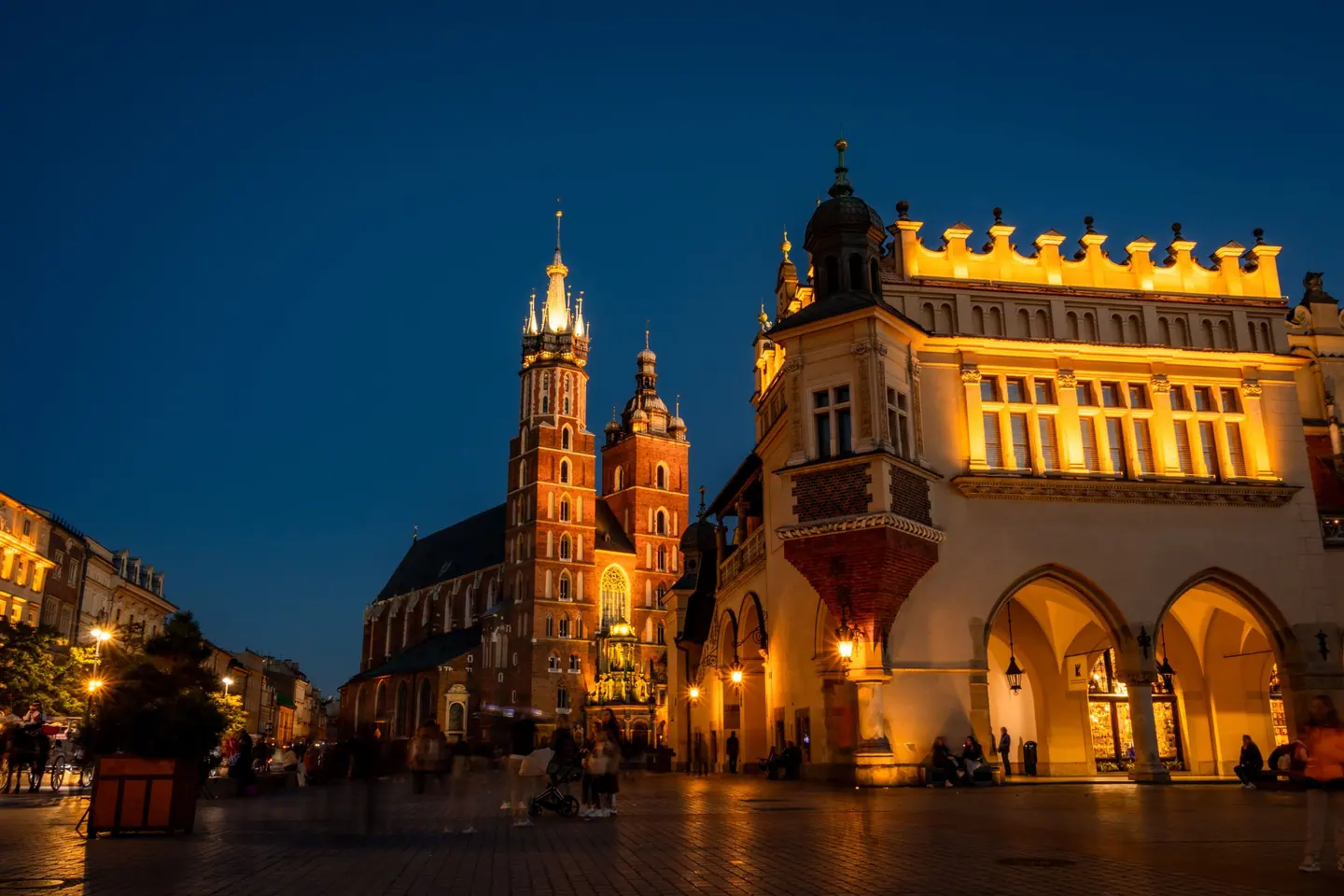
Rynek Główny, Cloth Hall & St Mary’s Basilica
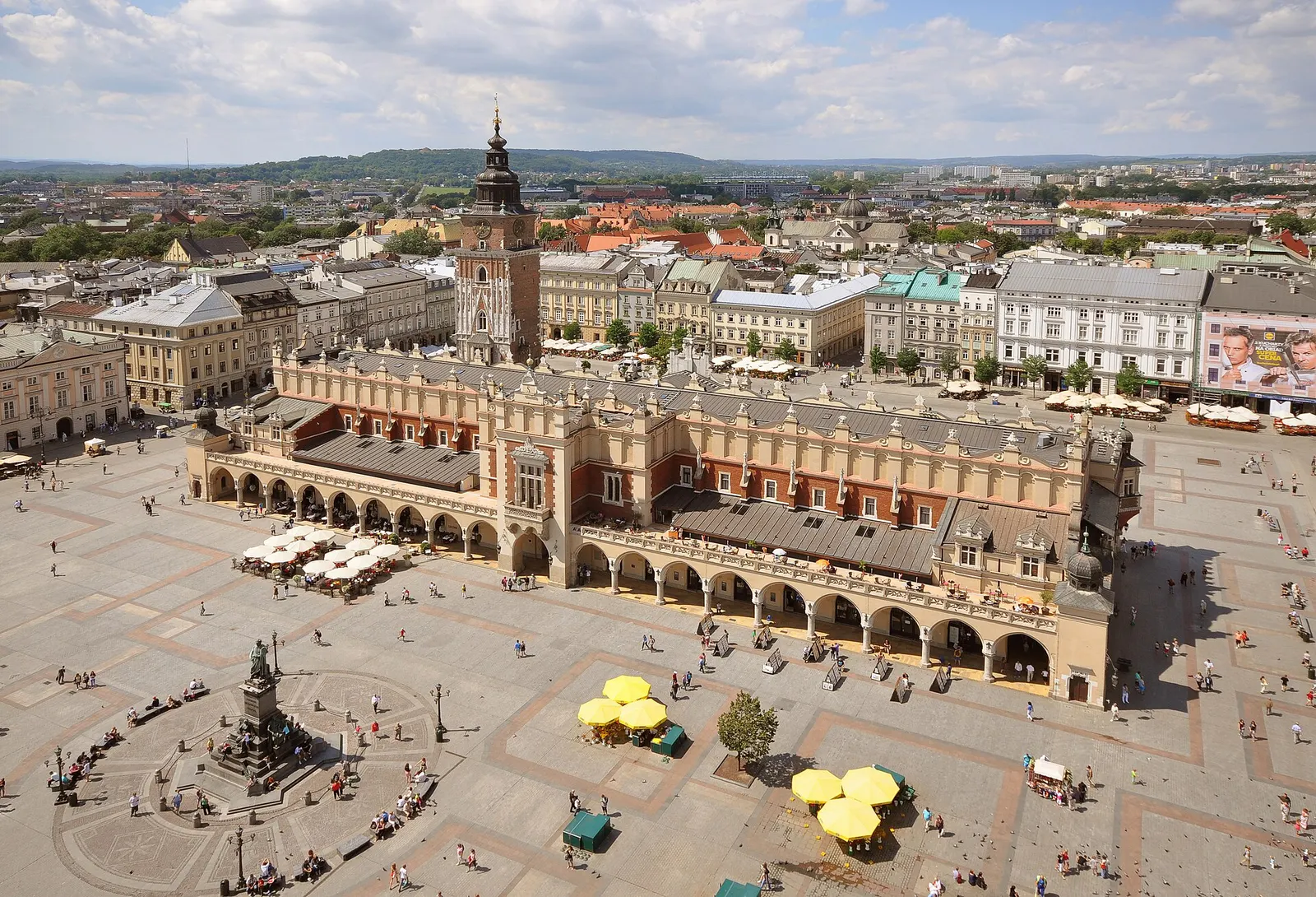
Main Market Square Rynek Główny, Sukiennice Cloth Hall, Rynek Underground Museum, St Mary’s Basilica Veit Stoss Altarpiece, Town Hall Tower, Church of St Adalbert, and Adam Mickiewicz Monument
Main Market Square
Laid out following the Mongol invasions, this expansive space forms the urban core of the Old Town. Surrounded by noble townhouses, it was planned on a strict grid pattern with side lengths of two hundred metres. We admire the surviving medieval street alignments branching directly from the perimeter corners.
Kraków Cloth Hall
Rebuilt by Italian architect Santi Gucci after a devastating fire in 1555, the central hall features an attic adorned with carved stone mascarons. The ground floor interior maintains rows of timber merchant stalls selling traditional Polish handicrafts. Arched neo-Gothic arcades were added in the late nineteenth century.
Rynek Underground
Located four metres beneath the stone pavement, this subterranean reserve preserves medieval trading booths, wooden walkways, and an eleventh-century cemetery. Visitors inspect preserved merchant weights, coins, and foundations uncovered during major archaeological excavations between 2005 and 2010. Holographic projections and intact stone masonry illustrate early commercial life.
Gallery of 19th-Century Polish Art at Sukiennice
Situated on the upper floor of the Cloth Hall, this gallery preserves Polish Romantic, Realist, and Academic paintings. The grand neoclassical rooms house monumental historical canvases, including Jan Matejko's Prussian Homage. Broad windows offer views over the pavement of the surrounding square below.
St Mary's Basilica
Constructed in the fourteenth century atop Romanesque foundations, the brick facade features two distinct spires of unequal height. Every hour, a bugle call known as the hejnał mariacki sounds from the taller northern tower. The vaulted interior displays historic wall paintings executed by Jan Matejko.
Veit Stoss Altarpiece
Carved between 1477 and 1489 by the German sculptor Veit Stoss, this altarpiece stands over thirteen metres high behind the high altar. The central panel depicts the Dormition of the Virgin Mary, surrounded by realistic figures of the Apostles. More than two hundred detailed wooden figures fill the composition.
Town Hall Tower
Standing seventy metres high, this fourteenth-century brick tower is the sole remnant of the city hall dismantled in 1820. Built in Gothic style with Baroque helm additions, it leans slightly due to a seventeenth-century storm. A stone lion guards the entrance, leading to an interior branch of the Kraków Museum.
Church of St Adalbert
Dating back to the eleventh century, this limestone structure stands askew to the surrounding Renaissance and Gothic grid layout. The building commemorates Saint Adalbert, who according to tradition preached on this spot before his Prussian mission. The lower crypt now houses an archaeological display charting the history of the square.
Adam Mickiewicz Monument
Unveiled in 1898 on the centenary of the poet's birth, this bronze memorial was designed by Teodor Rygier. Four allegorical figures representing the Fatherland, Science, Courage, and Poetry sit at the pedestal base. Destroyed by occupying forces during the Second World War, it was carefully reconstructed in 1955.
Eros Bendato
Created by Polish sculptor Igor Mitoraj, this large bronze head depicts a bandaged Eros lying on its side. Installed near the Town Hall Tower in 2005, the artwork contrasts classical Roman forms with modern fragmentation. Visitors can step inside the hollow bronze cast to peer out through its empty eye sockets.
Pod Krukiem Tenement
Formed through the merger of two medieval properties, this house features a late nineteenth-century neo-Renaissance facade. Today it serves as the headquarters for the International Cultural Centre, hosting public galleries and cultural research facilities. Inside, historic masonry blends with contemporary architectural restorations around an enclosed central courtyard.
Pod Baranami Palace
Constructed in classical style on the south-western edge of the square, the building is named after the sculpted ram heads supporting its stone balcony. Formerly owned by the influential Potocki family, it housed political and cultural salons during the nineteenth century. The basement has functioned as a celebrated literary cabaret venue since 1956.
Pod Jaszczurami Tenement
This townhouse takes its name from the sculpted lizards appearing above the entrance portal. The ground floor preserves Gothic rib vaulting, representing one of the finest domestic medieval interiors surviving on the square. It has operated for decades as a popular student club and live performance venue.
Kamienica Greyowska
Known as the Grey Tenement, this large mansion stands on the corner of the square and Bracka Street. During the seventeenth and eighteenth centuries, it provided royal lodgings and hosted visits from foreign diplomats. Surviving interiors retain original stone portals, wood ceilings, and fragments of Renaissance frescoes.
Krzysztofory Palace
Built in the mid-seventeenth century by Crown Court Marshal Adam Kazanowski, this lavish palace features an Italianate courtyard with double arcades. It now serves as the headquarters of the Museum of Kraków, presenting comprehensive permanent exhibitions on local urban history. We note the elaborate stucco decorations created by Baltazar Fontana.
Przełom Tenement
Situated on the western flank of the square, this tenement exhibits layers of medieval stone work, Renaissance window frames, and later Baroque remodelling. The facade displays carved stone details alongside historic decorative emblems. Ground floor establishments maintain the deep structural plots characteristic of Kraków's thirteenth-century urban settlement.
Hetman Tenement
Once the property of high military commanders, this building features one of the most complete medieval domestic halls in the city. The ground floor contains fifteenth-century keystones carved with royal coats of arms and religious scenes. The exterior was updated with a neoclassical facade during the eighteenth century.
Zbaraski Palace
Erected between 1620 and 1631 for the Zbaraski family, this residence demonstrates the transition from Mannerist to early Baroque residential architecture. The exterior presents a disciplined symmetry with rusticated stonework framing the central carriage gate. The inner courtyard features covered loggias that accommodated noble domestic retinues.
Kamienica Pod Orłem
Located near the corner of Szczepańska Street, this house is recognisable by the stone relief of a Polish eagle on its facade. Originally established during the High Middle Ages, it was remodelled repeatedly to accommodate prosperous merchant families. Deep cellars beneath the building preserve original rubble-stone barrel vaults used for storing imported goods.
Church of St Barbara
Constructed between 1394 and 1402, this Gothic church served the local German-speaking burgher community and later the Jesuit Order. The exterior showcases an outdoor Gethsemane chapel containing expressive stone sculptures attributed to the circle of Veit Stoss. Inside, seventeenth-century Baroque altars complement the original Gothic rib-vaulted sanctuary.
Floriańska Gate, Planty Ring & Jagiellonian Quarter
Krakow Barbican, St Florian’s Gate, Floriańska Street, Czartoryski Museum Lady with an Ermine, Juliusz Słowacki Theatre, Collegium Maius Jagiellonian University, St Anne’s Church, and Planty Park
Krakow Barbican
Built around 1498 in late Gothic style, this circular brick bastion once linked directly to St Florian's Gate across a moat. We can inspect its seven turrets, three-metre-thick walls and 130 embrasures designed for artillery defence. It survives as one of only a handful of preserved European barbicans.
St Florian's Gate
Dating from the early fourteenth century, this stone tower served as the primary entrance along the Royal Road towards Wawel Castle. The southern facade features a bas-relief of Saint Florian, while the northern face displays a stone Piast eagle carved by Zygmunt Langman. It remains the sole surviving original city gate.
City Arsenal
Constructed between 1626 and 1643 from early Baroque brick, the arsenal stored gunpowder and artillery for Krakow's civic militia. Integrated directly into the remaining defensive curtain wall, the elongated building connects with two original watchtowers: the Joiners' and Carpenters' towers. Today it displays antique armaments and decorative arts.
Floriańska Street
Laid out during the 1257 city charter, this paved avenue formed the ceremonial commencement of royal coronations entering through St Florian's Gate. Its tall tenements feature preserved stone portals, vaulted entrance halls and medieval basements. Walking south offers clear visual alignment directly with the twin towers of St Mary's Basilica.
Jan Matejko House
Occupying a redesigned sixteenth-century tenement on Floriańska Street, this townhouse is where painter Jan Matejko was born, worked and died. The rooms contain his personal library, collected historical garments, weapons and sketches used for monumental canvases. The facade preserves distinctive neoclassical alterations designed by the artist himself.
Czartoryski Museum
Founded by Princess Izabela Czartoryska in Puławy and relocated to Krakow in 1876, this museum spans several interconnected historical buildings. The galleries display European masterworks, notably Leonardo da Vinci's portrait of Cecilia Gallerani and Rembrandt's Landscape with the Good Samaritan. Extensive collections of antique Greek pottery and Islamic armaments complete the display.
Church of the Piarist Fathers
Designed by Kacper Bażanka and completed with a facade by Francesco Placidi between 1718 and 1761, this sanctuary represents Roman late Baroque architecture. The curved exterior features dynamic column arrangements and statues of saints. Inside, visitors observe trompe l'oeil ceiling frescoes painted by Moravian master Franz Eckstein.
Juliusz Słowacki Theatre
Erected in 1893 to designs by Jan Zawiejski, this theatre anchors Holy Ghost Square on the site of a demolished medieval monastery. The exterior combines Neo-Renaissance and Neo-Baroque stone carvings with allegorical statues representing drama and comedy. The auditorium features an ornate painted curtain executed by artist Henryk Siemiradzki.
Church of the Holy Cross
This brick Gothic structure dates from around 1300 and displays an unusual square nave supported by a solitary central stone pillar. The ribbed vaulting fans outward from this column in a distinctive palm-tree pattern. Well-preserved medieval wall paintings and a fifteenth-century bronze baptismal font survive within the quiet interior.
Planty Park
Created between 1822 and 1830, this garden ring replaced Krakow's crumbling medieval ramparts and stagnant moat system. Today it forms eight interconnected garden sectors enclosing the entire Old Town with mature chestnut trees, lawns and gravel pathways. Monuments honouring Polish poets, artists and historical events punctuate the circuit.
Palace of the Arts
Erected in 1901 by the Krakow Society of Friends of Fine Arts, this structure was designed by architect Franciszek Mączyński in Vienna Secession style. A gilded frieze designed by Jacek Malczewski wraps around the upper facade, illustrating the trials and triumphs of the artist. Sculptures of Apollo crown the entrance portico.
Church of the Transfiguration
Built during the first half of the eighteenth century, this church adjoins the historic Piarist monastery complex. The single-nave interior features rich stucco decorations, gilded altars and illusionistic paintings highlighting theological themes. An urn containing the heart of educational reformer Stanisław Konarski is preserved inside the wall.
Collegium Maius
Dating back to 1400 when King Jogaila purchased the property, this Gothic complex centres on an arcaded courtyard with diamond vaulting and outdoor staircases. The interior chambers preserve the historic assembly hall, the professors' common room and scientific instruments once used by Nicolaus Copernicus, including a fifteenth-century astrolabe.
Collegium Novum
Completed in 1887 to commemorate the university's quingentenary, this red-brick Neo-Gothic hall was designed by Feliks Księżarski. The central ceremonial hall contains full-length portraits of university benefactors, including King Casimir the Great and Queen Jadwiga. The building served as the tragic gathering point during the 1939 Nazi Sonderaktion Krakau operation.
St Anne's Church
Rebuilt between 1689 and 1703 by Dutch-Polish architect Tylman van Gameren, this collegiate temple reflects the design of Rome's Sant'Andrea della Valle. The interior features theatrical stucco work by Baldassarre Fontana and trompe l'oeil paintings by the Monti brothers. The central transept houses the black-marble tomb of Saint John Cantius.
Collegium Minus
Originally acquired by the university faculty of arts in 1449, this brick building stands beside Collegium Maius along Gołębia Street. Several phases of Gothic and Renaissance reconstruction created its asymmetrical layout, vaulted basement rooms and stone window frames. Today it accommodates the Institute of Archaeology and historic seminar rooms.
Collegium Nowodworski
Founded in 1586 through endowments by Bartłomiej Nowodworski, this institution served as one of Poland's earliest secular secondary schools. The stone-paved interior courtyard features two storeys of Renaissance loggias that mirror the spatial design of Italian academic colleges. The building now belongs to the Jagiellonian University Medical College.
Collegium Broscianum
Formed by connecting two sixteenth-century residential buildings on Grodzka Street, this site was converted for university scholars during the seventeenth century. The portal preserves original Renaissance stone carvings, while the courtyard retains arcaded fragments. It now houses faculties of religious studies and philosophy alongside classical seminar libraries.
Bunkier Sztuki
Erected in 1965 to designs by Krystyna Tołłoczko-Różyska, this venue represents rare central Brutalist architecture constructed within the medieval urban boundary. The concrete facade features raw textures and modular cast panels directly bordering Planty Park. The institution curates contemporary visual arts exhibitions, debates and experimental design installations.
Potocki Palace
Positioned at the corner of the Main Market Square and Bracka Street, this classical palace originated from joined fourteenth-century tenements. Major eighteenth-century redesigns by Ferdynand Nax added classical pilasters, stone balustrades and richly decorated salons. Today the building serves as a public cultural venue hosting literary events and book festivals.
Grodzka Royal Road, Wawel Castle & Wawel Cathedral
Franciscan Church Wyspiański Stained Glass, Bishop’s Palace, Church of Saints Peter and Paul, Church of St Andrew, Kanonicza Street, Wawel Royal Castle, Sigismund Bell, Wawel Cathedral, and Wawel Dragon’s Den
Church of St Francis of Assisi
Founded by Prince Bolesław the Chaste in 1237, this Gothic Franciscan church underwent significant restoration following a devastating fire in 1850. Visitors admire the vivid polychrome murals and original stained glass windows crafted by Polish modernist master Stanisław Wyspiański, most notably the commanding depiction of God the Father above the organ gallery.
Bishop's Palace
Serving as the official residence of Krakow bishops since the late fourteenth century, this renaissance structure surrounds a classical courtyard designed by architect Gabriel Słoński. Pope John Paul II famously addressed crowds from the first-floor window above the gateway during his papal pilgrimages, turning the courtyard into an enduring gathering place for pilgrims.
All Saints Square
Named after an early medieval church demolished in the nineteenth century, this junction connects the historic centre with the southern avenues. The square is framed by the Wielopolski Palace, which serves as Krakow City Hall, and features a prominent bronze monument commemorating Polish politician and reform advocate Mikołaj Zyblikiewicz.
Church of the Holy Trinity
Established in 1222, this Dominican basilica features an imposing stepped brick gable and a tall nave rebuilt after the fire of 1850. Inside, the late-Renaissance Myszkowski Chapel showcases sophisticated masonry, while the adjoining cloister contains burial tombs and wall paintings dating from the fourteenth and fifteenth centuries.
Church of Saints Peter and Paul
Constructed between 1597 and 1619 for the Jesuit order, this was Krakow's first Baroque religious building, designed after the Church of the Gesù in Rome. The limestone railing out front holds expressive statues of the twelve apostles, while inside, the central nave suspends a heavy Foucault pendulum demonstrating Earth's rotation.
Church of St Andrew
Erected at the end of the eleventh century, this limestone church survived the devastating Mongol invasion of 1241 due to its thick defensive walls and arrow slits. While its exterior remains one of Poland's finest examples of Romanesque architecture, the interior features contrasting eighteenth-century Baroque stuccoes and an ornate boat-shaped pulpit.
Church of St Giles
Believed to have been founded in the fourteenth century by King Casimir the Great, this compact Gothic church features ribbed vaulting and stalls made of colourful marble. Positioned just below Wawel Hill, the adjoining courtyard displays the Katyń Memorial Cross, dedicated to Polish officers executed during the Second World War.
Kanonicza Street
Running parallel to Grodzka, this quiet cobblestone street retains an authentic late-medieval and renaissance character, having historically housed cathedral canons. Most properties exhibit carved Renaissance portals, armorial coats of arms, and arcaded inner courtyards, including the Deanery where Karol Wojtyła resided before his appointment as archbishop.
Bishop Erazm Ciołek Palace
Constructed around 1505 through the union of two fourteenth-century houses, this former residence of humanist diplomat Bishop Ciołek displays classical stone details and gothic ceilings. Today it houses the National Museum's significant collection of Polish medieval sculpture, painting, and religious icons rescued from south-eastern borderland churches.
Jan Długosz House
Located at the southern bend of Kanonicza Street, this ancient brick building was once the residence of cathedral canon and royal tutor Jan Długosz. The interior preserves original gothic wooden ceilings and polychrome paintings, and the building now accommodates the rectorate of the Pontifical University of John Paul II.
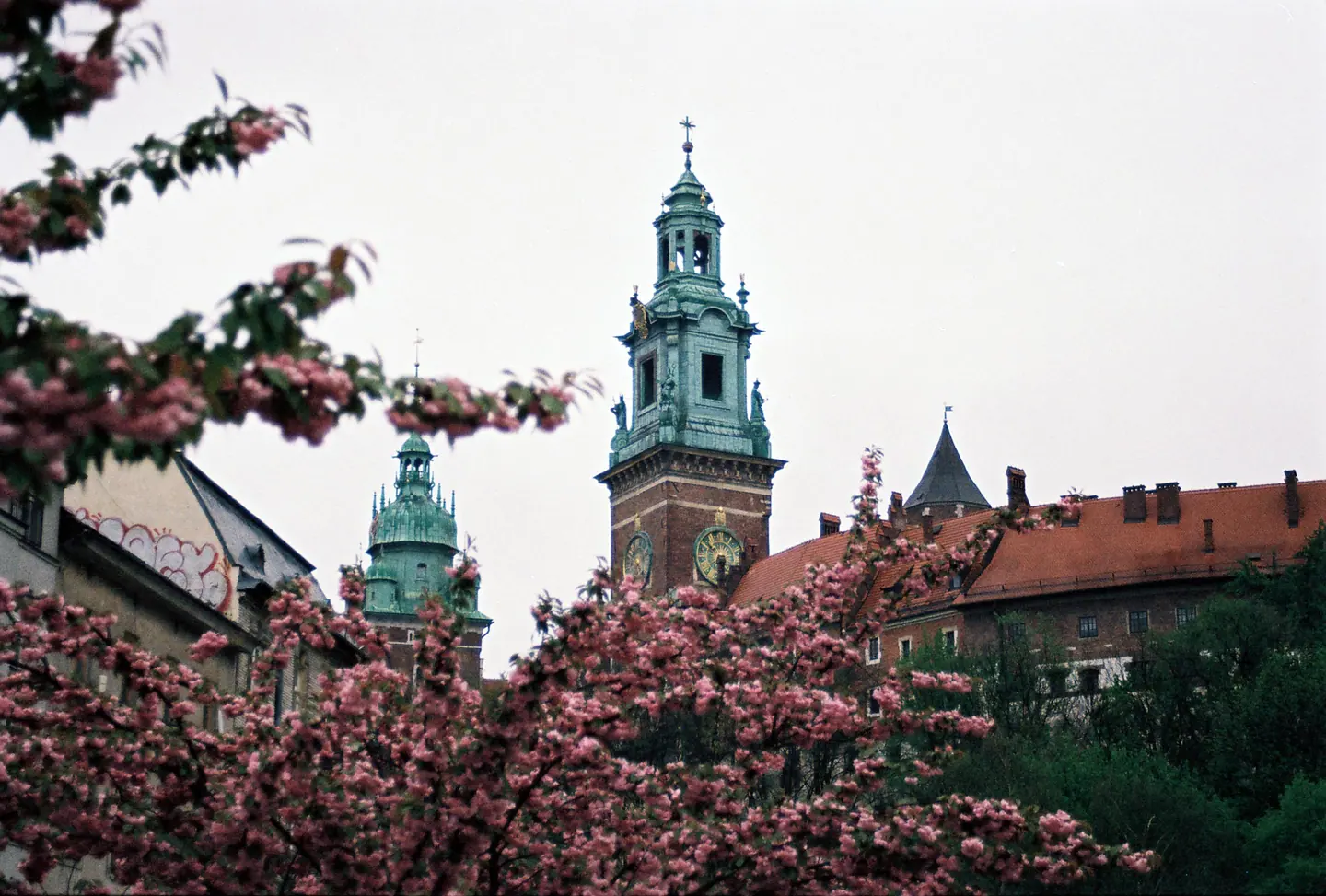
Wawel Royal Castle
Perched on a limestone promontory above the Vistula River, this complex served as the residence of Polish kings for over five centuries. Visitors explore the vast Italianate arcaded courtyard, royal private apartments, and the Crown Treasury, which preserves historic regalia including the coronation sword, Szczerbiec.
Wawel Castle Arcaded Courtyard
Commissioned in the early sixteenth century by King Sigismund I the Old, this court was designed by Italian architects Francesco Fiorentino and Bartolommeo Berrecci. Slender columns support three storeys of graceful loggias, adorned with original upper-level friezes depicting Roman emperors, illustrating the arrival of the Renaissance in northern Europe.
Wawel Cathedral
Constructed in the fourteenth century atop earlier Romanesque sanctuaries, this Gothic cathedral witnessed the coronations and funerals of almost all Polish sovereigns. The interior contains the silver reliquary sarcophagus of Saint Stanislaus beneath a gilded Baroque canopy, as well as marble burial monuments dedicated to kings and national poets.
Sigismund Chapel
Regarded as a peerless example of Tuscan Renaissance architecture outside Italy, this square-plan chapel was created between 1519 and 1533 by Bartolommeo Berrecci. It features a bright gold-plated dome, intricate carved mythological reliefs on its red Hungarian marble walls, and the royal tombs of Sigismund I and Sigismund II Augustus.
Sigismund Bell
Cast in 1520 by Hans Behem of Nuremberg, this massive bronze bell weighs nearly thirteen tonnes and requires a team of twelve bellringers to swing. Housed in the Sigismund Tower, it sounds exclusively during major national holidays, royal anniversaries, and notable civic events, offering visitors views over the Old Town roofs.
Crypt of the National Bards
Situated underneath the northern transept of Wawel Cathedral, this underground chamber was dedicated in the late nineteenth century to Poland's cultural luminaries. It houses the stone sarcophagi of literary heroes Adam Mickiewicz and Juliusz Słowacki, alongside commemorative plaques for Cyprian Kamil Norwid and composer Frédéric Chopin.
Rotunda of the Blessed Virgin Mary
Preserved beneath the Castle's former royal kitchens, this circular four-apse structure represents one of the oldest surviving Christian stone monuments in Poland. Visitors view the preserved sandstone foundations through elevated walkways inside the Lost Wawel archaeological reserve, which displays medieval fortifications, tiles, and reconstructed architectural fragments.
Wawel Dragon's Den
Formed in the Jurassic limestone of Wawel Hill, this 270-metre cave system descends through an old Austrian brick well shaft. Historical sources record that the cavern operated as a tavern in medieval centuries before being sealed, terminating at the riverside exit where a bronze fire-breathing dragon statue sits.
Wawel Dragon Statue
Created in 1972 by Polish sculptor Bronisław Chromy, this multi-headed bronze monument commemorates the mythological beast slain by Krakus or his sons. Situated on the riverside promenade beneath the western castle ramparts, the mechanical installation expels genuine flames from its jaws every few minutes.
Sandomierska Tower
Erected around 1460 during the reign of King Casimir IV Jagiellon, this fortified tower served as artillery defense and later held royal political prisoners. Recent restoration reopened the interior brick platforms, providing sweeping views across the Vistula River bends and the historic district of Kazimierz to the southeast.
Kazimierz Historic Jewish & Christian Quarter
Szeroka Street, Old Synagogue Krakow, Remuh Synagogue and Cemetery, Tempel Synagogue, Izaak Synagogue, Plac Nowy, Corpus Christi Basilica, St Catherine’s Church, and Father Bernatek Footbridge
Old Synagogue
Built during the late fifteenth century, this is Poland's oldest surviving example of Jewish religious architecture. Rebuilt in Renaissance style by Italian architect Matteo Gucci after a destructive fire, the fortress-like structure houses a branch of the Historical Museum of Krakow. Visitors can examine liturgical vestments, metalwork, and permanent displays documenting regional Jewish traditions.
Remah Synagogue
Named after the distinguished sixteenth-century scholar Rabbi Moses Isserles, this Renaissance prayer house remains an active place of Jewish worship. The modest interior features restored stone walls, a classical Torah ark, and historical Hebrew inscriptions. Pilgrims from across the world visit the sanctuary before continuing directly outside to the adjacent historic burial ground.
Remah Cemetery
Established in 1552, this old cemetery preserves rare Renaissance matzevot that survived wartime destruction. The tomb of Rabbi Moses Isserles stands near the centre, surrounded by centuries of prayer notes left by travellers. Fragments of desecrated headstones recovered after the Second World War are assembled along the perimeter into a solemn mosaic wall.
Szeroka Street
Serving as the administrative and communal centre of Jewish Kazimierz from the fourteenth century onwards, this broad space resembles a market green rather than a traditional street. Several synagogues, historic bathhouses, and merchant dwellings line the cobblestones. It forms the primary outdoor staging ground each summer for the Krakow Jewish Culture Festival.
Popper Synagogue
Financed in 1620 by wealthy merchant Wolf Popper, this baroque prayer house once boasted lavish decorations funded by his international trading enterprises. Although the wartime occupation stripped its original timber furnishings, the masonry shell and barrel vault survived intact. Today, the building functions as an energetic cultural community centre offering workshops, lectures, and rotating art exhibits.
High Synagogue
Constructed in the 1560s, this brick building takes its name from the elevated prayer hall placed deliberately on the upper floor for safety and privacy. Ground-floor defensive walls protected the congregation from potential street-level disturbances. The restored interior retains Renaissance wall frescos, decorative stone cornices, and periodic photographic exhibitions dedicated to Jewish life.
Izaak Synagogue
Erected in the 1640s through the bequest of banker Isaak Jakubowicz, this building represents the largest historical synagogue in Kazimierz. Its lofty interior features fine baroque stucco work, restored polychrome inscriptions, and a dramatic arched entrance hall. Educational panels on site recount the long communal struggles that accompanied its initial construction permits.
Kupa Synagogue
Financed in the 1640s by the local kehilla, or communal fund, the synagogue stands directly beside the medieval city ramparts. The building is renowned for its early twentieth-century ceiling paintings depicting biblical scenes, musical instruments, and towns across the Holy Land. It remains a functional venue for community events, religious lectures, and kosher culinary gatherings.
Tempel Synagogue
Built in the 1860s for Kazimierz's progressive and reform Jewish community, this structure is distinguished by its Moorish Revival details. The sanctuary features rich gold-leaf patterns, a coffered timber ceiling, and thirty-six brilliant stained-glass windows lighting the nave. An expansive women's gallery lines the upper perimeter, where classical concerts and choral performances regularly take place.
New Jewish Cemetery
Opened in 1800 on Miodowa Street when older parish sites ran out of space, this leafy burial ground covers roughly four hectares. Thousands of matzevot represent varied artistic movements, ranging from traditional biblical stonework to Art Nouveau and neoclassical family vaults. A striking monument near the entrance commemorates the city's victims of the Holocaust.
Plac Nowy
Laid out in the early twentieth century, this square served as an open-air market for poultry and vegetables. At its centre stands the Okraglak, a circular brick pavilion constructed in 1900 as a communal slaughterhouse. By day, market traders sell antiques and fresh produce here, while perimeter windows serve traditional toasted zapiekanka baguettes to passers-by.
Galicia Jewish Museum
Housed inside a converted pre-war industrial warehouse, this institution was founded by British photojournalist Chris Schwarz in 2004. Its acclaimed permanent exhibition, Traces of Memory, avoids romanticised nostalgia, presenting contemporary photographs of surviving relics across Polish Galicia. The centre frequently hosts book launches, living history lectures, and educational tours.
Corpus Christi Basilica
Founded around 1335, this colossal brick basilica combines soaring Gothic exterior lines with a sumptuously fitted baroque interior. The nave contains a monumental timber pulpit shaped like a sea galley, supported by mermaids and nautical symbols. The choir stall carvings, imposing high altar, and centuries of monastic craftsmanship reward careful inspection inside.
Kazimierz Town Hall
Rising over Wolnica Square, the former administrative seat of the independent town of Kazimierz features a Renaissance attic and an ornate clock tower. Since the mid-twentieth century, the building has housed the Seweryn Udziela Ethnographic Museum. Displays showcase regional Polish folk dress, carved domestic interiors, agricultural implements, and traditional religious crafts from Lesser Poland.
Plac Wolnica
Originally matching the scale of Krakow's main square, this vast opening was reduced in size over centuries of urban development. Its name derives from the Latin forum liberum, granting local residents free trade privileges. Cobbled open spaces, seasonal market stalls, and a modern sculptural fountain depicting three musicians characterise the current public square.
St Catherine's Church
King Casimir the Great established this monastery church in 1363, creating one of Poland's most ambitious examples of brick Gothic architecture. Although earthquakes and wartime occupations damaged the tall nave vaults over the centuries, the lofty choir retains its medieval proportions. The attached cloister contains fifteenth-century murals and peaceful monastic arcades.
Church of St Michael the Archangel and St Stanislaus
Known locally as Skalka, or the Little Rock, this hilltop Pauline monastery complex overlooks the Vistula River. Tradition holds that Bishop Stanislaus of Szczepanow was martyred here in 1079 by King Boleslaw the Bold. The current late-baroque church includes a national crypt containing tombs of prominent Polish figures, including Jan Dlugosz, Stanislaw Wyspianski, and Czeslaw Milosz.
Museum of Municipal Engineering
Occupying Krakow's oldest horse-drawn and electric tramway depot on Saint Lawrence Street, this museum preserves city infrastructure history. The red-brick industrial sheds house vintage motorcars, Polish motorcycles, early printing machinery, and restored historical streetcars. Interactive science exhibitions illustrate the development of domestic municipal sanitation, lighting networks, and transport links.
Church of the Holy Trinity
Constructed in the mid-eighteenth century for the Trinitarian Order and later entrusted to the Brothers Hospitallers, this church displays an undulating late-baroque facade. Designed by architect Franciszek Placidi, the frontage incorporates dynamic classical pilasters, stone statues, and an ornate pediment. Inside, visitors find Rococo altars and an adjoining medical hospital compound founded by the religious order.
Father Bernatek Footbridge
Spanning the Vistula River between Kazimierz and the neighbouring district of Podgorze, this pedestrian and bicycle link was completed in 2010. Named after a revered local monk and physician, the steel-arched structure features separate paths for walkers and cyclists. Suspended along the central cables are dynamic balancing bronze sculptures by artist Jerzy Kedziora.
Podgórze, Schindler’s Factory, Mounds & Wieliczka
Ghetto Heroes Square, Eagle Pharmacy, Oskar Schindler’s Enamel Factory, Cricoteka Tadeusz Kantor, Krakus Mound, Kościuszko Mound, Tyniec Abbey, and Wieliczka Salt Mine Chapel of St Kinga
Ghetto Heroes Square
Formerly known as Plac Zgody, this public square served as the primary gathering point during the wartime deportations of Krakow's Jewish population. The memorial features seventy bronze chairs dispersed across the open paving, symbolising the personal belongings abandoned by families. The site invites quiet reflection directly opposite the district's historic pharmacy.
Eagle Pharmacy
Operated by Tadeusz Pankiewicz, the only non-Jewish resident permitted to live inside the ghetto walls, this apothecary functioned as a clandestine refuge. The preserved interior now houses museum exhibitions detailing clandestine medical care, food distribution and secret meetings. Original cabinetry, laboratory instruments and survivor testimonies illustrate the risks taken by staff.
Oskar Schindler's Enamel Factory
This industrial complex, founded as the Deutsche Emailwarenfabrik, provided employment and shelter to over one thousand Jewish workers during the Second World War. Today, the administrative block hosts an immersive permanent exhibition dedicated to Krakow under Nazi rule from 1939 to 1945. Visitors can walk through Schindler's preserved office, containing his desk and symbolic enamelware displays.
MOCAK Museum of Contemporary Art in Krakow
Constructed on the grounds of Schindler's former factory halls, MOCAK showcases post-war avant-garde and contemporary artwork from Poland and abroad. The sleek concrete and glass architecture contrasts deliberately with surrounding industrial brickwork. Rotating galleries highlight post-conceptual installations, political posters, photography and large outdoor sculpture.
Krakow Ghetto Wall Fragment
Located along Lwowska Street, this surviving segment of the ghetto perimeter was deliberately constructed by the occupying forces to resemble Jewish gravestones. A commemorative bronze plaque marks the stone masonry, reminding travellers of the district's strict wartime confinement. An additional preserved fragment stands nearby within a primary school playground on Czarneckiego Street.
Church of St Joseph in Podgórze
Dominating Podgórze Market Square, this brick parish church was built between 1905 and 1909 to designs by architect Jan Sas-Zubrzycki. Its striking facade incorporates slender spires, intricate openwork pinnacles and an impressive clock tower reminiscent of St Mary's Basilica. Inside, carved wooden altars and soaring ribbed vaults display classic Polish historicist craftsmanship.
Podgórze Market Square
Established in the late eighteenth century when the Austrian Empire founded Podgórze as a rival trading town, this triangular market square slopes gently towards the River Vistula. Neoclassical and Art Nouveau townhouses line its edges, reflecting the settlement's nineteenth-century municipal autonomy. Tree-lined promenades and stone benches offer clear views up to the parish church.
Cricoteka Centre for the Documentation of the Art of Tadeusz Kantor
This dramatic steel and weathered-corten structure bridges directly over the brick buildings of Podgórze's former municipal power station. Dedicated to the visionary theatre director and artist Tadeusz Kantor, the institution preserves stage props, theoretical sketches and archival film recordings. The mirrored underside of the aerial gallery reflects pedestrians and river breezes along the Vistula promenade.
Father Bernatek Footbridge
Opened in 2010 to reconnect the historic districts of Kazimierz and Podgórze, this pedestrian and bicycle crossing spans the River Vistula. The central arch supports suspended bronze figures created by sculptor Jerzy Kędziora, which pivot and balance with the river winds. The structure has become a popular walking link between riverside cafes and historic trails.
Krakus Mound
Rising sixteen metres above the surrounding hill, this earthen mound is traditionally considered the burial site of King Krakus, the legendary founder of Krakow. Archaeological digs uncovered eighth-century artefacts, indicating early Slavic ritual significance. The summit provides broad vantage points across the Old Town skyline, Wawel Hill, and the limestone expanse of Liban Quarry below.
Liban Quarry
Operating from the late nineteenth century, this deep excavation was converted into a brutal penal labour camp during the Nazi occupation. Rusted industrial kilns, metal cranes and replica camp fencing from the filming of Schindler's List still stand amid self-seeded birch groves. The rugged limestone cliffs now serve as a quiet ecological and memorial preserve.
Kraków-Płaszów Concentration Camp Memorial
Erected in 1964, the Memorial of the Torn Hearts towers over the rolling terrain where the Płaszów forced labour and concentration camp operated. The five carved stone figures represent the victims suffering under camp commandant Amon Göth, whose former residence remains situated down the hill. Educational signs and open grasslands outline the camp boundaries and mass graves.
Bednarski Park
Established in the 1890s by school director Wojciech Bednarski, this public garden represents an early Polish example of industrial landscape reclamation. Towering limestone crags frame landscaped walking paths, classical busts and mature woodland plantings high above Podgórze. Wooden viewing terraces provide quiet spots overlooking church spires and the southern suburbs.
Kościuszko Mound
Built between 1820 and 1823 to honour national hero Tadeusz Kościuszko, this massive conical mound contains soil gathered from American and Polish battlefields. In the mid-nineteenth century, Austrian authorities encircled the base with a formidable red-brick citadel fort. Today, the ramparts house historical exhibitions, while the winding summit path opens onto broad panoramas of the Vistula valley.
Piłsudski's Mound
Constructed between 1934 and 1937, this prominent thirty-five-metre earthen monument commemorates statesman Józef Piłsudski and the restoration of Polish independence. Situated within the dense Wolski Forest, the mound features soil contributed from battlefields where Polish soldiers fought throughout history. Clear days reveal sweeping views extending southwards to the distant peaks of the Tatra Mountains.
Tyniec Benedictine Abbey
Founded in 1044 by King Casimir the Restorer, this fortified monastic complex occupies a dramatic limestone bluff above the River Vistula. The site blends Romanesque foundations with rebuilt Gothic cloisters and a richly decorated Baroque abbey church dedicated to Saints Peter and Paul. The monastic museum preserves excavated medieval capitals, liturgical manuscripts and centuries of monastic craft traditions.
Wieliczka Salt Mine
Continuous extraction from the Middle Ages until 2007 created over three hundred kilometres of underground passages and nearly three thousand excavated chambers. Travellers descend through timber-lined shafts to explore saline tunnels, brine lakes and preserved mining apparatus spanning nine levels. Saline airflow and massive wooden support frameworks highlight centuries of sophisticated subterranean mining engineering.
Chapel of St Kinga
Located over one hundred metres underground within the Wieliczka mine, this subterranean hall was painstakingly carved out of natural salt deposits by miner-sculptors between 1896 and 1963. Intricate bas-reliefs illustrating biblical scenes, elaborate salt crystal chandeliers and detailed religious statues adorn the chamber. The polished salt floor reflects illumination across salt masonry altars dedicated to Saint Kinga.
Wieliczka Saltworks Castle
Serving as the administrative headquarters of the Kraków Saltworks from the late thirteenth century, this fortified castle complex managed royal salt mining revenues for over seven hundred years. The compound includes a fourteenth-century round tower, Gothic residential wings and an archaeological pavilion displaying centuries-old mining tools. The castle houses extensive collections of historic salt cellars.
Museum of Engineering and Technology
Occupying Krakow's original standard-gauge tramway depot established in the late nineteenth century, this museum complex displays historical transport, industrial machinery and printing equipment. Restored wooden-bodied trams, early Polish motor vehicles and interactive technological exhibits fill the expansive red-brick halls. The architecture preserves original track turnouts, iron trusses and authentic workshop machinery.
Planty Ring Walks and Salt Mine Connections from Krakow
Our main Krakow Main Market Square, Wawel Castle & Kazimierz guide covers airport arrivals, neighbourhood bases and multi-day pacing to complement this walk; see also our full collection of city route guides.