A detailed walking and paddle-steamer route where the River Reuss exits Lake Lucerne: fourteenth-century covered timber bridges, frescoed Altstadt squares, Musegg towers, and Pilatus.
Gotthard Trade across Lake Lucerne and Fourteenth-Century Covered Bridges
Growing around an eighth-century Benedictine monastery of St Leodegar on the shore of the Vierwaldstättersee (Lake of the Four Forested Cantons), Lucerne boomed after the twelfth-century bridging of the Schöllenen Gorge opened the Gotthard Pass route between Germany and Italy. In 1332 Lucerne became the first urban canton to join the rural Forest Cantons of Uri, Schwyz, and Unterwalden in the Old Swiss Confederacy.
To defend its lake and river approaches across the Reuss, fourteenth-century citizens built the diagonally angled Chapel Bridge (Kapellbrücke) with its octagonal Water Tower, the Spreuer Bridge, and the nine-towered Musegg Wall, later adding seventeen-century triangular gable paintings beneath the bridge eaves.
Chapel Bridge, Reuss Needle Dam & Spreuer Bridge
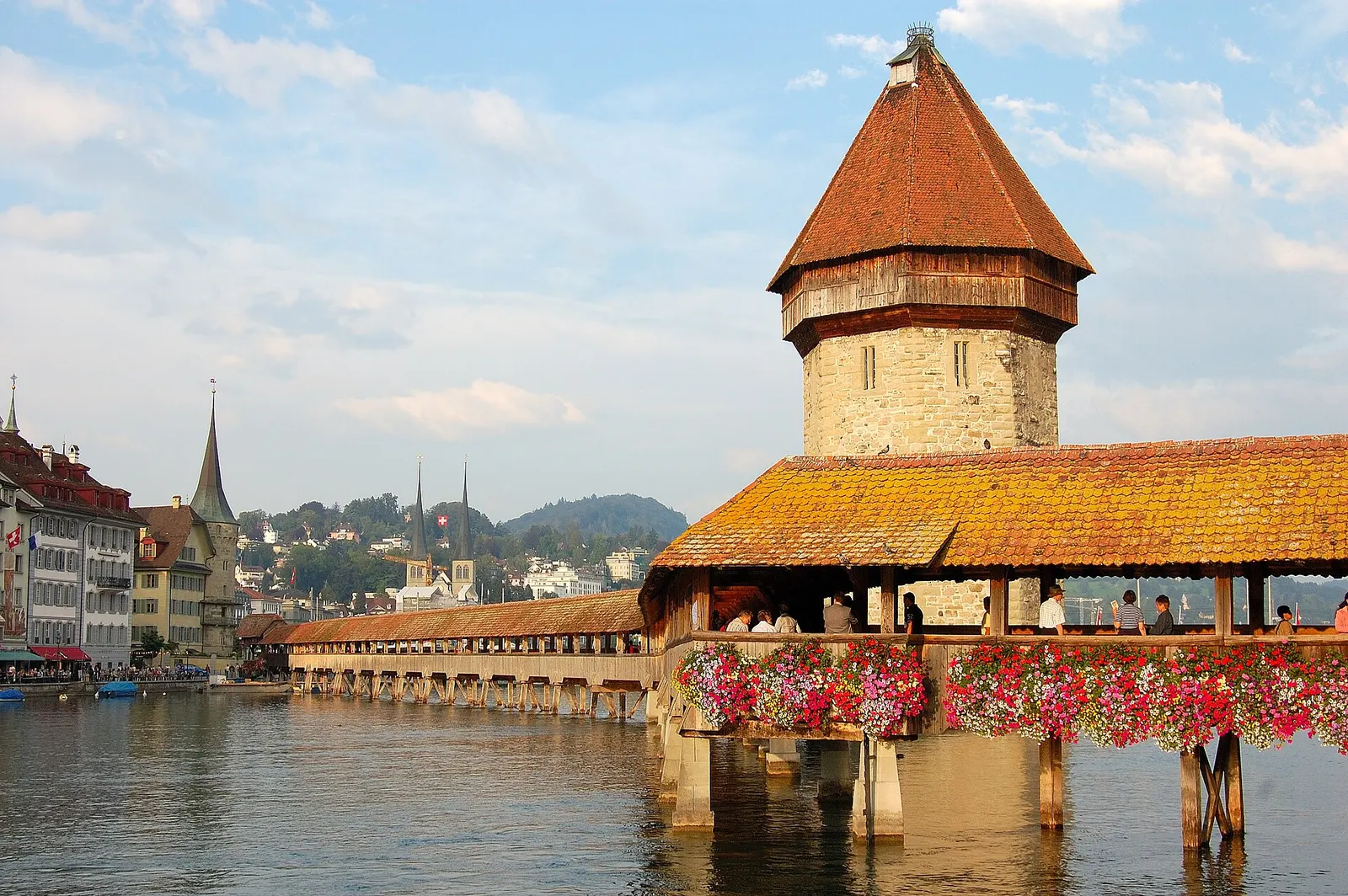
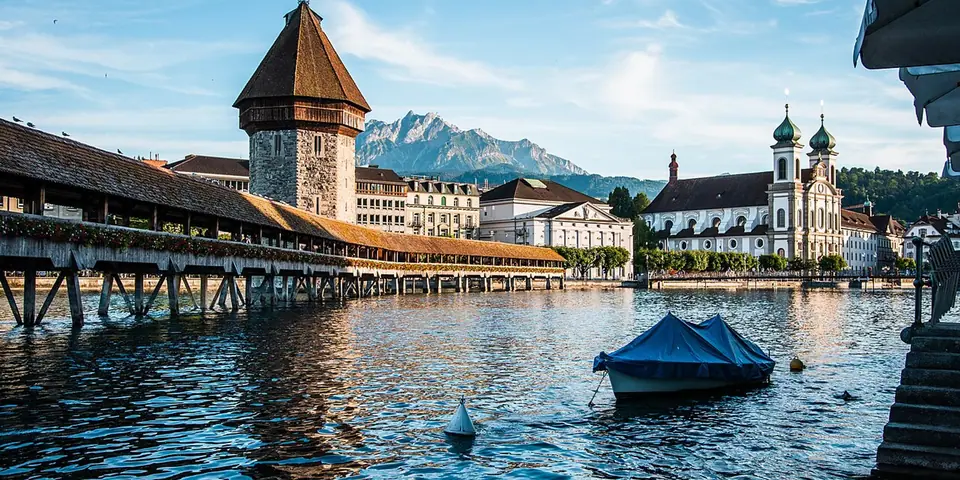
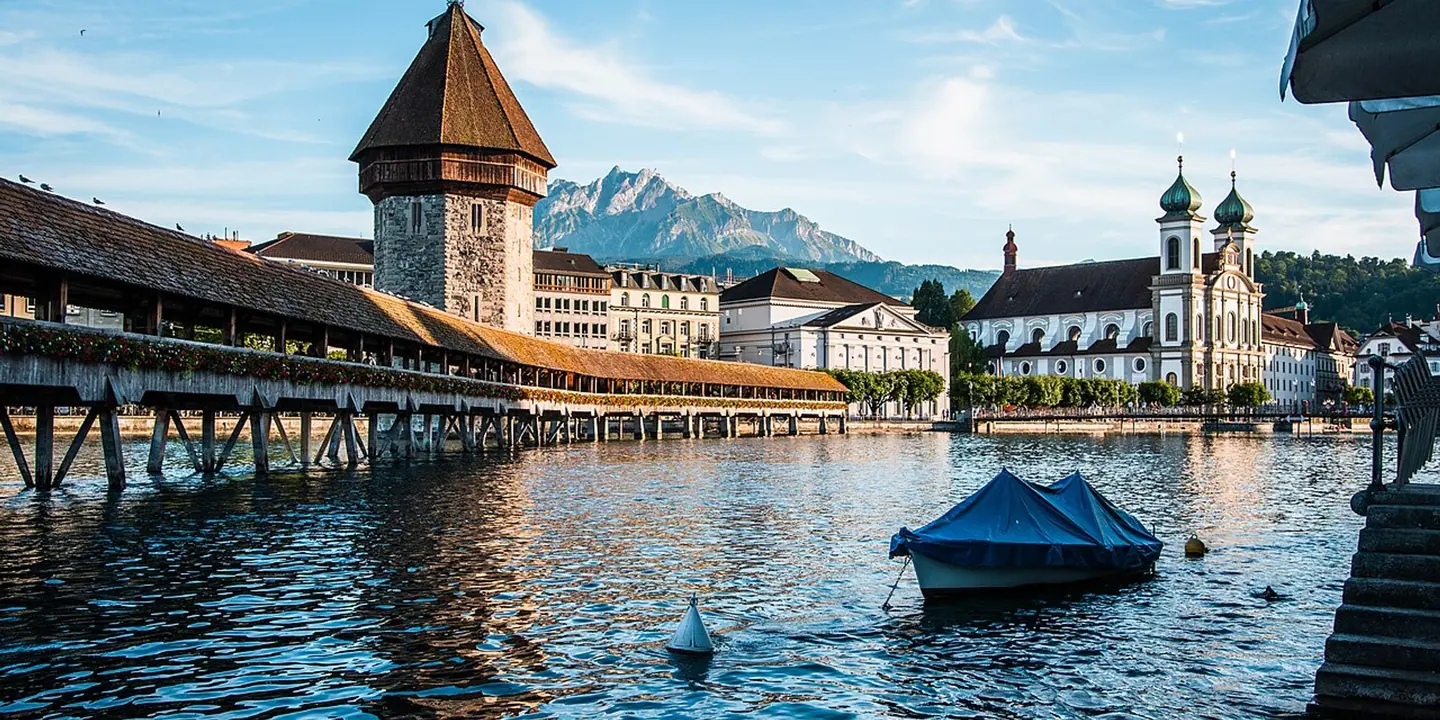
Chapel Bridge Kapellbrücke (c. 1365) & 17th-Century Triangular Roof Paintings, Octagonal Wasserturm Water Tower, Jesuit Church of St Francis Xavier (Switzerland’s first large Baroque church), Ritter Palace Courtyard, Needle Dam Nadelwehr Wooden Sluices, and Spreuer Bridge Dance of Death Panels
Chapel Bridge
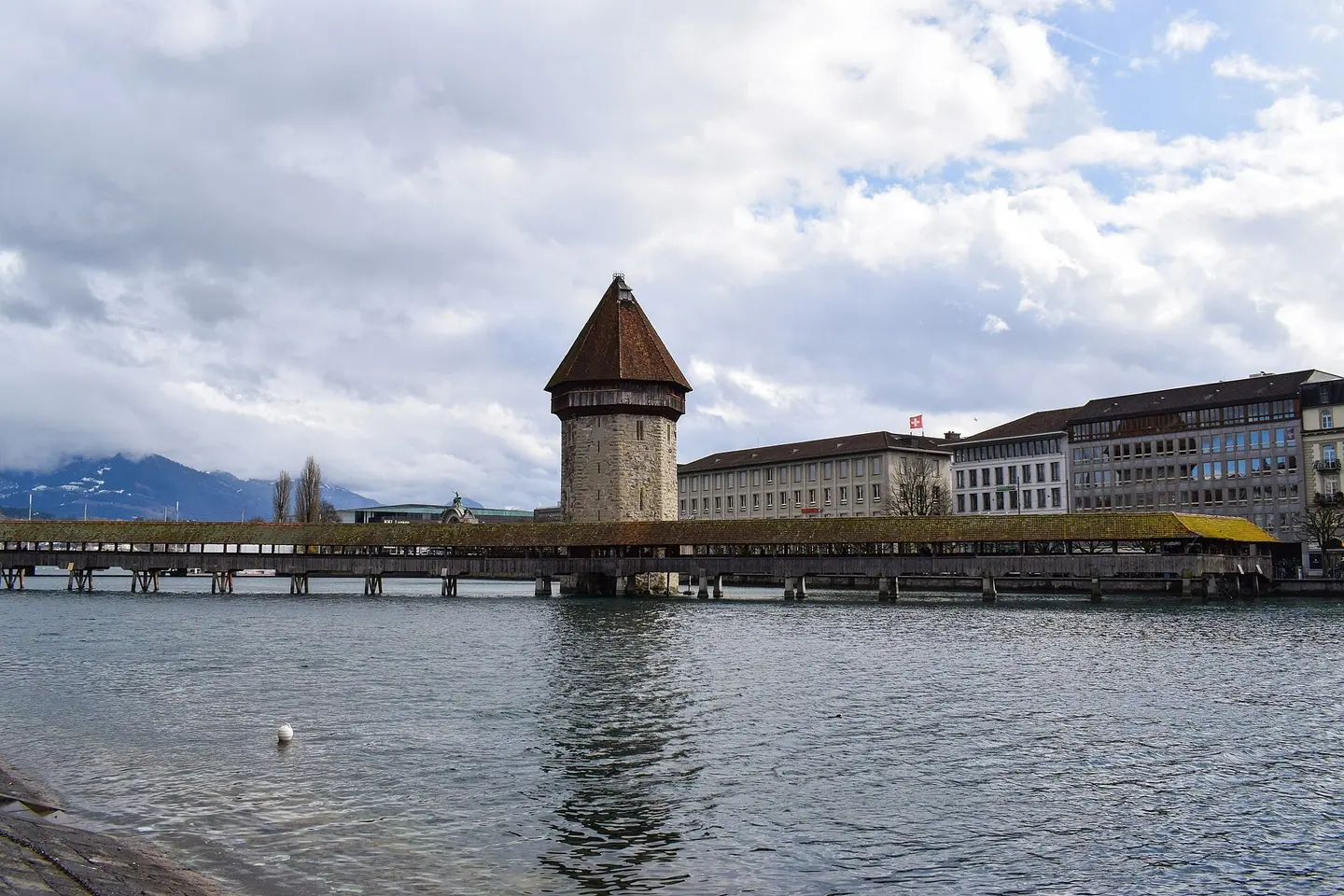
Constructed around 1365 as part of the municipal fortifications, this covered timber bridge spans obliquely across the River Reuss. Visitors can walk beneath its gabled roof to view the triangular pediment paintings from the seventeenth century depicting local civic history. The structure was meticulously restored following a major fire in 1993.
Water Tower
Standing thirty-four metres high beside Chapel Bridge, this octagonal stone tower pre-dates the adjoining wooden pathway by several decades. Built around 1300, it historically functioned as a rampart watchtower, city treasury, archive, and municipal prison. Its thick rubble masonry walls and tiled roof remain striking landmarks along the riverfront.
Jesuit Church of St Francis Xavier
Founded in 1667 for the Jesuit college, this riverside church stands as the earliest grand Baroque ecclesiastical building erected in Switzerland. The interior features bright white stucco reliefs, ornate pink marble columns, and a dynamic ceiling fresco celebrating the missionary work of Saint Francis Xavier. The twin onion-domed towers were completed later in 1893.
Ritter Palace
Commissioned in 1556 by Mayor Lux Ritter, this elegant stone palazzo reflects the influence of the Italian Renaissance in central Switzerland. Following Ritter's death, the Jesuits acquired the premises to serve as their administrative headquarters. Today, travellers can enter the ground floor to admire the three-storey loggia courtyard decorated with classical columns.
Needle Dam
Installed between 1859 and 1861, this rare hydraulic weir regulates the outflow of Lake Lucerne into the lower Reuss. Operators manually insert and remove individual spruce timber poles, termed needles, to adjust the river depth. It represents a remarkable feat of pre-industrial civil engineering that continues to protect the old town from flooding.
Spreuer Bridge
Completed in 1408 as the town's lower river crossing, this timber footbridge was the sole location where millers could tip chaff into the current. Suspended within the roof trusses are sixty-seven seventeenth-century painted triangular panels by Kaspar Meglinger depicting the Dance of Death. A small seventeenth-century chapel dedicated to the Virgin Mary stands along the wooden deck.
Old Town Hall
Erected between 1602 and 1606 by architect Anton Isenmann, this riverside civic building combines Swiss regional architecture with Italian Renaissance elements. The hall is crowned by a high Bernese-style hip roof and an adjoining rectangular clock tower. The ground floor arcades facing the river historically accommodated grain merchants and weekly open-air trade.
Kornmarkt
Located behind the Old Town Hall, this public square served for centuries as the central distribution point for cereals in the canton. Intricate historical frescoes adorn the facades of the enclosing townhouses, displaying coats of arms and merchant allegories. The square remains a natural gathering point during weekly market days and the annual carnival.
Weinmarkt
In 1332, delegates met on this cobblestone square to swear the oath that brought Lucerne into the Swiss Confederation. Formerly a fish and cattle market, it gained its wine-trading identity in the fourteenth century. An elaborate late-Gothic fountain adorned with stone statues of warriors stands in the centre, encircled by richly decorated patrician buildings.
Hirschenplatz
Named after a long-vanished medieval inn, this historic junction displays some of the finest facade paintings in the pedestrian core. The surfaces depict traditional heraldic motifs, mythological allegories, and historical events painted directly onto lime plaster. German poet Johann Wolfgang von Goethe lodged at one of the flanking guesthouses during his 1779 Swiss journey.
St Peter's Chapel
First documented in 1178, this venerable Roman Catholic chapel stands at the northern approach to Chapel Bridge. The building underwent extensive renovations during the eighteenth century, resulting in a refined interior decorated with late-Baroque ceiling frescoes and gilded altars. It remains an active place of quiet worship amid the historic quarter.
Musegg Wall
Constructed after 1386 following the Battle of Sempach, this eight-hundred-metre stone wall remains largely intact above the old town. Nine fortified towers punctuate the battlement, each built with distinct defensive layouts and roof shapes. The elevated walkway provides expansive views across the roofs of Lucerne, the Reuss, and Lake Lucerne.
Zyt Tower
Forming an integral part of the Musegg Wall, this tower houses an astronomical public timepiece crafted by Hans Luter in 1535. By ancient civic privilege, the clock bell chimes every hour exactly one minute ahead of the city's other official bells. Inside, an exhibition explains the mechanical workings of historical Swiss clockwork.
Männli Tower
Rising thirty-three metres from the western ridge of the Musegg fortifications, this stone tower takes its name from the small iron soldier figure standing upon its battlements. Visitors can climb interior wooden flights of stairs to access open viewing platforms. It historically protected the northern approach facing Basel and the lower valley.
Historisches Museum Luzern
Housed within a fortified municipal armoury constructed in 1567, this museum preserves artifacts documenting the cultural life of central Switzerland. The building features massive oak timber framing, heavy sandstone walls, and original weapons storage racks. Displays include medieval guild banners, domestic furnishings, and trade tools spanning seven centuries.
Natur-Museum Luzern
Positioned beside the River Reuss near the southern abutment of Spreuer Bridge, this institution charts the geological and biological diversity of the region. The permanent collection highlights alpine minerals, fossilised flora from central Swiss strata, and regional wildlife dioramas. It provides an instructive companion to the hydraulic engineering sights located outside its doors.
Franciscan Church
Erected between 1270 and 1280 by the Franciscan order, this church is the most significant medieval Gothic place of worship in central Switzerland. The nave interior displays painted reproductions of war trophies captured by Lucerne forces during ancient confederate battles. A finely carved wooden pulpit completed in the early seventeenth century adorns the central aisle.
Church of St Leodegar
Built on the foundations of an eighth-century Benedictine monastery, this collegiate church was reconstructed in German Renaissance style after a catastrophic 1633 fire. The twin bell towers survived the blaze and retain their late-Gothic profiles. Within, visitors can view a monumental 1640 pipe organ, rich relief altars, and delicately carved choir stalls.
Lion Monument
Hewn directly into a former sandstone quarry face in 1821, this colossal sculpture depicts a dying lion resting upon fallen weapons and royal French emblems. Designed by Danish sculptor Bertel Thorvaldsen, it commemorates the Swiss Guards massacred during the storming of the Tuileries Palace in 1792. Mark Twain once described it as the mournfulest stone on earth.
Glacier Garden
Discovered in 1872, this geological monument contains thirty-two natural potholes carved into bedrock by glacial meltwaters twenty thousand years ago. An elevated pathway allows travellers to inspect the polished stone basins and erratic granite boulders transported from the Alps. The adjoining pavilion includes an antique Alhambra mirror maze built in 1896.
Frescoed Old Town Squares: Weinmarkt, Hirschenplatz & Kornmarkt
Mühlenplatz, Weinmarkt Gothic Fountain, Fritschi Fountain on Kapellplatz, St Peter’s Chapel, Kornmarkt & Old Town Hall Altes Rathaus (1602 Italian Renaissance Arcades), Picasso Photography Museum, Hirschenplatz Painted Facades, and Sternenplatz
Mühlenplatz
Formed in the sixteenth century following the clearance of local mill buildings, this is the largest historic square in the old quarters. Cobbled terraces look directly over the rushing river, bordered by tall residential houses with painted window surrounds. Visitors can inspect the ancient stone paving that once supported heavy grain carts and milling trade.
Weinmarkt
Lucerne swore its federal oath of confederacy on this historic square in 1332. The open space features tall guildhouses adorned with intricate narrative wall paintings depicting biblical, chivalric, and mercantile allegories. We recommend examining the detailed facade of the former guildhall of the wine merchants, complete with projecting timber oriel windows.
Weinmarkt Gothic Fountain
Erected in 1481 by stonemason Konrad Lux, this fountain served as the primary source of clean spring water for the market. The central pillar features statues of warrior Saint Maurice, heraldic lions, and graceful pinnacles chiseled in the Late Gothic style. A detailed replica occupies the square today, with the original masterwork preserved in the cantonal museum.
Kornmarkt
Operating as the municipal grain market throughout the Middle Ages, this square formed the economic core of the merchant quarter. The open plaza is defined by substantial merchant palaces featuring decorative plasterwork and wrought-iron trade signs. It connects pedestrian pathways running between the upper hillsides and the lower river wharves along the Reuss.
Old Town Hall (Altes Rathaus)
Constructed between 1602 and 1606 by architect Anton Isenmann, this monument blends Italian Renaissance proportions with traditional Swiss roof carpentry. Open ground-floor arcades historically hosted market vendors while upper chambers accommodated the town council. Notable exterior details include finely carved limestone pilasters and a prominent rectangular clock tower dating to the fourteenth century.
Rathausquai
This riverfront promenade extends directly beneath the southern arcade of the Altes Rathaus along the Reuss. Medieval vessels previously docked here to unload commercial freight directly into town storehouses. Today, the pedestrian walkway offers clear sightlines across the water towards the Jesuit Church, backed by historic facade paintings and decorative stonework.
Hirschenplatz
Taking its name from a historic hostelry where Johann Wolfgang von Goethe stayed in 1779, this square retains tightly packed medieval plots. The building facades showcase exuberant nineteenth-century paintings that portray historic parades, coats of arms, and civic celebrations. Intricate iron hanging tavern signs project over the cobblestones, marking ancient hospitality establishments.
Sternenplatz
Positioned at a crossroads of ancient pedestrian lanes, this compact square was historically designated for small trades and poultry vendors. The dominant building, Gasthaus zum Sternen, features an ornate star motif and trompe-l'œil murals detailing traditional folklore. Travellers passing through can observe original Renaissance window frames and traditional wooden shutter mechanisms.
Kapellplatz
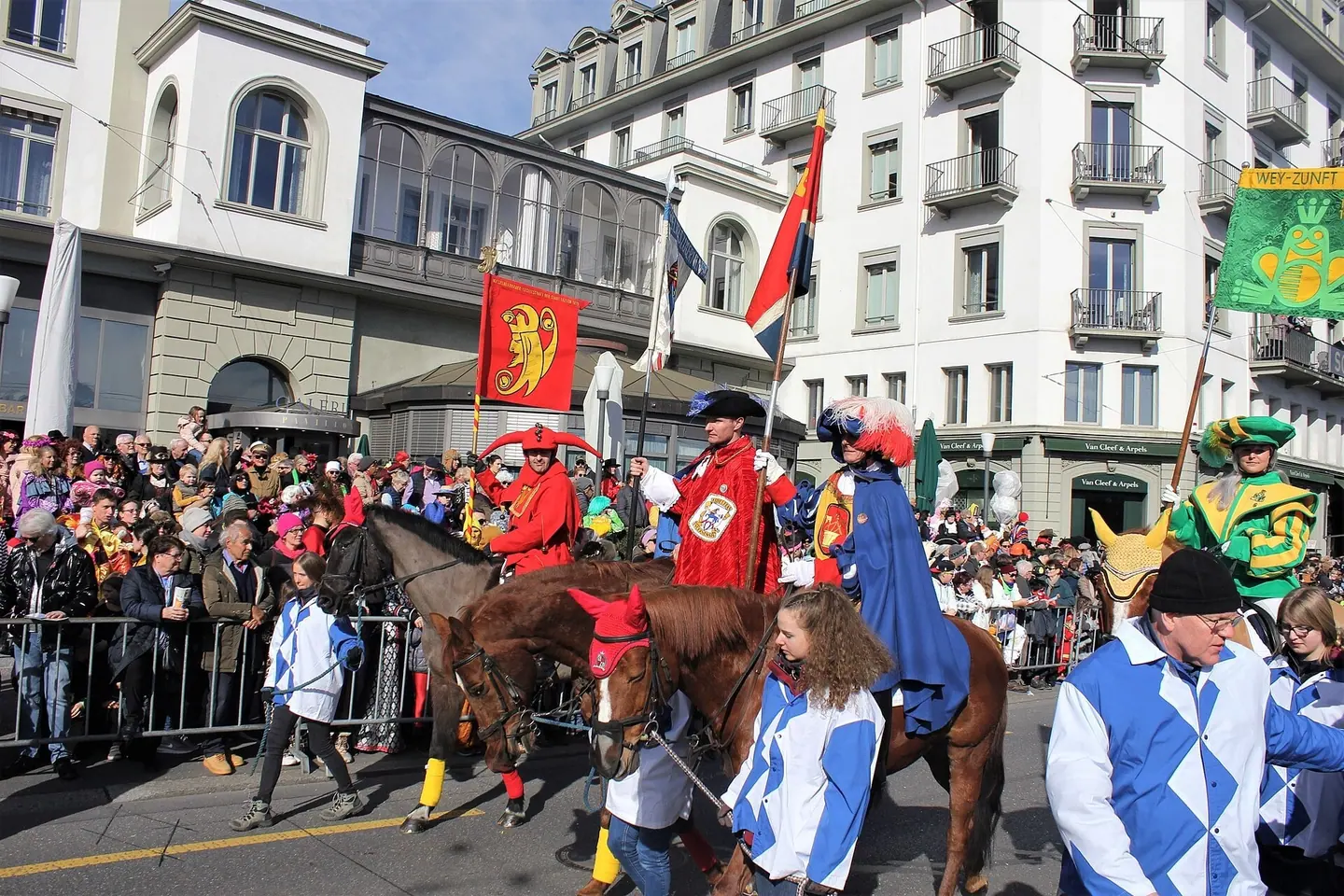
Kapellplatz serves as the eastern threshold of the pedestrian core, leading visitors toward the Chapel Bridge. The open plaza is bounded by pastel-hued townhomes, municipal offices, and ecclesiastical buildings dating back several centuries. It acts as the traditional assembly ground for local carnival festivities during late winter each year.
St Peter’s Chapel
Consecrated around 1178, this church predates the formal charter of the city and underwent significant Baroque modification during the eighteenth century. Inside, the quiet nave displays restored altarpieces, decorative stucco mouldings, and oil paintings depicting the life of Saint Peter. The exterior wall facing the square displays a memorial tablet dedicated to Swiss poet and politician Josef Eutych Kopp.
Fritschi Fountain
Installed on Kapellplatz in 1918, this decorative fountain honours Brother Fritschi, the folkloric patriarch of the Lucerne carnival. The limestone pillar displays carved figures wearing traditional festive masks, capped by a statue of the character himself clutching a staff. Chiseled relief plaques around the base depict joyful carnival musicians and heraldic shields.
Am-Rhyn-Haus
Constructed between 1616 and 1618 for the town clerk Ulrich Am Rhyn, this building represents prime late-Renaissance residential architecture. It features a private inner courtyard with graceful stone arches and an authentic spiral staircase tower. For decades, the manor exhibited late-period paintings and photographs by Pablo Picasso before the collection moved to the nearby Rosengart Museum.
Zunfthaus zu Pfistern
Occupying a riverside plot near Kornmarkt, this building has served as the guild headquarters for town bakers since the Middle Ages. The exterior wall is decorated with an immense mural portraying the bakers' genealogical tree alongside scenes of municipal breadmaking. Gothic stepped gables and ornamental stone lintels highlight its enduring medieval craftsmanship.
Haus zur Sonne
This striking residential house anchors the western edge of Weinmarkt and has hosted traders since the fifteenth century. Its frontage features a golden radiating sun motif surrounded by allegorical figures representing virtue, commerce, and industriousness. The fine masonry at street level preserves antique sandstone brackets that supported early cantilevered timber upper floors.
Zur Metzgern
Standing on the corner of the Weinmarkt, this historic property was the formal headquarters of the city butchers guild. The facade displays historic frescoes illustrating traditional livestock husbandry, medieval trade assemblies, and regional coats of arms. It represents one of the finest surviving examples of late-nineteenth-century romantic historicist mural restoration in Central Switzerland.
Kramgasse
Running between Weinmarkt and Kornmarkt, this cobblestone thoroughfare formed an essential merchant axis in early Lucerne. The narrow lane is framed by tall four-storey buildings featuring carved stone lintels, Renaissance courtyards, and ornate guild insignia. Walking here offers an authentic sense of medieval urban density, sheltered from modern vehicular transport.
Weggisgasse
This ancient thoroughfare formed part of the regional trading path leading towards the town gate and Lake Lucerne docks. While now a principal retail lane, its upper floors retain timber framing, original stone mullions, and early seventeenth-century facade inscriptions. Several courtyards branch off the main path, leading into quiet residential passages preserved since the early modern period.
Eisengasse
Connecting Hirschenplatz directly to the riverside, Eisengasse was historically home to metalworkers, farriers, and toolmakers. The narrow lane retains significant masonry houses with detailed plaster scrollwork and ornamental wrought-iron window grilles. Architectural highlights include preserved gothic doorways and deep stone basements formerly used for stockpiling heavy imported metals.
Brandgässli
This steep, shadowed alley connects the lower squares to the upper defensive perimeters of the city. Its name recalls destructive blazes that prompted local authorities to mandate stone construction over timber framing in the late medieval era. Today, the passage features stone-arched buttresses spanning between houses to support opposing building walls.
Spreuerbrücke
Completed in 1408, this timber bridge served as the lower river crossing, from which millers were permitted to dump chaff into the water. Beneath its triangular ceiling gables hangs an exceptional seventeenth-century cycle of sixty-seven paintings by Kaspar Meglinger depicting the Dance of Death. The bridge also incorporates an embedded small timber chapel dedicated to the Virgin Mary.
Nine Towers of the Musegg Wall, Lion Monument & Glacier Garden
Museggmauer Rampart Walk, Nölliturm, Männliturm, Zytturm (1385 Clock Tower that strikes one minute before all others), Schirmerturm, Lion Monument Löwendenkmal carved by Bertel Thorvaldsen (1821), Bourbaki Panorama Rotunda, and Glacier Garden Gletschergarten Potholes & Mirror Maze
Musegg Wall Ramparts
Constructed towards the close of the fourteenth century, this 870-metre stone rampart protected the northern flank of Lucerne following the Battle of Sempach. Visitors can traverse open sections of the parapet walkway, inspecting arrow loops and projecting battlements while surveying the town rooftops and Lake Lucerne below.
Nölliturm
Erected in 1513, this round defensive bastion anchors the western termination of the Musegg ramparts by the River Reuss. The tower features robust masonry pierced by gunports and now serves as the headquarters of the ancient Saffron Guild, housing historic ceremonial weapons and guild relics within its circular walls.
Männliturm
Rising 33 metres, this crenellated observation tower takes its name from the cast-copper pikeman balancing on its summit flagpole. Travellers can climb the internal timber staircases to reach an open viewing platform, gaining uninterrupted panoramas across Mount Pilatus and the surrounding Pre-Alpine landscape.
Luegisland
Built around 1370, Luegisland is recognized as the oldest structure along the Musegg fortifications. Its distinctive high pyramidal roof and open rear facade allowed town guards to keep continuous vigil over approaching armies from the north without allowing invaders a fortified retreat if captured.
Wachturm
Constructed in 1701 following a catastrophic lightning strike that detonated gunpowder stored in its medieval predecessor, the Wachturm displays eighteenth-century rebuilding techniques. Its sturdy masonry was designed to house heavy ordinance, providing crucial artillery support along the central ridge of the defensive ridge line.
Zytturm
Constructed in 1442, this prominent tower holds the oldest monumental clock in Lucerne, engineered by Hans Luter in 1535. By ancient civic privilege, its bell strikes the full hour one minute ahead of all other church bells across the city, accompanied by large external clock dials visible from afar.
Schirmerturm
Standing 28 metres tall, the Schirmerturm incorporates an arched ground-floor portal that once served as a primary gate into rural territory north of the city. Visitors ascending the timber flights find exhibitions on historic building conservation and can inspect medieval defensive loopholes along its upper stories.
Pulverturm
Rebuilt in 1701 following an accidental explosion, the Pulverturm served the city council for centuries as a secure repository for munitions and black powder. The tower features exceptionally thick lower ashlar walls, small ventilation slits, and today provides meeting chambers for the historic Wey Guild.
Allenwindenturm
Situated on the exposed eastern spur of the Musegg crest, this square stone structure sheltered town defenders against hostile movements across open northern pastures. Together with the neighboring rampart walls, its rugged limestone blocks demonstrate the utilitarian engineering applied to keep Lucerne invulnerable during regional Swiss conflicts.
Dächliturm
The smallest among the nine fortifications, the Dächliturm is distinguished by its low pyramidal timber cap and compact rectangular footprint. In earlier centuries, it housed the town carpenters and joiners guild, while its strategic placement offered defensive coverage where the stone curtain wall began its descent.
Lion Monument
Carved directly into a former sandstone quarry face in 1821, this colossal relief was designed by Danish sculptor Bertel Thorvaldsen and carved by Lukas Ahorn. It portrays a dying lion sheltering the French fleur-de-lis, commemorating the Swiss Guards massacred during the 1792 storming of the Tuileries Palace.
Glacier Garden
Discovered in 1872 during cellar excavation work, this natural monument displays thirty-two deep potholes gouged by swirling glacial torrents during the last Ice Age twenty thousand years ago. Visitors can walk along elevated footbridges above the polished rock formations and explore a subterranean alpine cavern exhibition.
Glacier Garden Mirror Maze
Originally built for the 1896 Geneva National Exhibition and later relocated to Lucerne, this maze features ninety full-length mirrors arranged into Moorish-style archways. The optical illusions produce endlessly repeating corridors that challenge visitors to navigate their way through its intricate, historic interior hall.
Bourbaki Panorama
Housed within an original circular rotunda, this 112-metre-long circular painting was executed in 1881 by Edouard Castres. The canvas depicts eighty-seven thousand defeated French troops under General Bourbaki crossing into neutral Switzerland during the winter of 1871, representing an early landmark in modern humanitarian relief.
Alpine Museum at Glacier Garden
Located in the nineteenth-century residence of the Amrein-Troller family who excavated the site, this museum presents historic relief models of Switzerland crafted by Franz Ludwig Pfyffer. Exhibits include fossilised seashells, palm leaves from prehistoric subtropical eras, and period furnishings reflecting regional scientific discoveries.
Church of St. Leodegar
Erected between 1633 and 1639 after a devastating fire, this collegiate church retains its twin Gothic towers from 1525 alongside a masterfully proportioned German Renaissance interior. Travellers should observe the ornate wooden choir stalls, the high golden altar, and the historic seventeenth-century rain-making organ mechanism.
Löwenplatz
Serving as the northern civic gateway to the old quarter, this paved square connects the lakeside boulevards with the approach to the Lion Monument and the Bourbaki Rotunda. It features preserved nineteenth-century commercial facades, historic tram-line relics, and key transit paths used by travellers exploring the Musegg district.
Old Lion Fountain
Set within the tranquil landscaped park below the rock cliff, this stone fountain provides fresh spring water in front of the reflective memorial pond. Its understated design complements the towering weeping trees and surrounding sandstone bluffs, creating a quiet space for reflection before the fallen lion relief.
Kapuzinerkloster Wesemlin
Founded in 1588 on the Wesemlin hill just north of the Glacier Garden, this monastic complex remains one of the oldest Capuchin settlements in continuous use. The simple stone chapel contains regional devotional paintings, while the walled cloister grounds preserve historic medicinal herb terraces and quiet courtyards.
Wey Guild Hall
Located near the Schirmer gate approaches, this historic building serves as the traditional gathering seat for the Wey Guild, caretakers of several northern rampart structures. The building preserves heraldic stained-glass panels, period woodwork, and civic archives chronicling early modern trade guilds and their civic guard duties.
Hofkirche, Lakefront Quay, KKL & Swiss Museum of Transport
Church of St Leodegar Hofkirche Twin Gothic Spires & Renaissance Carved Choir, Schweizerhofquai Promenade, KKL Luzern Culture and Congress Centre by Jean Nouvel, Collection Rosengart (Picasso & Paul Klee), Richard Wagner Museum at Tribschen Villa, and Swiss Museum of Transport Verkehrshaus
Church of St. Leodegar
Founded around 735, this landmark church was destroyed by fire in 1633, sparing only its two Romanesque spires. The rebuilt nave represents one of the finest German Renaissance basilicas north of the Alps. Visitors admire the carved choir stalls, the gold-leaf High Altar, and the colossal Great Organ containing nearly five thousand pipes.
Hofkirche Arcades
Enclosing the courtyard around the Church of St. Leodegar, these stone arcades served as a burial cloister for prominent city families from the seventeenth century onward. The walls display original funerary coats of arms, wrought-iron gates, and Latin epitaphs. Walking along the flagstones offers views over the lake through open classical arches.
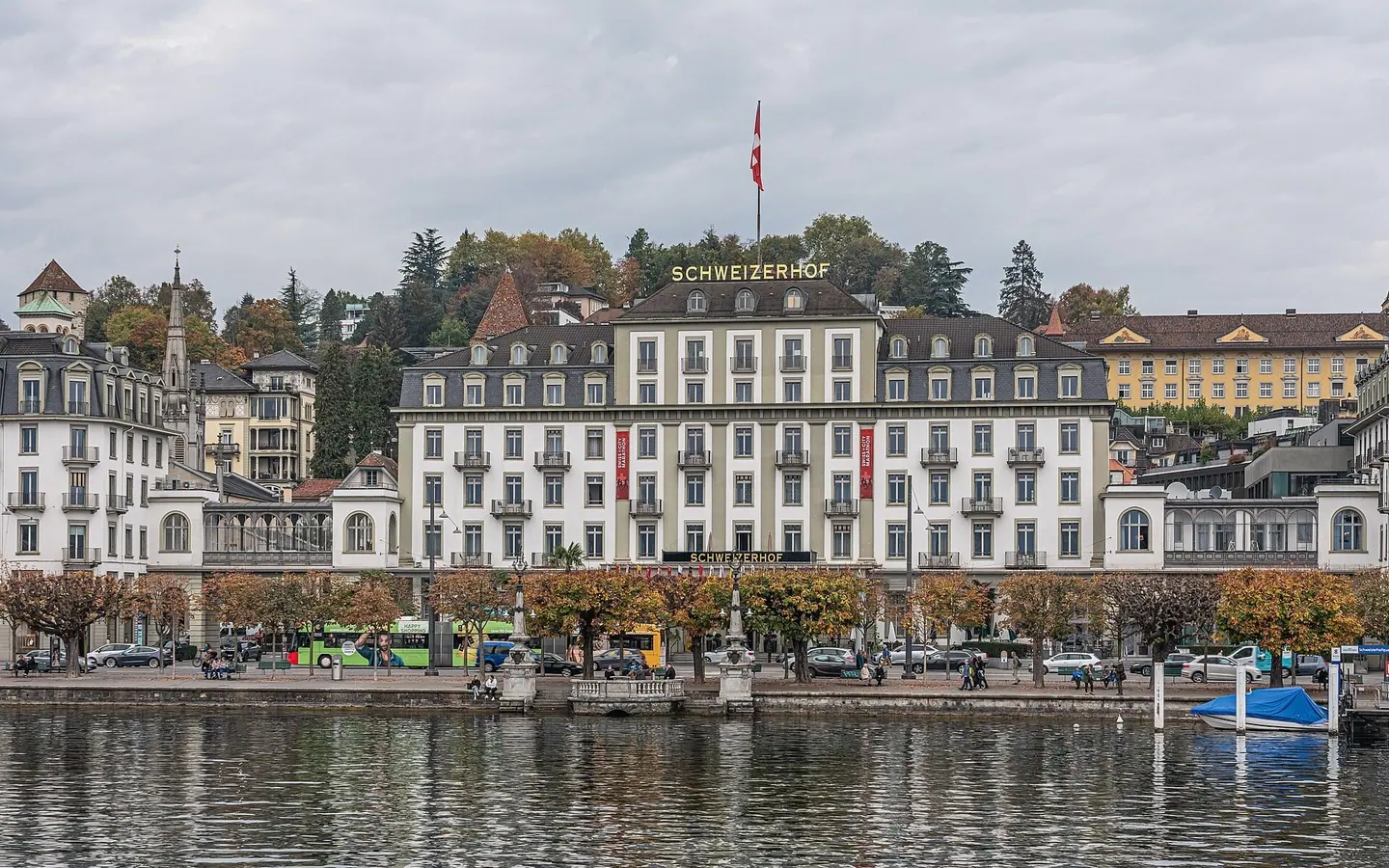
Schweizerhofquai
Developed in the mid-nineteenth century to accommodate wealthy travellers arriving during the Belle Epoque, this wide walkway connects the historic city to the lakefront. Lined with classicist hotels and shaded benches, it looks directly across the water towards Mount Pilatus. The path remains a central axis for leisurely strolls and boat arrivals.
Hotel Schweizerhof Luzern
Opened in 1845 by the Hauser family, this neo-Renaissance grand hotel has retained its lavish historic salons and ornate facade. Mark Twain, Leo Tolstoy, and Richard Wagner resided here during their Swiss journeys. Inside, restored ceiling frescoes and antique chandeliers reflect the golden age of European grand tourism.
Nationalquai
Continuing east from the Schweizerhofquai, the Nationalquai was constructed in 1870 to expand Lucerne's resort frontage. The promenade passes formal flowerbeds and marble statues of Swiss historical figures, leading towards the Kurpark. It provides unobstructed vantage points for watching classic paddle steamers glide across the bay.
Grand Hotel National Luzern
Constructed in 1870 by architect Horace Edouard Davinet, this palatial property was transformed into a legend by manager Cesar Ritz and chef Auguste Escoffier. The building features an elegant mansard roof, symmetrical bays, and opulent Empire style reception rooms. It continues to define the architectural grandeur of Lucerne's eastern lakefront.
Kurpark Lucerne
This landscaped public park was established in the late nineteenth century directly in front of the Grand Casino. Shaded by ancient plane trees, it houses several civic memorials and decorative bronze statues. The waterside perimeter offers open public seating facing Mount Rigi and the Bürgenstock peninsula.
Grand Casino Luzern
Erected in 1882 as the Kursaal, this palatial pavilion was designed to entertain fashionable summer visitors taking the cure. Its exterior exhibits neoclassical colonnades and a grand lakeside terrace overlooking the water. The restored interior salons retain gilded stuccowork, crystal chandeliers, and vaulted ceilings.
Seebad Luzern
Constructed in 1885, this heritage wooden bathing pavilion floats directly on the lake along Nationalquai. The structure contains two enclosed open-air swimming basins surrounded by simple wooden sunbathing decks and changing cabins. It represents a rare preserved example of nineteenth-century municipal wellness architecture.
Culture and Congress Centre Lucerne
Completed in 2000, the KKL features an enormous cantilevering flat roof that reaches far out over the lakefront plaza. Architect Jean Nouvel integrated water channels that flow directly inside the building between the distinct pavilions. The main concert hall is internationally renowned for its acoustic engineering.
Kunstmuseum Luzern
Located inside the upper level of Jean Nouvel's KKL, the cantonal art museum presents major works from the Renaissance to contemporary Swiss art. The collection includes notable landscape paintings by Caspar Wolf and historic works by Ferdinand Hodler. Expansive window slots offer curated views across the harbour and railway tracks.
Lucerne Railway Station
Following a devastating fire in 1971, a new station complex was designed by architect Santiago Calatrava and opened in 1991. The surviving neoclassical sandstone portal from the original 1896 terminal stands proudly on the station plaza as a standalone monument. Inside, Calatrava's bright subterranean hall displays sweeping white concrete columns.
Collection Rosengart
Housed within an imposing neoclassical building that formerly served as the Swiss National Bank, this museum displays the private collection of art dealer Angela Rosengart. The lower ground floor holds over one hundred watercolours and drawings by Paul Klee. The upper halls feature major late paintings by Pablo Picasso and works by French Impressionists.
Inseli Park
Situated on a peninsula adjacent to the train station docks, Inseli provides grassy recreation spaces beneath shady tree canopies. Originally constructed as an industrial railway depot, it was repurposed during the twentieth century into a civic park. The water's edge provides uninterrupted vistas of passing motor vessels and the distant northern shoreline.
Tribschen Peninsula
Jutting into Lake Lucerne south of the city centre, the Tribschen promontory combines historic parkland, protected reed beds, and public walking paths. The land retains a quiet pastoral atmosphere distinct from the busy urban quays. It is universally celebrated for the seventeenth-century manor house situated near its crest.
Richard Wagner Museum
German composer Richard Wagner lived in this three-storey manor house between 1866 and 1872, where he completed Die Meistersinger von Nürnberg. The museum exhibits Wagner's original Erard grand piano, handwritten music scores, letters, and family portraits. The surrounding garden is where the Siegfried Idyll was first performed on Christmas morning in 1870.
Swiss Museum of Transport
Opened in 1959, this vast complex is Switzerland's most visited museum, housing over three thousand transport artefacts. The exhibits trace the engineering triumphs of Alpine railway tunnels, early postal stagecoaches, and pioneering aviation. Visitors can inspect genuine historic steam engines, vintage funicular carriages, and regional passenger planes.
Hans Erni Museum
Located within the Swiss Museum of Transport grounds, this distinct hexagonal exhibition building was built in 1979 to showcase the works of Lucerne-born artist Hans Erni. The central auditorium contains his monumental mural Panta Rhei, covering over two hundred square metres. The galleries display Erni's paintings, tapestries, lithographs, and sculptural works.
Lidowiese
Adjoining the Transport Museum, the Lido opened in 1929 as a municipal public beach along a wide natural bay. The extensive lawn areas are dotted with towering poplars and offer direct sandy access to Lake Lucerne. It remains a celebrated vantage point for admiring the southern pre-Alpine mountains.
Meggenhorn Castle Viewpoint
Set on a high promontory east of the transport museum, this chateau was built in 1868 inspired by the French Chateau de Chambord. Surrounding the residence are public vineyards, historic formal gardens, and a gothic neo-chapel. The perimeter paths offer expansive views over the cross-shaped waters of Lake Lucerne towards the Alps.
Château Gütsch, Paddle Steamers, Mount Pilatus & Mount Rigi
Château Gütsch Funicular Viewpoint, Meggenhorn Castle on the Lake, Historic Paddle Steamer Cruise on Lake Lucerne, Rütli Meadow Birthplace of Switzerland, Vitznau Rack Railway to Mount Rigi Kulm, and Alpnachstad World’s Steepest Cogwheel Railway (48% gradient) to Mount Pilatus
Château Gütsch
Constructed in 1888 following the designs of architect Emil Vogt, this grand hotel draws inspiration from Bavarian romanticism. Guests arrive via a dedicated funicular railway to enjoy panoramic terraces. The interiors preserve Belle Époque details, timber panelling and decorative plaster ceilings from the late nineteenth century.
Gütsch Funicular
First opened in 1892 as a water ballast railway, this historic transport link connects the Baselstrasse quarter with the ridge above. Modernised with automated cars, the route climbs steeply through woodland. It provides an efficient connection while tracing the pioneering days of Swiss mountain urban transit.
Meggenhorn Castle
Built in 1868 for industrialist Edouard Hofer, the estate borrows heavily from French Loire Valley architecture. The adjacent Gothic Revival chapel features a historic Welte organ and stands beside formal gardens. Footpaths descend directly to the lake shore, where a nineteenth-century Christ statue looks across the water.
Lake Lucerne Steamship Uri
Launched in 1901 by Sulzer Brothers, Uri represents the golden age of lake navigation in Central Switzerland. The vessel retains its original two-cylinder compound steam engine visible from the main deck. Polished brass fittings, varnished woodwork and ornate saloons provide an authentic Edwardian travel experience.
Lake Lucerne Steamship Stadt Luzern
Commissioned in 1928, this vessel is the largest and final steamship constructed for the lake fleet. It features Art Deco embellishments across its expansive first-class dining saloon and broad promenade decks. The ship famously carried Queen Elizabeth II during her official state visit to Switzerland in 1980.
Lake Lucerne Steamship Unterwalden
Entering service in 1902, Unterwalden was engineered specifically to pass beneath the low Acheregg bridge into Lake Alpnach. The ship features an adjustable funnel and wheelhouse designed to fold flat during passage. Restored woodwork, gleaming brass machinery and period passenger salons showcase early twentieth-century Swiss naval craftsmanship.
Lake Lucerne Steamship Schiller
Constructed in 1906, Schiller is celebrated for its finely preserved Art Nouveau main salon. The vessel plies the scenic line between Lucerne and Flüelen, powered by an exposed steam engine. Richly decorated interior panels and classical fittings pay homage to the author of the William Tell drama.
Lake Lucerne Steamship Gallia
Entering passenger service in 1913, Gallia earned renown as one of the swiftest paddle steamers on European lakes. Built by Escher Wyss, its Neoclassical interior highlights the tastes of the pre-war era. Visitors can inspect the powerful engine working through open galleries on the central deck.
Vitznau-Rigi Railway
Inaugurated in 1871 by engineer Niklaus Riggenbach, this was Europe's first mountain rack railway. Trains depart from the lakeside terminus at Vitznau, climbing steep pastures towards the summit. Historic rolling stock, vintage steam locomotives and original track alignments remain central to the operating heritage line.
Rigi Kulm
Rising to 1,798 metres, Rigi Kulm offers sweeping views over thirteen surrounding lakes and the Alps. In the nineteenth century, travellers gathered here to witness sunrise, inspiring writings by Mark Twain and Victor Hugo. A stone observation tower and historical markers stand beside the high railway terminus.
Rigi Kaltbad
Pilgrims first visited this sunny terrace in the sixteenth century to bathe in cold spring waters. Later transformed into a Victorian resort, it continues to serve mountain travellers via railway and cableway links. Modern thermal baths designed by architect Mario Botta now stand on the historic grounds.
Rigi Bahnhöfli Arth-Goldau
Completed in 1875, this wrought-iron elevated platform allowed passengers to transfer smoothly between main-line trains and mountain services. As Switzerland's first electrified standard-gauge rack railway, it features distinctive vintage carriages and electrical substations. The route scales the rugged northern slopes of Mount Rigi toward Kulm.
Pilatus Railway Alpnachstad
Engineered by Eduard Locher and opened in 1889, this line overcomes gradients of up to 48 percent. It utilises a unique rack system with horizontally opposed toothed wheels to prevent derailment. The historic base station at Alpnachstad marks the departure point for the climb up Mount Pilatus.
Pilatus Kulm
Pilatus Kulm crowns the massif at 2,073 metres above sea level, long associated with medieval dragon folklore. The Hotel Pilatus-Kulm, erected in 1890, anchors the complex with its timber-clad Queen Victoria dining hall. Cliffside walkways carved into the limestone lead to observation platforms like the Esel and Tomlishorn peaks.
Kriens-Fräkmüntegg Aerial Cableway
Opened in the mid-twentieth century to provide all-weather access from Lucerne, this aerial route ascends from Kriens through pine forests. The intermediate station at Fräkmüntegg connects travellers with the high-capacity Dragon Ride cable car. It provides alternative historic transit tracing the post-war expansion of Swiss Alpine tourism.
Rütli Meadow
According to national tradition, representatives of Uri, Schwyz and Unterwalden took the Federal Oath here in 1291. Accessible primarily by passenger steamer, the tranquil clearing features the historic Rütlihaus inn built in 1868. Interpretive paths and natural springs mark this symbolic cradle of Swiss confederate democracy.
Tell's Chapel
Constructed in 1879 on the rocky ledge known as the Tellsplatte, this chapel commemorates Tell's legendary escape from bailiff Gessler. Inside, four monumental frescoes by Ernst Stückelberg illustrate scenes from the founding narrative. The site sits right above the water and can be reached directly via excursion steamer.
Schiller Stone
Standing 25 metres high at the entrance to Lake Uri, this natural rock obelisk was modified as a monument in 1859. Gilded inscriptions commemorate Friedrich Schiller, who popularised the legend of William Tell without ever visiting Switzerland. The landmark is viewed exclusively from the water aboard lake steamers.
Treib Historical Landing
This wooden hostelry dates to 1658 and served for centuries as a shelter for boatmen waiting out Alpine storms. The building displays traditional timber construction with carved brackets and hand-painted façades. It also houses the lower terminus for the funicular railway climbing to the mountain village of Seelisberg.
Hertenstein Peninsula Landing
This quiet lake landing gained international notice as a nineteenth-century retreat for European nobility and artists. Queen Victoria stayed nearby in 1868, while composer Sergei Rachmaninoff built his Villa Senar along the rocky peninsula. The pier remains a scenic stop for heritage paddle steamers navigating between Lucerne and Flüelen.
Paddle Steamers and Cogwheel Railways on Lake Lucerne
Before setting out, check local transit connections, museum booking notes and monthly weather data in our Lucerne city guide, and compare other walking itineraries.