All 100 essential sights across Piazza del Duomo, Galleria Vittorio Emanuele II, Teatro alla Scala, Brera, Castello Sforzesco, Santa Maria delle Grazie and Navigli mapped in walking order.
Celtic Mediolanum, Visconti-Sforza Duchy and Leonardo’s Canal Locks
Founded by the Celtic Insubres around 600 BC and conquered by Rome in 222 BC as Mediolanum, Milan served from 286 to 402 AD as the western capital of the Roman Empire, where Emperor Constantine issued the Edict of Milan in 313 AD and Bishop Ambrose built early Christian basilicas that still stand along the city ring. In the late Middle Ages and Renaissance, under the Visconti and Sforza dukes, Milan began its pink Candoglia marble Gothic Duomo (1386), rebuilt the red-brick Castello Sforzesco and invited Leonardo da Vinci and Donato Bramante to court, producing The Last Supper in the refectory of Santa Maria delle Grazie and the canal locks of the Navigli.
Subsequent Spanish, Austrian Habsburg and Napoleonic eras endowed Milan with the Pinacoteca di Brera, Teatro alla Scala (1778) and the iron-and-glass Galleria Vittorio Emanuele II after Italian unification, laying the foundation for modern Italy financial, publishing, fashion and industrial design capital.
Piazza del Duomo, Cathedral Rooftops, Galleria Vittorio Emanuele II & La Scala
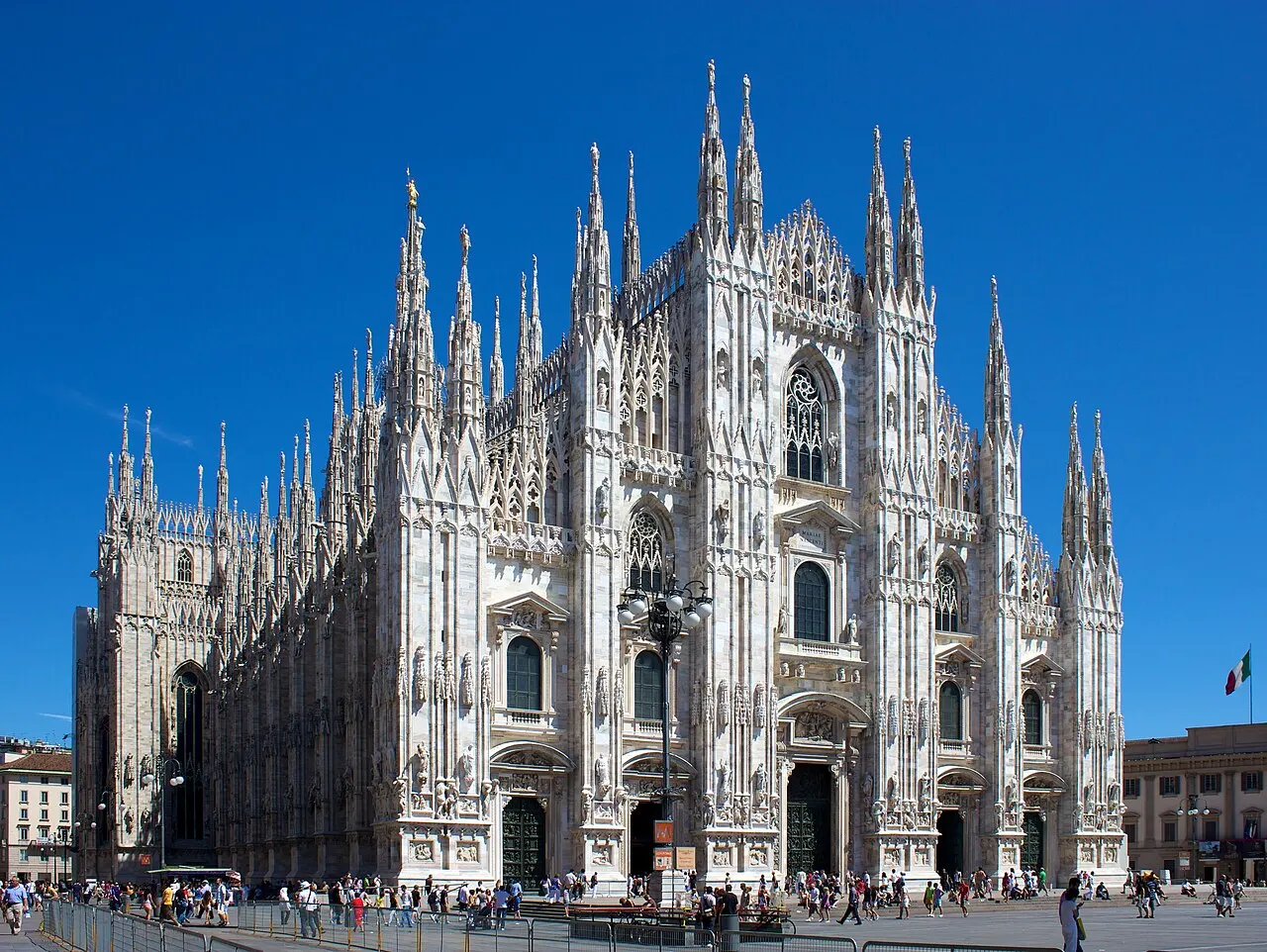
Begin beneath the marble spires and golden Madonnina of Milan Duomo, walking through the glass-vaulted Galleria Vittorio Emanuele II to Teatro alla Scala and Palazzo Reale.
Milan Cathedral
Commissioned in 1386 by Gian Galeazzo Visconti, this Gothic cathedral features an elaborate facade bristling with pinnacles and thousands of exterior statues. Inside, soaring stone columns draw the gaze upward to stained glass windows dating from the fifteenth to twentieth centuries, alongside a sundial line embedded into the marble floor.
Duomo Rooftop Terraces
Climbing to the roof reveals an intricate forest of carved buttresses, gargoyles, and openwork balustrades built from pale pink marble. From the upper walkway, travellers can inspect close architectural masonry and look out across central Milan towards the surrounding Lombard plains and northern Alpine peaks on clear days.
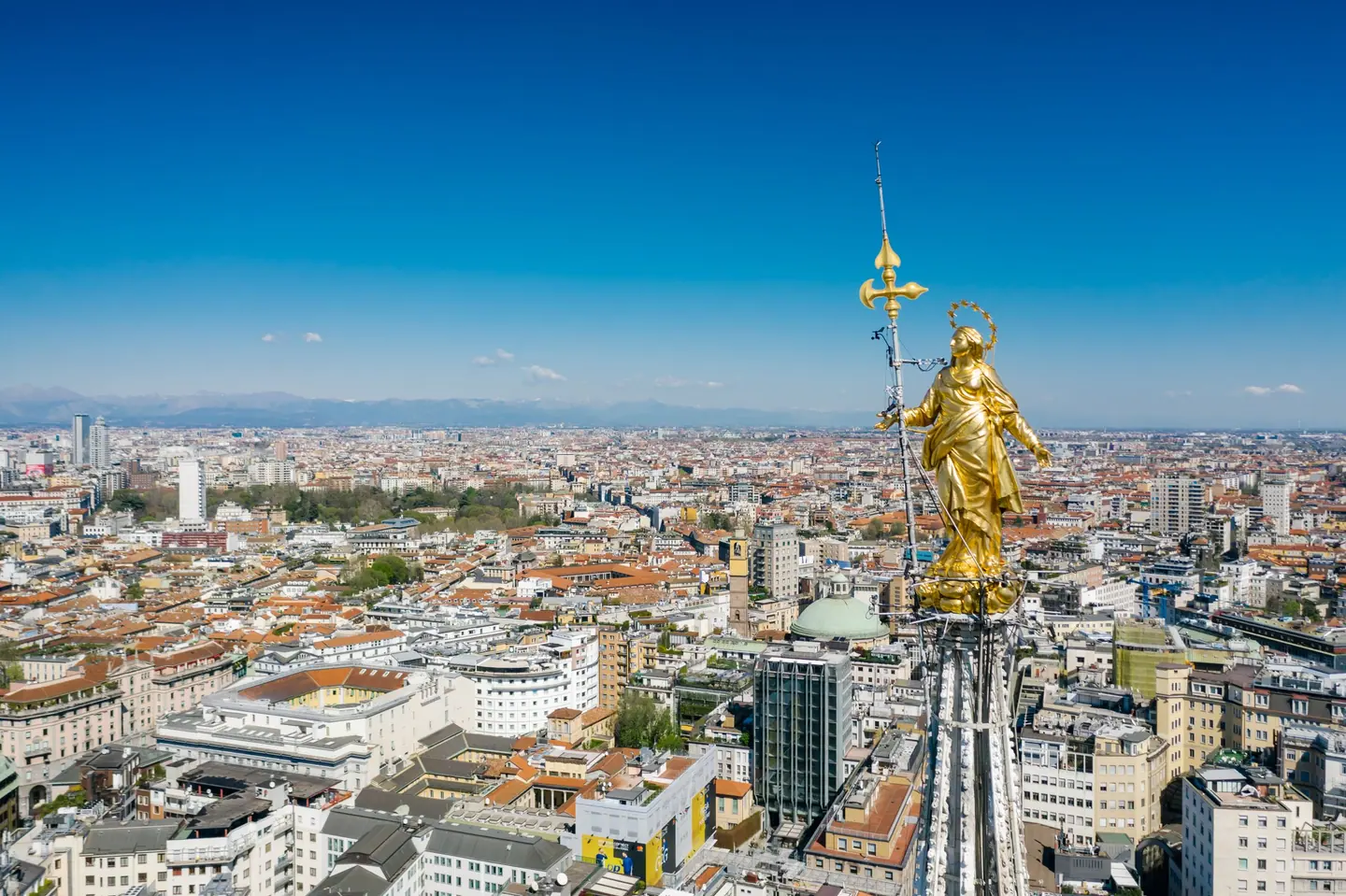
Madonnina
Sculpted by Giuseppe Perego and cast in copper in 1774, this four-metre gilded statue stands atop the cathedral's main spire over a hundred metres above ground. Historically, city ordinances prevented any building from exceeding her height, and tradition still dictates that a replica adorns the highest modern skyscraper.
Piazza del Duomo
Redesigned in the nineteenth century by architect Giuseppe Mengoni, this expansive public square serves as the geographical and political centre of Milan. Broad stone pavements provide sweeping viewpoints towards the cathedral facade, bordered by symmetric porticoed arcades and major cultural institutions that draw commuters and visitors day and night.
Monument to Vittorio Emanuele II
Created by Ercole Rosa and inaugurated in 1896, this large bronze monument depicts King Vittorio Emanuele II mounted on horseback directing troops at the Battle of San Martino. The substantial red granite pedestal is flanked by sculpted lions and reliefs that celebrate the unification struggles of the Risorgimento.
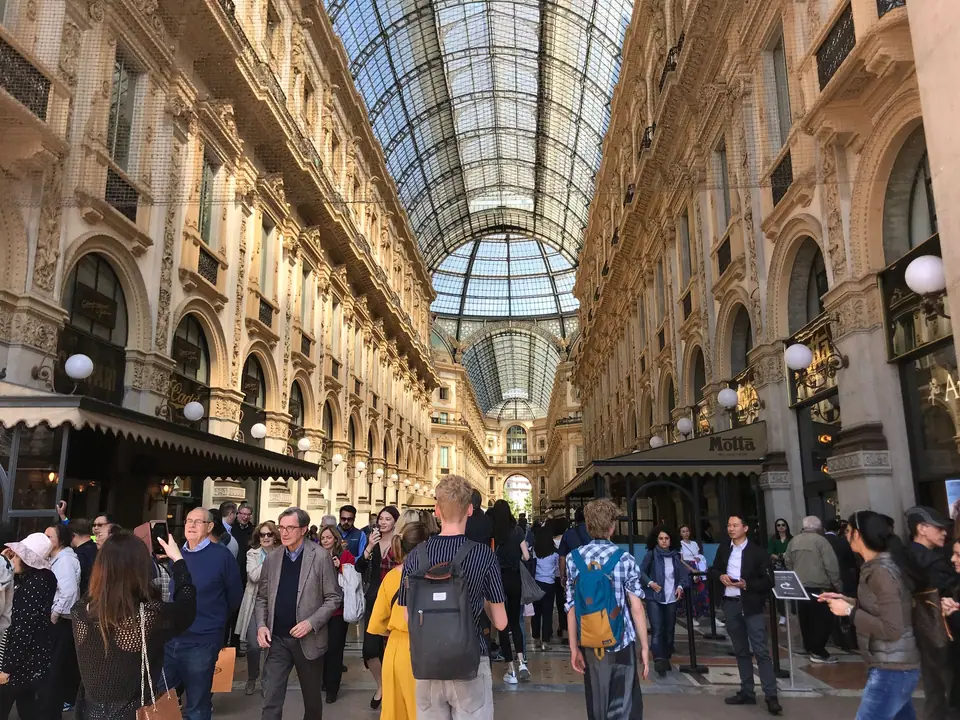
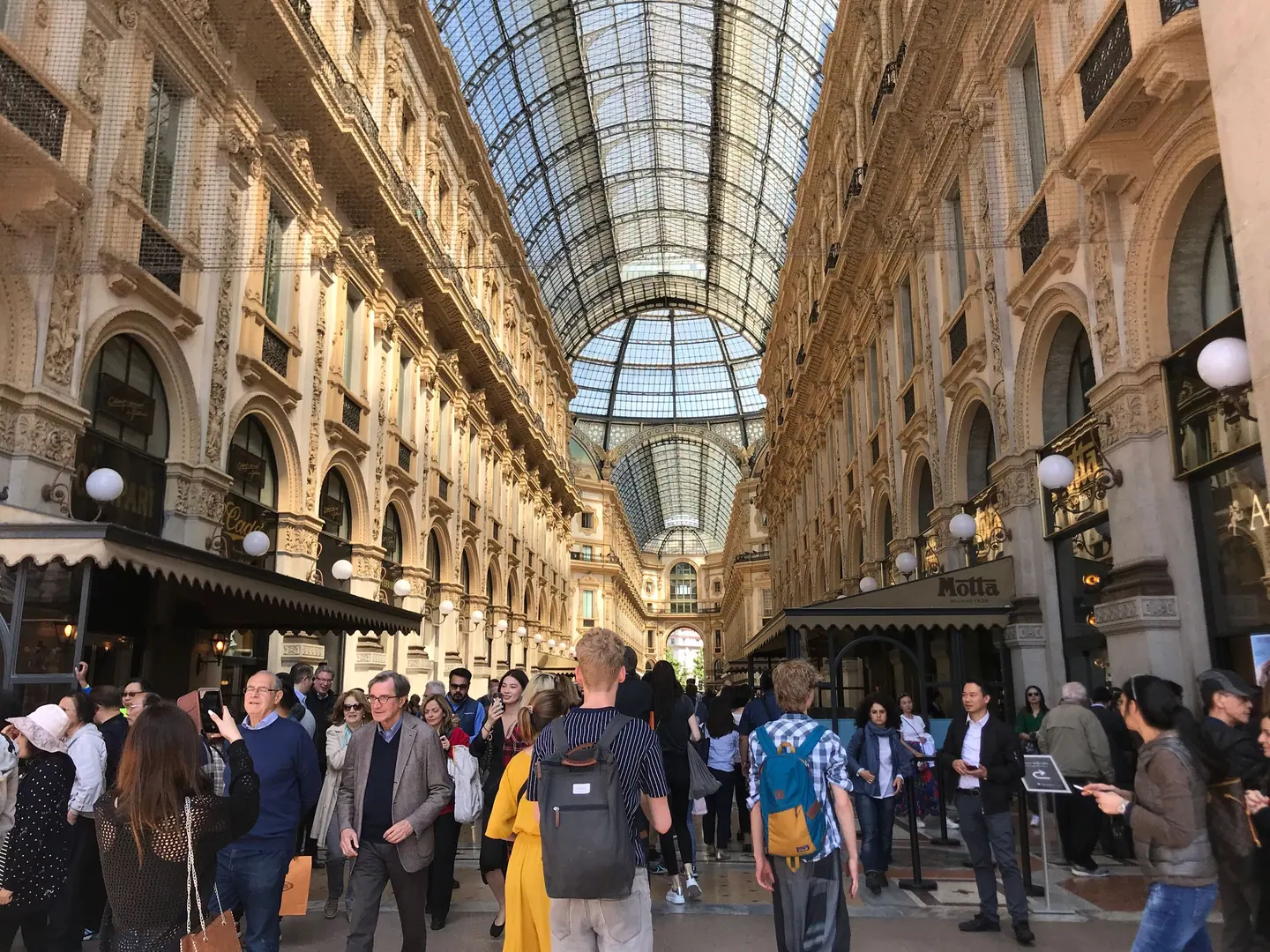
Galleria Vittorio Emanuele II
Connecting the cathedral square to the opera house, this cross-shaped arcade was designed by Giuseppe Mengoni and completed in 1877. Its cast-iron skeletal roof and soaring central glass dome shield mosaic floors, historic cafes, and bookshops that earned it the enduring nickname of Milan's drawing room.
Bull Mosaic of the Galleria
Positioned under the central glass dome, this floor mosaic depicts a charging bull, part of the heraldic arms of Turin. A longstanding local ritual invites pedestrians to spin backwards three times on their right heel upon the bull's testicles, an act believed by tradition to bring good fortune.
Piazza della Scala
Opened in the nineteenth century following the demolition of older buildings, this square bridges high culture and municipal authority. Centred around a statue of Leonardo da Vinci, it links the Teatro alla Scala on its north side with the stately entrance of Palazzo Marino directly opposite across manicured flowerbeds.
Monument to Leonardo da Vinci
Sculpted by Pietro Magni and unveiled in 1872, the monument features Leonardo da Vinci standing in meditative contemplation wrapped in heavy robes. Below him around the pedestal stand four of his accomplished pupils, including Giovanni Antonio Boltraffio and Cesare da Sesto, alongside marble reliefs honouring his varied artistic and scientific pursuits.
Teatro alla Scala
Designed by Giuseppe Piermarini after a fire destroyed the previous ducal theatre, La Scala remains one of the premier opera houses in Europe. The horseshoe-shaped auditorium, draped in crimson velvet and gilded plasterwork, is famous for its exceptional acoustics and has staged historic premieres by Rossini, Verdi, and Puccini.
Museo Teatrale alla Scala
Adjacent to the main theatre foyer, this museum chronicles centuries of Italian performing arts through extensive collections of composers' portraits, rare scores, and vintage playbills. Visitors can inspect historical pianos that belonged to Franz Liszt, decorative stage costumes, and peer into the theatre's private boxes when rehearsals permit.
Palazzo Marino
Built between 1557 and 1563 for the Genoese merchant Tommaso Marino, this Mannerist palace was designed by Galeazzo Alessi. It features an ornate courtyard with rusticated pillars, classical statues, and carved friezes illustrating the labours of Hercules, housing the municipal government and the office of the Mayor of Milan.
Gallerie d'Italia: Piazza Scala
Spanning three grand historical residences, including Palazzo Anguissola and Palazzo Brentani, this gallery displays Italian nineteenth-century masterpieces. The rooms feature bas-reliefs by Antonio Canova and paintings by Francesco Hayez, leading through an underground bank vault into a twentieth-century wing overlooking a quiet garden containing modern public sculptures.
Palazzo Beltrami
Designed by architect Luca Beltrami and completed in the 1920s, this stately stone building functions as the municipal government accounting department. Its disciplined facade, punctuated by Ionic pilasters and an elevated portico, was carefully proportioned to harmonise with Piermarini's facade of La Scala across the square.
Casa dei Panigarola
Located on the west side of Piazza Mercanti, this historic building housed the notary office where municipal decrees were registered and transcribed. Its pointed brick arches and terracotta friezes preserve original fifteenth-century architectural details, including a Latin inscription warning against dishonest legal practices.
Palazzo della Ragione
Constructed in 1233 under Podesta Oldrado da Tresseno, this red-brick edifice served as the judicial and administrative centre of medieval Milan. The ground level forms an open colonnade that historically held daily markets, while the vast upper hall features high arched windows and remnants of communal frescoes.
Loggia degli Osii
Erected in 1321 by Matteo I Visconti, this Gothic municipal building stands out with its contrasting courses of white and black stone. Notaries and magistrates addressed citizens from the central balcony, the ringhiera, which is decorated with carved stone coats of arms representing the historic districts of Milan.
Palazzo Reale di Milano
Serving as the seat of government for centuries under Visconti, Sforza, Spanish, and Austrian rulers, this sprawling complex was redesigned in neoclassical style by Piermarini. Although damaged in wartime bombardments, its Hall of the Caryatids and restored royal apartments now stage major international fine-art exhibitions.
Museo del Novecento
Housed within a 1930s twin-pavilion palace designed by Griffini and Portaluppi, this gallery charts Italian modernism with emphasis on the Futurist movement. A monumental spiralling ramp leads past works by Umberto Boccioni and Giorgio de Chirico up to a top floor framed by views over Piazza del Duomo.
Chiesa di San Gottardo in Corte
Built around 1336 as a private chapel for Azzone Visconti, this brick church contains Azzone's marble funerary monument sculpted by Giovanni di Balduccio. Its most distinctive exterior feature is the octagonal terracotta bell tower, which once housed the first public striking mechanical clock in Milan.
Brera Art District, Pinacoteca di Brera, Quadrilatero della Moda & Porta Nuova
Stroll the cobbled artists lanes of Brera and the Pinacoteca di Brera across Via Monte Napoleone to the vertical forests of Porta Nuova.
Pinacoteca di Brera
Housed within an eighteenth-century neoclassical palace originally run by Jesuits, this gallery displays definitive works by Caravaggio, Raphael, and Mantegna. The central courtyard features Antonio Canova's bronze statue of Napoleon as Mars the Peacemaker. Visitors can observe conservators restoring delicate centuries-old canvases behind glass partitions in the central laboratory.
Orto Botanico di Brera
Established in 1774 under Empress Maria Theresa of Austria, this botanical enclave served medical students training in pharmaceutical botany. Preserved brick paths guide travellers between ancient ginkgo biloba specimens, historic greenhouse structures, and rectangular cultivation beds. The grounds retain their original layout alongside seventeenth-century water basins used for irrigating medicinal plants.
Brera Astronomical Observatory
Founded by Father Ruggero Boscovich in 1764, this scientific institution stands atop the roof of the Brera complex. Astronomer Giovanni Schiaparelli used its Merz refractor telescope in 1877 to map the surface markings of Mars. Today, visitors examine historic brass instruments, celestial globes, and early chronometers preserved in the dome museum.
Santa Maria del Carmine
Rebuilt in the mid-1400s following a structural collapse, this Carmelite church presents a Lombard Gothic profile with an ornate nineteenth-century neo-Gothic facade. Inside, the Baroque Chapel of the Madonna del Carmine displays stucco work by Camillo Procaccini. The exterior piazza features Polish sculptor Igor Mitoraj's bronze monument titled Grande Toscano.
San Marco
Constructed during the late thirteenth century, this red-brick basilica preserves fourteenth-century frescoes by the circle of Giotto in its transept. A young Wolfgang Amadeus Mozart lived in the adjoining monastery for three months in 1770 while rehearsing. Giuseppe Verdi conducted the premier performance of his Requiem Mass at its high altar in 1874.
San Simpliciano
Erected along the ancient Roman road to Mediolanum, this basilica was completed by Bishop Simplician in the early fifth century. The interior preserves classical Roman brickwork alongside Romanesque vaults added during the twelfth century. In the apse, look for Bergognone's monumental sixteenth-century fresco depicting the Coronation of the Virgin.
Teatro Piccolo Grassi
Founded in 1947 by Paolo Grassi and Giorgio Strehler, this venue operates inside the fifteenth-century Palazzo Carmagnola. The building features a porticoed Renaissance courtyard that once served as a ducal residence for Ludovico Sforza. It remains a key centre for modern stage productions, having introduced Brecht and classical revivals to Italian audiences.
Palazzo Citterio
Constructed between 1764 and 1766, this stately Baroque mansion acts as an extension of the Pinacoteca di Brera. The palace retains ornate stuccoes, parquet floors, and an expansive garden enclosed by historic masonry. Following extensive restoration, its halls showcase modern Italian masterpieces from the Jesi and Vitali collections, including pieces by Boccioni and Modigliani.
Via Monte Napoleone
Tracing the line of Roman city walls, this thoroughfare took its current name during Napoleon's administration when a financial institution occupied the street. Elegant neoclassical facades by Giuseppe Piermarini flank the road, concealing secluded internal courtyards. Today the street accommodates luxury design houses, tailoring ateliers, and traditional pasticcerie serving espresso and panettone.
Palazzo Morando
Located on Via Sant'Andrea, this aristocratic residence showcases period furnishings, antique clocks, and eighteenth-century domestic art on its noble floor. The adjoining museum spaces display historical textiles, ceremonial court uniforms, and twentieth-century couture garments reflecting Milan's sartorial development. The courtyard provides an example of private Baroque urban architecture with stone columns and vaulted porticos.
Palazzo Bagatti Valsecchi
Brothers Fausto and Giuseppe Bagatti Valsecchi refurbished this mansion in the 1880s to recreate a sixteenth-century Lombard aristocratic home. The rooms display authentic fifteenth-century panel paintings, wrought-iron fixtures, carved walnut furnishings, and an armoury room. Despite the antiquarian atmosphere, the house incorporated modern nineteenth-century heating systems and electrical installations.
Via della Spiga
Paved in traditional stone setts, this narrow lane is entirely closed to motor traffic, allowing visitors to inspect historic residential facades undisturbed. Many buildings date to the eighteenth and nineteenth centuries, featuring wrought-iron balconies and shuttered windows. The street forms the northern boundary of the Quadrilatero della Moda alongside contemporary fashion houses.
Ca' de Sass
Designed by architect Giuseppe Balzaretto and finished in 1872, this building drew inspiration from Florence's Palazzo Strozzi. The structure features rugged rusticated ashlar stonework across its exterior, inspiring its local Milanese dialect name. Massive arched windows and defensive grilles reflect the nineteenth-century banking prosperity of Milan.
Palazzo Borromeo d'Adda
Remodelled in 1820 by architect Girolamo Arganini, this palace presents an austere facade with a portico framed by heavy Ionic columns. French novelist Stendhal resided here during his visits to Milan and praised its refined neoclassical courtyard. The estate remains a private residence preserving historic reception rooms overlooking manicured interior grounds.
Porta Nuova (medieval)
Constructed in 1171 following the destruction of Milan by Emperor Frederick Barbarossa, this defensive double arch formed part of the medieval fortifications. The structure incorporates Roman funerary stelae within its stonework alongside fourteenth-century marble niches holding religious carvings. A pedestrian footbridge once connected the walls across the inner ring canal that formerly ran beneath.
Porta Nuova (city gate)
Erected between 1810 and 1813 by Giuseppe Zanoia, this Ionic triumphal arch marked the customs entrance along the road to Monza. Constructed from yellow sandstone, the gate features fluted columns and bas-relief panels representing river allegories. Two matching neoclassical duty pavilions border the arch at the southern entrance to Corso Como.
Piazza Gae Aulenti
Designed by Argentine architect César Pelli, this circular podium sits six metres above street level, connecting historical neighbourhoods with the modern business quarter. The plaza features shallow reflective pools, water cascades, and solar-panel canopies. It serves as an open-air public venue surrounded by curved glass-fronted offices and urban retail spaces.
Torre UniCredit
Completed in 2012, this glass skyscraper rises 231 metres to the tip of its slender steel spire. The curved facade wraps around Piazza Gae Aulenti, directing winds and maximising natural daylight into its commercial offices. The spire contains an integrated LED system that illuminates the structure during civic commemorations and national holidays.
Bosco Verticale
Engineered by Boeri Studio and completed in 2014, these two residential high-rises integrate more than eight hundred trees and fifteen thousand perennial plants into their cantilevered balconies. The biological vegetation absorbs carbon dioxide, regulates indoor temperatures, and shields residents from street noise. Specialist arborists inspect and prune the foliage suspended by ropes several times each year.
Biblioteca degli Alberi
Opened in 2018, this ten-hectare urban park acts as an outdoor library of plant species with circular tree clusters, thematic gardens, and meadow lawns. Geometric paths cross the site, directly connecting the Isola quarter with the office towers of Porta Nuova. Informative botanical phrases and poems carved into the stone walkways describe the surrounding arboreal specimens.
Castello Sforzesco, Parco Sempione, Pinacoteca Ambrosiana & Leonardo Last Supper
Explore the courtyards and Michelangelo Rondanini Pietà at Castello Sforzesco, Leonardo Codex Atlanticus at the Biblioteca Ambrosiana and The Last Supper at Santa Maria delle Grazie.
Castello Sforzesco
Constructed by Francesco Sforza upon fourteenth-century Visconti foundations, this sprawling brick citadel defended Milan before transforming into an artistic court. Visitors can stroll through expansive internal courtyards, admire thick defensive ramparts, and enter diverse civic museums displaying decorative arts, musical instruments, and Renaissance masterworks.
Torre del Filarete
Reconstructed at the start of the twentieth century by architect Luca Beltrami, this soaring entrance tower honours the original Renaissance design by Antonio Averlino, known as Filarete. The central facade incorporates a statue of King Umberto I, decorative heraldic shields, and a clock mechanism overlooking Piazza Castello.
Corte Ducale
Forming the private residential quarter of the citadel, this elegant courtyard features Gothic-Renaissance terracotta arcades, decorative window mouldings, and a quiet central pool. Inside its flanking halls, visitors encounter collections of antique furniture, Renaissance portraiture, and stone sculptures salvaged from demolished medieval churches across Lombardy.
Sala delle Asse
Commissioned by Ludovico Sforza in 1498, this vaulted ducal chamber displays a rare trompe-l'oeil botanical canopy conceived by Leonardo da Vinci. The fresco mimics sixteen mulberry trees whose interlacing branches, knotted golden cords, and exposed root systems cover the stone ceiling, celebrating ducal wisdom and agrarian prosperity.
Rondanini Pietà Museum
Housed within the former Spanish hospital in the castle courtyards, this dedicated space contains Michelangelo Buonarroti's unfinished marble masterpiece. Carved during the sculptor's final days, the slender composition depicts the Virgin Mary supporting Christ's upright body, offering an intimate study in raw emotional vulnerability and Renaissance sculpting technique.
Pinacoteca del Castello Sforzesco
Occupying several grand halls on the upper floor of the Corte Ducale, this gallery traces Milanese artistic developments from the fourteenth to the eighteenth centuries. Key exhibits include Andrea Mantegna's Trivulzio Madonna alongside works by Vincenzo Foppa, Bramantino, and Canaletto, illustrating the technical evolution of Northern Italian perspective.
Parco Sempione
Laid out in the 1890s by architect Emilio Alemagna, this English-style public park occupies the former ducal parade grounds. Broad curving pathways, shady groves of beech and plane trees, and a serpentine lake create a peaceful scenic corridor linking the castle ramparts directly to the Arco della Pace.
Arco della Pace
Commenced under Napoleonic rule by Luigi Cagnola and completed in 1838 under Austrian Habsburg patronage, this grand triumphal gate is built from Crevola marble. It features Corinthian columns, allegorical river reliefs, and a colossal bronze sculpture of the Sestiga della Pace drawn by six horses atop the attic.
Arena Civica Gianni Brera
Commissioned by Napoleon and opened in 1807, this oval sports arena draws direct inspiration from Roman imperial circuses. Designed by Luigi Cagnola, its perimeter is lined with grand stone seating tiers and an imposing Doric entrance lodge, serving today as a historic venue for athletics and civic ceremonies.
Palazzo dell'Arte and Triennale Milano
Designed by Giovanni Muzio and constructed in 1933, this rationalist red-clinker building serves as the permanent home of the Triennale design institution. The interior spaces host rotating exhibitions of contemporary architecture, decorative arts, and an expansive collection of Italian twentieth-century furniture, flanked by a tranquil parkside sculpture garden.
Torre Branca
Engineered by architect Gio Ponti for the fifth Triennale exhibition in 1933, this slender tubular steel structure rises over one hundred metres. A high-speed lift ascends to the hexagonal panoramic cabin, which provides unobstructed elevated vistas across the historic rooftops of Milan, the modern skyscrapers, and the distant Alpine crests.
Acquario Civico di Milano
Constructed for the 1906 Milan International Exposition, this charming pavilion represents an exceptional surviving example of Italian Liberty architecture. The exterior displays glazed ceramic tiles, friezes of marine life, and a statue of Neptune, while the interior tanks showcase native freshwater fish from Lombard lakes and Alpine river basins.
Santa Maria delle Grazie
Commissioned by Duke Ludovico Sforza as a dynastic mausoleum, this Dominican convent church fuses late Gothic brick architecture with monumental Renaissance planning. Architect Donato Bramante contributed the expansive hemispherical tribune, decorative terracotta cloisters, and an airy polygonal dome that exemplifies the architectural harmony of fifteenth-century Lombard design.
Cenacolo Vinciano
Located in the refectory adjoining Santa Maria delle Grazie, this hall houses Leonardo da Vinci's celebrated depiction of the Last Supper, executed in tempera and oil on dry plaster. Opposite Leonardo's mural, visitors can examine Giovanni Donato da Montorfano's large Crucifixion fresco, painted concurrently in 1495.
Casa degli Atellani
Granted by Ludovico Sforza to courtiers of the Atellani family, this historic townhouse preserves frescoed halls and quiet Renaissance courtyards restored by architect Piero Portaluppi. Behind the residential quarters lies the replanted vineyard originally given to Leonardo da Vinci as partial payment while he painted the Last Supper.
Pinacoteca Ambrosiana
Established in 1618 by Cardinal Federico Borromeo to inspire artistic standards, this venerable picture gallery displays an extraordinary array of European paintings. Its chambers house masterworks such as Caravaggio's Basket of Fruit, Leonardo's Portrait of a Musician, and Raphael's monumental preparatory cartoon for the School of Athens.
Biblioteca Ambrosiana
Ranked among Europe's earliest public libraries, this scholarly repository houses thousands of ancient codices, illuminated manuscripts, and rare classical texts. Its most celebrated treasure is Leonardo da Vinci's Codex Atlanticus, a twelve-volume bound collection containing over one thousand pages of drawings, technical inventions, and scientific diagrams.
Crypt of San Sepolcro
Situated beneath the Church of San Sepolcro directly adjacent to the Ambrosiana, this atmospheric subterranean sanctuary was founded by crusaders in the eleventh century. The floor incorporates large stone slabs from the ancient Roman Forum of Mediolanum, surrounded by weathered medieval frescoes and a terracotta sepulchre effigy.
San Maurizio al Monastero Maggiore
Formerly part of Milan's most important Benedictine female convent, this church is divided by a central dividing wall into public and cloistered nun areas. Nearly every interior surface is covered in historic Renaissance frescoes by Bernardino Luini and his workshop, depicting martyrdom scenes, biblical parables, and celestial choirs.
Civico Museo Archeologico di Milano
Occupying the former cloistered monastic complex of the Monastero Maggiore, this museum documents the ancient history of Milan from its Celtic origins to early Christian times. The garden preserves substantial ruins of the third-century Roman city wall, an intact polygonal watchtower, and a corner of Mediolanum's ancient chariot circus.
Sant Ambrogio, San Maurizio, Columns of San Lorenzo & Porta Ticinese
Discover Roman and Romanesque Milan at the Basilica of Sant Ambrogio, the frescoed vaults of San Maurizio al Monastero Maggiore, the sixteen Roman Columns of San Lorenzo and Sant Eustorgio.
Basilica di Sant'Ambrogio
Founded in 379 AD, this church represents the prototype of Lombard Romanesque architecture. Its brick atrium leads inside to the golden altar of Volvinius and the fourth-century Sarcophagus of Stilicho beneath the pulpit. Visitors should also inspect the ninth-century mosaic dome in the Chapel of San Vittore in Ciel d'Oro.
Colonna del Diavolo
Standing outside the basilica in Piazza Sant'Ambrogio, this ancient Roman column bears two distinct cylindrical punctures. Medieval legend claimed Saint Ambrose drove the Devil into the marble during a fierce temptation, leaving the permanent holes. The pillar previously formed part of an imperial palace complex before its Christian reinterpretation.
Tempio Civico dei Santi Sebastiano e Rocco
Commissioned in 1576 by Archbishop Carlo Borromeo, this cylindrical church fulfilled a civic vow during the catastrophic plague. Pellegrino Tibaldi designed the central-plan structure, which reflects the architectural theories of the Council of Trent. The vast interior features late Renaissance paintings and an imposing coffered dome modelled on Roman rotundas.
San Maurizio al Monastero Maggiore
Once part of Milan's most powerful Benedictine nunnery, this church is divided by a central partition wall separating the public nave from the nuns' choir. Bernardino Luini and his workshop blanketed every interior surface with historic Renaissance frescoes. Highlights include detailed biblical cycles and portraits of the prominent Bentivoglio family patrons.
Civico Museo Archeologico di Milano
Housed within the cloisters of Monastero Maggiore, this museum documents Mediolanum from prehistoric settlements to early medieval rule. The inner garden preserves a twenty-four-sided Roman defensive tower and remnants of the Roman circus wall. Galleries exhibit fine carved gemstones, Roman milestones and the famous Parabiago plate.
Torre dei Gorani
This eleventh-century brick watchtower was originally integrated into the palace of the aristocratic Gorani family. After devastating bombardments during the Second World War flattened surrounding houses, modern redevelopment preserved the isolated tower as an urban monument. Architectural elements include arched Romanesque windows and decorative terracotta friezes along the upper level.
Palazzo Litta
Constructed for Count Camillo Borromeo in the seventeenth century, the residence showcases an exuberant late Baroque facade added by Bartolomeo Bolli. The grand ceremonial staircase leads to state apartments decorated with intricate stuccoes and frescoes by Giovanni Antonio Cucchi. The complex also houses one of the oldest private theatres in Milan.
Museo Nazionale Scienza e Tecnologia Leonardo da Vinci
Housed in a sixteenth-century monastery, this institution displays historic scientific instruments, transport vehicles and industrial machinery. Its premier gallery contains scale wooden models constructed directly from Leonardo da Vinci's technical drawings and notebooks. Outside, the museum preserves the Enrico Toti submarine and historic steam locomotives in open-air transport pavilions.
San Vittore al Corpo
Occupying a former fourth-century imperial cemetery, the current basilica was rebuilt by Galeazzo Alessi in the sixteenth century for the Olivetan Order. The barrel-vaulted nave features extensive stucco decorations, wooden choir stalls and paintings by Camillo Procaccini. The church enshrines the relics of Saint Victor Maurus, martyred in early Christian Mediolanum.
Columns of San Lorenzo
These fluted Corinthian columns date from the second century, likely taken from a Roman pagan temple or public bath complex to embellish the new basilica. Transported here during the fourth century, the colonnade now stands opposite the church across a pedestrian square. Today they serve as the most prominent surviving Roman structure in Milan.
Basilica di San Lorenzo
Constructed in the late Roman era, this massive tetraconch structure was among the largest centrally planned buildings in the Western empire. Surmounted by a sixteenth-century dome designed by Martino Bassi, its central nave retains classical spatial geometry. Inside, the ancient Chapel of Sant'Aquilino contains fifth-century mosaics depicting Christ with his apostles.
Porta Ticinese Medievale
Rebuilt following Frederick Barbarossa's sack of Milan in 1162, this medieval gate was integrated into the city's second ring of defensive walls. Architect Camillo Boito restored the brick gatehouse in the nineteenth century, opening lateral arches for pedestrians. A fourteenth-century tabernacle by Giovanni di Balduccio adorns the upper section facing the canal district.
San Giorgio al Palazzo
Standing on grounds once covered by Emperor Diocletian's fourth-century residence, this church was where tradition holds Constantine issued the Edict of Milan in 313 AD. Bernardino Luini decorated the Chapel of the Passion here in 1516 with expressive oil panels. The Baroque exterior masks deeply layered Romanesque and palaeochristian structural elements.
Chiesa di Sant'Eufemia
Founded in 472 AD by Bishop Saint Senator, the church was reconstructed multiple times before undergoing a major nineteenth-century restoration by Enrico Terzaghi. The porch features intricate mosaics, while the interior holds early Renaissance paintings, including a notable work by Marco d'Oggiono. The crypt retains historical tombs and fragments from ancient structures.
Basilica di Sant'Eustorgio
This Dominican convent church was an essential medieval pilgrimage stop, revered for housing the relics of the Three Magi before Barbarossa transferred them to Cologne. The interior features early Christian burials, medieval sarcophagi and a monumental Romanesque nave. It also houses the Portinari Chapel, a masterpiece of Florentine Renaissance design.
Cappella Portinari
Commissioned by the Florentine banker Pigello Portinari in 1462, this square chapel reflects the geometric proportions of Brunelleschi. The upper walls are decorated with frescoes by Vincenzo Foppa illustrating the life of Saint Peter Martyr. In the centre sits the Gothic marble Ark of Saint Peter Martyr, sculpted by Giovanni di Balduccio.
Porta Ticinese Neoclassica
Constructed between 1801 and 1814, this monumental granite gate was erected to commemorate Napoleon's victory at Marengo. Architect Luigi Cagnola employed massive Ionic columns to frame the entrance, which formerly marked the southern customs boundary along the Ticino road. Flanking classical pavilions originally served as customs offices guarding traffic entering the city centre.
Museo Diocesano Carlo Maria Martini
Set around the restored cloisters of Sant'Eustorgio, this museum preserves sacred art, textiles and precious liturgical objects from parishes across Lombardy. The permanent collection features paintings by Tintoretto, Titian and Giovanni Battista Crespi. Temporary exhibitions explore religious iconography and historic sacred craftsmanship in modern gallery settings.
Chiesa di San Vincenzo in Prato
Erected in the ninth century over an earlier Christian oratory, this structure is one of the purest examples of early medieval brickwork in Milan. The austere interior features three naves divided by recycled Roman columns, leading to an elevated presbytery and an open crypt below. Remarkable for its lack of Baroque alterations, the church retains genuine Romanesque austerity.
Palazzo Pozzobonelli-Isimbardi
Originating in the fifteenth century, this noble palace features a quiet Renaissance courtyard and an elaborate garden nymphaeum attributed to the school of Donato Bramante. The interiors preserve historical ceiling frescoes, classical friezes and fine Lombard architectural details. Today the complex maintains its quiet aristocratic character away from the main streets.
Navigli Canals (Naviglio Grande & Pavese), Darsena, Fondazione Prada & Monumental Cemetery
Follow the historic canal towpaths of the Darsena and Naviglio Grande, and visit Fondazione Prada and the open-air sculpture gallery of the Cimitero Monumentale.
Naviglio Grande
Constructed between 1177 and 1257, this historic shipping canal linked the Ticino River directly with central Milan. Heavy Candoglia marble blocks sailed along its length to build the Duomo. Today, walking along the towpaths reveals old iron mooring rings, low-rise tenement blocks, and traditional railing houses.
Darsena
Excavated under Spanish rule in 1603, the Darsena served as Milan's principal trading port until commercial barge traffic ceased in 1979. Modern redevelopment revitalised the vast water basin, exposing original brick quays and former customs locks. It remains a central junction where the Naviglio Grande and Naviglio Pavese converge.
Vicolo dei Lavandai
Tucked off the northern bank of the Naviglio Grande, this historic alley retains its stone washing troughs and wooden shelter. Members of the Confraternity of Washers once scrubbed laundry for wealthy Milanese households using hot water, ash, and soap. A historic centrifuge machine sits inside a preserved washing shed.
Santa Maria delle Grazie al Naviglio
Tracing its foundations to a sixteenth-century chapel, this church took its current monumental form following a major reconstruction that began in 1889. Designed by Cesare Nava, the exterior features an unfinished exposed brick facade, while the grand interior houses classical columns, colourful frescoes, and a venerated painting of the Madonna.
Ponte Alda Merini
Spanning the Naviglio Grande near the Vicolo dei Lavandai, this pedestrian bridge pays tribute to Alda Merini, who lived nearby. Merini drew endless literary inspiration from the surrounding waterways and working-class streets. The bridge offers clear vistas along the western canal axis towards the setting sun.
Centro Artistico Alik Cavaliere
This cultural space preserves the atelier and open courtyard of sculptor Alik Cavaliere, a prominent twentieth-century artist and Brera Academy director. The rooms showcase his bronze, copper, and stainless steel plants, trees, and cages. Visitors can inspect his experimental metalcasting techniques alongside temporary contemporary exhibitions.
Naviglio Pavese
Initiated under Spanish rule and eventually inaugurated by Napoleon in the early nineteenth century, this thirty-three-kilometre canal connects the Darsena with the Ticino at Pavia. Its banks feature complex navigation locks designed to overcome regional elevation differences. Cobblestone paths flank the waters, lined with historic taverns and storehouses.
Conchetta
Engineered to manage the sudden descent of water flowing south from the Darsena basin, this lock represents an essential piece of hydraulic heritage. Leonardo da Vinci contributed conceptual designs to similar lock chambers in the district. The heavy wooden mitre gates and stone side chambers survive clearly in place.
Mercato Comunale Ticinese
Positioned directly on the edge of the Darsena, this covered food hall was rebuilt during the 2015 dock regeneration project. It retains the character of neighbourhood trading, supplying local cheeses, cured meats, fresh produce, and baked goods. The waterside terrace allows visitors to sample regional dishes facing the canal.
San Cristoforo sul Naviglio
Standing along the western stretch of the Naviglio Grande, this site comprises two conjoined churches built between the thirteenth and fifteenth centuries. The left chapel dates from Romanesque times, while the right was commissioned by Gian Galeazzo Visconti. The interior preserves valuable fourteenth-century frescoes and a fine wooden ceiling.
Fondazione Prada
Designed by Rem Koolhaas and OMA, this complex repurposes an early twentieth-century industrial facility into a dynamic cultural campus. The site contrasts historic warehouses with bold contemporary architecture, notably a building coated in real gold leaf and a prominent white concrete tower. Rotating exhibitions explore modern visual arts.
Bar Luce
Located inside the entrance of Fondazione Prada, this cafe recreates the atmosphere of a classic 1950s Milanese bar. Film director Wes Anderson conceived the interior, incorporating pastel Formica tables, retro pinball machines, and patterned wallpaper mimicking the Galleria Vittorio Emanuele II. It functions both as an artwork and working refreshment room.
Chiesa di San Gottardo al Corso
Erected in the late eighteenth century by architect Giovanni Battista Moraglia, this neoclassical church sits just off the Navigli basin. Its facade presents clean Corinthian pilasters and a triangular pediment. Inside, visitors can observe classical altarpieces and intricate marble decorations representative of post-Enlightenment sacred design in Lombardy.
Parco Segantini
Occupying land previously used for rail transport and pharmaceuticals, this urban green space lies behind the Naviglio Grande. The park incorporates natural wetlands, wild flower meadows, and community gardens. It offers a quiet pedestrian corridor between the canal banks and the surrounding residential quarters.
Fabbrica del Vapore
Originally the Carminati & Toselli workshop producing trams and railway rolling stock, this massive brick complex now hosts creative laboratories. The industrial halls feature exposed metal trusses, high clerestory windows, and paved internal lanes. It hosts regular design festivals, youth theatre programmes, and modern sculpture installations.
Cimitero Monumentale Famedio
Serving as the monumental entrance to Milan's primary cemetery, this imposing structure was designed by Carlo Maciachini in 1866. Constructed from alternating grey stone and blue-tinted marble, it houses the crypts of influential Milanese citizens, including novelist Alessandro Manzoni. The vaulted ceilings display elaborate star-patterned frescoes.
Tomb of the Campari Family
Created by sculptor Giannino Castiglioni in 1935, this bronze funerary monument marks the resting place of the Campari liqueur dynasty. The larger-than-life sculptural group portrays the biblical Last Supper with intense expressive realism. Positioned along the cemetery's main lanes, it highlights the technical mastery of twentieth-century Italian casting.
Mausoleo Casati Stampa
Built for one of Lombardy's most historic noble lineages, this elevated tomb dominates its central section of the cemetery grounds. Enrico Butti designed the dynamic sculptural figures, capturing grief and spiritual transcendence in polished white Carrara marble. The site exemplifies late nineteenth-century realism and theatrical Italian funerary architecture.
Edicola Besenzanica
Sculpted by Enrico Butti in 1912, this monument portrays a peasant farmer leading two enormous oxen over uneven ground. Symbolising human toil and eventual rest, the bronze and stone ensemble draws heavily on the Italian Liberty style. It stands among the finest achievements of social-realist funerary art in Europe.
Civico Tempio Crematorio
Inaugurated in 1876, this was one of the earliest purpose-built cremation structures erected in modern Europe. Funded by Alberto Keller, the temple exhibits classical Doric colonnades and solemn pediments. Although decommissioned from active service, the building remains an important testament to nineteenth-century civic secularism and scientific reform.
Milan Neighbourhoods and Day Connections
For neighbourhood accommodation notes, seasonal weather tables and airport transfer details, consult our Milan destination guide, or browse other city and regional walking routes across the atlas.