A 100-stop architectural route through Munich, connecting medieval Marienplatz, the Wittelsbach Residenz, neoclassical Königsplatz, the English Garden, and Nymphenburg Palace.
Salt Bridge on the Isar to Ludwig I’s Neoclassical Capital
Munich was founded in 1158 when Henry the Lion, Duke of Saxony and Bavaria, built a toll bridge across the River Isar near a settlement of Benedictine monks (Munichen). In 1255 the city became the seat of the Wittelsbach dynasty, who ruled Bavaria for over seven centuries and transformed Munich from a medieval salt-trading market town into a major Renaissance and Baroque court capital under Duke Maximilian I and Elector Ferdinand Maria.
In the nineteenth century, King Ludwig I and his architect Leo von Klenze reshaped Munich into an Athens on the Isar, lining Ludwigstrasse and Königsplatz with monumental neoclassical museums, triumphal arches, and royal galleries. Despite heavy wartime destruction in the 1940s, Munich meticulously reconstructed its historic civic core while preserving the original street plan of the medieval Altstadt.
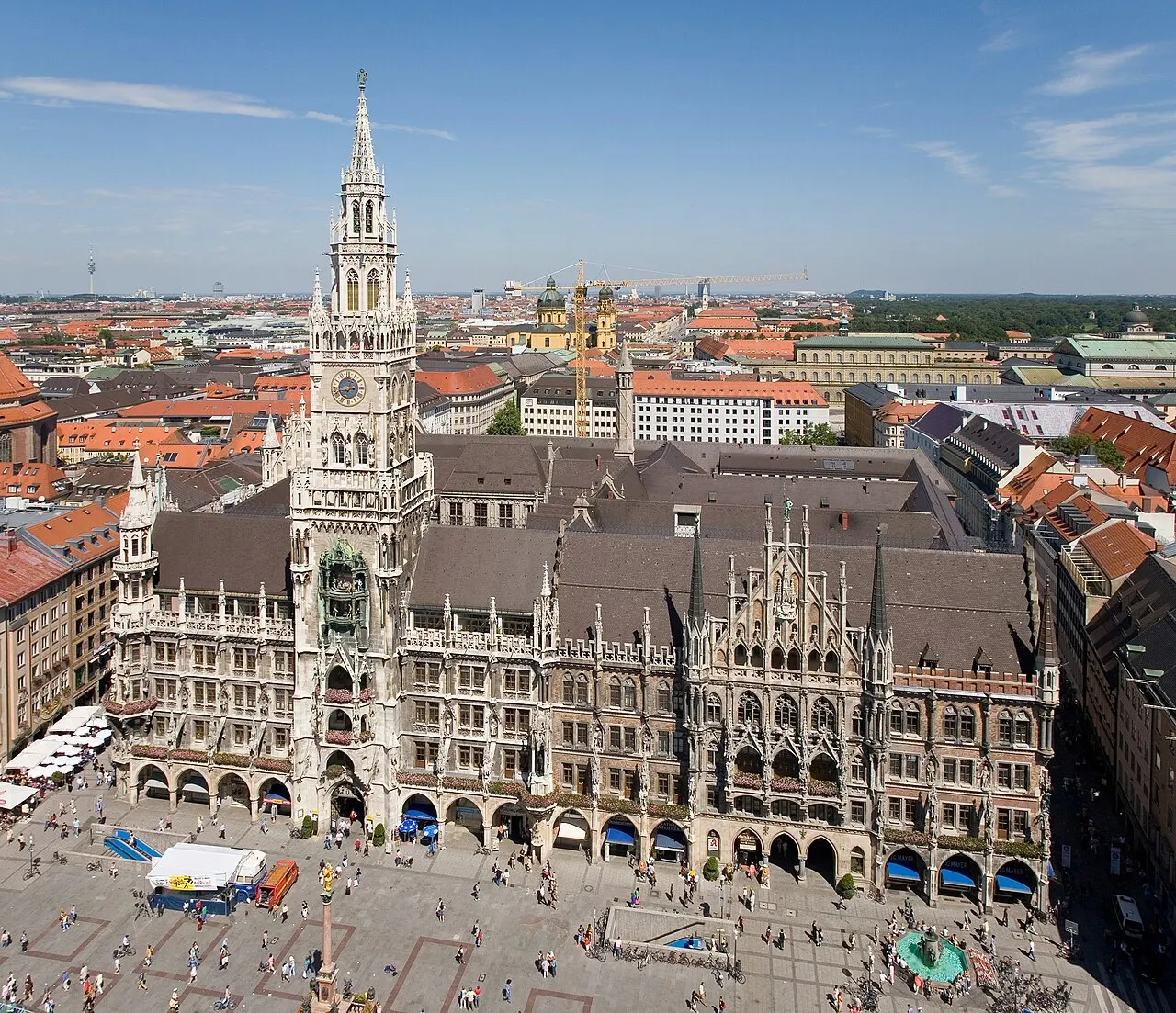
Marienplatz, Frauenkirche & Medieval Altstadt
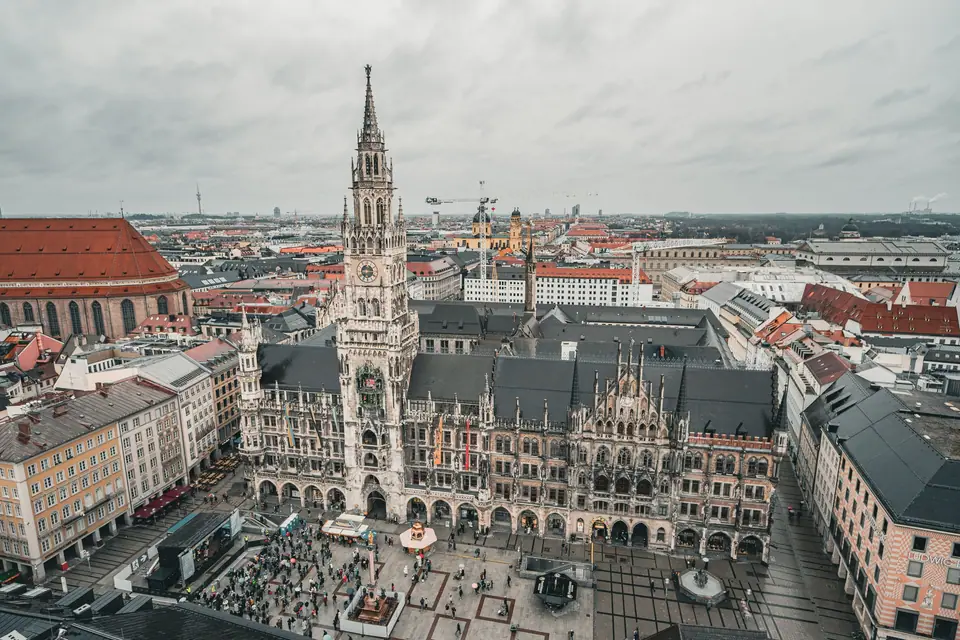
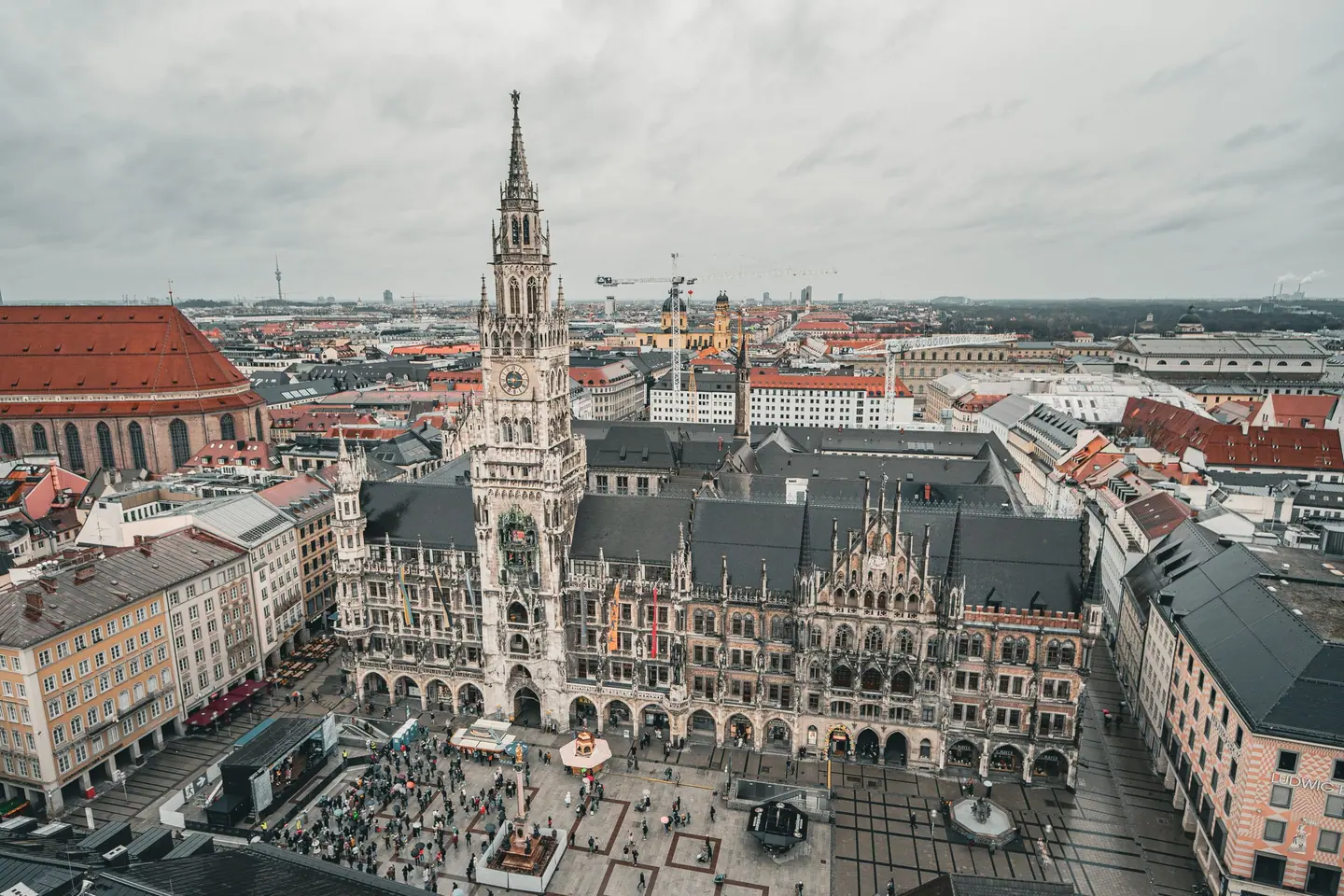
Marienplatz, Neues Rathaus, Altes Rathaus, Peterskirche Alter Peter, Frauenkirche, Viktualienmarkt, Asamkirche, Sendlinger Tor, and Hofbräuhaus
Marienplatz
Marienplatz has anchored civic life since Henry the Lion founded the city in 1158. Originally used for medieval tournaments and salt markets, the square takes its modern name from the central Marian column erected in 1638. Visitors gather across the stone paving to observe the surrounding town halls and historic facades.
Neues Rathaus
Designed by Georg von Hauberrisser, this expansive municipal complex was constructed between 1867 and 1909. Its stone facade features ornate tracery, statues of Bavarian dukes, and an eighty-five-metre tower housing a mechanical clock with revolving copper figures. The interior courtyards offer a peaceful contrast to the public square outside.
Mariensäule
Erected in 1638 by Elector Maximilian I, this golden bronze sculpture of the Virgin Mary stands atop a tall marble column. Four bronze cherubs at the base battle allegorical beasts symbolising war, pestilence, hunger, and heresy. It serves as the official geographical centre from which regional road distances are measured.
Fischbrunnen
Standing directly before the New Town Hall entrance, this fountain traces its origins back to medieval butcher and fishmonger traditions. Rebuilt after wartime destruction by sculptor Josef Henselmann, the basin incorporates bronze fish and apprentice figures. It remains the most customary rendezvous point for city residents meeting in the centre.
Altes Rathaus
Architect Jörg von Halspach designed this Gothic council building between 1470 and 1480. Heavily damaged during the Second World War, it was meticulously rebuilt alongside its medieval spire, which now accommodates a historical toy museum. Inside, the grand ceremonial ballroom preserves wood carvings executed by medieval craftsman Erasmus Grasser.
St Peter's Church (Alter Peter)
Established in the late twelfth century, this parish church predates the official town charter and displays elements of Romanesque, Gothic, and Baroque architecture. The ninety-one-metre spire, known locally as Alter Peter, provides extensive views towards the Bavarian Alps. Inside, the high altar contains a gilded sculpture of Saint Peter by Erasmus Grasser.
Viktualienmarkt
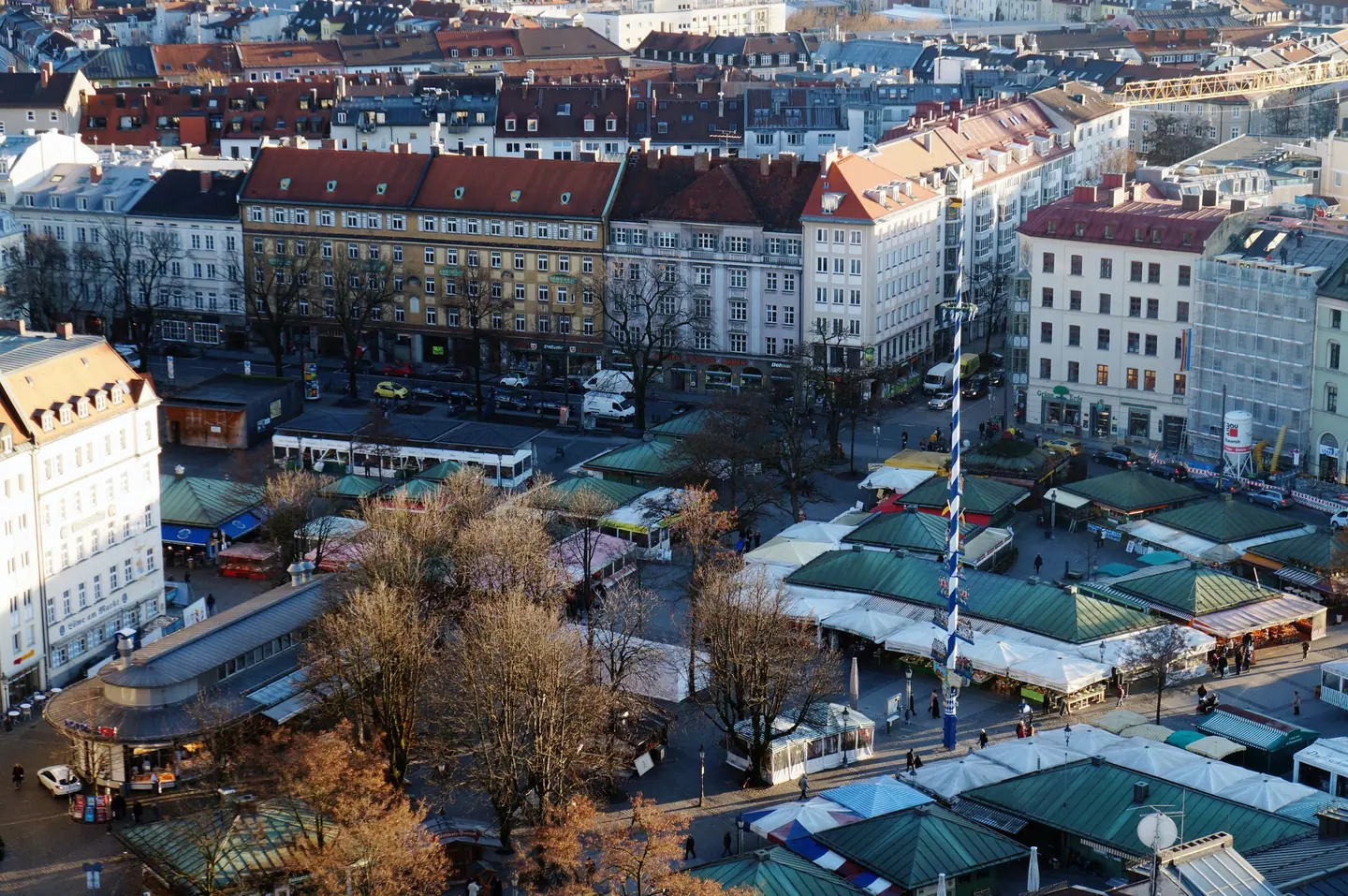
King Maximilian I decreed the establishment of this permanent food market in 1807 after Marienplatz became overcrowded. Spread across two hectares, it features permanent stalls selling regional cheeses, sausages, flowers, and foreign delicacies. A central traditional Maypole, painted in Bavarian blue and white, depicts local trades and historical guilds.
Frauenkirche
Constructed from red brick between 1468 and 1488, the Cathedral of Our Lady is the seat of the Archbishop of Munich and Freising. Its characteristic twin onion domes, added in 1525, define the municipal skyline. Inside the nave, visitors can examine the black tile bearing the legendary Devil's Footstep mark.
Michaeliskirche
Duke William V commissioned this Jesuit church between 1583 and 1597 as a spiritual centre of the Counter-Reformation. Its barrel-vaulted ceiling ranks among the widest masonry vaults constructed since classical antiquity. Below the choir lies the Wittelsbach crypt, which preserves the tomb of King Ludwig II of Bavaria.
Bürgersaalkirche
Constructed around 1710 by Giovanni Antonio Viscardi, this hall initially served the Marian Congregation of Men before being consecrated for church services. The building contains two levels, with an upper prayer hall decorated in late Baroque stucco and a lower crypt. The crypt houses the grave of anti-Nazi resistance figure Father Rupert Mayer.
Karlstor
Originally named Neuhauser Tor, this stone gate formed part of the outer ring of medieval fortifications built between 1285 and 1347. It was later modified in the neo-Gothic style during the nineteenth century by Arnold Zenetti. The archways feature stone medallions depicting prominent Munich folk figures and former civic court characters.
Asamkirche (St Johann Nepomuk)
Built between 1733 and 1746 by brothers Egid Quirin and Cosmas Damian Asam, this private chapel occupies a plot measuring only eight by twenty-two metres. The interior presents an intricate ensemble of stucco, gilding, and ceiling frescoes illuminated by concealed windows. It remains one of Europe's most cohesive examples of late Baroque interior architecture.
Asamhaus
Standing directly adjacent to the Asamkirche, this residence was purchased and redecorated by sculptor Egid Quirin Asam in 1733. The exterior facade displays theatrical Rococo stucco reliefs depicting classical allegories and Christian virtues. A private window connected Asam's living quarters directly to the church altar, allowing him to pray in seclusion.
Sendlinger Tor
Commissioned by Emperor Louis the Bavarian in the early fourteenth century, this fortified red-brick gateway controlled merchant traffic entering from northern Italy. Its lateral towers retain their medieval fabric, while the central arch was widened in 1906 to facilitate modern street traffic. The surrounding plaza links the old centre to the neighbouring hospital quarter.
Jakobsplatz and Ohel Jakob Synagogue
Redesigned in 2006, this public square unites the Munich Stadtmuseum, the Jewish Museum, and the Ohel Jakob Synagogue. The synagogue combines a solid travertine stone base with a glass cube draped in a bronze mesh canopy. An underground tunnel, the Pathway of Remembrance, links the communal centre with the sanctuary.
Münchner Stadtmuseum
Occupying the former Gothic armoury and stable buildings, this museum chronicles the cultural and social development of Munich from the Middle Ages to modern times. Collections feature historical puppetry, graphic arts, photography, and musical instruments from across Europe. The central courtyard preserves the utilitarian brickwork of the late fifteenth-century arsenal.
Heilig-Geist-Kirche
Founded in the fourteenth century as the chapel of the adjacent Hospital of the Holy Ghost, this structure combines medieval masonry with later Baroque embellishments. Cosmas Damian Asam provided ceiling frescoes in the 1720s, while the facade received neo-Baroque styling in the late nineteenth century. It borders the northern end of Viktualienmarkt.
Hofbräuhaus am Platzl
Established in 1589 by Duke William V to supply the royal court, this brewery moved to the Platzl square during the seventeenth century. The current neo-Renaissance building, designed by Max Littmann in 1897, features a vast ground-floor Schwemme with vaulted ceilings and historic wooden trestle tables. It represents one of Bavaria's most enduring public drinking establishments.
Alter Hof
Serving as the ducal seat of Bavaria from the thirteenth to the fifteenth century, this complex became an imperial palace during the reign of Emperor Louis IV. The courtyard features the historic Monkey Tower, named after a court legend involving a runaway ape and infant prince. Today, the vaulted cellars accommodate exhibitions detailing Munich's early history.
Isartor
Erected in 1337 during the expansion of Munich's defensive perimeter, Isartor preserves its central tower, flanking octagonal battlements, and courtyard. A nineteenth-century exterior fresco by Bernhard von Neher illustrates the triumphant entry of Louis the Bavarian after the Battle of Mühldorf. The gate tower now houses the Valentin-Karlstadt-Musäum, dedicated to regional comedy and satire.
Munich Residenz, Odeonsplatz & Maximilianstrasse
Munich Residenz, Cuvilliés Theatre, Odeonsplatz, Feldherrnhalle, Theatinerkirche, Hofgarten, Nationaltheater, Maximilianstrasse, and Isartor
Munich Residenz
Serving as the seat of government and residence of the Wittelsbach dukes, electors, and kings from 1508 to 1918, this vast palace evolved across four centuries. The architecture incorporates Renaissance, Baroque, Rococo, and Neoclassical styles across ten courtyards. Visitors can explore more than one hundred preserved rooms displaying state furniture, tapestries, and ancestral portraits.
Antiquarium
Constructed between 1568 and 1571 for Duke Albrecht V, this sixty-six-metre hall ranks as the oldest surviving room in the Munich Residenz. Originally designed to house antique classical sculptures, it features a barrel-vaulted ceiling decorated with grotesque frescoes by Friedrich Sustris. Below the vault, painted lunettes illustrate detailed topographical views of historical Bavarian towns and castles.
Cuvilliés Theatre
Commissioned by Elector Maximilian III Joseph in 1751, this court theatre stands as a masterpiece of Bavarian Rococo craftsmanship. The tiered auditorium features four tiers of red and gold wood carvings meticulously salvaged before wartime bombing destroyed the original shell. Mozart premiered his opera Idomeneo here in 1781, cementing the hall's place in classical music history.
Residenz Treasury
Founded by Duke Albrecht V in the late sixteenth century, the treasury occupies ten rooms on the ground floor of the Königsbau wing. The collection displays medieval goldsmith work, ceremonial weapons, enamel crosses, and the royal regalia of the Kingdom of Bavaria. Highlights include the ninth-century cross of Queen Gisela and the gemstone-encrusted statue of Saint George.
Allerheiligen-Hofkirche
Designed by court architect Leo von Klenze and consecrated in 1837, this church was inspired by the Palatine Chapel in Palermo. The interior showcases Romanesque arches, marble-clad columns, and restored brickwork that reflects its post-war ruin status. Now functioning as an atmospheric concert venue, the structure offers visitors a glimpse into nineteenth-century historicist design.
Königsbau
King Ludwig I commissioned Leo von Klenze to construct this monumental southern wing between 1826 and 1835, modelling its facade on Florence's Palazzo Pitti. The rusticated stone exterior fronts lavish royal living quarters adorned with literary frescoes depicting classical epics. Inside, the Nibelungen Halls display dramatic nineteenth-century murals illustrating scenes from medieval Germanic legend.
Kaiserhof of the Residenz
Laid out between 1612 and 1616, the Kaiserhof served as the primary ceremonial entry for Holy Roman Emperors visiting Munich. The courtyard is defined by its octagonal clock tower and symmetrical Renaissance elevations that project formal courtly authority. Access leads directly to the Imperial Staircase and the expansive banqueting halls of the upper state apartments.
Brunnenhof
This courtyard took shape around 1610 as an enclosed carriage drive and tournament arena for the electoral court. At its centre stands the large bronze Wittelsbach fountain, surmounted by a sculpture of Duke Otto I, the dynasty's first Bavarian ruler. Today, the space hosts open-air classical concerts against a backdrop of historic palace facades.
Feldherrnhalle
Commissioned by King Ludwig I in 1841 and designed by Friedrich von Gärtner, this open loggia anchors the southern end of Odeonsplatz. Modelled on Florence's Loggia dei Lanzi, it shelters bronze statues of military commanders Johann Tserclaes von Tilly and Carl Philipp von Wrede. The stone steps and guardian Bavarian lions mark the site of the failed 1923 Beer Hall Putsch.
Theatinerkirche
Built between 1663 and 1690 to celebrate the birth of Crown Prince Max Emanuel, this church introduced Italian High Baroque to Bavaria. Agostino Barelli designed the Mediterranean-inspired basilical layout, while François de Cuvilliés later completed the ornate yellow Rococo facade. The white stuccoed interior houses the Wittelsbach royal crypt, where many Bavarian electors and kings lie buried.
Odeonsplatz
Conceived by King Ludwig I in the early nineteenth century, this urban square presents an Italianate gateway to the city. Framed by the Feldherrnhalle, the Residenz, and historic government palaces, the open space establishes the grand axis running northward to the Siegestor. Visitors frequently gather here to admire the harmonious neoclassical streetscape created by Leo von Klenze.
Hofgarten
Laid out between 1613 and 1617 by Elector Maximilian I in the Italian Renaissance style, this manicured public park features gravel paths and geometric flower beds. At its centre stands the Pavilion of Diana, an eight-sided dome topped by a bronze statue representing Bavaria. The northern and western arcades display historical frescoes recounting major events in Wittelsbach family history.
Bavarian State Chancellery
Completed in 1993, this government complex integrates the monumental central dome of the former 1905 Bavarian Army Museum with modern steel-and-glass wings. Located on the eastern fringe of the Hofgarten, it serves as the official executive office of Bavaria's Minister-President. A sunken war memorial in the forecourt commemorates Bavarian soldiers fallen in the two world wars.
National Theatre Munich
Designed by Karl von Fischer and rebuilt by Leo von Klenze following an 1823 fire, this opera house serves as home to the Bavarian State Opera. Its classical portico features Corinthian columns and pediment mosaics celebrating Pegasus and the Muses. The interior auditorium boasts five tiers finished in classical red, gold, and ivory, celebrated for exceptional acoustic clarity.
Max-Joseph-Platz
Constructed in the early nineteenth century during Munich's royal expansion, this plaza links the Residenz, the National Theatre, and the starting point of Maximilianstrasse. At its centre rests Christian Daniel Rauch's monumental bronze monument to King Maximilian I Joseph, depicted seated on an elevated throne. The surrounding facades demonstrate the restrained classicism championed by architect Leo von Klenze.
Maximilianstrasse
Planned by King Maximilian II in 1853, this broad boulevard runs eastward from Max-Joseph-Platz across the Isar River toward the Maximilianeum. Architect Friedrich Bürklein devised a unique hybrid architectural style blending English Perpendicular Gothic with Italian Renaissance motifs along its facades. Today, the street houses high-fashion retail houses, international art galleries, and historic cultural venues.
Münzsammlung
Originating from Duke Albrecht V's private coin cabinet established in the sixteenth century, this specialised museum holds over three hundred thousand numismatic artefacts. The collection features ancient Greek coins, Roman imperial medallions, Renaissance medals, and historic Bavarian currencies. Housed in the north wing of the Residenz, the exhibition tracks monetary history from antiquity through the modern era.
Siemens Forum Munich
Also known as Palais Ludwig Ferdinand, this stately residence was erected between 1825 and 1826 by Leo von Klenze for his personal residence, later purchased by Prince Alfons. Positioned at the transition from Odeonsplatz to Wittelsbacherplatz, it displays balanced classical symmetry and delicate decorative relief panels. It now serves as the global corporate headquarters of the Siemens industrial group.
Marstall
Erected by Leo von Klenze between 1817 and 1822, the Marstall served as the equestrian arena and court stables for the Bavarian monarchy. Its broad facade incorporates arched entrance bays adorned with stone reliefs of Roman horse tamers sculpted by Johann Martin von Wagner. The historic building now functions as an experimental performance stage for the neighbouring Residenztheater.
Isartor
Built in 1337 under Holy Roman Emperor Louis the Bavarian, this gate tower protected the eastern entry to Munich along the historic salt road. It survives as the only city gate retaining its defensive octagonal tower, flanking bastions, and inner courtyard. The exterior wall features an expansive nineteenth-century fresco depicting Emperor Louis returning victorious from the Battle of Mühldorf.
Kunstareal Museums, Königsplatz & Maxvorstadt
Alte Pinakothek, Neue Pinakothek, Pinakothek der Moderne, Brandhorst Museum, Königsplatz, Glyptothek, Propylaea, Lenbachhaus, and Siegestor
Alte Pinakothek
Commissioned by King Ludwig I and designed by Leo von Klenze, this vast museum opened in 1836 to house royal art collections. Travellers admire monumental canvases by Rubens, exquisite Renaissance portraits by Albrecht Dürer, and masterful Italian works. Notice the repaired brickwork on the southern façade, intentionally left visible after wartime damage.
Neue Pinakothek
Founded in 1853, the gallery was the first public collection dedicated exclusively to contemporary art of its era. Architect Alexander von Branca rebuilt the venue in 1981, combining modernist concrete with classical stone arches. While major artworks occasionally tour neighbouring venues, the site remains central to Munich's artistic legacy.
Pinakothek der Moderne
Designed by Stephan Braunfels and inaugurated in 2002, this airy structure unites four independent collections beneath one dramatic glass rotunda. The museum houses fine art, the International Design Museum, the Architecture Museum, and the state graphical collection. Visitors appreciate the sweeping central staircase and natural light filtering across expansive gallery halls.
Museum Brandhorst
Completed in 2009 by Sauerbruch Hutton, this striking building displays modern masterpieces collected by Udo and Anette Brandhorst. The exterior features thirty-six thousand glazed ceramic louvres in diverse hues, functioning as a passive acoustic shield. Inside, visitors encounter expansive holdings of Cy Twombly, including the Lepanto cycle, alongside major works by Andy Warhol.
Königsplatz
Conceived by Ludwig I and architect Karl von Fischer, Königsplatz resembles an Athenian acropolis transported to Bavaria. The open plaza is flanked by neoclassical temples and paved avenues that served as ceremonial grounds throughout Bavarian and twentieth-century German history. Green lawns now carpet the square, inviting locals and travellers to relax beside antique colonnades.
Glyptothek
Erected between 1816 and 1830 by Leo von Klenze, this temple-fronted venue was commissioned to house Ludwig I's extensive collection of classical statuary. The collection highlights the archaic pediment sculptures from the Temple of Aphaia in Aegina, alongside the famed Barberini Faun. Inside, austere brick vaulted ceilings provide a dignified backdrop for Roman and Greek marble.
Propylaea
Completed by Leo von Klenze in 1862, this monumental marble portal forms the western entry to Königsplatz. Built to honour the Bavarian Prince Otto ascending the Greek throne, it directly references the ancient entrance gate of the Athenian Acropolis. Relief sculptures celebrate the Greek War of Independence against the Ottoman Empire across its grand pediments.
Staatliche Antikensammlungen
Standing opposite the Glyptothek, Georg Friedrich Ziebland designed this Corinthian-order building in 1848 as an arts and exhibition hall. Today it holds the state's prime collection of ancient vases, bronzes, terracottas, and Etruscan jewellery. Visitors can inspect finely painted Attic black-figure and red-figure vessels charting ancient Mediterranean life and mythology.
Lenbachhaus
Originally the private residence of painter Franz von Lenbach, this villa was enlarged in 2013 with a gleaming brass-clad wing by Foster and Partners. The institution houses the preeminent collection of Der Blaue Reiter art, featuring Wassily Kandinsky, Gabriele Münter, and Franz Marc. Historic studio rooms contrast gracefully with modern, light-filled exhibition galleries.
Munich Documentation Centre for the History of National Socialism
Constructed upon the former site of the Brown House, the Nazi party headquarters, this stark white concrete cube opened in 2015. Designed by Georg Scheel Wetzel, it provides an uncompromising historical examination of Munich's specific role in the rise of the regime. The minimalist interior encourages reflection through documents, photographs, and clear multimedia installations.
Staatliches Museum Ägyptischer Kunst
Located entirely underground beneath the University of Television and Film, this innovative museum opened in 2013. Designed by Peter Böhm, visitors descend via a sunken courtyard into concrete chambers evocative of royal tombs. The collection features exceptional dynastic statuary, reliefs, and funerary objects covering more than three millennia of Egyptian history.
Siegestor
Commissioned by Ludwig I and designed by Friedrich von Gärtner, this monumental gate was completed in 1852 to honour Bavarian military courage. A bronze quadriga of Bavaria driving four lions crowns the monument. Following significant wartime devastation, the southern side was deliberately left unrestored with an inscription reading, 'Dedicated to victory, destroyed by war, urging peace'.
Ludwig-Maximilians-Universität Main Building
Designed by Friedrich von Gärtner in the 1830s, this central university building was the heart of Munich higher education. The central atrium witnessed the courageous anti-Nazi leaflet protests of Hans and Sophie Scholl in 1943. Embedded into the stone square outside, ceramic leaflets commemorate the White Rose resistance group with poignant simplicity.
St. Ludwig, Munich
Commissioned by Ludwig I to terminate the vista of Ludwigstrasse, this limestone basilica was constructed between 1829 and 1844 by Friedrich von Gärtner. The interior houses the second-largest altar fresco in the world, depicting the Last Judgement painted by Peter von Cornelius. Twin towers with octagonal spires dominate the university quarter's skyline.
Bavarian State Library
Architect Friedrich von Gärtner constructed this monumental Florentine-style palace along Ludwigstrasse between 1832 and 1843. Guarded by four seated statues of classical scholars, the building contains millions of volumes, including rare medieval codices and musical scores. The grand entrance stairway, restored after wartime bombing, remains an impressive example of mid-nineteenth-century public architecture.
Amerikahaus, Munich
Erected in 1957 on Karolinenplatz, this rotunda-shaped building was established by American authorities to foster transatlantic understanding and democracy in post-war Germany. Featuring an elegant glass façade and curved exhibition spaces, it now hosts lectures, theatre, and cultural exchanges. The building stands as an important monument to mid-century civic architecture and intellectual reconstruction.
Karolinenplatz Obelisk
Dominating Karolinenplatz since 1833, this twenty-nine-metre bronze obelisk was designed by Leo von Klenze. Cast from melted down Turkish cannons captured during the Greek War of Independence, it honours thirty thousand Bavarian soldiers who perished in Napoleon's 1812 Russian campaign. The tapered column provides a focal point at the junction of several broad neoclassical boulevards.
Alter Nordfriedhof
Conceived by Arnold Zenetti and opened in 1868, this historical cemetery closed for new burials in the mid-twentieth century. Today it serves Maxvorstadt residents as a tranquil park, where ivy-covered tombstones and weathered family vaults line gravel alleys. Prominent nineteenth-century artists, scientists, and university professors rest beneath its mature chestnut trees.
St. Benno, Munich
Constructed between 1895 and 1897 by architect Leonhard Romeis, this imposing church honours Munich's patron saint, Benno of Meissen. The exterior features heavy rhenish-romanesque styling with two sixty-four-metre bell towers, ornate portal sculptures, and polychrome masonry. Inside, travellers can appreciate the detailed mosaics, vaulted ceilings, and quiet chapels crafted in medieval revival splendour.
Geological Museum, Munich
Housed within the central institute buildings of the Kunstareal, this museum presents Earth's geological evolution through regional rock formations and continental drift models. The neighbouring Museum Reich der Kristalle showcases dazzling collections of minerals, gemstones, and meteorites gathered by Bavarian collectors over centuries. It provides a fascinating scientific complement to the neighbouring classical art halls.
English Garden, Schwabing & Isar Riverbank
Englischer Garten, Monopteros, Chinese Tower, Eisbachwelle, Haus der Kunst, Bavarian National Museum, Friedensengel, Maximilianeum, and Deutsches Museum
Eisbachwelle
Formed at the southern threshold of the Englischer Garten, this artificial standing wave on the Eisbach river draws skilled surfers at all seasons. Stone embankments frame the cold torrent where boarders queue along both sides. We can watch their agile turns directly from the bridge overlooking Prinzregentenstrasse.
Haus der Kunst
Constructed between 1933 and 1937 to designs by Paul Ludwig Troost, this austere colonnaded hall originally opened as the Haus der Deutschen Kunst. Stripped of its National Socialist imagery after the Second World War, it was thoroughly repurposed. Today, it hosts international contemporary art installations and rotating exhibitions beneath its monumental ceilings.
Bavarian National Museum
Founded by King Maximilian II in 1855, the museum moved into Gabriel von Seidl's historicist complex on Prinzregentenstrasse in 1900. Its vast galleries display medieval sculptures, Renaissance tapestries, delicate porcelain, and an exceptional collection of historic Nativity scenes. Notice the eclectic exterior, which fuses German and Italian Renaissance architectural elements.
Prack-Haus and Schackgalerie
Built by Max Littmann in 1909 to house Count Adolf Friedrich von Schack's private art collection, this neoclassical building features a handsome stone loggia. The rooms preserve a distinct late-nineteenth-century atmosphere, displaying major canvases by Arnold Böcklin, Moritz von Schwind, and Anselm Feuerbach. It offers quiet insight into German Romanticism.
Luitpoldbrücke
Replacing an earlier iron suspension bridge destroyed by floods in 1899, this stone arch bridge opened in 1901 named after Prince Regent Luitpold. Sculptures by prominent artists adorn the piers, representing Bavaria, Franconia, Swabia, and the Palatinate. Crossing the Isar here links the museum quarter with the hillside below the Friedensengel.
Friedensengel
Inaugurated in 1899, this monument commemorates twenty-five years of peace following the Franco-Prussian War. A gilded bronze angel, modelled after the Greek Nike of Paeonios, balances atop a Corinthian column thirty-eight metres high. A stone hall below features mosaics, while the balustrade affords an open vista down Prinzregentenstrasse.
Villa Stuck
Symbolist painter Franz von Stuck designed this villa between 1897 and 1898 as a complete work of art. The Italianate residence integrates classical friezes, polychrome wall paintings, gilded coffered ceilings, and bespoke Art Nouveau furniture. Visiting the historic atelier and private living quarters reveals Stuck's meticulous approach to private aesthetic patronage.
Maximilianeum
Perched on the eastern bank of the Isar, this grandiose building was begun in 1857 under King Maximilian II to house talented scholars. Architect Friedrich Bürklein designed its sprawling facade with Neo-Gothic arcades, later modified with Renaissance terracotta details. Since 1949, it has served as the meeting place of the Bavarian Landtag.
Max-Joseph-Brücke
Also known as the Bogenhauser Brücke, this structure was designed by Theodor Fischer and completed in 1902. Constructed from shell limestone, it features carved reliefs representing the four elements: earth, water, air, and fire. The bridge connects the residential streets of Schwabing and the Englischer Garten to the leafy district of Bogenhausen.
Monopteros in the Englischer Garten
Leo von Klenze designed this open circular temple in the Greek revival style, completed in 1836 on an artificial knoll. Ten Ionic columns support a copper dome decorated with delicate polychrome accents. From its raised stone plinth, visitors enjoy sweeping views over the southern meadows and the church spires of Munich's historic core.
Chinese Tower
Constructed in 1790 by Johann Baptist Lechner, this twenty-five-metre wooden pagoda was inspired by the Great Pagoda in London's Kew Gardens. Rebuilt faithfully after wartime destruction, it anchors a famous shaded beer garden. Traditional brass bands often perform from the open first-storey balcony on sunny afternoons.
Kleinhesseloher See
Created around 1803 by garden designer Reinhard von Werneck and expanded by Friedrich Ludwig von Sckell, this artificial lake spans eight hectares. Walking paths wind around its wooded edges, which provide habitats for herons and waterbirds. Rowing boats can be hired, and the Seehaus restaurant sits conveniently along the eastern bank.
St. Ursula Church, Munich
Architect August Thiersch designed this prominent parish church, built between 1894 and 1897 in the Italian Renaissance style. The exterior features light sandstone, an elegant portico, and a freestanding campanile tower that dominates Kaiserplatz. Inside, quiet barrel-vaulted aisles lead to colourful mosaics depicting biblical scenes and early Christian saints.
Wedekindplatz
Named after playwright Frank Wedekind, this triangular plaza was the centre of Schwabing's turn-of-the-century literary and artistic community. The square features a bronze sculpture of the Munich folk figure 'Der Schwadronör'. Traditional taverns, pavement cafes, and bookshops still flank the surrounding pavements, retaining an easygoing neighbourhood charm.
Siegestor
Commissioned by King Ludwig I and designed by Friedrich von Gärtner, this three-arched monument was finished in 1852. Modelled on Rome's Arch of Constantine, it is crowned by a bronze Bavaria riding a chariot drawn by four lions. Following heavy wartime damage, it was deliberately rebuilt with a simple inscription dedicated to peace.
Ludwig-Maximilians-Universität Main Building
Erected between 1835 and 1840 by Friedrich von Gärtner, the main building features a stately Florentine-inspired facade. The central atrium is historically notable as the site where Hans and Sophie Scholl distributed the White Rose resistance leaflets in 1943. A permanent memorial and sunken stone flyers in the square commemorate their bravery.
St. Luke's Church, Munich
Built between 1893 and 1896 to designs by Albert Schmidt, St Lukas is the only largely preserved historicist Lutheran church building in Munich. Its striking riverfront design combines Romanesque revival facades with a towering octagonal central dome. The spacious interior contains tall stone arches and luminous stained-glass windows produced by Munich workshops.
Praterinsel
Situated in the middle of the Isar, this island became a recreational destination in the early nineteenth century and later housed a famous liqueur distillery. Today, the restored brick industrial buildings provide atmospheric spaces for contemporary art exhibitions, theatre performances, and private events. Shaded paths along the water offer tranquil walks away from city traffic.
Müller'sches Volksbad
Completed in 1901 by Karl Hocheder through an endowment by Karl Müller, this riverside bathhouse was once Europe's most modern public pool. The building showcases exuberant Art Nouveau styling, complete with stucco sea motifs, bronze railings, and sweeping barrel-vaulted pool halls. It remains in daily use for recreational swimming and Roman-Irish steam baths.
Deutsches Museum
Occupying Museumsinsel, an island in the Isar, this institution was founded in 1903 by engineer Oskar von Miller. The vast complex houses tens of thousands of exhibits spanning aerospace, maritime transport, nuclear physics, and industrial machinery. Visitors can inspect historic aircraft, early diesel engines, and walk through full-scale historic mine reconstructions.

Nymphenburg Palace, Olympiapark & Haidhausen
Nymphenburg Palace, Amalienburg, Marstallmuseum, Botanical Garden Munich, Olympiapark, Olympic Tower, BMW Welt, Müller’sches Volksbad, and Gasteig
Nymphenburg Palace
Commissioned in 1664 to celebrate the birth of an heir, this sprawling baroque estate served as the main summer retreat for Bavarian monarchs. Visitors can inspect the lavish Steinerner Saal, adorned with ceiling frescoes by Johann Baptist Zimmermann, and King Ludwig I's famed Gallery of Beauties.
Amalienburg
Designed by court architect François de Cuvilliés between 1734 and 1739, this pavilion is an exemplar of European rococo decoration. Inside, the Hall of Mirrors features silvered stucco carvings set against pale blue walls, crafted alongside a bespoke porcelain-tiled kennel room and pheasant gallery.
Badenburg
Constructed by Joseph Effner between 1718 and 1722, the Badenburg was among the earliest heated indoor swimming facilities in modern Europe. The two-storey building features a two-tier bathing hall lined with Dutch Delft tiles, as well as an opulent Chinese-themed dressing room with hand-painted wallpaper.
Pagodenburg
This octagonal pleasure house was constructed by Joseph Effner between 1716 and 1719 to provide a resting place following royal games of boules. The interior blends blue-and-white Delft tiles on the ground floor with historic lacquered rooms upstairs that display authentic Far Eastern decorative motifs.
Magdalenenklause
Built deliberately as an artificial ruin between 1725 and 1728, this secluded brick hermitage offered Elector Max Emanuel a dedicated retreat for private contemplation. The interior houses an intentionally rugged grotto chapel covered in tufa and shells, dedicated to Saint Mary Magdalene, alongside ascetic living quarters.
Marstallmuseum
Located in the southern wing of Nymphenburg Palace, this museum presents an extensive historical collection of state coaches, sleighs and riding equipment used by the Wittelsbachs. Highlights include the gilded coronation coach of Emperor Charles VII and the ornate fairy-tale sleighs commissioned by King Ludwig II.
Museum of Man and Nature
Set within the northern outbuildings of Nymphenburg Palace, this museum opened in 1990 to present geological history, genetics and evolutionary biology. Exhibits feature preserved animal specimens, interactive sensory displays and the taxidermy mount of Bruno the brown bear, who roamed the Bavarian Alps in 2006.
Botanischer Garten München-Nymphenburg
Established in 1914, this 21-hectare botanical institution protects around 20,000 plant species and cultivars. The grounds include an arboretum, an alpine rock garden and a large complex of historic greenhouses sheltering tropical palms, desert cacti, aquatic flora and giant Victoria water lilies.
Olympiapark
Engineered on wartime rubble for the XX Olympic Games, this recreational park transformed northern Munich with sculpted rolling hills, green lawns and a central lake. The landscape was created by Günther Grzimek, intended to be a democratic park completely open to citizens without barriers.
Olympiastadion
Architect Günter Behnisch and structural engineer Frei Otto designed this ground-breaking arena with a revolutionary lightweight tent-canopy made of prestressed acrylic glass panels. The stadium hosted the 1972 Olympic athletic competitions, the 1974 FIFA World Cup Final and decades of major football matches.
Olympiaturm
Erected between 1965 and 1968, this 291-metre concrete broadcast tower stands as an enduring vertical anchor over Olympiapark. High-speed lifts carry visitors to several open-air observation decks, providing sweeping views across the city centre towards the Bavarian Alps on clear days.
Olympiaschwimmhalle
Constructed to host the swimming and diving competitions during the 1972 Summer Olympics, this facility remains a public swimming pool. It sits beneath the same continuous acrylic-glass roof structure as the stadium, featuring tall glass walls that connect swimmers visually to the neighbouring park.
Olympic Village
Designed by Heinle, Wischer and Partner, this modular residential complex housed athletes during the 1972 Olympic Games. The car-free estate features tiered concrete apartments, a separate low-rise student quarter whose bungalows are painted with murals, and a memorial marking the site of the 1972 hostage tragedy.
BMW Headquarters
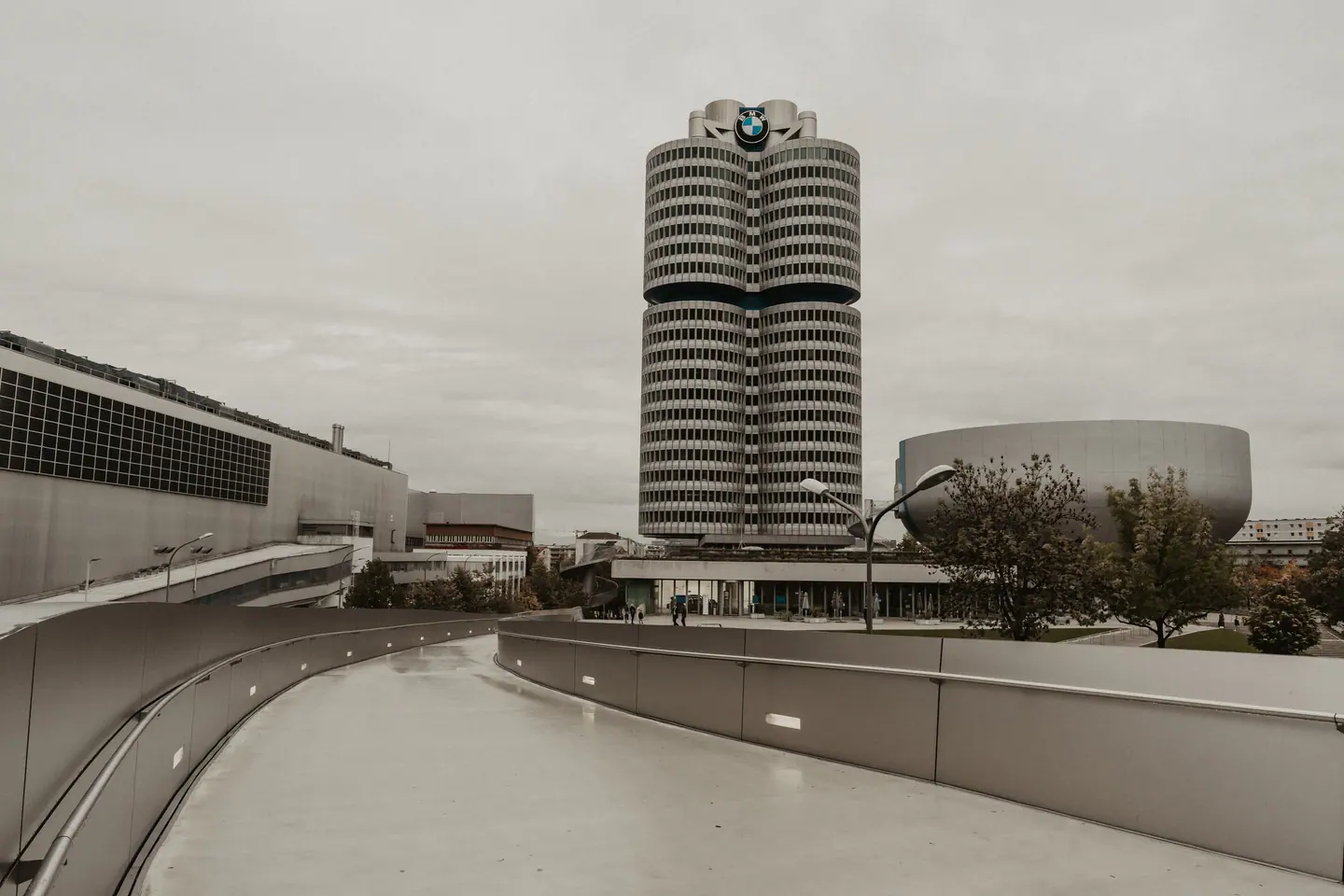
Designed by Austrian architect Karl Schwanzer and completed in 1972, this 101-metre office tower resembles four engine cylinders suspended from a central concrete core. The building stands directly beside the Olympic grounds and represents a striking example of structural engineering and corporate architecture.
BMW Museum
Housed beneath an unmistakable silver bowl-shaped building designed by Karl Schwanzer, this museum showcases the evolution of Bavarian motor manufacturing. An ascending spiral walkway leads past vintage aeroplanes, historic motorcycles, race cars and concept prototypes produced over more than a century.
BMW Welt
Opened in 2007 and designed by the architectural firm Coop Himmelb(l)au, this delivery centre features a dramatic glass facade and a double-cone steel vortex. The venue functions as an interactive public showroom, technological exhibition space and collection point for new automobile owners.
Müller'sches Volksbad
Completed in 1901 by Karl Hocheder, this bathhouse was funded by engineer Karl Müller to provide hygienic public bathing facilities. Its ornate Jugendstil interior retains two vaulted swimming pools, ornamental stucco reliefs, decorative wrought-iron railings and a Roman-Irish steam bath heated by traditional tiled ovens.
Gasteig
Opened in 1985 on an elevated bluff above the Isar river, this modernist red-brick arts centre has long served as a focal point for Munich's cultural life. The facility traditionally housed the Munich Philharmonic, the Richard Strauss Conservatory, public library branches and a large adult education centre.
Max-Weber-Platz
Named after the pioneering sociologist Max Weber, this broad square functions as the commercial heart of the Haidhausen district. Surrounded by nineteenth-century apartment blocks, historic tramlines and small shops, the plaza provides access to the neighbouring hospital Klinikum rechts der Isar.
Wiener Platz
Named after Vienna as the route origin for Danube trade, this charming square retains the small-scale character of old Haidhausen. It features permanent market booths selling fresh cheese, flowers and bread, an open-air beer garden, and an ornamental Bavarian Maypole erected at its centre.
Museum Quarters and Isar Parklands in Munich
Before setting out, check local transit connections, museum booking notes and monthly weather data in our Munich Altstadt, Residenz & Royal Boulevards city guide, and compare other walking itineraries.