


























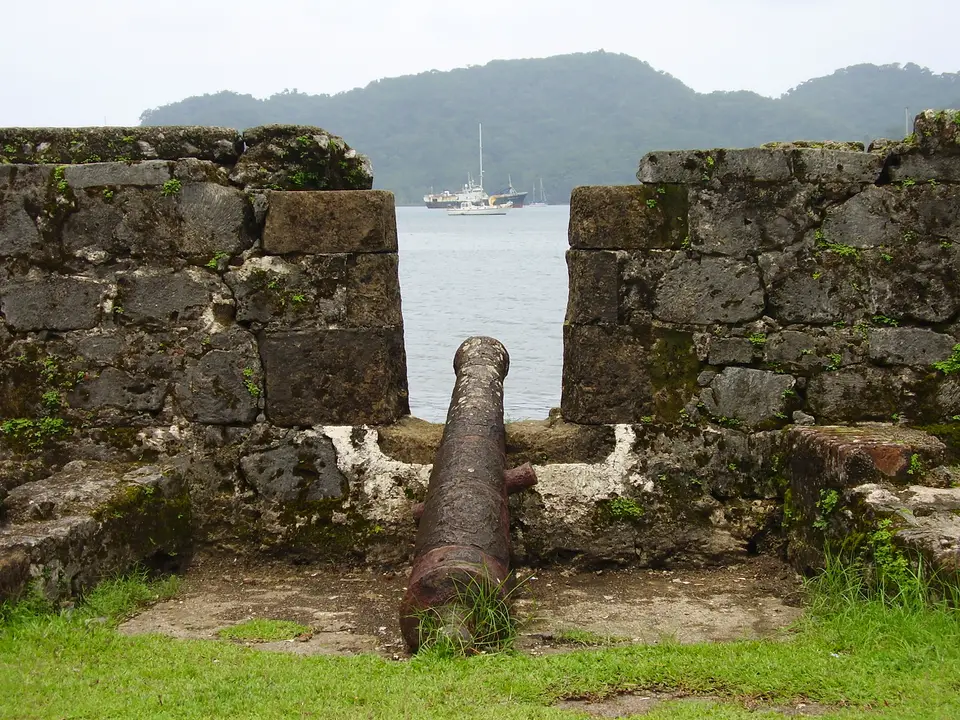
Quick Field Data
- UNESCO Inscription: 1980 · Criteria (i), (iv) · Placed on the Danger List since July 2012
- Scale & Footprint: Serial coastal fortification system in Colón Province, uniting the harbour forts and customs house of Portobelo (32 km northeast of Colón) with San Lorenzo Castle forty-three kilometres away at the Chagres River mouth
- Access & Ticketing: Open-air bayside ruins at Portobelo (San Jeronimo and Santiago) and the colonial port buildings are accessible directly from town; Castle San Lorenzo is managed inside a protected forest reserve west of the Panama Canal
- Arrival Logistics: Located on the Caribbean coast of Colón Province on the northern Isthmus of Panama, reached by road from Colón and Panama City
Trans-Isthmian Silver Logistics and Bautista Antonelli's Caribbean Bastions
Set forty-three kilometres apart along the tropical Caribbean shoreline of Colón Province on the northern side of the Isthmus of Panama, the Fortifications of Portobelo and San Lorenzo protected the Atlantic bottleneck of the Spanish Empire's richest transcontinental trade route for nearly two centuries. Coral stone and iron cannon guarded imperial silver here. Designated a UNESCO World Heritage Site in 1980 under Criteria (i) and (iv) and added in July 2012 to the Danger List due to environmental factors, lack of maintenance as well as uncontrolled urban developments, the serial defensive line unites two strategic Caribbean terminals: the deep natural harbour of Portobelo (seat of Portobelo District in Colón Province at coordinates 9.4390 N, 79.8294 W, located 32 km or 20 miles northeast from modern Colón port near the Caribbean mouth of the Panama Canal across a 244.7 km2 land area whose population grew from 3,058 in 1990 and 3,867 in 2000 to 4,559 in 2010 at a density of 18.6 inhabitants per square kilometre) and the cliff-top the fortress of San Lorenzo el Real del Chagre (San Lorenzo Castle), paired with its detached Upper Battery commanding the mouth of the Chagres River.
According to colonial tradition, Christopher Columbus sailed into the sheltered bay in 1502 and named it Puerto Bello (meaning Beautiful Port in modern Spanish alongside historically rendered in Portuguese as Porto Belo). Nearly a century later, following the 1596 death from dysentery of the English privateer Francis Drake, whose lead coffin was lowered into the sea off Portobelo near the harbour mouth island memorialised as Isla Drake (Drake Island), Spanish explorer Francisco Velarde y Mercado officially founded the city of Portobelo in 1597. Replacing the exposed earlier port of Nombre de Dios, Portobelo became the premier Caribbean entrepôt of New Granada on the Spanish Main, operating in tandem with Veracruz in Mexico (2,066 km or 1,284 miles to the northwest), Cartagena in Colombia as well as Havana in Cuba.
Every treasure shipment mined in colonial Peru and Upper Peru crossed the narrow Isthmus of Panama from Panama City on the Pacific Ocean along two arteries: either overland by mule train overland from Panama City on the Pacific coast across the Isthmus into Portobelo, or down the navigable Chagres River past San Lorenzo Castle and along the coast to Portobelo's harbour. Once the Spanish treasure fleet anchored in the deep bay, merchants held the famous Portobelo fairs that handled imperial trade and bullion shipped from South America to Spain, before late-19th-century work on the Panama Canal brought a renewed economic upswing.
To defend these twin terminals against rival European navies and Caribbean privateers, the Spanish Crown commissioned the military engineer Bautista Antonelli, who prepared the first comprehensive fortification plan for the entrance to Portobelo Bay and the mouth of the Chagres River in 1586. Construction began in the 1590s, skilfully embedding coral-stone and masonry batteries into the steep jungle headlands and reefs around the harbour and on the sheer promontory overlooking the Chagres River. In these earliest late-16th- and 17th-century works, Antonelli blended Renaissance bastion geometry with medieval military features including high curtain walls, corner watchtowers, and cliff-edge gun platforms designed to trap attacking ships in interlocking crossfire across the narrow harbour mouth.
Buccaneer Raids, Admiral Vernon's 1739 Siege as well as Neoclassical Rebuilding
Because the gold and silver stacked inside Portobelo's royal treasury made the harbour the ultimate prize of the Caribbean, the fortifications were tested repeatedly in battle throughout the 17th and 18th centuries. Just four years after the town's founding, William Parker and a force of English privateers seized Portobelo in 1601. Sixty-seven years later, in 1668, the Welsh privateer Henry Morgan landed a force of 450 buccaneers, stormed the harbour castles from the landward side, and plundered the city for 14 days before withdrawing, followed in 1680 by another raid under the English pirate John Coxon.
In the 18th century, British and Spanish commercial rivalry escalated into full-scale naval warfare. In 1726, a British Royal Navy squadron under Admiral Francis Hosier blockaded the harbour from Bastimentos, 11 km (6.8 miles) to the northeast, to prevent the treasure fleet from sailing for Spain, though tropical fever claimed Hosier and hundreds of his crew. Thirteen years later, at the outbreak of the War of Jenkins' Ear on 21 November 1739, British Admiral Edward Vernon attacked Portobelo with a six-ship squadron, overwhelming its defences and systematically demolishing the older Antonelli forts. Vernon's victory sparked such jubilation across the British Empire that more commemorative medals were struck for him than for any other British commander of the 18th century, and the name Portobello was bestowed upon Portobello Road in London (now a famous 19th-century street market drawing millions of visitors each year), the coastal district of Portobello in Edinburgh, and Portobello Barracks in Dublin.
After Spain recovered Portobelo in 1741 following the British defeat at the Battle of Cartagena de Indias, and simultaneously shifted Atlantic shipping from huge annual treasure fleets toward smaller, flexible merchant squadrons sailing directly around Cape Horn, Spanish military engineers completely rebuilt both Portobelo and San Lorenzo during the mid-18th century. Abandoning the high medieval-style towers that Vernon's cannon had shattered, engineers constructed low-profile, thick-walled neoclassical artillery batteries with glacis slopes, dry moats, and vaulted casemates. This 18th-century neoclassical transformation remains clearly visible today at the bayside batteries of Fort Santiago, Fort San Jeronimo, and the across-bay complex of Fort San Fernando in Portobelo, as well as at the rebuilt San Lorenzo Castle and its detached Upper Battery above the Chagres River.
Exploring Portobelo Bay and the Cliff Promontory of San Lorenzo
Visiting the two sectors of this World Heritage Site requires separate half-day drives on opposite sides of the city of Colón: east along the Caribbean coast to the town of Portobelo, and west across the Atlantic locks of the Panama Canal through the coastal rainforest to the mouth of the Chagres River.
- Portobelo Bay, Fort San Jeronimo, and Iglesia de San Felipe: Drive 32 km northeast from Colón into the harbour town of Portobelo to walk directly onto the wide 18th-century neoclassical gun esplanade of Fort San Jeronimo on the water's edge and inspect the hillside structures of Fort Santiago along the western approach, noting how the earliest 16th- and 17th-century military style with mediaeval features evolved into 18th-century neo-classical defensive architecture adapted to changing artillery technologies across three centuries. Directly beside the harbour batteries stands the historic Iglesia de San Felipe, while the town is also known for its cultural traditions including the 2009 Festival de Diablos y Congos and the Devils' Dance celebration shared with Santiago and La Villa de Los Santos.
- Boat crossing to Fort San Fernando and the Upper Battery: Hire a local launch at the Portobelo pier to cross the sheltered bay to the northern shore, where the lower shore battery and uphill redoubt of Fort San Fernando remain framed by tropical forest, offering clear sightlines back across the harbour entrance toward Isla Drake where Francis Drake was buried in 1596.
- San Lorenzo Castle at the Chagres River mouth and Panama City links: Travel forty-three kilometres west of Portobelo past Colón and through the protected coastal forest reserve to the rocky promontory where the Chagres River meets the Caribbean Sea. Walk across the dry moat into the 18th-century vaulted brick casemates and neoclassical ramparts of Castle San Lorenzo and its separate Upper Battery, then pair your Caribbean coast excursion with our UNESCO World Heritage Atlas and our Panama City guide at the Pacific end of the transcontinental Isthmus route.
