


























Quick Field Data
- UNESCO Inscription: Inscribed in 1987 as a cultural urban monument on the Baltic coast of northern Germany.
- Scale & Footprint: Three protected historic zones across the blade-shaped Old Town island, stretching from the 1227 Burgkloster in the north to the St Aegidien quarter in the south, including the Holstentor brick gate, salt storehouses, patrician residences, and narrow Gänge courtyard alleys.
- Access & Ticketing: The Old Town island streets, Gänge passages, and waterfronts are open year-round, while the Holstentor museum, the European Hansemuseum, the Burgkloster, and church towers require entry tickets; check the official site before visiting.
- Arrival Logistics: Located in northern Germany near the Baltic coast and Hamburg, southwest of Copenhagen via regional rail and Baltic ferry links.
Set on a blade-shaped island encircled by the Trave waterways near the Baltic coast of northern Germany, some southwest of Copenhagen, the Hanseatic City of Lübeck stood for three centuries from 1230 to 1535 as the informal informal capital and Queen City of the medieval Hanseatic League (the Hansa or Deutsche Hanse). First founded in 1143 by Count Adolf II of Schauenburg and Holstein on the Buku isthmus and rebuilt in 1159 after Duke Henry the Lion of Saxony and Bavaria, captured the territory, Lübeck rapidly eclipsed earlier Scandinavian Baltic trading hubs such as Birka, Haithabu, Schleswig, and Visby on Gotland (whose merchants had established the Gutagard or Gotenhof post in Novgorod in 1080 and signed an autonomy treaty in 1120). Granted imperial immediacy in 1226 during the reign of King Valdemar II of Denmark within the Holy Roman Empire (following Hamburg's 1189 charter) and commemorated in the north by the Dominican Burgkloster built after the 1227 Battle of Bornhöved over Count Adolf's castle foundations, Lübeck became the legal, diplomatic, and maritime linchpin connecting the North Sea and the Baltic Sea. Since 1987, the UNESCO World Heritage Atlas in 1987, the Old Town preserves the 15th- and 16th-century patrician gable houses, monumental Brick Gothic churches, waterfront salt storehouses, and the twin-towered Holstentor gate that defined northern European commerce.
To walk the crest of Lübeck's Old Town island along its two parallel north-south traffic arteries is to read the socioeconomic map of medieval merchant capitalism. On the western slope descending toward the river piers and salt storehouses sat the wealthy merchant quarters and trading houses of the long-distance patricians (the Gründungsviertel), who exported Lüneburg, French, and Portuguese salt (hauled along the Stecknitz Canal dug from 1391 to 1398 linking Lauenburg with Lübeck) to salt herring at the 30 seasonal vitten outposts in Scania, while importing Russian beeswax, furs, timber, amber, resin, flax, rye, and wheat from the Peterhof Kontor on the Volkhov in Novgorod, copper, iron, and herring from Sweden's Bergslagen mines, stockfish from the Bryggen Kontor in Bergen, and Flemish and English broadcloth from the Bruges Kontor and London's Steelyard (Stalhof, where Cologne merchants had won toll exemptions from King Henry II between 1173 and 1175 and Lübeck and Hamburg gained a 1266 charter from King Henry III before merging in 1282). On the eastern slope of the island worked the small traders and artisans, while tucked inside the rear courtyards of the wealthy merchant houses, reached through narrow brick-vaulted passages called Gänge, sat the Buden, compact rental workshops and dwellings that housed craftsmen and sailors.
Lübeck Law, Brick Gothic Spires, and the 200-Town Hanseatic Network
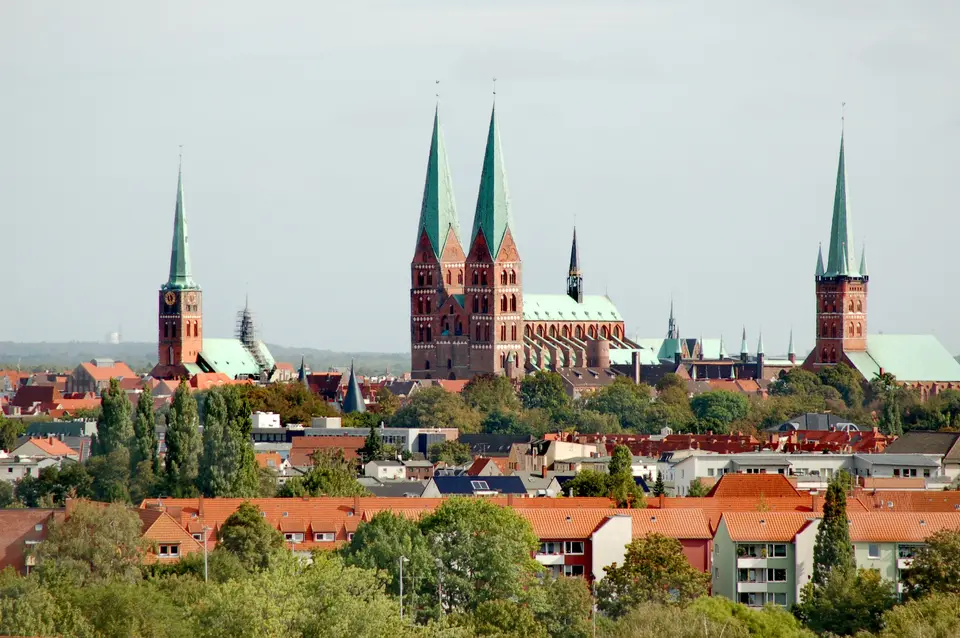
From its 1241 alliance with Hamburg and the 1260 Diet with Cologne (shortly before the Middle Low German term Hanse appeared in a 1267 document), Lübeck exported both its legal code and its architectural language across nearly 200 settlements in eight modern countries, from Estonia and Russia to the Netherlands. While Danzig adopted Magdeburg or Culm law from 1295, most eastern Baltic colonial ports, including Wismar, Rostock, Stralsund, Riga, Reval (Tallinn), Dorpat (Tartu), Thorn (Toruń), and Elbing (Elbląg), many aligned with the Teutonic Order whose Grand Master served as the league's sole territorial prince, adopted Lübeck Law, making Lübeck's city council their supreme court of appeal, even when sailing from Reval to Lübeck took four weeks in summer and four months in winter. Likewise, the soaring red-brick basilicas of Lübeck, led by the Cathedral of Lübeck and the churches of St Mary, St Peter, and St Aegidien, set the template for Brick Gothic ecclesiastical and civic architecture around the entire Baltic rim.
Starting around 1300 and formalised in 1356 and 1358 after the 1347 Bruges Kontor statute divided the league into three regional thirds (Drittel, reorganised in 1554 into four Quartiere led by Wendish, Saxon, Baltic, and Westphalian circles), envoys (Ratssendeboten) gathered in Lübeck for the irregular Hanseatic Diet (Tagfahrt or Hansetag), passing binding Recesses (Rezess) through the Low Saxon consensus tradition of Einung and regulating maritime safety through lighthouses (beginning with Lübeck's 1202 lighthouse at Falsterbo and reaching 15 beacons by 1600) and ordinances culminating in the 1614 Ship Ordinance and Sea Law. Backed by fleets of clinker-built cogs (carrying 125 tons, like the Bremen cog), 15th-century 500-ton hulks, and multi-masted carvels (such as the 40-metre Peter von Danzig of 1464, the Jesus of Lübeck, and Lübeck's massive 78-metre four-masted warship Adler von Lübeck launched in 1566 during the Northern Seven Years' War of 1563 to 70 and broken up in 1588), the league imposed blockades on Novgorod (1268, 1277/1278, and 1443 to 1448 after 36 German traders died following 1424 arrests) and boycotts on Norway (1284) and Flanders (moving the Bruges staple to Aardenburg in 1280 to 1282, 1307 to 1310, and 1350, then to Antwerp in 1436 after moves to Dordt in 1358 and 1388 and 1520). At its zenith during the 1361 to 1370 Danish-Hanseatic War, the 1368 Confederation of Cologne sacked Copenhagen and Helsingborg and forced King Valdemar IV of Denmark and King Haakon VI of Norway to sign the 1370 Treaty of Stralsund, granting the league Øresund fortresses for 15 years until 1385, followed by the 1389 to 1398 struggle between Queen Margaret I, ruler of Denmark and King Albert of Mecklenburg (whose Victual Brothers privateers seized Bornholm and Visby in 1392 while 7 Hanseatic cities governed Stockholm from 1395 to 1398).
Walking the Three Protected Zones from the Burgkloster to the Holstentor
Although an Allied air raid during the Second World War destroyed almost 20 percent of historic Lübeck, heavily damaging the Cathedral, St Peter's, St Mary's, and the gabled merchant houses of the Gründungsviertel, post-war urban planners selectively reconstructed the monumental churches while leaving the medieval street plan and three intact residential and civic zones to form the 1987 World Heritage property. The primary zone stretches north-to-south from the 1227 Dominican Burgkloster (now integrated into the European Hansemuseum, one of two major Hansa museums alongside Bergen's Schøtstuene) down to the artisan quarter of St Aegidien; the second covers the patrician mansions of the southwestern island; and the third encompasses the western approach anchored by the famous twin-towered Holstentor brick gate and the adjacent riverside salt storehouses.
- Begin at the Holstentor and the riverside salt storehouses: Start at the western water approach where the 15th-century brick towers of the Holstentor and the gabled salt warehouses beside the Trave illustrate how Lüneburg salt and Baltic herring financed Lübeck's rise; check the official site for museum entry details.
- Step through the narrow Gänge into the rear Buden courtyards: As you walk the eastern and southern streets toward St Aegidien, duck through the low brick archway passages between street-front facades to discover the quiet medieval Gänge alleys and miniature Buden cottages preserved behind patrician houses.
- Trace Hanseatic history from the Burgkloster to St Mary's: Spend time at the northern tip of the island inside the 1227 Burgkloster and European Hansemuseum, easily reached on a regional rail itinerary from Hamburg or Copenhagen, before walking south along the island crest past St Mary's, St Peter's, and Lübeck Cathedral.
Rival Powers, the 1669 Last Diet, and Modern Hanseatic Identity
Over the 15th and 16th centuries, Lübeck worked to hold the confederation together through internal craft revolts between 1403, 1405, 1408, and 1418, the 1426 to 1435 war with Eric of Pomerania (including the 1428 bombardment of Copenhagen and the 1435 Treaty of Vordingborg), the 1438 to 1441 conflict that opened the Baltic to Amsterdam grain ships after Holland and Zeeland shifted to Duke Albert I, ruler of Bavaria, in 1395 and Burgundy between 1417 and 1432, and the 1494 closure of the Novgorod Peterhof by Tsar Ivan III. Waterways still frame the island. Even after syndic Heinrich Sudermann was appointed in 1556, Queen Elizabeth I, who expelled the league from the London Steelyard in 1597 and 1598 (briefly returned under James I, in 1606, before burning in the 1666 Great Fire of London and being sold in 1852, while Bergen's Bryggen lasted until 1754), the Thirty Years' War, and the last Hanseatic Day in 1669 brought the medieval league to a quiet close.
Yet Lübeck, Hamburg, and Bremen preserved their shared Hanseatic diplomacy into the 19th century, sending Vincent Rumpff to the United States in 1827 and maintaining joint diplomatic ties up to the 1867 North German Confederation and the 1871 proclamation under Kaiser Wilhelm I, of the German Empire, before the Greater Hamburg Act of 1937 ended Lübeck's imperial immediacy. Revived in 1979 and 1980 at Zwolle as the Union of Cities THE HANSA, headquartered in Lübeck with 187 member cities by 2012, the city's maritime heritage remains alive across its brick-gabled lanes, salt storehouses, and quiet Gänge courtyards.
