





















Quick Field Data
- UNESCO Inscription: 1992, among the first sites in the country · Criterion (iv)
- Scale & Footprint: The historic town on both banks of the Vltava and the castle complex of about 7 hectares, with around 40 buildings and palaces set around five courtyards
- Access & Ticketing: The streets, bridges, castle courtyards and the castle garden are open to walk through; the castle interiors, the tower and the Baroque theatre are seen on ticketed tours
- Arrival Logistics: About 20 kilometres south-west of České Budějovice and 134 kilometres south of Prague, with trains via České Budějovice and direct buses to Prague, Linz, Salzburg and Munich
A Town Shaped by a River Meander
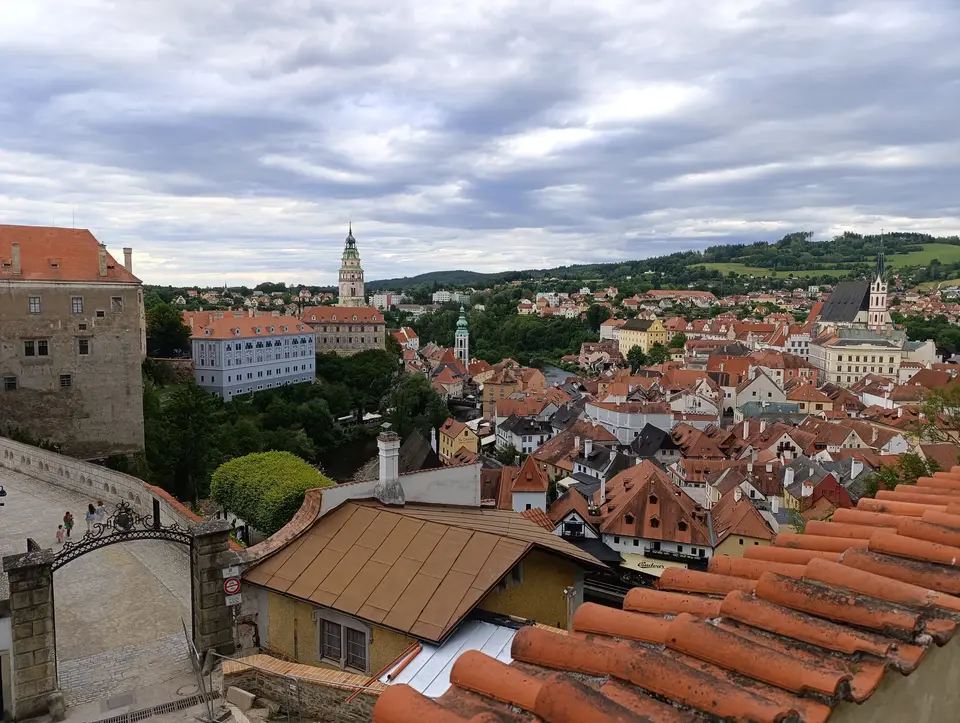
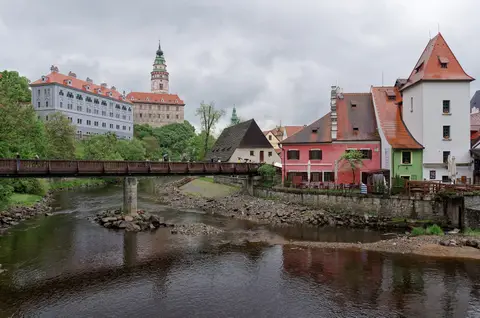
Český Krumlov lies in a horseshoe bend of the Vltava river in South Bohemia. The river loops around the old town on three sides. The castle stands on a rocky ridge above the river and looks down on the roofs. UNESCO notes that the meander and the rocky slopes decided both the town plan and the castle's dominant position.
The town was first mentioned in writing in 1253. The noble Vítkovci family founded the castle shortly before 1250. Two settlements grew below it, the Old Town and Latrán. In 1555 William of Rosenberg joined them into one town.
The street plan is typical of a planned medieval town. Many houses keep their original roof shapes and vaulted rooms. UNESCO also points to Renaissance and Baroque decoration on the facades and to original interiors behind them.
The castle is the second largest castle complex in the Czech Republic after Prague Castle. It covers about 7 hectares. Around 40 buildings and palaces stand around its five courtyards, with a large castle park beyond them.
Rosenbergs, Eggenbergs and Schwarzenbergs
In 1302 the Vítkovci line died out, and the estate passed to the Rosenberg family. In the early fourteenth century Peter I of Rosenberg built the upper castle. Late in the sixteenth century William of Rosenberg rebuilt the castle in the Renaissance style. The paintings on the round castle tower date from 1580.
In 1602 Peter Vok of Rosenberg sold the town to Emperor Rudolf II. After 1620 the emperor Ferdinand II gave it to the Eggenberg family. From 1719 to 1947 it belonged to the Schwarzenbergs. Each family left its mark, and the castle mixes Gothic, Renaissance and Baroque work in one complex.
The Baroque additions are the most unusual. UNESCO lists a garden, the Bellaire summer pavilion, a winter riding school and a Baroque theatre completed in 1766. The theatre is one of very few in the world that still have their original scenery, props and stage machinery. The five-storey Cloak Bridge of 1764 crosses a deep moat to link the upper castle with the theatre and garden. Elsewhere in the castle, a moat holds bears instead of water.
The town has fine churches and houses. The late Gothic church of St Vitus was built between 1407 and 1439 on older foundations. It is the town's most valuable church. In Latrán and the Old Town, rows of burgher houses survive, and UNESCO notes carved wooden Renaissance ceilings in some of them.
The town was largely spared industry in the nineteenth century and heavy rebuilding in the twentieth. UNESCO rates its authenticity as high, and facade repairs use traditional materials and methods. In August 2002 the town was damaged by the floods that hit much of Central Europe.
The town's population has changed over time. In the 1910 census, about 85 per cent of its 8,662 residents were German speakers. Today the historic centre is protected under the Czech heritage act of 1987 as an urban conservation area. The castle with its garden and a parish church in the centre have the highest level of national protection. The painter Egon Schiele lived here for a time, and the Egon Schiele Art Centrum now shows his work.
Exploring the Town and the Castle Today
Český Krumlov has about 13,000 residents, and the historic centre is small enough to explore on foot. In summer the main lanes fill with day visitors. Staying overnight lets you see the town in the quiet of early morning and evening.
- Cross the River and Climb to the Castle: Start on the main square in the Old Town, then cross the bridge to Latrán. Climb up into the castle and walk past the bear moat, through the courtyards and over the Cloak Bridge to the castle garden. In the garden, look for the revolving auditorium, which has been used for open-air performances since 1959.
- Choose a Castle Tour and the Tower: The castle interiors and the Baroque theatre are seen on guided tours. Check the castle's website for the tour season and book the theatre early. The castle tower gives a view over the whole meander of the Vltava. In the town, visit St Vitus and the Egon Schiele Art Centrum.
- Time Your Visit and Travel On: Come outside the peak summer weeks, or arrive early before the tour buses. The Five-Petalled Rose Festival fills the town on the summer solstice weekend with costumes and jousting. Look up other historic towns in our UNESCO World Heritage Atlas, and continue by bus or train to Prague, our closest city guide.
