


























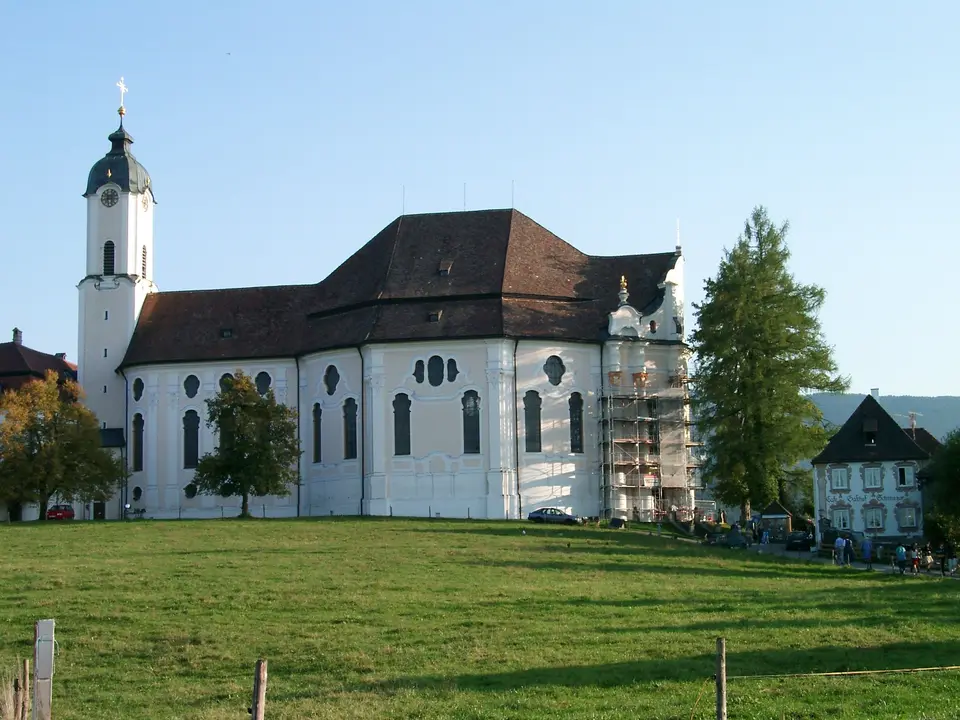
Quick Field Data
- UNESCO Inscription: 1983 (Cultural Criteria i, iii)
- Scale & Footprint: 0.1-hectare oval sanctuary surrounded by an 8.4-hectare pastoral Alpine valley buffer zone in Upper Bavaria
- Access & Ticketing: Active Roman Catholic pilgrimage church within the Diocese of Augsburg; check the official site for liturgical schedules, concerts, and group visiting rules
- Arrival Logistics: Situated in the village of Wies in the municipality of Steingaden (Weilheim-Schongau district), southwest of Munich in the foothills of the Ammergau Alps
A Masterpiece of Bavarian Rococo in the Ammergau Alpine Meadows
Preserved in the pastoral setting of an Alpine valley in the foreland of the Ammergau Alps, the mountain range separating southern Bavaria and the Austrian region of Tyrol, the Pilgrimage Church of Wies (known in German as the Wieskirche, or "Meadow Church", translating its longer title as the "Pilgrimage Church of the Scourged Saviour on the Meadow") stands among the finest architectural achievements of Bavarian Rococo design. Registered in the UNESCO World Heritage Atlas in 1983 under cultural criteria i and iii across a 0.1-hectare core and an 8.4-hectare meadow buffer zone, the Roman Catholic sanctuary lies in the tiny village of Wies, southeast of the municipality of Steingaden inside the Upper Bavarian district of Weilheim-Schongau, southwest of Munich. Administered within the Weilheim-Schongau deanery of the Diocese of Augsburg and dedicated to Saint Joseph, the church was designed in the late 1740s and completed between 1745 and 1754 through the artistic collaboration of the brothers Dominikus alongside Johann Baptist Zimmermann. Inside its oval walls, exuberant, colourful, together with joyful Rococo art achieves complete harmony with the surrounding pastoral countryside. Sunlight fills the oval nave.
The spiritual history of the sanctuary began in the hamlet of Wies in the year 1738. According to the account of the miracle that made the meadow famous across central Europe, tears were seen on a simple, dilapidated wooden figure of the Scourged Saviour, a carved wooden figure depicting Christ bound to a flagellation column that the Premonstratensian canons of nearby Steingaden Abbey had set aside from public veneration. The legend of this 1738 miracle immediately sparked a massive pilgrimage rush as rural and urban devotees travelled to the Alpine foothills to pray before the wooden sculpture. In 1740, a small wooden chapel was constructed in the fields of Wies to house the miraculous statue for some time. Soon, however, crowds of devotees travelling from Bavaria, Austria, Bohemia, plus Italy grew so large that church authorities recognised the small field chapel could no longer accommodate the worshippers it attracted. Consequently, the Abbot of the Premonstratensians of Steingaden Abbey decided to commission a separate, splendid sanctuary in the meadow despite the immense financial commitment required for such an ambitious undertaking.
Architectural Collaboration of the Zimmermann Brothers (1745 to 1754)
Construction of the new sanctuary commenced during 1745 under architect Dominikus Zimmermann, collaborating closely with his brother Johann Baptist Zimmermann, who painted the interior stucco decorations and expansive ceiling frescoes. Construction progressed across nine years in the green foothills of the Alps: the eastern choir was consecrated first in 1749 so that liturgical services could proceed around the miraculous statue, and the remainder of the oval church was finished by 1754. So deeply attached was Dominikus Zimmermann to the sanctuary he had created that upon its completion in 1754 he left the city of Landsberg to settle permanently in the hamlet of Wies near his architectural masterpiece, residing in a newly built house beside the sanctuary across his final eleven years until passing away there in 1766.
To accommodate large processions of visiting pilgrims while flooding the interior space with natural Alpine light, Dominikus Zimmermann devised an oval ground plan preceded on the west by a semi-circular entrance narthex and extended on the east by a deep liturgical choir:
- The Western Semi-Circular Narthex: Preceding the oval body of the church to the west, the semi-circular narthex provides a transitional threshold and gathering vestibule between the open meadow of Wies and the bright interior volume of the sanctuary.
- The Oval Plan and Twin Columns: Inside the main oval nave, pairs of twin columns are placed directly in front of the perimeter walls to support an elaborate, capriciously cut-out cornice and flattened wooden vaulting, thereby defining a second, lighter interior volume within the outer structural shell.
- Cleverly Diffused Direct and Indirect Light: Through the spatial gap between the outer masonry walls and the inner ring of twin columns, daylight entering from the exterior windows and upper oculi is diffused both directly and indirectly across the cornice and vaulting, making the architectural frame appear weightless and luminous at every hour of the day.
- The Long Deep Eastern Choir: Extending eastward beyond the oval congregation nave, an elongated, deep liturgical choir is framed by both lower and upper galleries, creating a richly layered perspective that draws every pilgrim's gaze toward the high altar where the wooden figure of the Scourged Saviour is venerated.
Wessobrunner Stuccowork and Trompe-l'Œil Ceiling Painting
Inside the Wieskirche, every artistic medium and craft technique, including architecture, sculpture, painting, stucco work, wood carving, plus wrought ironwork, was integrated into a single cohesive vision that contrasts deliberately with the calm simplicity of the exterior meadow setting. Across every bay of the interior, the Zimmermann brothers crafted the decorative programme to render the supernatural visually immediate, with three-dimensional sculpture and painted murals combining to unleash the divine in visible form before the eyes of the faithful. Executed in the celebrated tradition of the Wessobrunner School, the elaborate stucco decorations wrapping the twin columns, cut-out cornice, and upper and lower choir galleries were painted in luminous pastel colours by Johann Baptist Zimmermann to blend with the carved wooden statues, gilded altar frames, and ornamental ironwork.
Above the capriciously cut-out cornice, the flattened wooden ceilings of the nave and choir feature illusionistic trompe-l'œil frescoes that appear to open the roof of the church directly up to an iridescent sky. Across the centuries since 1745, numerous worshippers kneeling in prayer before the altar figure of Jesus have reported miraculous recoveries from illness, a living devotional tradition that has made the church an enduring European pilgrimage centre as well as an exceptional testimony to 18th-century Bavarian Rococo civilisation.
Nineteenth-Century Survival, 1985 to 1991 Restoration, and Visitor Access
Local folklore long maintained that Bavarian state authorities intended to auction or pull down the Rococo church during Bavaria's early 19th-century secularisation, and that protests by farming communities in the surrounding valley alone rescued the sanctuary from demolition. Surviving archival records demonstrate, however, that the state commission in charge explicitly supported keeping Wies open as a pilgrimage sanctuary despite financial objections raised by the Abbot of Steingaden. Following its inclusion in the UNESCO catalogue in 1983, the church underwent an extensive six-year restoration campaign between 1985 and 1991 to conserve its painted stucco, ceiling murals, and timber structure.
- Entry and Route: The Wieskirche is located in the village of Wies, southeast of Steingaden in the Weilheim-Schongau district of Upper Bavaria. Drivers approaching from Munich or the Alps use the nearest motorway exit at Murnau am Staffelsee / Kochel am See on Federal Motorway 95. Rail travellers can take the Ammergau Railway, which links Murnau am Staffelsee and Oberammergau, to the closest railway stations at Bad Kohlgrub-Kurhaus and Saulgrub, while during summer weekends a direct bus service (the DAV BergBus, line 996) runs between Munich-Pasing railway station and the Wieskirche.
- Tickets and Viewpoints: As an active Roman Catholic pilgrimage church in the Diocese of Augsburg, the sanctuary welcomes visitors outside of scheduled religious services; check the official site before travelling to confirm liturgical and concert times, as sightseeing inside the oval nave and choir is paused during services and organ recitals.
- Timing and Onward Connections: Arrive on a clear morning or afternoon when natural sunlight streams through the windows and oculi to illuminate the twin columns, Wessobrunner stucco, and trompe-l'œil sky, and take time afterward to walk the quiet Alpine meadow trails of Steingaden overlooking the Ammergau Alps, where the contrast between the simple rural exterior of the Wieskirche and its richly gilded and painted Rococo interior can be appreciated in full peace.
