


























Quick Field Data
- UNESCO Inscription: 1986 (Criteria i, ii, iii, iv; 2,000-year repository of Roman, Visigothic, Islamic, Jewish, and Christian civilisations set on a rocky promontory above the Tagus River).
- Scale & Footprint: Encompasses a 259.85-hectare (about 260-hectare) historic core surrounded by a 7,669.28-hectare buffer zone at 529 metres elevation within the 232.1-square-kilometre municipality of Toledo, Castilla-La Mancha, Spain.
- Access & Ticketing: The walled medieval streets, Tagus bridges, and Zocodover plaza are open public spaces, while individual tickets or combined monument passes apply for the Cathedral, Alcázar, synagogues, and mosques, so check the official site before visiting.
- Arrival Logistics: Located 70 kilometres south of Madrid (88 kilometres from Madrid Barajas Airport), linked directly to Madrid in under 30 minutes via the high-speed rail line (opened 15 November 2005) arriving at the 1919 Neo-Mudéjar Toledo Railway Station, as well as the A-42 and AP-41 motorways.
From Roman Toletum and the Visigothic Capital to the School of Translators
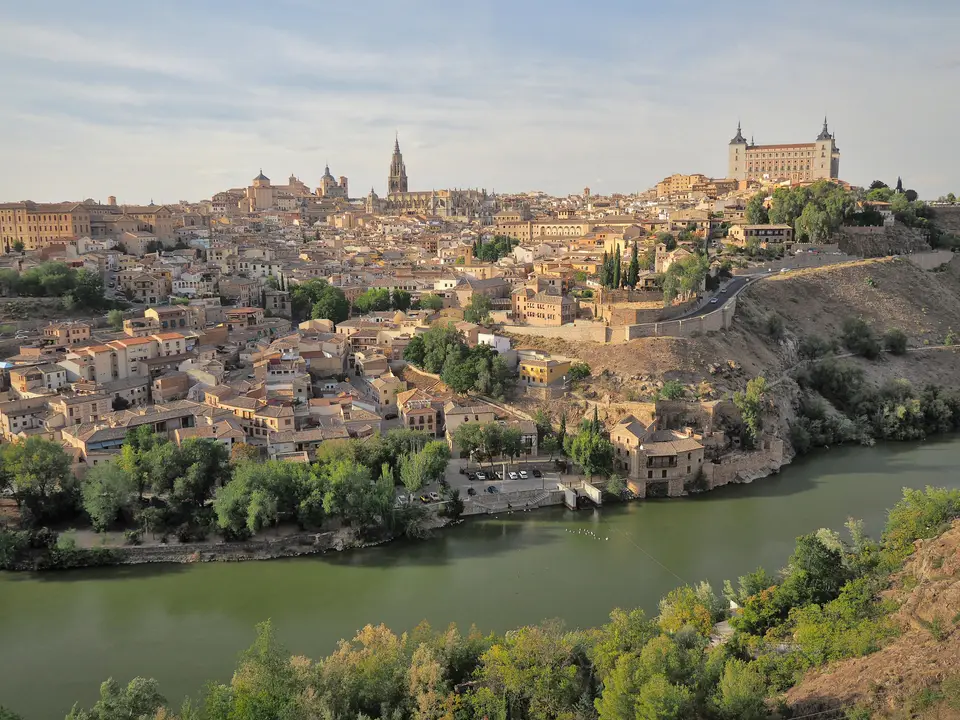
Perched at 529 metres elevation atop a steep granite promontory skirted on three sides by a 150-degree bend in the Tagus River, 70 kilometres south of Madrid, the Historic City of Toledo (called Toletum in Latin, Tulaytulah in Arabic, Tolétho in Andalusi Romance, and Toldoth in Judaeo-Spanish) preserves more than 2,000 years of layered Iberian history. Three cultures shaped the medieval city. Originally a fortified settlement of the Carpetani tribe (described by Roman historian Livy as urbs parva, sed loco munita, where Roman general Marcus Fulvius Nobilior defeated a Celtic confederation and captured King Hilermus in 193 BC), Toletum became a Roman civitas stipendiaria and municipium famed since 500 BCE for its high-alloy steel weaponry (used by Hannibal in the Punic Wars and later by Roman legions) and equipped with city walls, public baths, an aqueduct, and a vast Roman circus holding up to 15,000 spectators.
During late antiquity, Toledo hosted early church synods in 400 and 527 (combating Priscillianism) before King Theudis installed the capital of the Visigothic Kingdom here in 546. Across some thirty Councils of Toledo (including the 589 synod where King Reccared converted from Arianism to Catholicism, the 633 synod that standardized the liturgy and enacted harsh anti-Jewish decrees, and the 681 council that confirmed the Archbishop of Toledo's primacy over all Spain, a golden age of Visigothic art reflected in the nearby Treasure of Guarrazar excavated in 1858 at Guadamur), the city stood as Spain's unmatched royal and ecclesiastical seat until Tariq bin Ziyad and Governor Musa captured it in 711 or 712 for the Umayyad Caliphate. Often rebellious against Cordoban rule (inspiring verses by poet Girbib ibn Abdallah in 797, fighting alongside King Ordoño I, ruler of Asturias, at the Battle of Guadacelete after the 852 revolt, and enduring sieges by Emir Muhammad I, in 873, and Caliph Abd-ar-Rahman III in 932), Tulaytulah became the capital of the independent Taifa of Toledo under the Dhu l-Nunids in the early 11th century, counting roughly 28,000 inhabitants (including 4,000 Jews and a Mozarab Christian community with its own bishop).
When King Alfonso VI of León captured Toledo on 25 May 1085, the city entered its celebrated era as the City of the Three Cultures, where Christians alongside Jews and Muslims coexisted under distinct fueros (though later marred by riots and persecutions in 1212, 1368, 1391, 1449, and 1486 to 1490 before the expulsions of the Jews in 1492 and the Mudéjars in 1502). Under Archbishop Raymond of Toledo in the 12th century and King Alfonso X the Wise (El Sabio) in the 13th century, the Toledo School of Translators rendered Arabic and Hebrew scientific and philosophical texts into Castilian and Latin, transmitting classical knowledge across Europe. Later, Emperor Charles V established his imperial court in Toledo at least 15 times from 1525 (expanding the population from 31,930 in 1528 to 56,270 in 1561), before his son Philip II moved the royal capital to Madrid in 1561, freezing Toledo's monumental skyline in time.
Umayyad Oratories, Mudéjar Synagogues, and the Gothic Cathedral
Spanning 259.85 hectares within its medieval walls, Toledo's urban fabric juxtaposes Islamic mosques, Jewish synagogues, Gothic cathedrals, and Renaissance hospitals along steep, winding lanes. Bridging the Tagus gorge stand the Roman and medieval Alcántara Bridge (guarded on the eastern bank by the medieval Castle of San Servando near the Infantry Academy) and the medieval Puente de San Martín on the west, while the northern landward approach is defended by the 10th-century Umayyad Puerta Bab al-Mardum alongside the 10th-century Puerta de Bisagra Antigua (Puerta de Alfonso VI), the 14th-century Hospitaller Puerta del Sol, the 16th-century Puerta del Cambrón, and Alonso de Covarrubias's 16th-century Puerta de Bisagra Nueva. Surviving Islamic monuments include the pillars of the Puente de la Cava, the hammams in Calle del Ángel and Calle Pozo Amargo, the 11th-century Tornerías Mosque, the 13th-century Mudéjar Galiana Palace outside the walls, and the historic Bib Mardum Mosque (now the Church of El Cristo de la Luz), a brick private oratory completed in 999 AD and later extended with a Mudéjar apse.
In the western Jewish Quarter stand two masterpieces of Mudéjar synagogue architecture preserved after 1492 as Christian buildings: Santa María la Blanca, the oldest standing synagogue building in Europe with its forest of white octagonal piers and horseshoe arches, and the 14th-century Synagogue of El Tránsito, which houses the Sephardic Museum beneath a carved cedarwood ceiling and Hebrew stucco friezes. Overlooking the western river bend rises the Franciscan monastery of San Juan de los Reyes, constructed between 1477 and 1504 in a fusion of Isabelline Gothic-Spanish-Flemish architecture and Mudéjar ornament, while nearby in the 14th-century Mudéjar Church of Santo Tomé hangs El Greco's masterpiece painting The Burial of the Count of Orgaz (complemented by the nearby El Greco Museum).
Inside Spain, the heart of city rises the Gothic Primate Cathedral of Saint Mary, erected between 1226 and 1493 on the model of Bourges Cathedral with Mudéjar details. The second largest cathedral in Spain, it houses the Mozarabic Chapel (where the ancient Mozarabic Rite and music are still celebrated daily) and Narciso Tomé's multi-storey Baroque altarpiece El Transparente, carved in marble, stucco, and bronze so that a shaft of natural light illuminates the tabernacle through a vault oculus. Crowning the highest eastern summit above the Zocodover marketplace stands the 16th-century Alcázar fortress (besieged for two months from 21 July to late September 1936 under rebel commander José Moscardó until relieved by General Francisco Franco, and housing the Army Museum since 2009), complemented by the 16th-century Renaissance Hospital de Santa Cruz and the Hospital de Tavera (which influenced the layout of El Escorial), while downstream on the outskirts stands architect Sabatini's 1777 expansion of King Charles III's 1761 Royal Arms Factory (now housing a campus of the Castilla-La Mancha Technological University).
Field Route from the Bisagra Gates through the Cathedral to the Jewish Quarter
Declared a Historic-Artistic Site in 1940 and inscribed by UNESCO in 1986 (with 86,526 municipal residents as of January 2024, many living in the modern Santa María de Benquerencia or Polígono district), Toledo is best traversed from its northern gates across the central ridge to the western Tagus cliffs.
- Ascending from the Northern Gates to Cristo de la Luz and the Alcázar: Enter through Alonso de Covarrubias's 16th-century Puerta de Bisagra Nueva alongside the 10th-century Puerta de Bisagra Antigua and the 14th-century Puerta del Sol; pause at the 10th-century Puerta Bab al-Mardum to inspect the 999 AD brickwork of the Mosque of Cristo de la Luz, then climb through the central Zocodover plaza to the 16th-century Hospital de Santa Cruz and the hilltop Alcázar fortress overlooking the Tagus River and Alcántara Bridge.
- Exploring the Primate Cathedral and Visigothic San Román: Walk to the Gothic Cathedral (1226 to 1493) to examine the Mozarabic Chapel and watch the daily shaft of light strike Narciso Tomé's Baroque El Transparente altarpiece, then continue west to the Mudéjar Church of San Román (housing the Museum of the Councils and Visigothic Culture) and the Conceptionist Monastery holding the tomb of Saint Beatrice of Silva.
- Traversing Santo Tomé and the Jewish Quarter to San Martín Bridge: View El Greco's The Burial of the Count of Orgaz inside the 14th-century Church of Santo Tomé and visit the El Greco Museum, then explore the Synagogue of El Tránsito (Sephardic Museum), the white horseshoe arcades of Santa María la Blanca, and the 1477 to 1504 cloisters of San Juan de los Reyes before descending to the medieval Puente de San Martín.
Living Traditions, Steel Craftsmanship, and Tagus Conservation
Beyond its stone monuments, Toledo sustains centuries-old intangible traditions, from its Protected Geographical Indication marzipan (mazapán de Toledo) and artisanal swordsmith workshops to the Corpus Christi procession (declared of International Tourist Interest in 1980, when a two-kilometre route is shaded by historic woven awnings) and sections 1 and 8 of the Route of Don Quixote (connected with the Camino de Santiago along its Camino de Levante route). Arriving in under 30 minutes by high-speed rail from Madrid (which replaced the 1858 rail line promoted by the Marquis of Salamanca), travellers can explore Toledo alongside other Spanish imperial cities in our UNESCO World Heritage Atlas.
