Quick Field Data
- UNESCO Inscription: 2014 (Ref. 1361), cultural historic port quarter on the eastern Red Sea coast of Saudi Arabia; Criteria (ii) and (iv).
- Scale & Footprint: 17.92 hectares covering roughly one-third of Jeddah's former walled city, uniting traditional merchant quarters, souks, mosques and coral-stone tower homes.
- Access & Ticketing: Living heritage district protected under Saudi Royal Decree M/3 (2014) and Jeddah's 2011 Urban Regulation; public streets and markets welcome pedestrians freely, while restored museum houses follow local Ministry of Culture visiting schedules.
- Arrival Logistics: Direct commercial air travel lands at King Abdulaziz International Airport (JED), 22 kilometres north of the old quarter, while Red Sea trade historically linked opposite coasts toward Asmara (686 kilometres southwest).
Red Sea Maritime Port and Official Gate to Makkah
Positioned on the eastern shore of the Red Sea in western Saudi Arabia, Al-Balad (literally the town) formed in the seventh century AD. The Third Caliph Othman ibn Affan made Jeddah the official maritime harbour serving Makkah, launching centuries of cosmopolitan port life. From that early mandate onward, the coastal enclave served twin responsibilities: landing Indian Ocean spices, timber and textiles bound for Arabian markets while welcoming Muslim pilgrims arriving by sea for the annual Hajj. Today, understanding Al-Balad Jeddah location inside Saudi Arabia's second-largest city reveals a protected core covering roughly one-third of the former walled town.
Linking ocean shipping lanes with overland pilgrimage roads made this coastal quarter unusually diverse within the Hijaz. Sea vessels sailing up from East Africa, Malabar and Southeast Asia moored outside Jeddah's coral reefs before offloading passengers and timber cargo onto smaller coastal boats. Goods and pilgrims passed directly from dockside warehouses through busy bazaar streets toward inland camel trails climbing toward Makkah.
Maritime trade and pilgrimage shaped every facet of Al-Balad Jeddah history. Islamic scholars (Ulama) from Java and India debated religious law inside the district while traders from Yemen, Sudan, Somalia, Pakistan and the Middle East ran counting houses and stocked caravan goods. Pilgrims lodged in purpose-built hostels (ribats) and merchant caravanserais (wakalas), mingling foods, crafts and languages across dense alleys. When steamships arrived and the Suez Canal opened in 1869, expanding sea commerce between Europe, East Africa and East Asia, wealthy shipping families financed soaring coral tower residences across the old quarters.
Demolition of the city's perimeter defensive walls in the 1940s and oil-driven wealth during the 1970s and 1980s reshaped the district's social mix. Many Jeddawis moved north to modern suburban boulevards offering wider roads, parking spaces for large cars and upscale designer shops. Low-income migrant workers from Yemen, Sudan, Somalia, Pakistan and India filled vacant ground rooms, preserving traditional street-level retail even as salt air and deferred repairs threatened coral walls. Municipal preservation started in the 1970s, forming the Jeddah Historical Preservation Society in 1991, launching the Jeddah Urban Development Company around 2007, nominating the district in 2009 and enacting Royal Decree M/3 protection on 2 November 2014.
Coral Masonry, Wooden Roshan Towers and Four Historic Quarters
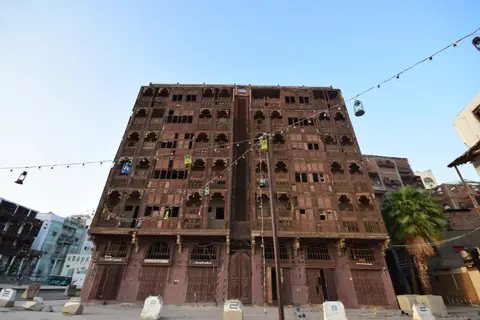
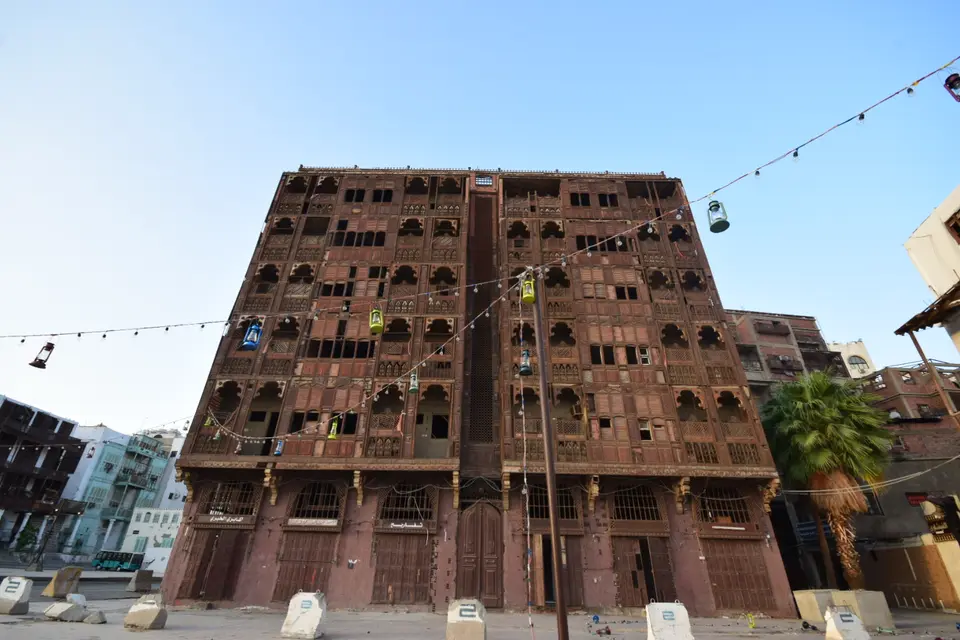
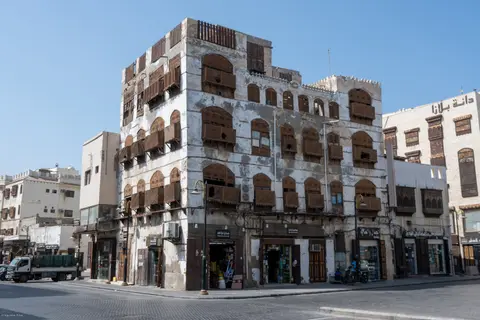
Entering Al-Balad Jeddah old town reveals a stark architectural contrast against modern glass towers surrounding the historic enclave. Unlike inland Arab courtyard houses designed around sealed central patios, extreme Red Sea heat and humidity led Hijazi builders to turn homes outward to catch sea breezes. Masons stacked blocks of local sea-coral stone bound with lime mortar and horizontal wooden tie-beams, raising multi-storey merchant towers over 30 metres high, some anchored on 500-year-old structural foundations. Porous sea-coral rock remained lighter than solid granite, allowing builders to stack broad reception halls vertically without overloading coastal sand and limestone foundations.
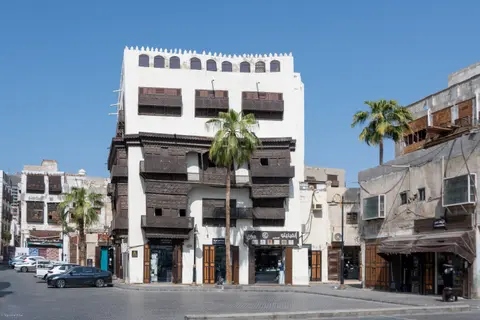
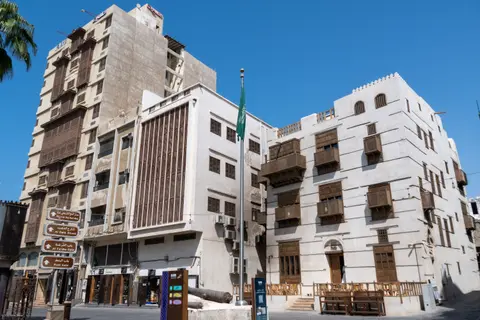
Projecting across upper storeys hang Jeddah's signature carved timber roshan (mashrabiya) casements. Joined from imported tropical hardwoods brought across Indian Ocean trade routes, slatted bay screens shade interior salons from harsh solar glare, draw upward cooling drafts through shaded street canyons and preserve household privacy above crowded bazaar corners below. Adjusting wooden shutters let households modulate airflow and daylight hour by hour as warm sea winds shifted direction across the roof skyline. Ground floors held merchant counting offices and warehouses, while upper floors provided formal apartments and chambers rented out during the busy Hajj season. Similar tower-house architecture that spread from Jeddah to Al-Madinah, Makkah and Taif disappeared completely under modern expansion, leaving Historic Jeddah as its last surviving ensemble.
Traditional urban order divides the historic quarter into four distinct districts arranged along primary bazaar corridors. North of Al-Alawi Street spreads Al-Mazloum quarter (named after Abdulkarim al-Barzanji, executed under Ottoman rule), holding Dar Al-Qabil, Souq Al-Jamaa (known as Souq Qabil) and Al-Shafi'i Mosque. To the north sits Al-Sham quarter containing Dar al-Sarti, Dar al-Zahid and Dar Al-Banaja. South of Al-Alawi Street lies Al-Yemen quarter (oriented toward Yemen), housing monumental towers including Dar Al-Nassif (Al Nassif House), Dar Al-Jumjum, Dar Al-Shaarawi and Dar Al-Abdul-Samad, while southwestern Al-Bahr quarter faces the old seafront around Dar Al-Radwan. Strolling cleanly between these four quarters reveals both unrestored coral shells awaiting timber stabilisation and crisply whitewashed merchant residences framing public squares. Tall wooden double doors along quiet residential lanes lead from ground-level counting offices and storage vaults toward ventilated upper-storey reception chambers where families received sea merchants and seasonal Hajj lodgers. Comparing narrow shadowed alleys near Dar Al-Banaja against wider public plazas around Dar Al-Nassif clarifies how residential tower blocks balanced tight desert-coast shade with generous upper airflow above ground-floor souk traffic.
Pilgrimage Souks, Wakalas and Major Restoration Campaigns
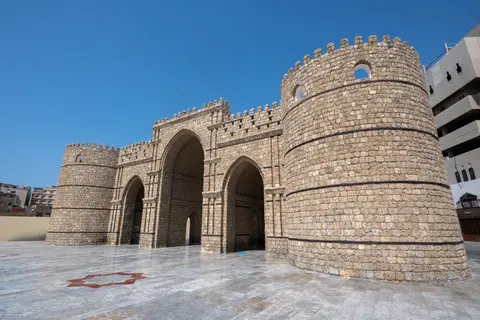
Commercial activity across Jeddah's historic core still follows the east-west axis running straight from Red Sea landing docks through covered souks toward Makkah Gate. Inside the Al-Balad Jeddah market network anchored by Souq Al-Alawi and Souq Qabil, century-old trading enterprises still share shaded alleys with retail stalls, small cafés, traditional bakeries and street food vendors busy until late night and packed throughout Ramadan. Neighbourhood mosques including Al-Shafi'i Mosque and Al Qabal Mosque retain unbroken daily community worship inside conserved coral halls.
Along King Fahd Branch Road sits the walled Non-Muslim Cemetery, hidden behind high walls and tall trees under Western consular supervision. Active since the sixteenth century for Portuguese casualties of Ottoman-Portuguese Red Sea battles and walled around the 1810s under Muhammad Ali of Egypt, the cemetery holds over 400 graves despite vandalism during the 1925 Battle of Jeddah. Burials include French explorer Charles Huber, murdered British Vice-consul Cyril Ousman and a Commonwealth War Graves Commission headstone for a Second World War British soldier, with rare recent burials of Indian and Filipino children.
Daily oversight combines local Municipality of Jeddah and cultural heritage offices inside the old town with the Ministry of Interior's traditional Umdah community mechanism. Working with Police and Civil Defence, the Umdah coordinates merchants and property owners' associations to tackle building decay, informal squatting and speculative pressure. Preserving these outward-facing coral homes remains urgent, as abandoned upper rooms often suffer humidity damage or unauthorised subdivision. Salt-laden Red Sea air and ground moisture can crystallise inside porous coral blocks if outer lime plaster wears thin, slowly weakening concealed timber tie-beams. Municipal conservation rules approved in 2011 and Royal Decree M/3 enacted on 2 November 2014 create strict binding protection for the historic building fabric and surrounding buffer zone, guiding artisans toward breathable lime repairs instead of rigid modern cements.
Major state-led renewal reinforces that legal framework across all 17.92 hectares. A 2019 crown-backed initiative committed structural restoration for 56 historic buildings together with cultural programmes such as Misk Historic Jeddah and Kanz Al-Balad (staging 41 plays and shows). Following Saudi Vision 2030's launch of Al Balad Development Company in October 2023, preservation teams announced in May 2024 the restoration of Jokhdar House, Al-Rayyis House and Kedwan House into boutique heritage hotels managed under Ministry of Culture conservation rules. Careful structural stabilisation aims to repair rotted timber beams inside masonry walls without erasing authentic surface materials. Rebuilding crumbling lime plaster and reinforcing timber tie-beams from within keeps tall coral facades standing safely while preserving genuine historic woodwork overhead.
Access Zones Across Historic Jeddah and Al-Alawi Street
Compact pedestrian alleys allow travellers following Jeddah old-town directions to inspect all four historic quarters, souks and tower houses smoothly on foot in one half-day walk. Dividing a route between eastern bazaar spines and residential lanes around Nassif House keeps orientation intuitive even inside shaded winding alleys. Allow pauses at corner squares where restored whitewash facades sit next to propped conservation sites, illustrating how modern urban stewardship balances daily commerce with fragile coral construction.
| Complex Zone | Key Highlights | Access & Ticket Rule |
|---|---|---|
| Al-Alawi & Souq Qabil Axis | East-west commercial street linking former docks toward historic Makkah Gate. | Pedestrian market corridors stay open across daytime and late evening trading hours. |
| Al-Yemen Quarter & Nassif House | Tall 30-metre coral tower houses including Dar Al-Nassif and Dar Al-Jumjum. | Exterior facades line public lanes; restored museum interiors follow scheduled admission. |
| Al-Mazloum & Al-Shafi'i Mosque | Historic Al-Balad Jeddah mosque courtyard, Dar Al-Qabil and Souq Al-Jamaa stalls. | Active worship hall; visitors inspect courtyard stonework respectfully outside prayer times. |
| Al-Sham & Al-Bahr Quarters | Restored merchant mansions, Dar Al-Banaja and newly adapted heritage house hotels. | Walkable lanes where timber scaffolding protects coral walls during active restoration. |
Three Hijazi Architectural and Urban Details in Al-Balad
- Horizontal Wood Tie-Beams Inside Coral Walls: Inspect weathered masonry corners on unrestored buildings in Al-Yemen or Al-Sham to spot dark horizontal timber bands sandwiched between layers of porous coral rock. Builders inserted wooden tie-beams to bind brittle marine blocks together and absorb settlement across tall multi-storey towers.
- Carved Roshan Louvres and Cooling Air Shafts: Stand directly under projecting wooden bay windows along shaded lanes around Nassif House. Tilted wooden slats catch evening sea breezes off the Red Sea while shielding rooms from solar glare and venting warm air upward through tall stairwell shafts.
- Al-Alawi Bazaar Spine Toward Makkah Gate: Follow the continuous commercial street heading east from the former coastal shore across the old quarter. This unbroken thoroughfare guided disembarked pilgrims straight past spice warehouses and caravanserai wakalas toward the eastern city gate facing Makkah.
Planning Cool-Season Walks From Jeddah Airport Across the Red Sea
Because coastal heat and Red Sea humidity climb sharply during summer, the best time to visit Al-Balad Jeddah runs from November through March. Cooler winter breezes keep walks past illuminated roshan facades and market alleys pleasant, especially toward dusk or during Ramadan nights when residents gather outdoors. Arriving in late afternoon lets coastal sunlight soften across carved hardwood bay screens before traditional shops, spice counters and cafés illuminate narrow lanes after sunset. Wear light breathable fabrics with modest shoulder and knee coverage around active neighbourhood mosques, paired with cushioned closed-toe shoes suited to uneven stone paving and ongoing conservation cordons. Checking doorway signage along active scaffolding routes helps walkers locate open pedestrian shortcuts between quiet residential lanes and covered souks.
Pilgrims and residents still pack narrow commercial lanes around evening prayer, preserving the lively urban rhythm of a working Red Sea harbour. Travellers checking how to get from Jeddah airport to Al-Balad travel 22 kilometres south from King Abdulaziz International Airport (JED) straight into central coastal Jeddah near Al-Alawi Street. From western Arabia, compare Red Sea port architecture across Asmara (686 kilometres southwest) or explore Indian Ocean trade cities in the UNESCO World Heritage Atlas.