


























Quick Field Data
- UNESCO Inscription: 1981 · Criterion (iii).
- Scale & Footprint: Approximately half a million tombs and graves spread across about 10 square kilometres along the edge of the 6.5-kilometre-long plateau of Makli Hill beside Thatta in southern Sindh, Pakistan
- Access & Ticketing: Open-air archaeological necropolis managed as a cultural monument in Thatta District; visitors walk or drive along the 6.5-kilometre limestone ridge to inspect the stone and glazed-brick mausolea alongside the nearby 17th-century Shah Jahan Mosque in Thatta city
- Arrival Logistics: Located near the apex of the Indus River delta in Thatta District (Banbhore Division) of southern Sindh Province, Pakistan, directly adjoining the municipal centre of Thatta
Four Centuries of Dynastic Rule Across Thatta and Makli Hill
Massed along the eastern edge of the 6.5-kilometre-long limestone plateau of Makli Hill near the apex of the Indus River delta in Pakistan's southern province of Sindh, the Historical Monuments at Makli, Thatta preserve one of the largest funerary landscapes in the world. Spread across roughly 10 square kilometres overlooking the medieval river port and provincial capital of Thatta (known in Sindhi and Urdu as Thatta Nagar or simply Nagar, and nicknamed the City of Silence), the necropolis encompasses approximately half a million tombs and graves erected continuously from the 14th to the 18th century. Throughout Pakistan, the UNESCO World Heritage List in 1981 under cultural criterion (iii), this vast cemetery of kings alongside queens, governors, Sufi saints, scholars, and philosophers provides an unmatched material record of lower Sindh civilisation across four dynastic eras. Half a million graves crown the ridge.
Etymologically, the 18th-century local scholar Ḳāni recorded two explanations for the name Thatta: either a distortion of Teh Teh (recalling the southward migration of settlers from northern cities) or a derivative of the Sindhi noun thatt (meaning a place of gathering), while Persian usage linked it to Tah-Tah, meaning layer over layer. Some historians also identify the town with ancient Patala (called Sarnee Nagar by Hindus before Greeks named it Pattala or Patala in 332 BC during the campaign of Alexander the Great) or with the early port of Debal captured by the Umayyad general Muhammad bin Qasim in 711 CE after defeating Raja Dahir north of Thatta. Following the early 11th-century invasion by Mahmud of Ghazna (under whom Abdul Razzaq became governor at Thatta in 1026), the local chieftain Ibn Sumar of Multan seized power and established the Sumra dynasty, ruling from Thatta for 300 years from 1051 until the mid-14th century while extending protection to the city's Ismaili Shia community.
Makli Hill rose to monumental prominence after 1351, when the Samma rulers, of Rajput lineage from Sehwan, took Thatta as their royal seat. In that same year of 1351, the Delhi Sultan Muhammad bin Tughluq died while campaigning to take Thatta, and his successor Firuz Shah Tughlaq failed twice (in 1361 and 1365) to subjugate the Samma rulers. Under the greatest Samma sovereign, Jam Nizamuddin II (ruling between 1461 and 1509 and ordering the construction of Thatta in 1495), lower Sindh experienced a scholarly and architectural flowering before the last Samma ruler, Jam Feroz, fell in 1520 to Shah Beg of the Arghun-Tarkhun line, displaced out of Afghanistan by Timurid expansion in Central Asia.
During mid-1500s Tarkhun disputes, Muhammad Isa Tarkhun sought Portuguese aid in 1555; arriving in 28 ships with 700 soldiers, unpaid Portuguese troops sacked Thatta in 1557, though historian Diogo do Couto still ranked Thatta among the wealthiest ports of the Orient. After Mirza Jani Beg destroyed the town, Emperor Akbar annexed Thatta in 1592 into the Mughal Empire governed from Agra and Delhi. Later, Prince Shah Jahan sought refuge in Thatta from his father Emperor Jahangir (with Shah Jahan's 13th son, Lutfallah, born in the city in 1626), and after a devastating storm nearly levelled Thatta in 1637, Emperor Shah Jahan commissioned the tile-clad Shah Jahan Mosque in 1647 (completed in 1659 under his son Emperor Aurangzeb, who had served as governor of lower Sindh). Although an English factory operated from 1635 to 1662 alongside a Dutch East India Company comptoir between 1652 and 1660, when Augustinian friars noted 2,000 textile looms exporting cloth and silk to Asia and Portugal, the silting and eastward shift of the Indus River in the late 1600s ended Thatta's seaport role, even as Hindu Bhatia merchants sailed their own ships to Masqat in Oman. Ceded to Nadir Shah of Persia after the 1739 Battle of Karnal and ruled successively by the Kalhora dynasty from 1736 (who moved the Lower Sind capital from Siwistan to Thatta before shifting it to Hyderabad in 1789, hosting a British comptoir from 1758 to 1775) and the Talpur dynasty until General Charles James Napier conquered Sindh at the battlefield of Miani in 1843 (annexing Thatta into the Bombay Presidency in 1847), the city shrank from 200,000 inhabitants in the 18th century to 20,000 in the early 19th century and 10,800 by 1920.
Syncretic Stone Carving alongside Gujrat Influence and Persian Terra-Cotta
What elevates the Historical Monuments at Makli to a masterpiece of Islamic funerary architecture is the way four centuries of builders fused Hindu stone-carving traditions of the Gujrat style with Mughal imperial symmetry and distant Persian and Central Asian glazed terra-cotta and tile models. Across the 6.5-kilometre ridge of volcanic and sedimentary rock exposed to salinisation from the Arabian Sea, the royal and saintly monuments progress chronologically from south to north across three distinct stylistic groups: the Samma period (14th to early 16th century), the Arghun and Tarkhan period (16th to early 17th century), and the Mughal period (late 16th to 18th century).
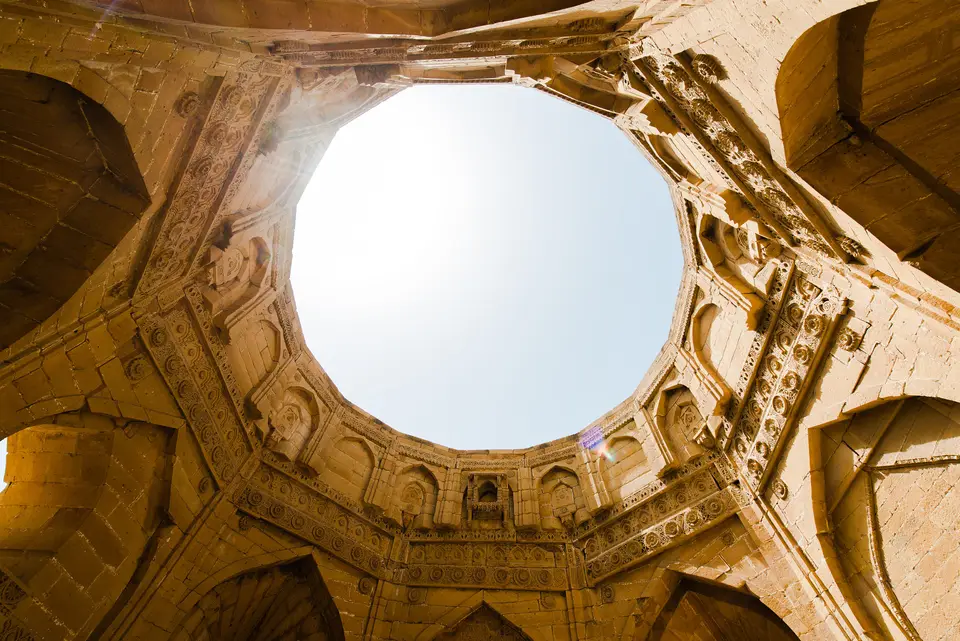
Foremost among the Samma sandstone monuments is the square, unroofed stone tomb of Sultan Jam Nizamuddin II (reigned 1461 to 1509). Built entirely of dressed local yellow sandstone without mortar, the cube-shaped chamber combines Islamic pointed arches and bands of carved Quran calligraphy with unmistakable Hindu temple motifs from neighbouring Gujarat: a projecting stone balcony window supported by finely carved brackets, miniature temple spires, lotus medallions, sunflower rosettes, and geometric friezes chiselled with the delicacy of woodwork. Rather than relying on coloured glaze, Samma master masons invented an original concept of lace-like stone surface relief at Makli that translated the visual rhythm of painted and glazed Persian tilework directly into carved sandstone.
Moving into the Tarkhan and Mughal periods, the necropolis reaches its monumental climax in two contrasting building materials: multi-storey carved sandstone pavilions and polychrome glazed-brick mausolea. Constructed before 1644, the grand stone mausoleum of Isa Khan Tarkhan the Younger (Isa Khan Hussain) stands inside a high-walled courtyard as a two-storey square pavilion surrounded on all four sides by pillared verandahs with honeycombed stone columns and perforated stone lattice screens, accompanied by a separate summer pavilion for the women of the royal household. Nearby rises the carved stone enclosure of his father, Jan Baba (also completed before 1644), whose interior and exterior walls are carpeted from base to cornice with geometric arabesques in relief.
In vivid contrast to the golden sandstone tombs are the brick and terra-cotta mausolea built under Persian and Central Asian Timurid influence. The most colourful monument on the ridge is the tomb of Diwan Shurfa Khan, a Mughal minister who died in 1638. Constructed of red brick set on a massive stone platform, its sturdy cylindrical corner towers and pointed dome are sheathed in turquoise alongside dark blue and white glazed ceramic tiles, standing beside a gravestone carved with floral and calligraphic bands. Along the plateau, these imperial tombs share the sacred ground with the shrines of Sufi saints, scholars such as Hashim Thattvi (1692 to 1761, who first translated the Quran into the Sindhi language), Mir Ahmed Nasrallah Thattvi (died 1588 at Akbar's court), and historian Mir Ali Sher Qaune Thattvi (1728 to 1788), as well as local Hindu heritage sites including the Mata Singh Bhawani Mandir at Makli and temples in Thatta dedicated to Jhulelal.
Walking the 6.5-Kilometre Makli Ridge and the Shah Jahan Mosque
Today, adjoining modern Thatta city (home to 51,723 residents in the 2023 census, where 96.3 percent speak Sindhi alongside 1.20 percent Punjabi and 1.10 percent Urdu speakers), the 10-square-kilometre Makli Necropolis can be explored along a sequential north-to-south route that follows the reverse chronology of Sindh's dynasties, paired with a visit into town to see the 1647 Shah Jahan Mosque.
Plan your field visit around the semi-arid climate of lower Sindh (where average annual temperature is 26.8 degrees and annual rainfall averages 250 millimetres).
- Inspect the Tarkhan and Mughal stone pavilions of Isa Khan and Jan Baba: Enter the southern and central sectors of the Makli plateau to walk through the walled courtyard of the pre-1644 mausoleum of Isa Khan Tarkhan the Younger. Climb the stone steps onto its double-tiered pillared verandah to examine how every sandstone shaft and lintel is carved with geometric and floral traceries, then step across to the open stone enclosure of his father, Jan Baba, to compare its pierced stone screens.
- Compare the 1638 glazed tiles of Diwan Shurfa Khan with Jam Nizamuddin II: Continue north along the 6.5-kilometre ridge to study the turquoise-tiled brick dome and corner towers of the 1638 tomb of Diwan Shurfa Khan. From there, proceed to the northern Samma cluster to stand before the sandstone cube of Jam Nizamuddin II (reigned 1461 to 1509), looking closely at the Gujrat projecting stone balcony and lotus carvings set beside inscriptions from the Quran.
- Pair the Makli ridge with the 1647 Shah Jahan Mosque in Thatta city: After walking the necropolis (where major monument restorations were undertaken in the 1970s under Zulfiqar Ali Bhutto), drive into nearby Thatta to visit the Shah Jahan Mosque, commissioned in 1647 and completed in 1659 under Aurangzeb, which preserves the most elaborate display of blue-and-white tilework in South Asia. Compare Makli with other Sindh and Mughal monuments across our UNESCO World Heritage Atlas.
