


























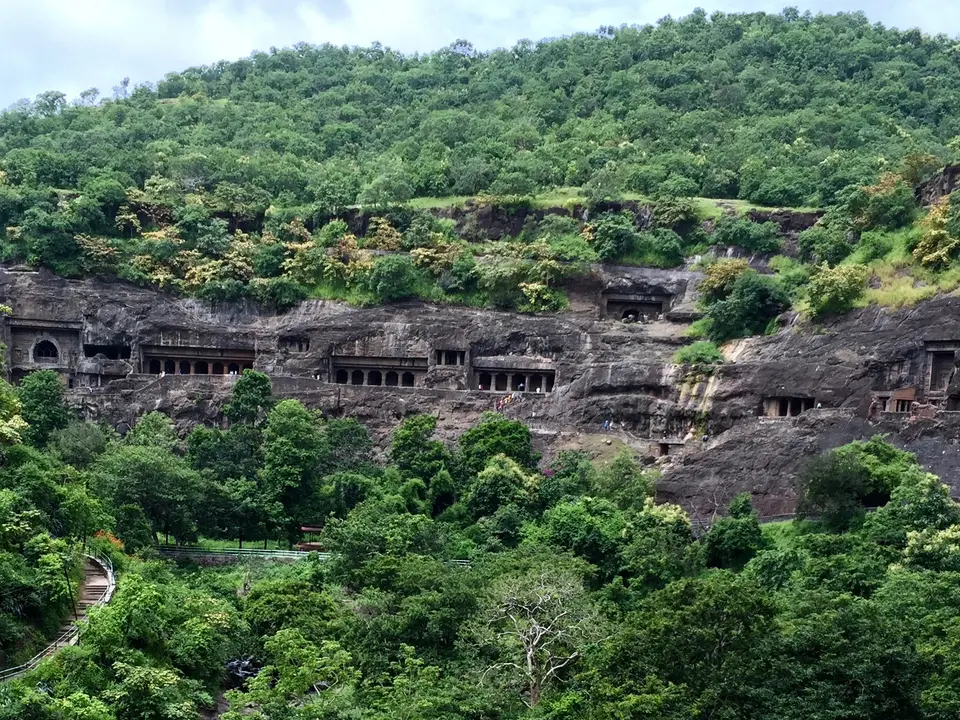
Quick Field Data
- UNESCO Inscription: 1983 (Cultural Criteria i, ii, iii, vi)
- Scale & Footprint: 30 rock-cut caves excavated along a 75-metre-high vertical basalt cliff above the Waghora River inside an 8,242-hectare protected zone (with a 78,676-hectare buffer zone)
- Access & Ticketing: Administered by the Archaeological Survey of India (ASI); check the official site for shuttle bus tickets from the Visitor Centre and cave access rules
- Arrival Logistics: Located in the Aurangabad district of Maharashtra, 59 kilometres from Jalgaon, 104 kilometres from Aurangabad, plus 350 kilometres east-northeast of Mumbai
A Horseshoe Gorge of Basalt Sanctuaries on the Deccan Plateau
Carved directly into the sheer, 75-metre-high (246-foot) vertical cliff of a U-shaped gorge eroded by the River Waghora (or Waghur) in the hills of the Deccan Plateau in Maharashtra, the Ajanta Caves comprise 30 numbered rock-cut Buddhist cave monuments (along with later-identified foundations bringing the total to 36 identifiable excavations, such as Cave 15A) that preserve the largest corpus of surviving ancient wall painting in India. Honoured in the UNESCO World Heritage Atlas in 1983 under cultural criteria i, ii, iii, and vi across an 8,242-hectare protected area, the cliff complex curves above the left bank of the river, where a series of waterfalls inside the gorge can be heard echoing outside the cliff chambers whenever monsoon waters run high. Textual records together with inscriptions indicate that the caves functioned both as a monsoon retreat for Buddhist monks and as a resting and pilgrimage site for merchants and travellers in ancient India. Every hall is cut from living rock.
Unlike built masonry temples constructed from the ground up, every monument at Ajanta was excavated out of horizontally layered flood basalt and granite rock belonging to the Deccan Traps, a volcanic formation created by repeated lava flows at the close of the Cretaceous period. Quarrymen initiated each cave by driving a narrow pilot tunnel along the ceiling level, which artisans then expanded downwards and outwards to the floor, as demonstrated by incomplete excavations including the unfinished vihara halls of Caves 21 to 24 alongside the abandoned Cave 28. Sculpture and painting inside each cave proceeded as integrated parallel tasks alongside the rock-cutting crews, while a grand gateway flanked on both sides by sculpted elephants alongside a protective Naga (serpent) deity was carved at the apex of the horseshoe gorge between Caves 15 and 16 where rock-cut staircases connected the cliff to the river below.
Two Distinct Chronological Eras: Satavahana and Vakataka Patronage
Archaeological, palaeographic, together with art-historical evidence confirms that excavation activity at Ajanta took place in two distinct phases separated by an interval of roughly four centuries, reflecting the doctrinal shift from early Hinayana (Theravada) Buddhism, wherein the Buddha was worshipped in aniconic and symbolic form, to theistic Mahayana Buddhism:
- The First Phase (Satavahana Period, 2nd to 1st Century BCE): Coinciding with the rule of the Satavahana dynasty (230 BCE to 220 CE, or dated by Walter Spink between 100 BCE and 100 CE), six caves were excavated during this inaugural phase: the two apsidal worship halls (chaityagrihas) of Caves 9 and 10, plus the four austere monasteries (viharas) of Caves 8, 12, 13, and 15A (along with Cave 30, a 3.66 by 3.66 metre monastery with stone beds discovered after a 1956 landslide near Cave 16). Cave 10, measuring 30.5 by 12.2 metres with 39 octagonal pillars, preserves the oldest Sanskrit inscription in Brahmi script at the site, dated to circa the 2nd century BCE and recording the gift of a cave-facade by Vasisthiputra Katahadi, proving that early caves were funded as community efforts by multiple donors.
- The Second Phase (Vakataka Period, 5th to 6th Centuries CE): While the Archaeological Survey of India dates the second phase broadly from the middle of the 5th century to the middle of the 6th century CE, scholar Walter M. Spink argued that most of the work occurred within a brief 20-year span between 460 and 480 CE under the patronage of the Hindu Emperor Harishena (reigned 460 to 477 CE) of the Vakataka dynasty. Harishena encouraged associates, including his prime minister Varahadeva (who sponsored Cave 16), the local sub-king Upendragupta (who sponsored at least 5 caves including Caves 17, 19, plus 20 before threats from the neighbouring Asmaka kings suspended work in 468 and caused a hiatus from 472 to 475 CE), the wealthy devotee Mathura (sponsor of Cave 4, the largest vihara at 970 square metres or 35 by 28 metres), and the monk Buddhabhadra (who gifted Cave 26 with an Asmaka minister), to commission elaborate Mahayana halls featuring central Buddha sanctuaries, followed by hundreds of smaller votive statues and paintings added between 478 and 480 CE.
Dry Fresco Technique and the Narrative Murals of Caves 1, 2, 16, and 17
While fragments of early Satavahana paintings survive in Caves 9 and 10 (including the Saddanta Jataka of the six-tusked elephant and the Shyama Jataka), Caves 1, 2, 16, and 17 preserve the great classical murals of the 5th century. Executed using a dry-fresco method applied over dried lime plaster rather than wet intonaco, and utilizing imported blue lapis lazuli pigment from Afghanistan or Iran alongside native earth colours, the compositions spread outward in all directions from central figures rather than following rigid horizontal bands, narrating the Jataka tales of the Buddha's previous births alongside scenes of courtly life, ships, and foreign visitors from Persia, Sogdia, together with Central Asia:
- Cave 1 (35.7 by 27.6 metres): Associated by Spink with Emperor Harishena himself, this twelve-pillared vihara concentrates on royal Jataka tales (such as the Sibi, Sankhapala, Mahajanaka, Mahaummagga, plus Champeyya Jatakas) and preserves Ajanta's two most famous individual painted images: the over-lifesize protective bodhisattvas Padmapani and Vajrapani flanking the entrance to the rear Buddha shrine.
- Cave 2 (35.7 by 21.6 metres): Probably sponsored by a woman closely related to Harishena between 475 and 477 CE, Cave 2 highlights noble women in prominent roles across the Hamsa, Vidhurapandita, Ruru, alongside Kshanti Jatakas, plus a 5th-century mural of children at a school and sculpted shrines to the fertility goddess Hariti.
- Caves 16 and 17: Sponsored by Prime Minister Varahadeva near the middle of the site (19.5 by 22.25 metres), Cave 16 narrates the conversion of the Buddha's half-brother Nanda, Sujata's offering, and the Hasti Jataka, whereas Cave 17 (34.5 by 25.63 metres, with a 380.53-square-metre hall supported by 20 pillars) contains 30 major murals commissioned by King Upendragupta, including the Wheel of Life, the Nalagiri elephant story, Prince Simhala's expedition to Sri Lanka, plus the Vessantara, Mahakapi, and Matiposaka Jatakas.
- Caves 19 and 26 (The 5th-Century Chaitya Worship Halls): Completed as apsidal worship halls with rock-cut ribbed roofs, Cave 19 (16.05 by 7.09 metres with 15 pillars) features an ornate porch and a standing Buddha carved on the front of its stupa, while Cave 26 (25.34 by 11.52 metres) contains a seated Buddha fronting its stupa (crowned by a nine-tiered harmika) alongside the monumental carved reclining Buddha (Mahaparinirvana) and the Temptation by Mara on its left aisle wall.
Rediscovery in 1819, Historic Copies, and Visitor Logistics
Visited by the Chinese pilgrims Faxian around 400 CE and Xuanzang in the 7th century, recorded in a late 7th- or early 8th-century Rashtrakuta inscription outside Cave 26, and mentioned in the 17th-century Ain-i-Akbari by Abu al-Fazl, the caves were overgrown by jungle until 28 April 1819, when British officer John Smith of the 28th Cavalry was guided by a local shepherd boy to the entrance of Cave 10 while hunting tigers and scratched his name and the date over a bodhisattva painting on a pillar. Following 19th- and early 20th-century painting copy campaigns by Major Robert Gill (from 1844 to 1863, whose painted copies were largely destroyed by fire inside London's Crystal Palace during 1866), John Griffiths (from 1872, with 166 canvases surviving at the Victoria and Albert Museum), Lady Christiana Herringham and Nandalal Bose (1909 to 1911), and Japanese artist Arai Kampō (1916 to 1918), plus 1920s conservation commissioned by Hyderabad's final Nizam, Mir Osman Ali Khan, under Italian experts Professor Lorenzo Cecconi and Count Orsini, the site is today managed by the ASI and Maharashtra authorities.
- Entry and Route: Ajanta lies 59 kilometres (37 miles) from Jalgaon, 104 kilometres (65 miles) from Aurangabad, plus 100 kilometres (62 miles) from the sister UNESCO World Heritage site of the Ellora Caves. The nearest railway stations are Jalgaon and Bhusawal.
- Tickets and Viewpoints: Visitors park at the modern Visitor Centre, from where ASI buses run at regular intervals to the foot of the cave staircases; in 2012, the Maharashtra Tourism Development Corporation also initiated plans to display complete replicas of Caves 1, 2, 16, and 17 at the entrance centre to reduce crowding inside the dimly lit originals. Check the official site before visiting.
- Timing and Onward Connections: Recent excavations along the opposite right bank of the Waghora River facing the cliff have also uncovered a burnt-brick vihara monastery yielding coins issued by the Western Satrap ruler Visvasena (who reigned from 293 to 304 CE) and Byzantine Emperor Theodosius II (ruled 402 to 450 CE), confirming the ancient international reach of the gorge.
