


























Quick Field Data
- UNESCO Inscription: 1983 (Criteria i, iii, vi; 34 rock-cut monasteries and temples excavated along a basalt escarpment representing the coexistence of Buddhism alongside Brahmanical Hinduism and Jainism in ancient India).
- Scale & Footprint: Stretches for more than 2 kilometres (1.2 miles) along the sloping basalt cliff of the Charanandri hills in Chhatrapati Sambhajinagar (Aurangabad) district, Maharashtra, anchored by the 32.6-metre-high monolithic Kailasa temple at Cave 16.
- Access & Ticketing: Administered as a protected monument complex in Maharashtra; entry tickets cover the main cave groups along the escarpment road, so check the official site before visiting.
- Arrival Logistics: Located not far from Aurangabad (Chhatrapati Sambhajinagar) in western Maharashtra, which provides the nearest commercial airport alongside railway and regional road links.
Three Religious Traditions Carved into the Charanandri Basalt Escarpment
Along a two-kilometre crescent of vertical volcanic basalt in the Charanandri hills of Maharashtra, not far from Aurangabad (Chhatrapati Sambhajinagar), generations of ancient Indian stonecutters excavated 34 monumental cave monasteries and temples side by side in the cliff face. Spanning an uninterrupted sequence of monuments from 600 to 1000 AD (with broader rock-cut activity carried out across three major chronological periods between the 6th and 12th centuries), the site historically called Elapura illustrates the spirit of religious coexistence and tolerance that characterised ancient India across three prominent faiths: Buddhism alongside Brahmanism (Hinduism) and Jainism. Every sanctuary was chiselled from living rock.
The earliest phase, excavated between the 5th and 8th centuries at the southern end of the cliff, comprises Caves 1 through 12, which reflect the Mahayana and developing Vajrayana philosophy of Buddhism then prevalent across the Deccan region. The second phase, excavated between the 7th and 10th centuries in the central sector, encompasses the Brahmanical Hindu group of Caves 13 through 29. Initiated during the reign of Rashtrakuta ruler Dantidurga (circa 735 to 756 CE, whose inscription survives in the Dashavatara Cave 15), this phase reached its pinnacle under his uncle and successor King Krishna I, (reigned circa 756 to 773 CE), whom two epigraphs (the Vadodara copper-plate inscription of circa 812 to 813 CE by Karkaraja II in Gujarat and the Kadaba grant of Govinda Prabhutavarsha in Gubbi taluka) credit as Krishnaraja, patron of the Kailasanatha Shiva temple at Elapura.
As scholars Hermann Goetz (1952) and M. K. Dhavalikar (1982) noted, subsequent Rashtrakuta monarchs including Dhruva Dharavarsha alongside Govinda III, Amoghavarsha, and later Krishna III extended portions of the complex, followed in the 11th century by Paramara ruler Bhoja (who added the elephant-lion plinth frieze and paintings during his Deccan campaign) and final mural layers commissioned by Ahilyabai Holkar, while the third major rock-cut phase between the 9th and 12th centuries produced the northern Jain group of Caves 30 through 34. Even during the medieval Sultanate and Mughal eras, when Khilji's troops spared Ellora after Devagiri and Sufi orders camped nearby at Rauza, the temples inspired admiration: Bijapur historian Rafi al-Din Shirazi compared the Kailashanatha temples in his Tadhkirat al Muluk to Persepolis and Naqsh-i-Rustom, while Mughal emperor Aurangzeb Alamgir praised the site in his memoirs as a marvellous place for strolling whose visual charm no written description could picture.
Multi-Storey Viharas, Vertical Excavation, and the Monolithic Kailasa Temple
Among the southern Buddhist sanctuaries (Caves 1 to 12), three monuments stand out for their architectural scale and Vajrayana Buddhist deity sculptures: Cave 10, known as Visvakarma or Sutar-ki-jhopari (meaning the Carpenter's cave); adjacent Cave 11; and the monumental Cave 12, called Teen Tal, a three-storey monastery that is the largest in its category. In the adjacent Brahmanical group (Caves 13 to 29), the most prominent sanctuaries are Cave 15 (known as Dasavatara, the Cave of Ten Incarnations, completed across the reigns of Dantidurga and Krishna I), Cave 16 (the Kailasa or Kailasha-natha temple, the largest monolithic temple), alongside Cave 21 (called Ramesvara) and Cave 29 (known as Dumar Lena).
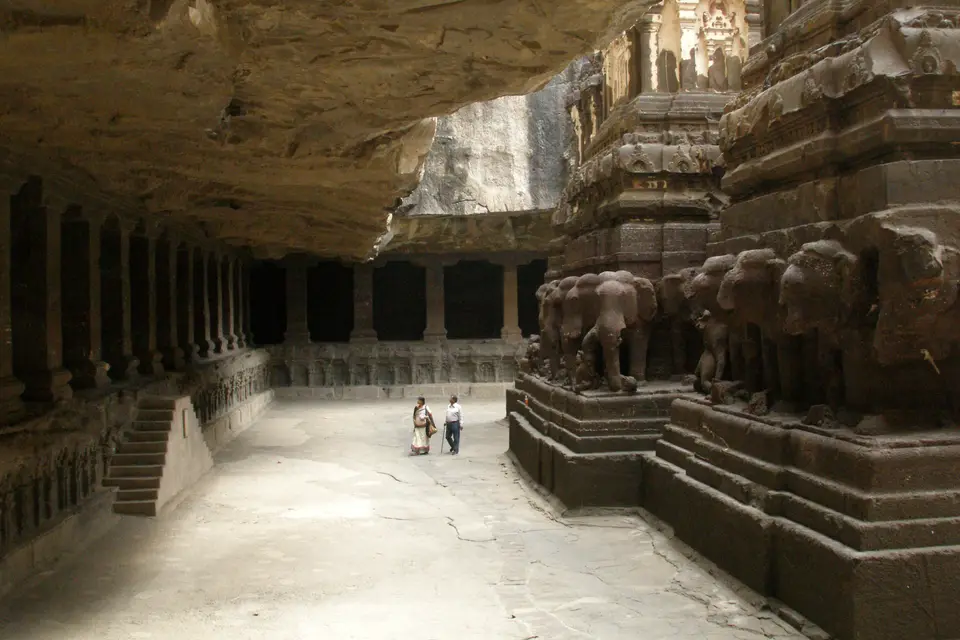
Rising 32.6 metres (107 feet) above the court below, the Kailasa temple (Cave 16) marks the culmination and climax of Indian rock-cut architecture. Modelled on the Chalukya Virupaksha Temple at Pattadakal (itself a replica of the Pallava Kailasa temple at Kanchi, whose Chalukya and Pallava artists were brought to Ellora after Krishna defeated the Chalukyas), the monument was excavated vertically from the top of the sloping basalt rock downward. According to a medieval Marathi legend recorded in the Katha-Kalpataru by Krishna Yajnavalki (circa 1470 to 1535 CE), when an ailing monarch's queen vowed to abstain from food until she beheld the completed shikhara crown of a new temple to Ghrishneshwar (Shiva) at Elapura, chief architect Kokasa carved the rock from the top downward to complete the upper shikhara in just seven days, naming the shrine Manikeshwar; Dhavalikar estimated that 250 labourers cutting 4 cubic feet of rock every day could have constructed the entire Kailasa monolith within 5.5 years.
Entered through a low western gopuram and two-storey gateway flanked by Shaivaite deities on the left and Vaishnavaite deities on the right, the U-shaped courtyard measures 82 metres by 46 metres at the base and is edged by three-storey columned arcades, huge sculpted panels, five detached shrines (three of which honour the river goddesses Ganga alongside Yamuna and Saraswati), and the upper Lankeshvar cave. Within the court stand two dwajasthambams (pillars with flagstaffs), freestanding court elephants, and the two-storey, 7-metre-high solid Nandi mandapa, connected by a rock bridge to the two-storey central Shiva shrine with its 16-pillar flat-roofed mandapa, Dravidian shikhara, inner and outer rooms alongside maithuna figures and sanctum stone lingam. The temple plinth is sculpted so that a row of elephants appears to bear the entire sanctuary on its back above scenes from the Mahabharata and Ramayana, while a celebrated relief panel depicts the demon Ravana attempting to lift and shake Mount Kailasa and images of Shiva the ascetic alongside Shiva the dancer and Parvati warning Shiva. At the northern end of the cliff, Caves 30 to 34 preserve the 9th- to 12th-century Jaina philosophical tradition in rock-cut halls and shrines whose richly carved pillars and ceilings attest to the artistic continuity that linked all three religious communities along the Charanandri escarpment.
Field Strategy for Navigating the Two-Kilometre Cliff
Because the 34 caves stretch across more than 2 kilometres of the sloping Charanandri basalt cliff, structuring your visit around the three sectarian groups makes navigation straightforward across the site and ensures that you can examine the structural progression from early Buddhist viharas to the monolithic Hindu and northern Jain sanctuaries.
- Starting at Cave 16 (Kailasa Temple): Begin at the central entrance to Cave 16 to walk the 82-by-46-metre U-shaped courtyard around the monolithic Shiva shrine, inspecting the elephant-and-lion plinth alongside the relief of Ravana shaking Mount Kailasa, the Nandi mandapa, the two dwajasthambams, the detached shrines of the river goddesses, and the upper Lankeshvar cave before climbing the outer rock slope to see how Kokasa's stonecutters excavated the 32.6-metre temple from the top downward.
- Walking South through Caves 15 to 1: From Cave 16, visit the adjacent two-storey Cave 15 (Dasavatara) with Dantidurga's inscription, then continue south into the 5th- to 8th-century Buddhist group (Caves 1 to 12) to explore the three-storey monastery of Cave 12 (Teen Tal) alongside Cave 11 and the worship hall of Cave 10 (Visvakarma, the Carpenter's cave), observing how the multi-storey rock-cut galleries and Vajrayana deity reliefs were chiselled directly into the southern basalt face.
- Exploring the Northern Caves 21, 29, and 30 to 34: Head north along the cliff face to examine the sculptural compositions of Cave 21 (Ramesvara) alongside Cave 29 (Dumar Lena), then continue to the northern terminus to inspect the 9th- to 12th-century Jain group of Caves 30 through 34.
Preservation of Basalt Reliefs and Painted Plaster Traces
Celebrated in European art and literature (such as Letitia Elizabeth Landon's 1833 poetical illustration The Kylas, Caves of Ellora in Fisher's Drawing Room Scrap Book, inspired by Samuel Prout's artwork and accompanied by commentary from Lord Munster's travels across India) and inscribed by UNESCO in 1983, the Ellora Caves preserve both bold free-standing basalt sculptures and fragile traces of the multi-layered paintings added across the centuries down to Ahilyabai Holkar. Ongoing conservation safeguards the 2-kilometre basalt escarpment and its 34 sanctuaries against monsoon runoff and weathering. You can compare Ellora's monolithic engineering with other rock-cut sanctuaries in our UNESCO World Heritage Atlas.
