The Walled Pink City: Hawa Mahal, City Palace and Jantar Mantar
Walking the royal core of the Pink City from Hawa Mahal through the City Palace and Jantar Mantar.
Inscribed as a UNESCO World Heritage site for its 1727 rectilinear street plan and uniform terracotta-pink facades, the walled city of Jaipur centres on a remarkable royal cluster. You can walk between Hawa Mahal, the City Palace and Jantar Mantar in under five minutes, adding the panoramic minaret of Isarlat and the Albert Hall Museum just south of the gates.
Hawa Mahal: the five-storey Palace of Winds
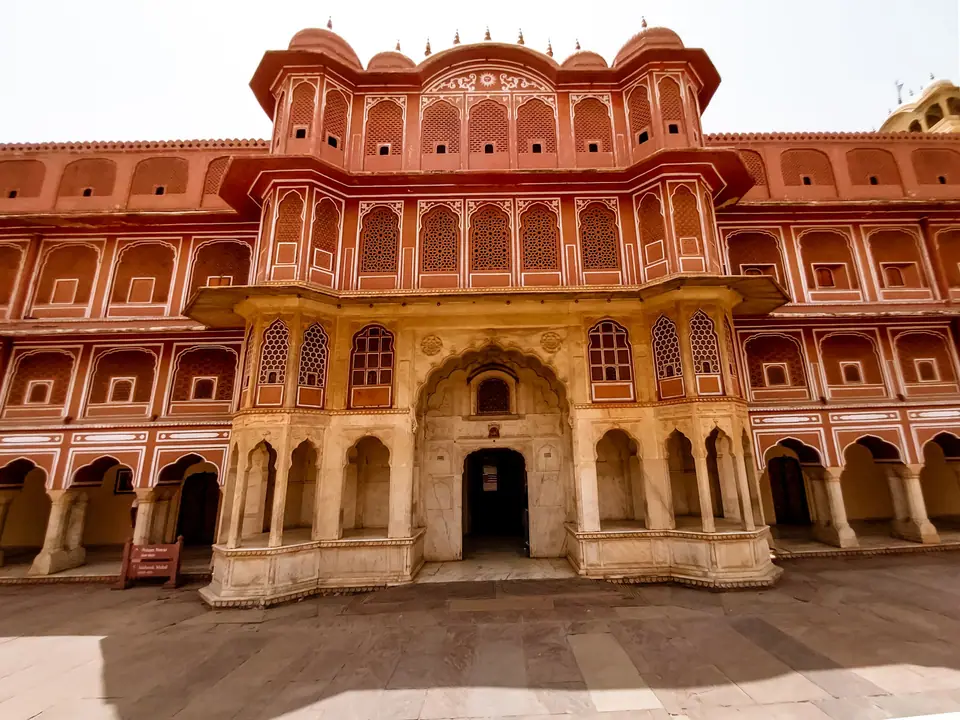
Rising like a tiered crown above Badi Chaupar, Hawa Mahal was built in 1799 by Maharaja Sawai Pratap Singh and designed by Lal Chand Ustad in the shape of Lord Krishna's crown. Although it looks like a deep palace from the street, it is actually a thin five-storey screen wall attached to the rear edge of the City Palace's women's quarters (zenana). Its 953 honeycombed windows (jharokhas) carved with delicate sandstone lattices allowed royal women to observe street festivals and bazaar life without being seen from below, while the Venturi effect funnelled cool breezes through the chambers. Admire the street facade first in the morning light from across Sireh Deori Bazaar, then enter via the Tripolia side lane to climb the internal ramps looking toward Nahargarh Fort.
The City Palace and Pitam Niwas Chowk
Occupying a seventh of the walled city, the City Palace remains the residence of Jaipur's royal family inside the seven-storey Chandra Mahal. A standard museum ticket takes you through the ceremonial heart of the complex:
- Mubarak Mahal (Welcome Palace): a late-19th-century pavilion designed by Samuel Swinton Jacob with lace-like carved marble arches, housing royal silk costumes and pashminas.
- Diwan-i-Khas (Hall of Private Audience): home to two monumental sterling silver vessels (Gangajalis), crafted so Maharaja Madho Singh II could carry holy Ganges water to London in 1902.
- Pitam Niwas Chowk: an inner courtyard framed by four painted doorways representing the seasons, led by the sculpted Peacock Gate (Mor Chowk) for autumn and the floral Lotus Gate for summer.
Jantar Mantar, Isarlat (Sargasuli) and Albert Hall Museum
Directly across from the City Palace entrance stands Jantar Mantar (1734), the largest of the five astronomical observatories built by Sawai Jai Singh II. Hiring an official guide or audio guide explains how the 27-metre-high Vrihat Samrat Yantra stone sundial tracks local time to within two seconds alongside twelve zodiac Rashi Valaya instruments. Afterwards, climb the seven-storey octagonal tower of Isarlat (Sargasuli) above Tripolia Bazaar for a 360-degree view over the pink roofs, and finish at the Indo-Saracenic Albert Hall Museum in Ram Niwas Garden.
Traveller tips
Real advice from people who have been to The Walled Pink City: Hawa Mahal, City Palace and Jantar Mantar. Every tip is read by our team before it goes live.
No tips yet. Been here? Yours could be the first.
Thank you! Your tip will appear here after a quick review.
More in Jaipur
Continue exploring Jaipur with related neighbourhood, food, and planning guides