


























Quick Field Data
- UNESCO Inscription: 1992 (Natural heritage property in Songpan County, northwestern Sichuan Province, China)
- Scale & Footprint: 60,000 hectares of World Heritage core area within a wider scenic zone stretching from 1,700 metres in Danyun Gorge to 5,588 metres atop Mount Xuebaoding
- Access & Ticketing: Administered by the Sichuan World Heritage protection authorities; check the official site for main valley entrance tickets, Muni Valley admission, and seasonal cableway passes
- Arrival Logistics: Situated in Songpan County roughly 370 kilometres north-northwest of Chengdu, served by Jiuhuang Airport and mountain roads crossing the 4,007-metre Xueshan Ridge
Travertine Rimstone Terraces and the Glaciated Peak of Mount Xuebaoding
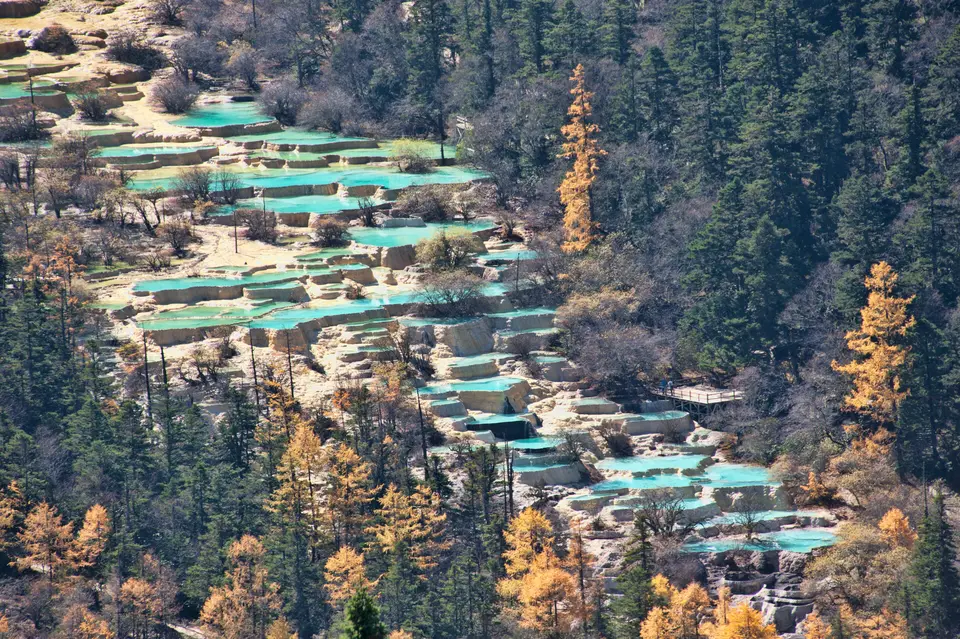
Perched high within the southern reaches of the Minshan Mountains in Songpan County, northwestern Sichuan, the Huanglong Scenic and Historic Interest Area encompasses 60,000 hectares of alpine karst canyons, glaciated peaks, and travertine cascades at the eastern edge of the Tibetan Plateau. Across China, the UNESCO World Heritage Atlas in 1992 and subsequently protected as a flagship reserve of northern Sichuan Province, the terrain rises at elevations ascending from 1,700 metres in the depths of the Danyun Gorge to 5,588 metres at the summit of Mount Xuebaoding, the highest mountain in the Minshan range. Located roughly 370 kilometres north-northwest of the provincial capital of Chengdu, the reserve is celebrated for its 3.6-kilometre chain of golden-yellow limestone tufa formations along the floor of Huanglong Valley that resembles a giant mythological dragon winding down through dark coniferous forest from the snowfields of Xuebaoding.
The geological creation of Huanglong's travertine landscape combines Quaternary alpine glaciation, subterranean karst hydro-chemistry, and organic biological precipitation. As meltwater from China's easternmost modern glaciers on Mount Xuebaoding and high-altitude rain percolate down through fault zones in Palaeozoic carbonate rocks, subterranean waters become heavily charged with dissolved calcium carbonate before emerging from underground springs near the upper valley floor near the upper valley head. Flowing down a gentle glaciated trough for 3.6 kilometres across widths of 30 to 170 metres along Yellow Dragon Gully, Huanglonggou, the mineral-rich stream precipitates solid calcite over fallen branches, glacial stones, mosses, algae, and bacterial mats.
Over thousands of years, this continuous deposition has constructed an interconnected staircase of thousands of terraced rimstone pools, golden travertine shoals up to 2.5 kilometres long, cascading waterfalls, and limestone caves. While similar freshwater travertine terraces occur at lower altitudes in Baishuitai in Yunnan, Plitvice in Croatia, and the geothermal springs of Pamukkale in Turkey and Mammoth Hot Springs in Yellowstone, Huanglong stands unmatched for the sheer scale, preservation, and extreme alpine altitude of its active cold-water calcite systems and is frequently compared with Baishuitai in Yunnan, Iran's Badab-e Surt, Afghanistan's Band-e Amir, Guatemala's Semuc Champey, Croatia's Plitvice Lakes, Turkey's Pamukkale, and Mammoth Hot Springs in Yellowstone National Park in the United States. Glacial meltwater feeds the golden terraces. Beyond the flagship Huanglong Valley, the reserve incorporates the precipitous 1,000-metre-deep canyon of Danyun Gorge, cutting through the Minshan range, and the parallel Muni Valley to the west, noted for its tall travertine waterfalls, forest lakes, and mineral hot springs.
Subalpine Coniferous Forests, Slipper Orchids, and Montane Fauna
Because the reserve rises nearly four vertical kilometres from the warm subtropical floor of Danyun Gorge to the permanent snow and ice of Xuebaoding, its undisturbed mountain slopes support a rich spectrum of temperate and alpine flora, including numerous ancient Tertiary plant relicts and rare highland orchids. Dense forests of spruces, firs, larches, birches, and rhododendrons cloak the steep valley walls around the pale yellow and turquoise travertine pools. On the mossy forest floor and carbonate margins grow diverse terrestrial orchids, including the pink-and-white slipper orchid Cypripedium plectrochilum, whose pouch-like labellum attracts female sweat bees of the genus Lasioglossum for unrewarded trap pollination before the emerging insect brushes past the stigma and anthers. Field research published by botanists studying Plant Biology across Huanglong Valley has documented how Cypripedium plectrochilum flowers bloom along the carbonate forest margins in spring, relying on solitary Halictidae bees to transfer pollen across the cool subalpine woodland floor. Beyond the valley floor, the wider 60,000-hectare reserve encompasses seven distinct scenic sectors across Songpan County, combining the main 3.6-kilometre travertine dragon of Huanglonggou with the deep canyon walls of Danyun Gorge, the waterfalls and thermal springs of Muni Valley, the 5,588-metre snow peak of Mount Xuebaoding, the 4,007-metre mountain pass of Xueshan Ridge, the alpine rock formations of Red Star Rock, and the western forested ravines of Sigou. Across these mountain valleys, repeated Pleistocene glaciations carved broad glacial troughs, hanging valleys, cirques, horns, and moraine ridges before post-glacial warming allowed dense coniferous and mixed broad-leaved forests to recolonise the lower slopes. Because the carbonate rocks of the Minshan Mountains are intersected by active fault lines and subterranean drainage networks, snowmelt from Mount Xuebaoding and seasonal rainfall dissolve calcium carbonate underground and feed a continuous succession of cold-water springs, tufa shoals, rimstone dams, waterfalls, and karst caves that continue to grow and evolve with every passing season. Conservation management across Songpan County focuses on monitoring water chemistry, maintaining elevated wooden walkways above the delicate travertine crusts, and protecting the forest corridors that link the habitats of the giant panda and golden snub-nosed monkey across northern Sichuan Province.
Across the bamboo understorey and remote rocky ridges, Huanglong provides contiguous high-mountain habitat for several of China's most celebrated endangered mammals. The giant panda, and the golden snub-nosed monkey inhabit the mid-elevation mixed and coniferous forests of the Minshan Mountains. Higher up toward the subalpine scrub and rocky crags roam the Sichuan takin, black bear, the snow leopard, the clouded leopard, the Chinese mountain cat, the forest musk deer, the white-lipped deer, and the blue sheep, alongside highland pheasants such as the Chinese monal and blue eared pheasant.
Cultural history is also woven directly into the upper valley landscape. For centuries, Tibetan and Chinese pilgrims have ascended Huanglong Valley to pay homage at the rear and middle Buddhist and Benbo temples set beside the highest travertine terraces, where the annual annual temple festival gathers local Tibetan and Chinese communities in traditional dress during the sixth lunar month. Sitting directly behind the uppermost pools at the valley head, the surviving wood-and-stone sanctuary of the ancient Buddhist and Benbo temple frames the view up toward the glaciated pyramid of Xuebaoding and the terminal moraines of Red Star Rock and Sigou.
Climbing the Travertine Boardwalk to the Five-Coloured Ponds
Travellers visiting Huanglong usually fly into Jiuhuang Airport, conveniently positioned in Songpan County, or drive from Songpan over the winding 4,007-metre pass of Xueshan Ridge. Because the upper boardwalk reaches high alpine elevations above sea level where thin air can trigger altitude sickness, many visitors ride the scenic cable car up the adjacent parallel ridge and walk gently across the upper forest trail to the top of the valley before descending along the wooden pedestrian walkway beside the cascades.
- Upper multi-coloured ponds and the ancient temple at the valley head: Begin at the highest point of the travertine sequence below the glaciers, where hundreds of terraced rimstone basins form the upper multi-coloured ponds beneath the snow-covered face of Mount Xuebaoding. Framed by the wooden eaves of the historic Huanglong temple, the stepped pools glow in shifting shades of azure, jade green, amber, and milky turquoise as mineral water trickles over golden scalloped rims.
- Yellow Dragon Gully travertine shoals and Guests Welcome Pond descent: Follow the descending timber boardwalk down the 3.6-kilometre valley along Yellow Dragon Gully, Huanglonggou, past reflective travertine pools toward the 2.5-kilometre sloping carpet of yellow and ochre calcite ripples resembling the shimmering scales of a golden dragon. Along the route, stop at the vegetated tufa basins where stunted willows, rhododendrons, and cypresses grow directly out of the submerged travertine rims, and at the karst caves and waterfalls where streams plunge over porous ledges down to the Guests Welcome Pond near the valley mouth.
- Muni Valley, the travertine waterfalls, and Danyun Gorge excursions: Pair the main Huanglong Valley walk with a half-day visit across Songpan County to Muni Valley, where wooden trails wind past tall travertine waterfalls and through forest lakes, sinkholes, and thermal springs. Driving along the eastern perimeter passes through Danyun Gorge, where sheer canyon cliffs tower more than 1,000 metres above the rushing mountain river, offering views of the vertical transition between the warm forested gorges of the lower valley and the glaciated arctic-alpine heights of the Minshan Mountains.
