


























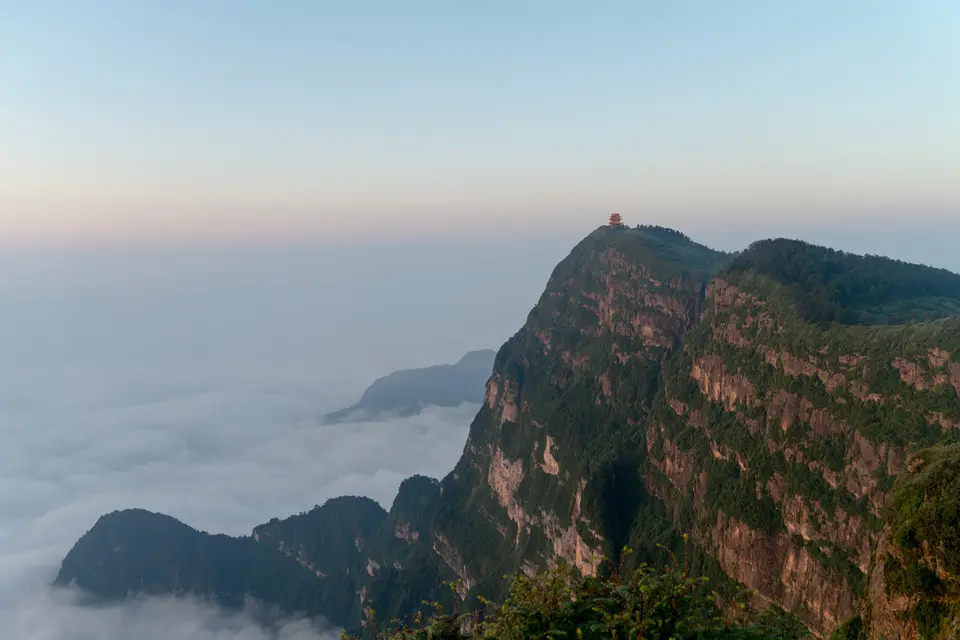
Quick Field Data
- UNESCO Inscription: 1996
- Scale & Footprint: A mixed cultural and natural site in Sichuan Province, China, uniting the 3,099-metre peak of Mount Emei (prominence 1,069 metres) and 50 kilometres of mountain footpaths with the 71-metre Leshan Giant Buddha at Xijuo Peak
- Access & Ticketing: Managed as two linked scenic zones with pedestrian trail networks, shuttle buses, and cable cars ascending to Jinding at 3,077 metres; check the official site
- Arrival Logistics: Located in Emeishan City within the prefecture-level city of Leshan on the western rim of the Sichuan Basin
Sacred Origins of Chinese Buddhism and the River Confluence Colossus
Rising abruptly along the western rim of the Sichuan Basin in Sichuan Province, China, with the Daxiangling mountain range to its west, Mount Emei (also spelled Emei Shan or Mount Omei, a Chinese title meaning "towering eyebrows") reaches an elevation of 3,099 metres (10,167 feet) with a topographic prominence of 1,069 metres. It is the tallest of China's Four Sacred Buddhist Mountains. Geologically, the massif and its surrounding countryside belong to the Permian Emeishan Large Igneous Province, generated by massive volcanic eruptions of the Emeishan Traps during the Permian Period. During the 1st century CE, China's earliest Buddhist sanctuary was founded in the summit surroundings of Mount Emei (Emeishan), establishing the mountain as the foundational territory from which Buddhism spread widely across China and East Asia. In Chinese Buddhist tradition, the mountain is revered as the enlightenment sanctuary of Bodhisattva Puxian (known in Sanskrit as Samantabhadra), where pilgrims offer burning sandalwood to send their prayers to heaven.
Over subsequent centuries, imperial patronage and monastic communities enriched the forested slopes with temples, pavilions, and cultural treasures. Sixteenth- and 17th-century historical records document monastic martial arts training on Mount Emei and contain the earliest surviving textual reference to the Shaolin Monastery as the origin point of Chinese martial arts. The summit sanctuary, originally called the Guangxiang Temple, received its royal name of Huazang in 1614. Across the mountain survive seventy-six Ming and Qing dynasty Buddhist monasteries, most clustered near the upper ridges and linked by a winding stone footpath 50 kilometres (31 miles) long that takes several days to walk from the foothills to the Golden Summit at Jinding (3,077 metres).
East of the mountain within the prefecture-level municipality of Leshan, which administratively encompasses county-level Emeishan City, the religious heritage of the region culminated in the 8th century CE with the carving of the Giant Buddha of Leshan directly out of the red sandstone cliffside of Xijuo Peak above the junction where three rivers meet. Rising 71 metres in height, the colossus ranks as the tallest pre-modern Buddhist stone statue on Earth, while an inscribed tablet on the cliff preserves a contemporary historical record of how the Giant Buddha was carved. Adjacent historic monuments include the 9th-century Lingbao Pagoda together with the early Qing Dynasty Dafo Temple (Giant Buddha Temple). Inscribed as a mixed World Heritage site at the 20th session in 1996, the designation unites both scenic areas.
Terrain-Adapted Monasteries, Vertical Forest Zones, and Endemic Fauna
Unlike lowland Chinese temples built on rigid rectangular grids, the seventy-six Ming and Qing monasteries of Mount Emei modify traditional fixed plans to fit steep cliffs, ridges, and ravines. In the foothills and middle slopes, the halls of Baoguosi (Baoguo Temple) step across terraces of varying levels, Fuhu Temple and Wannian Temple sit within dense forest groves, and the timber structures of Leiyinsi stand on raised stilts. At Qingyinge, monastery buildings occupy an irregular plot on the narrow strip of land where the Black Dragon River meets the White Dragon River, while upper trails pass Xixiang Chi (also called Tianhua Chanyuan) and the Shengji Bronze Bell before cable cars and stone steps reach the 2 temples at Jinding (3,077 metres), an hour's hike from the 3,099-metre summit.
This steep vertical rise spans a dramatic ecological gradient governed at the summit by a subarctic alpine climate (Köppen Dwc) featuring long winters and cool, brief summers. Monthly 24-hour mean temperatures at the summit range from minus 5.7 degrees in January (equivalent to 21.7 F) up to 11.6 degrees in July (52.9 F), around an annual mean of 3.07 degrees (37.5 F); precipitation falls on more than 250 days a year, and over 70% of annual rainfall arrives during the monsoon between June and September. Below 1,500 metres, the mountain preserves the largest intact stands of native Sichuan Basin subtropical evergreen broadleaf forest, where subtropical oaks and Schima trees grow alongside laurel genera such as Machilus, Lindera, Phoebe, Litsea, and Cinnamomum, with individual trees more than 1,000 years old. Above 1,500 metres, the forest transitions to mixed evergreen and deciduous broadleaf woodland and subalpine conifer forest before reaching subalpine shrubland above 2,800 metres. Approximately 100 plant species are endemic to Mount Emei, including the rare fir Abies fabri and Magnolia omeiensis.
Zoological surveys have documented roughly 2,300 animal species across the mountain slopes, encompassing more than 1,000 insects, 256 birds, 60 fish, 51 mammals, 42 oligochaetes (such as the half-metre giant earthworm Pheretima praepinguis), 34 reptiles, and 33 amphibians. Native forest mammals include Ailurus fulgens (the lesser or red panda), Catopuma temminckii (the Asian golden cat), Ursus thibetanus (the Asian black bear), and the mainland serow (Capricornis sumatraensis), alongside troops of Tibetan macaques, including a well-known one-armed female macaque called Xing Xing that accepts food from a local elderly resident and her son while ignoring tourists. Limited-range and threatened bird species on the slopes include Schoeniparus variegaticeps (golden-fronted fulvetta), Suthora zappeyi (grey-hooded parrotbill), Paradoxornis paradoxus (three-toed parrotbill), the Emei Shan liocichla (Liocichla omeiensis), Trochalopteron formosum (red-winged laughingthrush), the Omei warbler (Phylloscopus omeiensis), the Emei leaf warbler (Phylloscopus emeiensis), Poecile davidi (rusty-breasted tit), and Emberiza siemsseni (slaty bunting). Streams and damp forest floors shelter Andrias davidianus (the Chinese giant salamander), Oreolalax omeimontis (the Omei toothed toad), and the frogs Rana adenopleura and Vibrissaphora liui, while reptiles include the Indian forest skink, the lizard Takydromus intermedius, and at least six native snake species: the Chinese slug snake, the mountain water snake, the Mandarin ratsnake, Peters' odd-scaled snake, the venomous Chinese green tree viper, the Taiwan mountain pitviper, and the brown spotted pitviper.
Together, the vertical botanical zones of Mount Emei and the riverside sandstone cliffs of Leshan demonstrate how Buddhist monasticism in Sichuan integrated sacred architecture with mountain and river topography over nearly two millennia. From the 1st-century temple foundations and the 8th-century carving of the 71-metre Giant Buddha on Xijuo Peak to the 9th-century Lingbao Pagoda, the 1614 royal naming of Huazang Temple, and the seventy-six Ming and Qing monasteries linked by the 50-kilometre pilgrim trail, every level of the mountain preserves both living religious practice and intact subtropical-to-subalpine biodiversity.
Walking the 50-Kilometre Pilgrim Path and Viewing the Leshan Cliff
Travellers consulting the UNESCO World Heritage Atlas can explore the two scenic areas either as a multi-day trek along the 50-kilometre stone footpath from Baoguo Temple to Jinding or by combining lower monastery walks around Qingyinge, Fuhu Temple, and Wannian Temple with sightseeing buses and the upper cable car to 3,077 metres. At the Leshan Giant Buddha Scenic Area on Xijuo Peak, visitors can view the 71-metre sculpture from the cliff top near the Dafo Temple and Lingbao Pagoda before walking down the rock-cut stairway beside the statue, or observe the full cliff facade from excursion boats at the river confluence.
Along the stone stairways of Mount Emei, walkers frequently pass Tibetan macaques where local merchants sell nuts and snacks. Visitors must avoid holding food in their hands near the monkeys, as provoked macaques may grab at clothing, stare, or bite. Because rain and mist occur on more than 250 days a year and summit temperatures drop below freezing in winter, non-slip footwear and warm waterproof layers are essential. Mist often shrouds the upper cliffs.
- Combining trail walks and cable cars: Walk the lower subtropical gorges around Baoguosi, Qingyinge, and Wannian Temple on day 1, then ride the cable car to Huazang Temple at Jinding (3,077 metres) before hiking the final hour to the 3,099-metre peak.
- Behaving safely around Tibetan macaques: Keep all food sealed inside backpacks and do not hold snacks out near macaque troops along the 50-kilometre mountain footpath.
- Dressing for alpine monsoon weather: Carry rain protection and warm fleece layers year-round, as precipitation falls on over 250 days annually with more than 70% concentrated between June and September.
