


























Quick Field Data
- UNESCO Inscription: 1990 (Cultural, Criteria iv, v; Property ID 529).
- Scale & Footprint: Six colonial mission settlements (reducciones de indios) in Santa Cruz Department: San Francisco Javier (San Xavier), San Rafael, San José de Chiquitos, Concepción, San Miguel, and Santa Ana.
- Access & Ticketing: Living secular municipalities with active parish churches, museums, and music archives restored from 1972 onwards by Hans Roth; check the official site for church opening times and the biennial international Baroque music festival.
- Arrival Logistics: Located around 16.7205°S, 61.2670°W across the Ñuflo de Chávez, José Miguel de Velasco, and Chiquitos provinces to the northeast and east of the departmental capital, Santa Cruz de la Sierra, within eastern Bolivia.
Utopian Reductions in the Chiquitanía Lowlands (1691 to 1767)
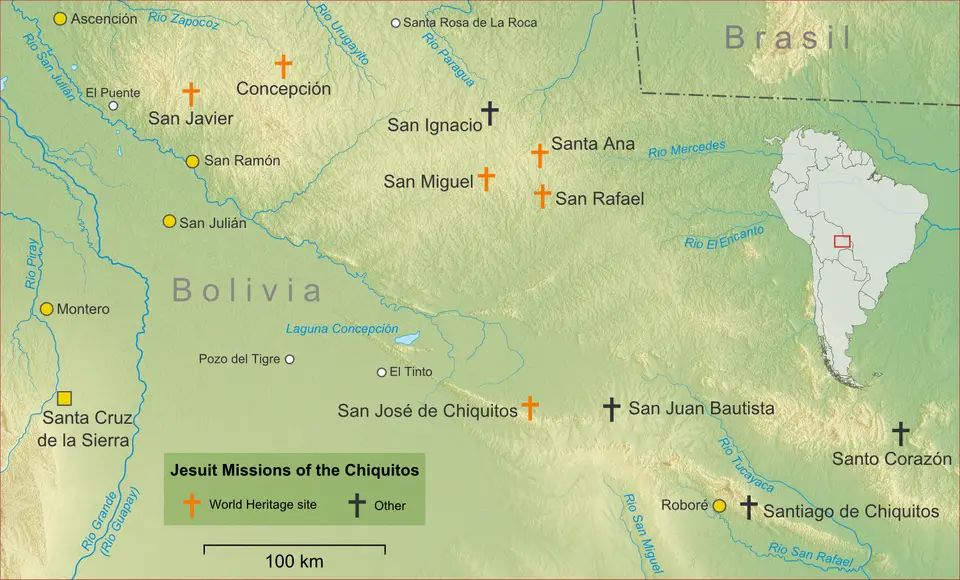
Spread across the hot, semi-arid lowlands of the Santa Cruz Department in eastern Bolivia between the Guapay and Paraguay rivers near the Gran Chaco and the Brazilian border (around 16.7205 degrees south and 61.2670 degrees west), the Jesuit Missions of the Chiquitos comprise six surviving colonial settlements inscribed together in 1990: San Francisco Javier (also written San Xavier or San Javier) and Concepción within Ñuflo de Chávez province, set between the Uruguayito and San Julián rivers; the three eastern missions in José Miguel de Velasco province, namely Santa Ana de Velasco, the parish of San Miguel de Velasco, and the parish of San Rafael de Velasco; and San José de Chiquitos in Chiquitos province, lying roughly 200 km (or 120 mi) southward from San Rafael. The 16th-century Spanish conquistador Ñuflo de Chávez, who founded Santa Cruz "la Vieja" (relocated 250 km west in 1592 after conflicts with indigenous groups following the 1587 arrival of the priests Fr. Diego Martínez and Fr. Diego Samaniego), introduced the name Chiquitos ("little ones") for the small doorways of the indigenous straw houses. After the Jesuits arrived in the Viceroyalty of Peru in 1568 under King Philip II of Spain, reached the Audience of Charcas in 1572, and founded their first Moxos reduction at Loreto under Fr. Cipriano Barace in 1682, Santa Cruz governor Agustín Gutiérrez de Arce encouraged Jesuit missions in the Chiquitania (spanning Chiquitos, Ñuflo de Chávez, José Miguel de Velasco, Germán Busch, and Ángel Sandoval provinces).
Between 1691 and 1760, priests of the Society of Jesus founded eleven settlements in 76 years across this remote frontier, drawing inspiration from the "ideal cities" described by 16th-century English humanist philosophers Thomas More (Utopia) and Philip Sidney (Arcadia) and governed under the colonial "foreigner law" initiated in 1515 by Bartolomé de las Casas, which barred Spanish colonists and permitted merchants to stay for at most three days. Seeking protection from Portuguese slave traders (Paulistas from Brazil) and the Spanish encomienda system, indigenous communities gathered into self-sufficient reductions of 2,000 to 4,000 free inhabitants led by two Jesuit priests alongside an indigenous cabildo (town council), cacique (tribal leader), and alcaldes representing both skilled artisans and agricultural workers. Although a 1745 report recorded 14,706 mission residents speaking diverse languages (including 65.5% speaking Chiquitano, 11% speaking Arawak, 9.1% speaking Otuquis, 7.9% speaking Zamucos, 4.4% speaking Chapacura, and 2.1% speaking Guaraní), the Jesuits promoted Gorgotoqui (the Chiquitano language) as a common lingua franca, uniting more than 40 ethnic groups while cultivating maize, yuca, cocoa, rice, cotton, yerba maté, honey, and tamarind, introducing cattle breeding, and exporting handmade musical instruments, silverware, shoes, and leather across Upper Peru without using money inside the towns.
The first Chiquitania reduction, San Xavier, was founded in September 1691 among the Piñoca tribe by Fr. José de Arce and Br. Antonio de Rivas, moving in 1696, 1698, and 1708 to its current site. Four more World Heritage reductions followed between 1695 and 1721: San Rafael de Velasco (founded in 1695 or 1696 by the priests Fr. Francisco Hervás and Fr. Juan Bautista Zea, relocated in 1701, 1705, and 1719, and reaching 2,615 inhabitants by 1718), San José de Chiquitos (founded in 1698 by Fr. Felipe Suárez and Fr. Dionosio Ávila among the Penoca tribe), Concepción (founded in 1699 by the priests Fr. Francisco Hervás and Fr. Francisco Lucas Caballero, absorbing San Ignacio de Boococas in 1708 and relocating in 1707, 1708, and 1722), and San Miguel de Velasco, founded in 1721 by Fr. Felipe Suárez and Fr. Francisco Hervás as an offshoot of crowded San Rafael. In 1755, Fr. Julian Knogler founded the sixth World Heritage reduction, Santa Ana de Velasco, among the Curuminaca and Covareca tribes (speakers of Otuke language dialects), while other missions such as San Juan Bautista (1699), San Ignacio de Zamucos (1724), San Ignacio de Velasco (1748), Santiago de Chiquitos (1754), and Santo Corazón (1760) are excluded from the World Heritage designation.
In February 1767, following the 1750 Treaty of Madrid, the Guarani War, the 1758 Távora affair, and the 1766 Esquilache Riots, King Charles III of Spain ordered the expulsion of the Society of Jesus from Spanish territories, where 25 Jesuits had served at least 24,000 residents across ten Chiquitania missions owning 25 estancias (ranches) with 31,700 cattle, 850 horses, and 2,094 library volumes. Despite post-expulsion decline under parish priests appointed by Archbishop Francisco Ramón Herboso and civil administrators appointed by the Audiencia of Charcas in 1790, as well as the dissolution of the reduction system by 1851 and the impact of the 1953 agrarian reform, anthropologist Bernd Fischermann notes that the Chiquitano people preserved their churches and liturgy, as admired by Alcide d'Orbigny in 1830 to 1831 and the Comte de Castelnau in 1842.
Carved Horcones, Mica-Washed Adobe Walls, and Baroque Polyphony
Modelled on the modular layout of San Xavier, each reduction was organised around a rectangular open plaza measuring from 124 by 148 metres (407 by 486 ft) at San Xavier and San Rafael de Velasco up to 166 by 198 metres (545 by 650 ft) at San Ignacio de Velasco, planted with palm trees around a central cross (recalling Psalm 92, verse 12) and four corner chapels. Along three sides of the square stood parallel rows of elongated indigenous houses with 6-by-4-metre rooms, 60-centimetre-thick (2 ft) adobe walls, 5-metre-high (16 ft) reed (caña) and cuchi-wood roofs, and open galleries, preserved most authentically around the grassy plaza of Santa Ana de Velasco. Along the fourth side stood the single-level church complex linking the templo, mortuary chapel, bell tower, and colegio (school, preserved intact at San Xavier and Concepción) in front of interior patios and workshops.
Erected between 1745 and 1780, the monumental churches measure 16 to 20 metres (52 to 66 ft) wide, 50 to 60 metres (160 to 200 ft) long, and 10 to 14 metres (33 to 46 ft) high, holding over 3,000 worshippers under wide tile-covered gable roofs. As recorded by Fr. José Cardiet, hundreds of indigenous carpenters built the roof skeleton first: adze-worked tree trunks called horcones (charred at the base to resist humidity) were lowered into 3-metre-deep (9 ft) pits to carry the entire roof weight across three aisles divided by carved Solomonic wooden columns, while non-load-bearing adobe walls were raised afterward on stone foundations and coated in mud, sand, lime, straw, earth-tone paint, and shimmering mica (at San Rafael and San Miguel), pierced by petal-framed oval oeil-de-boeuf windows. Swiss Jesuit architect and composer Fr. Martin Schmid designed the churches of San Rafael de Velasco (1747 to 1749), San Xavier (1749 to 1752), and Concepción (1752 to 1756, with Fr. Johann Messner), inscribing Chapter 28 (verse 17) of Genesis over the portals (CASA DE DIOS Y PUERTA DEL CIELO at San Xavier, and DOMUS DEI ET PORTA COELI at San Rafael and Concepción), while Fr. Johann Messner probably built San Miguel de Velasco (1752 to 1759), indigenous builders erected Santa Ana de Velasco (1770 to 1780) after the expulsion, and San José de Chiquitos represents the sole stone Baroque ensemble with its 1740 mortuary chapel, 1745 to 1760 church (dated 1747), 1748 stone bell tower, and 1754 colegio and workshops.
Inside, gilded retablos and siren-supported wooden pulpits accompanied daily polyphonic music. Fr. Martin Schmid trained indigenous choirs and orchestras on handmade violins, harps, flutes, zithers, lyres, and organs, and in 1751 transported a six-stop organ by mule 1,000 kilometres (620 mi) from Potosí to Santa Ana de Velasco, where it remains alongside three original Jesuit harps in San Xavier, San Rafael, and Santa Ana. From 1972 until 1999, Swiss architect Hans Roth led 40 to 80 local workers per town to restore all six World Heritage churches, uncovering over 5,000 colonial musical scores in Concepción in 1975, now performed by local orchestras of the Sistema de Coros y Orquestas (SICOR) such as Orquesta Urubicha during the biennial festival organised since 1996 by the Asociación Pro Arte y Cultura (APAC).
Circuit Logistics Across the Six Mission Towns
In 1990, the UNESCO World Heritage Atlas in 1990 under Criteria iv and v, the six secular municipalities form an overland circuit from Santa Cruz de la Sierra promoted since 2005 as the Jesuit Mission Circuit. You can map all six reductions on our interactive world map. Carved wooden columns hold the painted roofs.
- Starting at San Xavier and Concepción in Ñuflo de Chávez: Inspect Fr. Martin Schmid's 1749 to 1752 church and preserved colegio at San Xavier before travelling east to Concepción to see the 1752 to 1756 cathedral, woodcarving workshops, and the museum archive holding over 5,000 colonial Baroque scores unearthed in 1975.
- Visiting San Rafael, San Miguel, and Santa Ana in José Miguel de Velasco: Examine the mica-highlighted walls and siren-supported pulpits of San Rafael (1747 to 1749) and San Miguel (1752 to 1759), then continue to the open grassy colonial plaza of Santa Ana de Velasco to see the 1770 to 1780 indigenous-built church and the six-stop organ brought 1,000 km by mule from Potosí in 1751.
- Completing the circuit at the stone ensemble of San José de Chiquitos: Travel 200 km (or 120 mi) southward from San Rafael into Chiquitos province to explore the stone Baroque facade of San José de Chiquitos, including its 1740 mortuary chapel, 1747 church, 1748 stone bell tower, and 1754 colegio and workshops.
