Quick Field Data
- UNESCO Inscription: 1997 (Ref. 666), cultural pilgrimage site in Lumbini Province, Rupandehi District, Nepal; Criterion (iii).
- Scale & Footprint: 1.95-hectare core Sacred Garden inside a 4.8-kilometre by 1.6-kilometre planned monastic and cultural park.
- Access & Ticketing: Managed by the non-profit Lumbini Development Trust under the Ancient Monument Preservation Act 1956; check official site notices for Sacred Garden entry passes.
- Arrival Logistics: Major commercial flights land at Tribhuvan International Airport (KTM), 207 kilometres east near Kathmandu (204 kilometres). Closer Gautam Buddha International Airport (BWA) lies 14 kilometres away with more limited schedules.
Maya Devi Temple, the Ashoka Pillar, and Early Tree Shrines
Across the flat Terai plains of southern Nepal, Lumbini marks the sacred grove where Queen Maya gave birth to Siddhartha Gautama, the historical Buddha. Buddhist texts place his birth in 623 BC, while wider historical scholarship dates the event around 563 BC. Ancient scriptures such as verse 683 of the Sutta Nipata locate the park in Lumbineyya Janapada, east of Kapilavastu and southwest of Devadaha inside the Shakya oligarchic republic. Earlier centuries knew the surrounding countryside simply as Rupandehi, roughly 3.2 kilometres (2 miles) north of Bhagavanpura, until archaeological excavations restored its classical identity.
In 249 BC, twenty years after his anointing, the Mauryan Emperor Ashoka made a royal pilgrimage to Lumbini and raised a monolithic sandstone column. Written in Pali using Brahmi script, the inscription records that King Devanampriya Priyadarsin came personally to worship because the Buddha Shakyamuni was born here. The royal edict further states that Ashoka commissioned a stone horse monument, freed Lumbini village from imperial taxes and assessed only an eighth share of agricultural produce.
Forest regrowth hid the sanctuary for centuries until 1896, when former Nepalese general Khadga Shamsher Jang Bahadur Rana and Alois Anton Führer located the column at Rupandehi. Before that rediscovery, local officials did not identify the mounded ruins as ancient Lumbini. Relying closely on fifth-century travel journals by Chinese monk-pilgrim Faxian and seventh-century accounts by Xuanzang, researchers matched the sandstone column with historic descriptions. High on the weathered shaft sits a second medieval inscription dated Saka Era 1234, during the 13th to 14th century CE, carved by King Ripumalla invoking protective blessings with Om mani padme hum.
Excavations conducted inside Maya Devi Temple during 2013 under archaeologist Robin Coningham pushed evidence of human activity far deeper into antiquity. Trenches opened beneath third-century BC Ashokan fired-brick walls revealed postholes belonging to a pre-Mauryan timber enclosure surrounding an open central tree shrine. Radiocarbon dating of charcoal from wooden postholes and optically stimulated luminescence testing on soil samples indicated human presence around 1000 BC. While Coningham suggested possible sixth-century BC Buddhist monument status, other archaeologists argue the pre-Mauryan timber sanctuary proves sacred activity predating Buddhism itself.
Across Buddhist scripture, Lumbini anchors the four-part sacred geography highlighted in the Mahaparinibbana Sutta (Dighanikaya 16) before Gautama Buddha attained parinirvana at age eighty. Believers follow a regional pilgrimage circuit linking Lumbini as his birthplace with Bodh Gaya for enlightenment, Sarnath for his first sermon and Kushinagar for final nirvana. Adjacent places near Lumbini also honour earlier Buddhas who attained enlightenment and relinquished earthly forms. During his own lifetime, the Buddha stayed in Lumbinivana while visiting Devadaha and preached the Devadaha Sutta there.
Kenzo Tange's Master Plan Across Three Monastic and Cultural Zones
Modern revival gathered momentum after April 1967, when United Nations Secretary-General U Thant visited Lumbini on a self-described pilgrimage and championed its transformation into an international peace park. Working with United Nations planners between 1972 and 1978, Japanese architect Kenzo Tange designed a master plan shaping a 4.8-kilometre by 1.6-kilometre rectangle into three distinct zones. A commemorative bust honours U Thant's initiative inside the complex today. Tange's linear geometry isolates fragile archaeological ruins inside peaceful green buffers far from hotels, markets and heavy bus traffic.
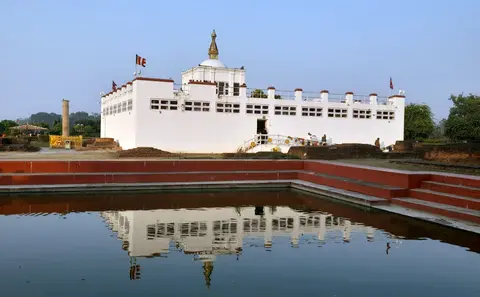
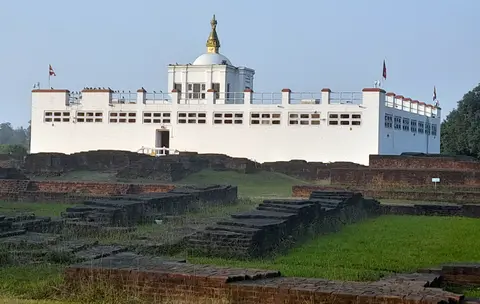
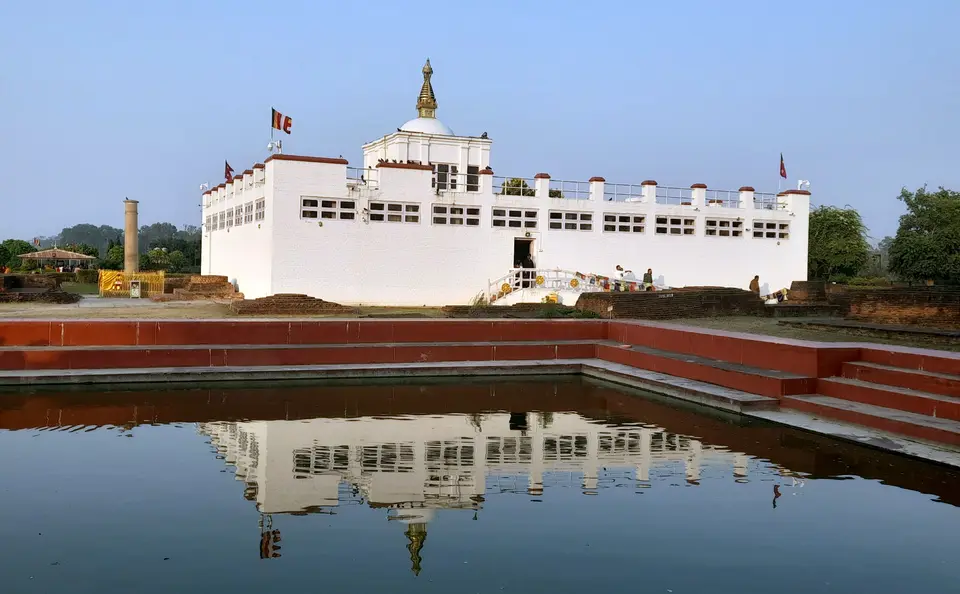
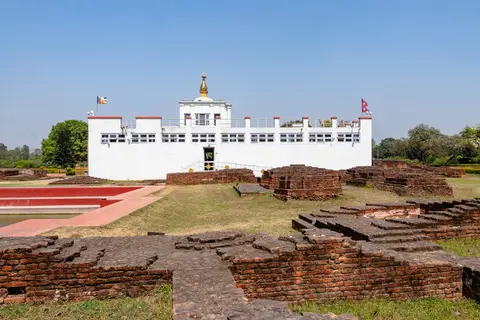
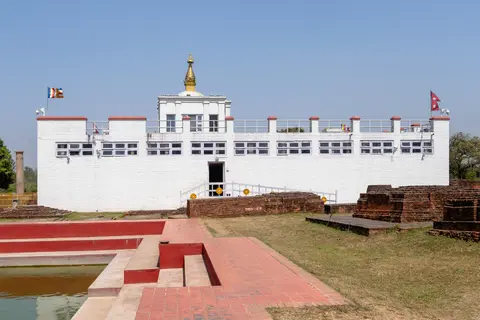
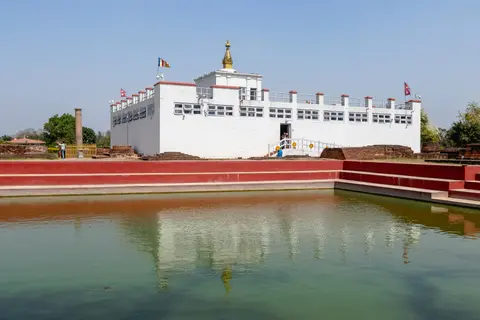
At the southern focal point lies the Sacred Garden, encompassing the 1.95-hectare World Heritage core around Maya Devi Temple. Inside the white protective pavilion, elevated steel walkways guide visitors above overlapping brick cross-wall foundations built from the third century BC down to modern restorations. Pilgrims pass quietly beside the ancient Marker Stone, the Nativity Sculpture and the fenced Ashoka Pillar. Immediately outside stands a sacred Bodhi tree and the stepped brick Puskarini bathing pond, where Queen Maya traditionally cleansed herself before childbirth and where the infant prince received his first ritual bath.
Dotting the surrounding Sacred Garden lawns are excavated ruins of Buddhist viharas (monasteries) constructed between the third century BC and fifth century AD. Memorial stupas spanning the third century BC through the 15th century AD cluster tightly around the central brickwork, demonstrating continuous pilgrimage devotion across eighteen centuries. Every monument zone respects Tange's clear separation between archaeological turf and surrounding monastic compounds. Early morning until evening, international pilgrims gather beside the pond and brick plinths for quiet chanting and seated meditation.
Moving north from the Sacred Garden enters the one-square-mile Monastic Zone, split cleanly down its axis by a long water-filled canal. Brick arch bridges join the eastern and western avenues, while simple outboard motorboats operating at the northern end offer short canal tours. Strict zoning bans all commercial shops, hotels and restaurants anywhere inside the Monastic Zone. Theravada Buddhist countries build monasteries across the East Monastic Zone, whereas Mahayana and Vajrayana traditions occupy plots inside the West Monastic Zone.
International participation continues adding national temples along both tree-shaded avenues. Bangladesh signed an agreement in 2021 to erect a national Buddhist monastery, Indian and Nepalese prime ministers jointly laid the foundation stone for India's monastery on Buddha's Birthday in 2022 and Russia laid its own foundation in 2023. Each national plot reflects regional sacred building traditions, keeping active pilgrimage communities distinct from quiet central excavation lawns. Further north, Cultural Centre grounds and New Lumbini Village gather the Lumbini Museum, Lumbini International Research Institute, administrative buildings, the 2001 Japanese Nipponzan Myohoji World Peace Pagoda and the Lumbini Crane Sanctuary.
Excavations Beneath Brick Walls and Regional Conservation Pressures
Public ownership and clear legal protections restrain urban encroachment inside the master plan perimeter. Both the 1.95-hectare core shrine precinct and its surrounding buffer zone are owned outright by the Government of Nepal under the Ancient Monument Preservation Act 1956. In 2011, national leaders formed the Lumbini Development National Director Committee under Prime Minister Prachanda to draft master proposals and widen international backing for peaceful regional conservation. Daily site stewardship rests with the autonomous, non-profit Lumbini Development Trust.
Heritage specialists emphasise that the narrow 1.95-hectare World Heritage line encloses only the core monument cluster while substantial buried archaeological layers extend into the surrounding buffer zone. Two additional Mauryan stone columns across the surrounding Terai plains demonstrate how extensive the wider Shakya landscape remains. Twenty-two kilometres northwest stands the inscribed Nigali Sagar pillar of Ashoka, while an uninscribed third Ashokan column rises 24 kilometres west at Gotihawa. Careful geophysical prospecting and non-destructive monitoring across buffer-zone fields remain top conservation priorities.
Balancing active pilgrimage with brick conservation requires constant vigilance across Nepal's humid monsoon belt. Early fired-brick cross-walls inside the Sacred Garden suffer natural weathering and capillary dampness when groundwater tables climb during summer rains. Dedicated conservation teams monitor moisture intrusion, salt crystallisation and structural wear along temple walkways so active chanting and heavy foot traffic never damage fragile third-century BC strata.
Meanwhile, visitor numbers and surrounding regional industrial growth pose growing pressures beyond the green park fence. By 2019, Lumbini attracted 1.5 million visitors annually, blending international Buddhist pilgrims with thousands of Hindu worshippers arriving on the full moon of Baisakh (April to May) to revere Queen Maya as Rupa Devi. During an October 2023 visit, United Nations Secretary-General António Guterres reflected on Buddhism's peace message amid global crises. Controlling regional industrial emissions across the wider Terai plain guides the trust's ongoing Management Plan.
Access Zones Across Lumbini, Nepal
Walking or cycling the north-south axis from New Lumbini Village toward the Sacred Garden keeps quiet meditation lawns separate from interpretive museums and national monasteries. Check current gate passes and silence rules at the entrance to Lumbini, Nepal before entering pedestrian precincts.
| Complex Zone | Key Highlights | Access & Ticket Rule |
|---|---|---|
| Sacred Garden Core | Maya Devi Temple brick cross-walls, Nativity Sculpture, Marker Stone, Ashoka Pillar, Puskarini Pond and stupas. | Foot access along designated paths; confirm Lumbini Development Trust entry tickets and photography rules at the gate. |
| East and West Monastic Zones | Theravada monasteries east of the canal, Mahayana and Vajrayana complexes west, plus brick arch bridges. | Pedestrian walkways and cycle paths link both banks; commercial shops, restaurants and hotels are banned inside. |
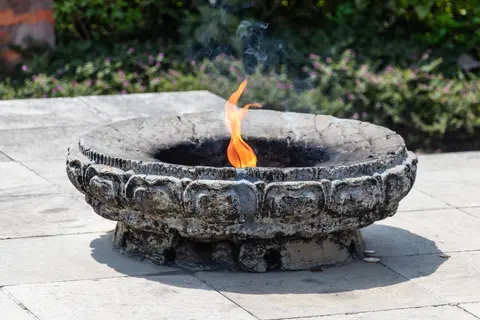
| Cultural Centre and Peace Flame | Eternal Peace Flame at the canal head, Lumbini Museum, Research Institute, Peace Pagoda and Crane Sanctuary. | Open public grounds along the northern axis; verify museum admission procedures and library access via official notices. |
| Outlying Shakya Pillar Sites | Inscribed Nigali Sagar pillar 22 kilometres northwest and uninscribed Gotihawa column 24 kilometres west. | Rural plains roads outside the central master plan park; arrange local road transport from Lumbini or Bhairahawa. |
Three Architectural and Archaeological Details Inside the Sacred Garden
- Brahmi Script Inscription on the Ashoka Pillar: Stand before the fenced sandstone column west of Maya Devi Temple to view the 249 BC Pali decree accompanied by King Ripumalla's medieval mantra. Morning or afternoon side-light clarifies the chiselled Brahmi characters cleanly at eye level.
- Subsurface Brick Cross-Walls Beneath Maya Devi Temple: Inside the white protective pavilion, elevated steel walkways let visitors look straight down onto third-century BC fired-brick chambers. Notice how the Ashokan brick layout follows the alignment of the pre-Mauryan timber shrine exposed in 2013.
- Central Axis Water Canal and Eternal Peace Flame: Gaze north from the Sacred Garden perimeter past the Eternal Peace Flame burning at the canal's southern head. Kenzo Tange aligned this linear water axis directly toward the distant Japanese World Peace Pagoda.
Best Time to Visit Lumbini, Nepal, and Connections From Kathmandu
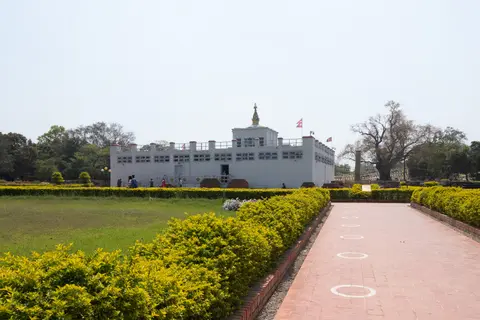
Timing a visit carefully around Terai seasons makes walking or cycling the 4.8-kilometre open corridor far more pleasant. Cooler dry-season months offer comfortable daytime weather for moving between the Sacred Garden, the northern canal motorboats, the Lumbini Museum and distant monasteries without monsoon rains or heavy summer heat. April and May bring the full moon of Baisakh, when butter lamps, collective chanting and dense crowds of Buddhist and Hindu pilgrims fill Maya Devi Temple grounds. Always check official Lumbini Development Trust announcements before arrival for festival rules and temple schedules.
Pacing half a day or a full day across Tange's three planned zones helps visitors appreciate both historical excavations and modern international architecture. Beginning at New Lumbini Village and the Lumbini Museum provides useful sculptural context before walking or cycling south past East Theravada and West Mahayana monasteries toward the Eternal Peace Flame. Reserving late afternoon or early morning for the Sacred Garden keeps brick ruins and Puskarini Pond quiet during key meditation windows.
Understanding Lumbini, Nepal distance from Kathmandu helps sequence domestic transfers cleanly across southern Nepal. Most international visitors land at Tribhuvan International Airport (KTM), 207 kilometres east, before catching domestic air links or overland highway coaches from Kathmandu (204 kilometres). Closer Gautam Buddha International Airport (BWA) sits just 14 kilometres from the sanctuary, though scheduled flight options remain far more limited than Kathmandu's main hub. Explore further South Asian monuments inside our UNESCO World Heritage Atlas.