


























Quick Field Data
- UNESCO Inscription: 1984 · Criteria (vii), (ix), (x).
- Scale & Footprint: 93,200 hectares (enlarged to 952.63 square kilometres, or 367.81 square miles, buffered by 75,000 hectares or 766.1 square kilometres added in 1996 to 1997) spanning elevations from 100 metres in the river valleys to 815 metres in the Siwalik (Churia) Hills across southern Central Terai, Nepal
- Access & Ticketing: Managed by Nepal's Department of National Parks and Wildlife Conservation; entry permits and licensed naturalists are required for jeep safaris alongside dugout canoe trips on the Rapti and Narayani rivers and guided walking tracks from buffer-zone gateways near Bharatpur
- Arrival Logistics: Situated across Nawalpur (Nawalparasi), Chitwan alongside Makwanpur and Parsa Districts in Bagmati Province, south-central Nepal, southwest of Kathmandu
Subtropical Terai Floodplains alongside the Siwalik Hills and Rhino Recovery
Wedged between two river valleys at the foot of the outer Himalayan Siwalik range in the Southern Central Terai of Nepal, spanning parts of Chitwan alongside Nawalparasi (Nawalpur), Parsa, and Makwanpur Districts near Bharatpur, Chitwan National Park preserves one of the last undisturbed vestiges of the subtropical Terai lowland ecosystem that once stretched across the foothills of Nepal and northern India. Gazetted in December 1970 and formally established in 1973 as Nepal's first national park (originally covering 544 square kilometres as Royal Chitwan National Park before expanding in 1977 to 93,200 hectares or 952.63 square kilometres, adding a 75,000-hectare or 766.1-square-kilometre buffer zone in 1996 to 1997, and dropping the word Royal from its name in 2006 when the Nepalese Civil War ended), the reserve was inscribed on the World Heritage List in 1984 under natural criteria (vii), (ix), and (x). Tall elephant grass hides one-horned rhinos.
Topographically, the core park rises from about 100 metres (330 feet) in the alluvial river plains up to 815 metres (2,674 feet) along the steep south-facing cliffs of the Sumeswar and Churia (Siwalik) Hills. Its boundaries are defined by the braided channels and oxbow lakes of the Narayani (Gandak) and Rapti rivers on the north and west (extending eastward from the Dawney Hills beyond the Narayani), the Reu River and the Indian border along Valmiki National Park on the south, and the contiguous Parsa National Park (Parsa Wildlife Reserve) on the east. Together, Chitwan, and Parsa and Valmiki form a coherent 2,075-square-kilometre protected core within a 3,549-square-kilometre Tiger Conservation Unit (TCU) of alluvial grasslands and deciduous forests, while inside the buffer zone the Beeshazar and associated lakes were designated a Ramsar wetland of international importance in 2003.
For decades from the late 19th century until the 1950s, when reaching the valley from Kathmandu required an arduous multi-week journey on foot, Chitwan served as an exclusive winter big-game hunting reserve where Nepal's feudal ruling class camped to shoot hundreds of Bengal tigers alongside Indian rhinoceroses, Asian elephants, and leopards and sloth bears. Back in 1950, Chitwan's jungles and grasslands still covered more than 2,600 square kilometres (1,000 square miles) and supported roughly 800 single-horned rhinoceroses. After DDT eradication of malaria in the 1950s opened the valley to land-hungry farmers from the mid-hills, however, 70 percent of Chitwan's forests were cleared by the end of the 1960s and rampant poaching reduced the rhinoceros population to just 95 surviving animals (surveyed between 1959 and 1963 by naturalist Edward Pritchard Gee after a 1957 rhino conservation law). To halt extinction, the government deployed the Gaida Gasti, an armed reconnaissance patrol of 130 men manning guard posts across the valley, and established the national park in 1973, a military enforcement process that also forcibly relocated indigenous Tharu villages from inside the park boundary into landless buffer settlements.
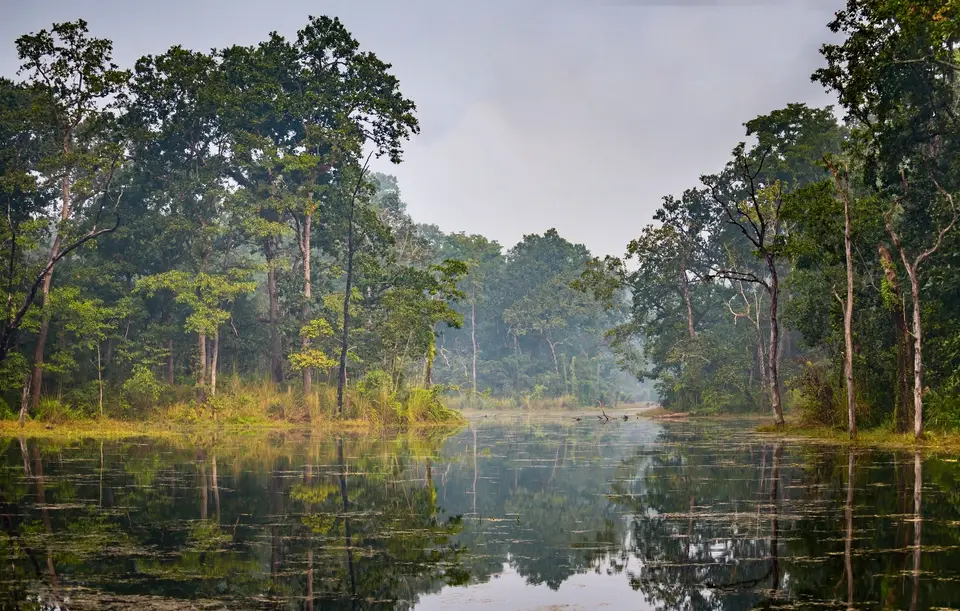
Driven by a humid subtropical monsoon climate (receiving most of its 2,500 millimetres or 98 inches of annual rain across 14 to 15 monsoon weeks from mid-June to late September, followed by dry cool months from October to December when daytime highs drop from 36 to 18 degrees and nights cool to 5 degrees), seasonal river floods and bushfires maintain a shifting botanical mosaic. About 70 percent of the park is cloaked in Himalayan subtropical broadleaf forest dominated by pure stands of sal trees, mixed with chir pine on the southern Churia slopes and beleric alongside rosewood, axlewood, elephant apple, and grey downy balsam and Bauhinia vahlii and Spatholobus parviflorus creepers on northern slopes. Newly deposited river alluvium supports acacia catechu and rosewood alongside kapok and Trewia nudiflora (rhino apple trees whose fruits rhinos relish) over velvety beautyberry alongside hill glory bower and gooseberry shrubs. Meanwhile, Terai-Duar savanna and floodplain grasslands cover 20 percent of the park with over 50 grass species, led by tall elephant grass (Saccharum ravennae) and giant cane (Arundo donax) alongside khagra reed (Phragmites karka) and pioneer kans grass (Saccharum spontaneum).
605 Single-Horned Rhinoceroses alongside 145 Bengal Tigers and Gharials
Across this lush subtropical mosaic live more than 700 species of vertebrate wildlife, including 68 mammal species alongside 543 bird species and 113 fish species. Conservation recovery has been most dramatic for the greater one-horned (single-horned Asiatic or Indian) rhinoceros: rebounding from 95 animals in the late 1960s to 544 around the turn of the century and 605 individuals out of Nepal's total of 645 by 2015 (despite severe poaching waves such as 2002, when poachers killed 37 rhinos for their horns), Chitwan's herd now supplies annual translocations begun in 1986 to safeguard second populations in Bardia and Shuklaphanta National Parks.
Equally celebrated is the park's population of the royal Bengal tiger, which thrives in the prey-rich alluvial floodplains. Growing from roughly 25 tigers at the park's founding in 1973 to between 70 and 110 in 1980, and studied via camera traps from 1995 to 2002 (identifying 82 breeding tigers at a density of 6 females per 100 square kilometres) and 2010 to 2011 (showing 4.44 to 6.35 tigers per 100 square kilometres that shift toward nocturnal activity to avoid daytime human presence), the tiger population in and around Chitwan reached an estimated 145 individuals by 2026. Sharing the forest periphery and hills are Indian leopards, rare camera-trapped clouded leopards (first radio-collared in 1988), striped hyenas on the Churia slopes, packs of dholes (wild dogs), Indian jackals, Bengal foxes, honey badgers, spotted linsangs, yellow-throated martens, crab-eating mongooses, smooth-coated otters, and fishing and jungle cats with leopard cats alongside large and small Indian as well as Asian palm civets. In addition, Chitwan supports the highest population density of sloth bears in the region (200 to 250 individuals), wild Asian elephants (complemented by the Khorsor Elephant Breeding and Training Centre founded in 1985), a herd of gaur (the world's largest wild cattle, which doubled from 188 to 368 animals in Chitwan between 1997 and 2016 plus 112 in Parsa), 18 wild water buffalo translocated from Koshi Tappu Wildlife Reserve in 2016, wild boars, four deer species (chital and sambar alongside red muntjac and Indian hog deer), hill-dwelling four-horned antelopes (choushingas) and Himalayan serows, rhesus macaques, grey langurs, Indian pangolins, crested porcupines, flying squirrels, and black-naped hares and endangered hispid hares.
In the Narayani-Rapti river channels swim mugger crocodiles alongside the critically endangered fish-eating gharial, whose wild Narayani population fell from 235 in the early 1950s to 38 in 2003, prompting the Gharial Conservation Project to collect riverside eggs and rear hatchlings for 6 to 9 years before releasing them into the rivers, while the forest floor shelters the king cobra and rock python and 17 other snake species alongside starred tortoises and monitor lizards. Recognised by BirdLife International as an Important Bird Area with 543 species recorded in 2006 by Bird Conservation Nepal, the park protects the critically endangered Bengal florican, lesser adjutant, grey-crowned prinia, swamp francolin, Oriental darter, and over 200 slender-billed babblers in its tall grasslands and 160 autumn-to-spring migratory species (including greater spotted alongside eastern imperial and Pallas's fish-eagles, brahminy ducks, and goosanders and February flocks of bar-headed geese) and monsoon breeders such as pittas alongside sunbirds and the Indian paradise flycatcher.
Tracking Rhinos and Gharials Across the Rapti Floodplain from Kathmandu
Visiting Chitwan works best between late October and March, when the monsoon humidity retreats, daily temperatures moderate to between 18 and 36 degrees while seasonal grass cutting and controlled burns open sightlines across the Saccharum elephant grass.
Combine river canoeing on the Rapti with guided jeep drives through the sal forests and Beeshazar Lakes.
- Float the Rapti or Narayani rivers by dugout canoe for gharials and waterbirds: Launch at dawn in a traditional dugout canoe along the Rapti or Narayani river border to drift silently past sandbanks where narrow-snouted gharials and broad-snouted mugger crocodiles bask in the sun, while scanning the riverine kapok and rosewood trees for Oriental darters and kingfishers alongside Pallas's fish-eagles and brahminy ducks.
- Traverse the Terai-Duar elephant grass and sal forests by jeep or on foot: Accompanied by two licensed park guides, track single-horned Indian rhinoceroses wallowing in oxbow marshes and browsing on Trewia nudiflora rhino apples, watch herds of chital and sambar deer alert to stalking Bengal tigers and Indian leopards, and look for sloth bears and gaur descending from the Churia Hills in spring.
- Visit the Gharial Breeding Centre alongside Beeshazar Lakes and connect via Kathmandu: Tour the Gharial Conservation Project breeding pools near park headquarters to see 6- to 9-year-old juvenile gharials being raised for river release, and birdwatch around the 2003 Ramsar wetland of Beeshazar Lakes inside the 75,000-hectare buffer zone for Bengal floricans and lesser adjutants. Plan your overland drive or short flight to Bharatpur from our closest city guide in Kathmandu and explore our UNESCO World Heritage Atlas.
