


























Quick Field Data
- UNESCO Inscription: 1980 · Criteria (iii), (vi).
- Scale & Footprint: Vast serial archaeological network of 18 inscribed components across the Taxila Valley on the Pothohar Plateau (549 metres elevation), encompassing a Mesolithic cave alongside four successive settlement mounds (Saraikala, Bhir Mound, Sirkap, and Sirsukh), Buddhist stupas and monasteries, and a medieval mosque and madrassa
- Access & Ticketing: Anchored by the central Taxila Museum (housing Sir John Marshall's excavated Gandharan stone and stucco collection); tickets and local roads connect the museum to the sprawling urban mounds and hilltop monasteries across the valley
- Arrival Logistics: Located in Rawalpindi District, Punjab, Pakistan, 25 to 35 kilometres (16 to 22 miles) northwest of the Islamabad and Rawalpindi metropolitan area along the N-5 National Highway (ancient Grand Trunk Road) and M-1 Motorway, 36.5 kilometres from Islamabad International Airport
Four Successive Cities Across the Pothohar Plateau Crossroads
Positioned at 549 metres (1,801 feet) above sea level on the Pothohar Plateau of northern Punjab, 32 to 35 kilometres (20 to 22 miles) northwest of Islamabad and Rawalpindi along the eastern approach to the Indus River, Taxila (known in Sanskrit as Takṣaśilā, translating as Rock of Taksha or City of Cut Stone, in Prakrit and Pali as Takkhasilā, and in ancient Greek as Táxila) stood for more than a millennium at the strategic junction where the royal Grand Trunk Road from Pataliputra met the Silk Road branches linking China alongside Bactria and the West. On the World Heritage List in 1980 under criteria (iii) and (vi) across 18 serial components, the valley preserves an unbroken archaeological record of urban evolution on the Indian subcontinent: as successive empires conquered the region, rather than rebuilding atop the same site, rulers shifted the capital across the valley floor to found four distinct settlement mounds, specifically Saraikala (Sarai Khola) alongside Bhir Mound (with Hathial), Sirkap, and Sirsukh, surrounded by dozens of Buddhist stupas and hillside monasteries. Empires built four cities here.
Human occupation in the valley began in the Mesolithic and Neolithic eras. At Sarai Khola (Saraikala), 2 kilometres southwest of the Taxila Museum, radiocarbon dates show Neolithic settlement from 3360 BCE (late 4th to early 3rd millennium BCE in Period 1, yielding polished stone celts alongside chert blades and basket-impressed burnished pottery), followed by wheel-thrown Early Harappan and Kot Diji-style wares between 2900 and 2600 BCE and Iron Age graves. Around 1000 BCE, the first urban nucleus of the ancient Gandhara kingdom arose on the Hathial mound (trading with sister capital Puṣkalāvatī by 900 BCE), expanding between 800 and 525 BCE into the adjacent Bhir Mound. Annexed into the Persian Achaemenid Empire as the province of Hinduš after Darius I, king of Persia, campaigned across the region in 516 BCE (until around 330 BCE), Bhir Mound represents the earliest historic city of Taxila: an organic, unplanned maze of rubblestone walls alongside irregular house foundations, soak pits, and winding streets.
In 326 BCE, Bhir Mound witnessed the peaceful arrival of Alexander the Great at Taxila when its local ruler, called Taxiles (Āmbhi) by Greek chroniclers such as Arrian, welcomed the Macedonian army without a battle and hosted gymnastic and equestrian games. Following Alexander's death in 323 BCE and the war between Seleucus and Chandragupta Maurya, the Mauryan Empire absorbed Taxila, sending Chandragupta's grandson Ashoka to function as provincial governor before Ashoka became emperor and transformed the valley into a seat of Buddhist learning (leaving an Aramaic inscription at Taxila). In the mid-2nd century BCE, Greco-Bactrian and Indo-Greek rulers (including the dynasty of Antialcidas) abandoned Bhir Mound and constructed a brand-new fortified capital across the stream at Sirkap. Built strictly on the classical Hellenistic grid system of a long central boulevard intersected at right angles by parallel residential streets, Sirkap remained inhabited under Indo-Scythian ruler Maues (around 90 BCE) and Azilises, and under the Indo-Parthian king Gondophares (who conquered Taxila around 20 BCE, and whose court around 46 to 50 CE is linked in tradition to visits by Thomas the Apostle and the Greek philosopher Apollonius of Tyana, described by Philostratus). After Kujula Kadphises and the Kushans captured the valley by 76 CE, the great Kushan emperor Kanishka founded the fourth and final ancient city to the north at Sirsukh, enclosed within a heavily fortified irregular rectangle of ashlar masonry reinforced by rounded semi-circular bastions.
Ancient Seat of Learning, Multi-Faith Sanctuaries, and Gandharan Monasteries
Across the Vedic alongside Mauryan, Indo-Greek, and Kushan eras, Taxila functioned as South Asia's premier centre of higher learning, celebrated in the Shatapatha Brahmana (which records the 7th-century BCE philosopher Uddālaka Āruṇi and his son Śvetaketu), the Mahabharata (traditionally first recited by Vaishampayana during King Janamejaya's snake sacrifice at Takshashila, where Parikshit was enthroned), the Ramayana (attributing the city's founding to Rama's brother Bharata for his son Taksha), and the Buddhist Jataka tales (such as the Telapatta Jataka). Unlike the later centralised monastic colleges of Nalanda, instruction at Taxila operated through autonomous teachers hosting up to hundreds of students in private households without formal examinations or written degrees; students entered around age sixteen for roughly eight years to master the ancient scriptures and the Eighteen Shilpas (arts including medicine alongside law, military science, archery, and elephant lore), offering a token gurudakshina upon completion. Among the luminaries who taught or studied at Taxila were the Sanskrit grammarian Pāṇini (author of the 4th-century BCE Aṣṭādhyāyī), the political strategist Chanakya (Kautilya, advisor to Chandragupta Maurya), the Ayurvedic physician Charaka, the physician Jīvaka (who treated the Buddha and King Bimbisara of Magadha), and King Prasenajit of Kosala.
When the British archaeologist Alexander Cunningham correctly identified the lost ruins of Taxila at Shah-dheri (one mile northeast of Kâla-ka-sarâi) in 1863 and 64 by following the three-day elephant march from the Indus at Ohind recorded by the 7th-century Chinese pilgrim Xuanzang rather than Pliny's erroneous two-day distance, and when Sir John Marshall conducted his monumental twenty-year excavations starting in 1913, the valley revealed an extraordinary synthesis of Hellenistic alongside Indian, Buddhist, and Jaina architecture. Along the gridded main street of Sirkap, Marshall uncovered private courtyard houses alongside multi-faith shrines in Blocks F and G (which Marshall identified as Jaina temples comparable to Kankali Tila in Mathura, corroborating Jaina texts such as the Āvaśyaka Cūrṇi alongside Vividha Tirtha Kalpa and Prabhavakacharita linking Takshashila to Rishabhanatha, Bahubali's Dharmachakra Tirtha, and Emperor Samprati's Kunala Stupa) as well as stupa shrines and an apsidal temple displaying classical Greek mouldings. Meanwhile, Chinese pilgrim Faxian, visiting around 400 CE, explained how the name Taxila and Sirkap (Baburkhana) came to mean Severed Head from the Jataka story in which Gautama Buddha in a previous life as Chandaprabha offered his head to a hungry lion.
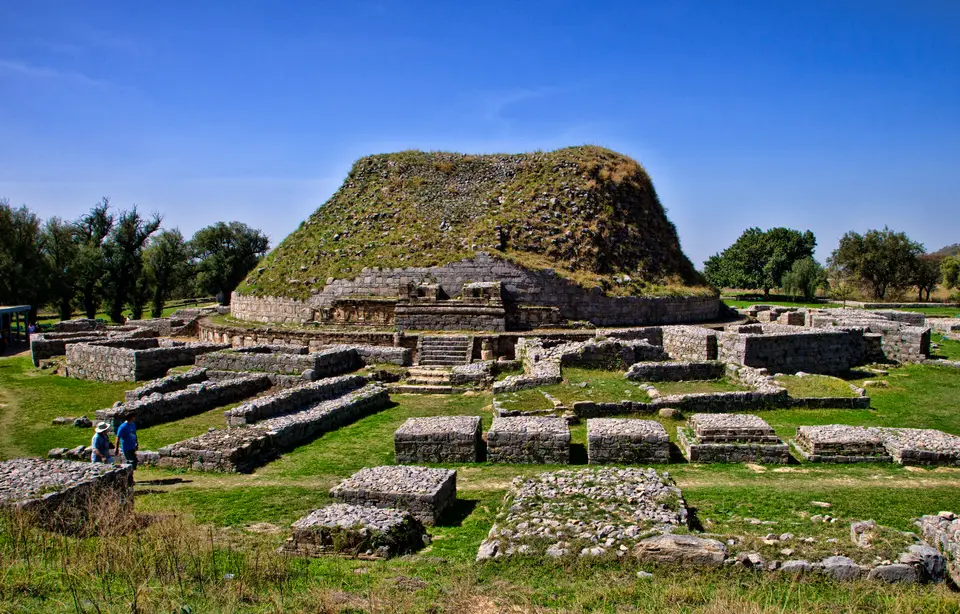
Surrounding the urban mounds stand the great Buddhist monastic complexes that define Gandharan art between the 1st and 5th centuries CE: the massive Mauryan-era Dharmarajika Stupa encircled by a ring of votive chapels; the hilltop Jaulian monastery and Mohra Muradu monastery, where stucco reliefs of the Buddha and attendants survive in situ inside monastic quadrangles; and the Kunala Stupa overlooking Sirkap. After Kidarite raids around 450 CE (repelled by Gupta emperor Skandagupta), the White Huns and Alchon Huns under Mihirakula swept through Gandhara between 470 and 540 CE, torching the monasteries and leaving the sangharamas desolate when Xuanzang visited in 630 CE during his 629 to 645 CE pilgrimage.
Touring the Taxila Museum, Sirkap Grid, and Hilltop Viharas
Today, modern Taxila (population 136,900 in the 2023 census across the city of 75,444 and cantonment of 61,456) is an accessible cultural destination 35 kilometres from Islamabad, where visitors can move directly from the curated galleries of the Taxila Museum to the four settlement mounds and quiet hillside monasteries scattered across the valley.
Organise your valley circuit by starting at the museum before tracing the chronological shift from Bhir Mound to Sirkap and Jaulian.
- Start at the Taxila Museum and inspect adjacent Bhir Mound: Begin your visit at the Taxila Museum (established during Sir John Marshall's twenty-year excavations starting in 1913 and expanded with artifacts from across Gandhara and the Ram Das Collection) to study stone and stucco Buddha sculptures alongside Indo-Greek coins and jewellery. Just outside the museum compound, walk across the undulating rubble foundations and winding streets of the 6th-century BCE Bhir Mound, where King Taxiles received Alexander the Great in 326 BCE.
- Walk the Hellenistic boulevard of Sirkap and the Dharmarajika Stupa: Drive east to the 2nd-century BCE Indo-Greek walled city of Sirkap to walk its straight axial street flanked by courtyard residences alongside Jaina and Buddhist shrines in Blocks F and G and classical stupa bases. Pair Sirkap with the circular mound of the Dharmarajika Stupa and the rounded ashlar bastions of Kanishka's Kushan city at Sirsukh to the north.
- Climb to the stucco chapels of Jaulian and Mohra Muradu: Follow the valley roads into the surrounding Margala hills to visit the 1st- to 5th-century CE hillside monasteries of Mohra Muradu and Jaulian, where tiered votive stupas and monastic cells preserve original Gandharan stucco carvings (monitored under 2026 UNESCO conservation warnings to prevent improper cement repairs). From the Grand Trunk Road (N-5) and Nicholson's Obelisk, explore other Silk Road cities across our UNESCO World Heritage Atlas.
