Photo: Winny Biets · CC BY 4.0
The Cathedral, the Grote Markt and the Old Town
Belgium's largest Gothic church, four Rubens altarpieces, restored Renaissance City Hall, 1591 Vlaeykensgang and medieval Het Steen.
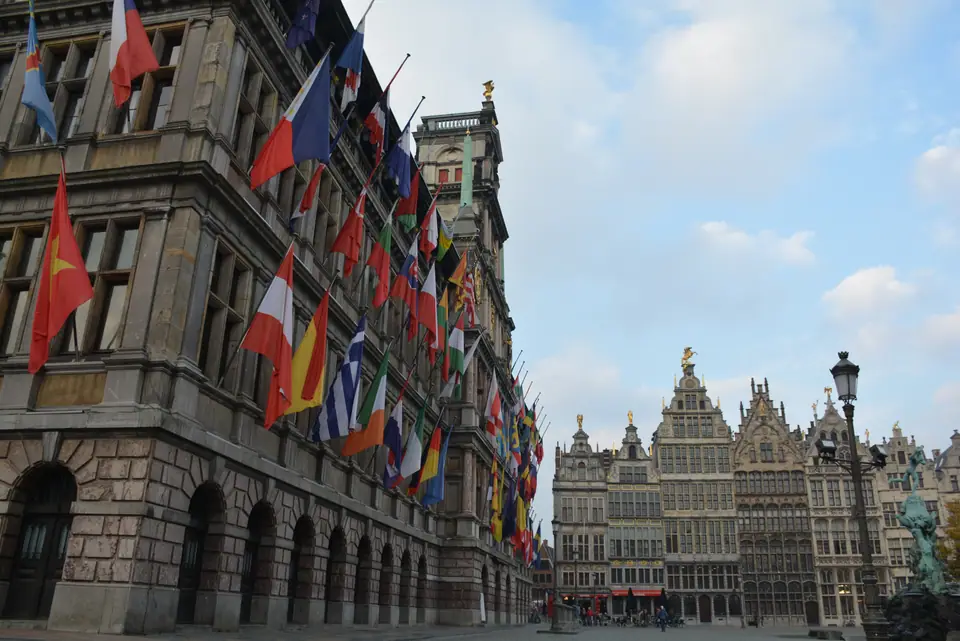
Antwerp's Historic Centre reads like a stone ledger of disasters survived and painstakingly rebuilt. Its cathedral rises across seven Gothic aisles beneath a 123-metre north belfry while its matching south tower halts abruptly halfway up at 65.3 metres. Nearby on Grote Markt, Renaissance City Hall burned down to scorched outer walls just eleven years after completion during the 1576 Spanish Fury. Following major conservation from 2018 to 2022, its restored facade faces the guildhalls ringing Brabo Fountain.
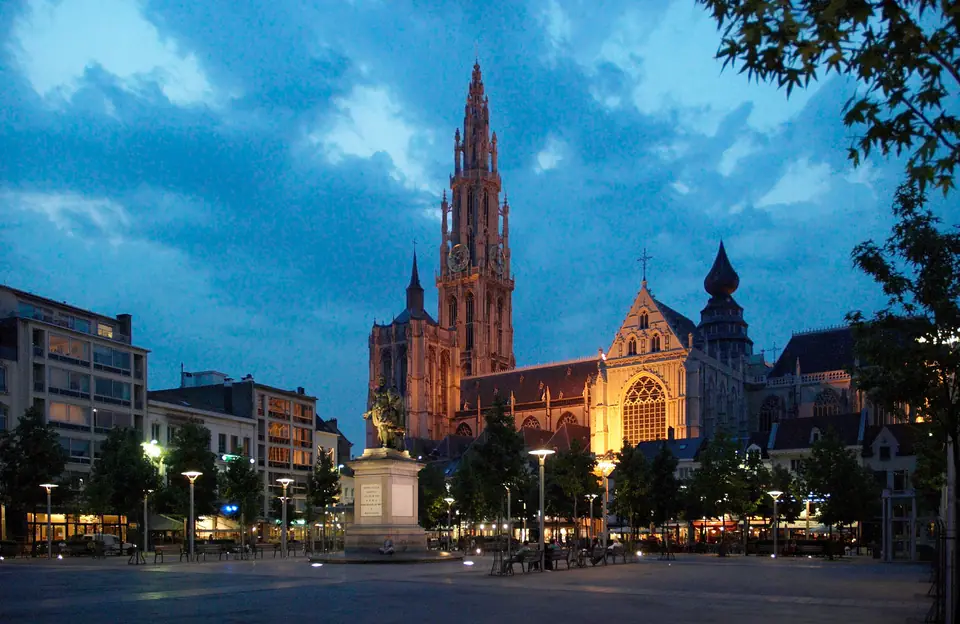
Seven Gothic aisles and an unfinished south tower
Architects Jan and Pieter Appelmans began building the Cathedral of Our Lady in 1352. Main medieval campaigns closed in 1521 with the south belfry capped forever at 65.3 metres, leaving a 57.7-metre gap below the UNESCO-listed 123-metre north spire. Spanning 8,000 square metres inside, the monument stands as Belgium's largest Gothic church. Seven broad aisles rest on 125 columns and piers lit by 128 windows, including 55 stained-glass compositions.
Measured from altar wall to west doors, the interior stretches 118 metres long and 53.5 metres wide beneath a 28-metre central nave vault. Stripped of bishopric rank under the 1801 Concordat until cathedral status returned in 1961, the pale stone sanctuary seats 2,400 worshippers and holds up to 25,000 standing. Its finished north tower enters the UNESCO Belfries of Belgium and France heritage listing jointly with Antwerp City Hall across nearby squares.
| Cathedral dimension | Verified figure |
|---|---|
| North spire / South tower | 123 metres / 65.3 metres. |
| Interior length / Maximum width | 118 metres / 53.5 metres. |
| Central nave height / Floor area | 28 metres / 8,000 square metres. |
| Aisles, pillars and windows | 7 aisles, 125 pillars, 128 windows (55 stained glass). |
| Schyven pipe organ / Carillon | 90 registers, 5,770 pipes / 49 bells. |
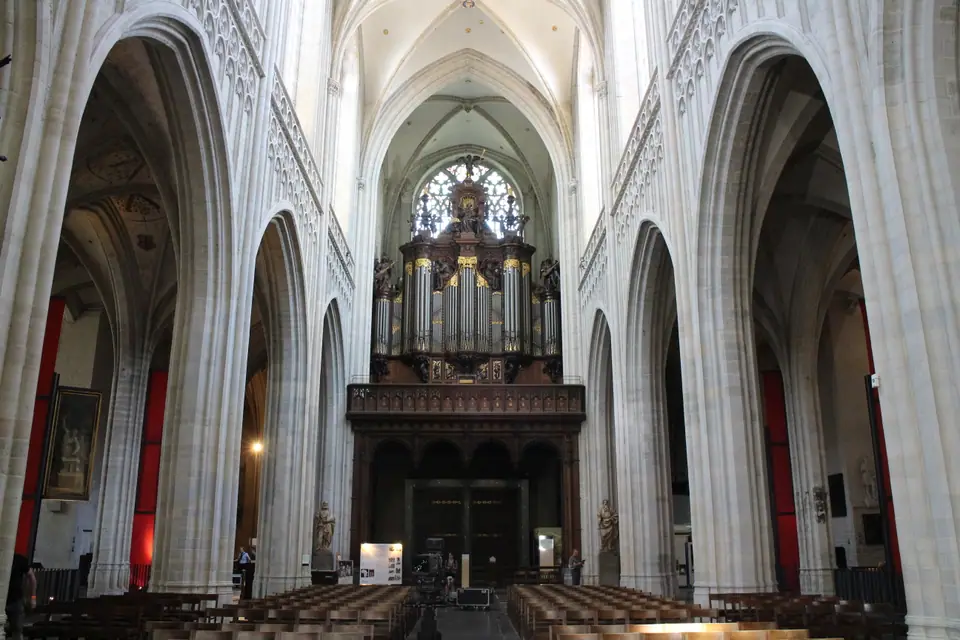
Rubens triptychs inside a church rebuilt four times
Walk through the nave and notice how Baroque paintings anchor an earlier medieval shell. Fires on 5 and 6 October 1533 destroyed 57 side altars. Then the 1566 Beeldenstorm iconoclast wave smashed interior sculptures and stone altarpieces. Eyewitness Richard Clough watched above 10,000 torches lighting the wrecked choir. Later shocks struck repeatedly. French revolutionaries plundered canvases in 1794 before key works returned from Paris in 1816 after Waterloo, ahead of nineteenth-century Gothic Revival refurnishing. German forces looted paintings after the 1914 Siege for transfer to Berlin until restitution followed the 11 November 1918 Armistice. Thorough architectural restoration ran for 28 years from 1965 to 1993, leaving today's luminous pale stonework.
After medieval altars vanished in 1566, Peter Paul Rubens's Counter-Reformation paintings became the cathedral's focal artworks. Stand beneath The Raising of the Cross (1610 to 1611), The Descent from the Cross (1612 to 1614), The Resurrection of Christ (1611 to 1612) and The Assumption of the Virgin (1626). High above the vaults sound the nineteenth-century Schyven romantic pipe organ (90 registers and 5,770 pipes) and a 49-bell carillon. Its heaviest bourdon bell, Karolus, weighs 6,434 kilograms and dates to 1507 castings by Willem and Jaspar Moer. Explore the studio behind those triptychs in our Golden Age museum guide.
| Year | Cathedral crisis or restoration milestone |
|---|---|
| 1533 | October fire destroys 57 altars. |
| 1566 | Beeldenstorm iconoclasm wrecks interior furnishings. |
| 1794 / 1816 | French plunder followed by post-Waterloo return from Paris. |
| 1914 / 1918 | Siege looting returned after Armistice. |
| 1965 to 1993 | Complete 28-year structural restoration. |
Habsburg stone and sixteenth-century guildhalls on Grote Markt
Walk 0.1 kilometres northwest onto Grote Markt to examine Cornelis Floris de Vriendt's Renaissance City Hall (1561 to 1565, with primary masonry dating 1561 to 1564). Municipal builders chose it instead of Domien de Waghemakere's unbuilt 1540 Gothic plan. Blending Flemish gables with Italian proportions, the facade stacks ground-floor arcades once rented as shops beneath Doric and Ionic storeys lighting upper state halls. An open fourth-floor gallery sits beneath a gilded central gable carrying statues of Justice, Prudence and the Virgin Mary over Habsburg and Brabant arms.
Barely eleven years after those royal arms went up, Spanish mutineers burned City Hall to a shell on 4 November 1576 during the Spanish Fury, forcing rebuilding around 1579. Listed under UNESCO's Belfries of Belgium and France heritage entry, City Hall completed full interior and exterior restoration between 2018 and 2022. Ringed by sixteenth- and seventeenth-century guildhalls and Jef Lambeaux's 1887 Brabo Fountain, the plaza stays calm before breakfast before diners fill Groenplaats chip stalls and Old Town breweries.
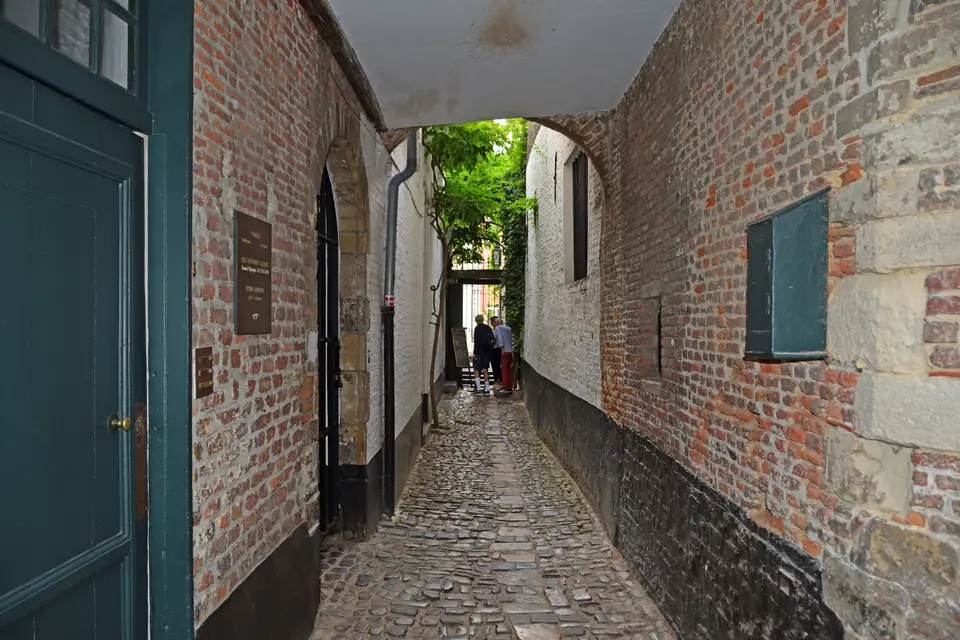
Hidden Vlaeykensgang cobbles and Groenplaats crossroads
Step 0.1 kilometres south from the Cathedral facade into pedestrian Groenplaats, centred around Pieter Paul Rubens's bronze statue and historic Fritkot Max chip stand (linking back to 1842 heritage). Roughly 0.2 kilometres away off Oude Koornmarkt 16 hides Vlaeykensgang, a cobblers' and cathedral bellringers' passage built in 1591. Ducking through its low timber doorway leaves heavy tram traffic behind for whitewashed walls and quiet courtyard calm in seconds.
Het Steen ramparts guarding the Scheldt quay
Continue 0.4 kilometres west to Steenplein 1 on the Scheldt riverbank, where Het Steen preserves Antwerp's oldest surviving stone building. Raised between 1200 and 1225 on ninth-century earthworks, its stone gatehouse holds Visit Antwerpen's Visitor Centre and the Antwerp City Shop. Visitors pick up neighbourhood maps inside before browsing local books and food souvenirs. Upstairs rooms stage the 11-room Antwerp Story exhibition below a free rooftop promenade facing freighters and Het Eilandje docks. Pair these riverfront monuments with our three-day walking route and Old Town lodging comparisons.
Where it is
- 1The Cathedral, the Grote Markt and the Old Town
- Brussels Airport (BRU) · about 36 km from here in a straight line
- Directions in Google Maps
Stations and taxi ranks: OpenStreetMap. Airports: OurAirports. Distances are in a straight line.
Traveller tips
Real advice from people who have been to Antwerp. Every tip is read by our team before it goes live.
No tips yet. Been here? Yours could be the first.
Thank you! Your tip will appear here after a quick review.
More in Antwerp
Continue exploring Antwerp with related neighbourhood, food, and planning guides