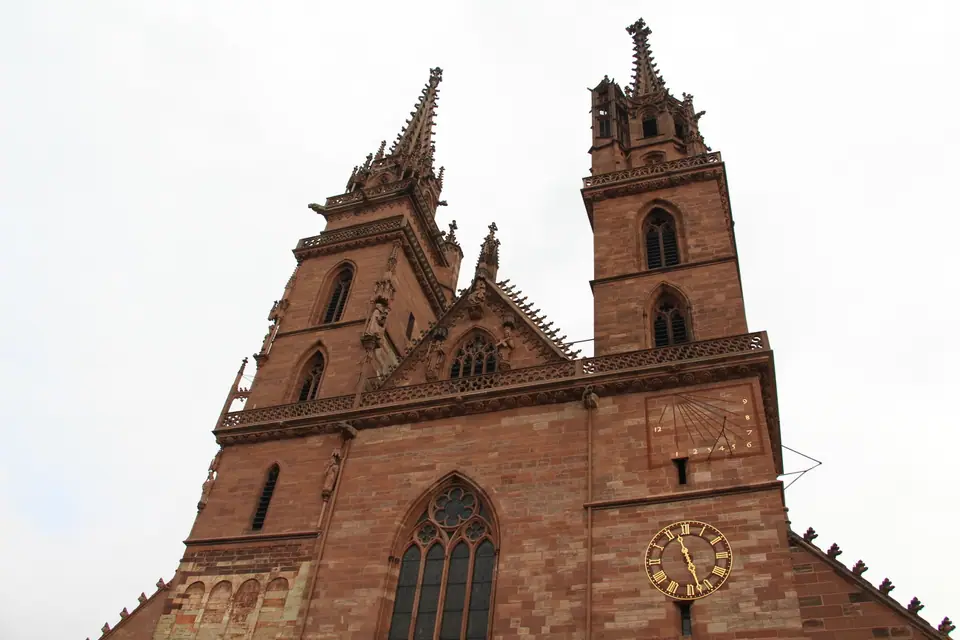
Photo: Fred Romero from Paris, France · CC BY 2.0
Red Sandstone Above the Bend: Inside Basel Minster
A Romanesque and Gothic red-sandstone cathedral rebuilt after the 1356 earthquake, crowned by glazed tiles and twin spires above the Pfalz terrace.
Twin slender spires of warm red Wiesental sandstone mark Grossbasel's high river bluff long before you climb off Marktplatz cobbles. Basel Minster (Basler Münster, MYOON-ster) preserves two architectural eras fused into one church. Its construction spanned nearly five centuries from the 1019 crypt consecration under Emperor Henry II to the south tower finish in 1500. Circle its outer walls and courtyard cloisters before stepping inside. Scars from medieval earth tremors read plainly across its weathered red stone blocks.
From the 1019 Crypt to the 1356 Collapse
Although Basel gained a bishopric during the eighth century, excavated foundations trace the earliest documented cathedral predecessor to the ninth century. Emperor Henry II then presided over consecrating a new Ottonian crypt and church in 1019. Starting in the late twelfth century, masons erected a sturdy late Romanesque sandstone basilica completed around 1225. That church framed a lofty choir and five skyline steeples ahead of late thirteenth-century west facade carving. Geometric multicoloured glazed roof tiles still signal that soaring nave silhouette miles across surrounding hills, catching low winter rays above white plaster gables. Afternoon sun brings warm ochre tones straight out of weathered stonework.
Disaster struck violently on 18 October 1356, when the catastrophic Basel earthquake toppled the choir, stone vaults, and all five steeples across Münsterhügel. Master builder Johannes Gmünd led urgent Gothic repairs using warm red sandstone quarried in the Wiesental and Degerfelden. Craftsmen reconsecrated the main altar just seven years later in 1363. Inside the nave, compare heavy rounded Romanesque ground-level piers against tall pointed Gothic upper ribs to see exactly where fourteenth-century repair masonry takes over above twelfth-century stone. Look closely round the ambulatory walls to appreciate how builders preserved carved Romanesque capitals beneath crisp vaulted ceilings.
Georgsturm, Martinsturm and the 250-Step Climb
Instead of rebuilding five separate steeples, Gothic masons focused height and delicate stonework onto two contrasting western spires framing the main portal. On the left rises the northern Georgsturm, finished around 1428 to 1429 with design input from Ulm master Ulrich von Ensingen and listed by cathedral surveyors at 67.3 metres. Opposite stands the southern Martinsturm, completed by Hans Nussdorf on 23 July 1500 at 65.5 metres. Some external handbooks cite 64.2 and 62.7 metres instead. Sculpted equestrian figures of Saint George and Saint Martin flank lower buttresses facing Münsterplatz gravel. Fine Gothic tracery catches passing light cleanly above narrow cathedral doors.
Climb 250 tight spiral stone steps inside the twin towers up to an airy panoramic walkway bridging both spires. The ascent starts past thick sandstone blocks before winding past bell chambers toward open stone balustrades. From that high open gallery, scan Mittlere Brücke, all four reaction-ferry cables, and industrial barges turning below Kleinhüningen. Beyond Kleinbasel rooftops stretch wooded Vosges and Black Forest ridges across France and Germany. Watch how steep nave tiles form crisp chevron patterns far below your feet when stepping across the central skybridge. Check daily tower access updates on baslermuenster.ch beforehand, as icy winter steps or organ rehearsals occasionally close upper stairwells.
Gallus Portal, Erasmus's Marble Tomb and the Pfalz
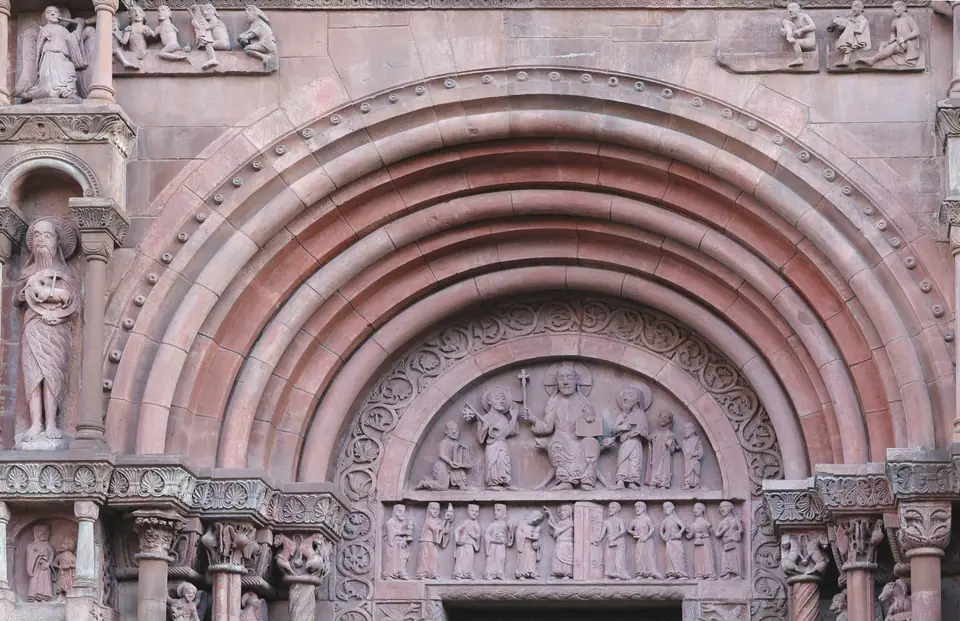
Start at the north transept entrance to inspect the Galluspforte (Gallus Portal, carved around 1185), hailed as one of the finest surviving Romanesque sculptural doorways north of the Alps. Crisp limestone figures show Christ enthroned above the Wise and Foolish Virgins and medieval acts of mercy, surviving the 1356 shock remarkably intact. Notice how deep architectural recesses protect finely chiselled robes from winter rain. Inside the sanctuary, Reformation iconoclasm struck fiercely across 1528 and culminated on 9 February 1529. That uprising ended Basel's Catholic bishopric, cleared gilded altars away, and turned the cathedral into a quiet Reformed Protestant church. Later church halls hosted the University of Basel's 1460 opening, forging close civic ties between town scholars and cathedral clergy. Stone carvings reward unhurried inspection before stepping inside the bright nave.
That serene Reformed stillness highlights a remarkable Renaissance memorial beside the north aisle. Dutch humanist scholar Desiderius Erasmus of Rotterdam settled in Basel with printer Johann Froben, whose press issued Erasmus's 1516 Greek New Testament. Erasmus died here in 1536 and rests beneath a bold red marble tablet carved with Latin inscriptions. Farther along the outer north aisle, inspect the Romanesque Vincentiustafel sandstone relief carved around 1200, depicting episodes from Saint Vincent of Zaragoza's martyrdom in sharp medieval carving. Sunlight slanting through tall plain lancets illuminates dark oak stalls and sculpted sandstone capitals quietly.
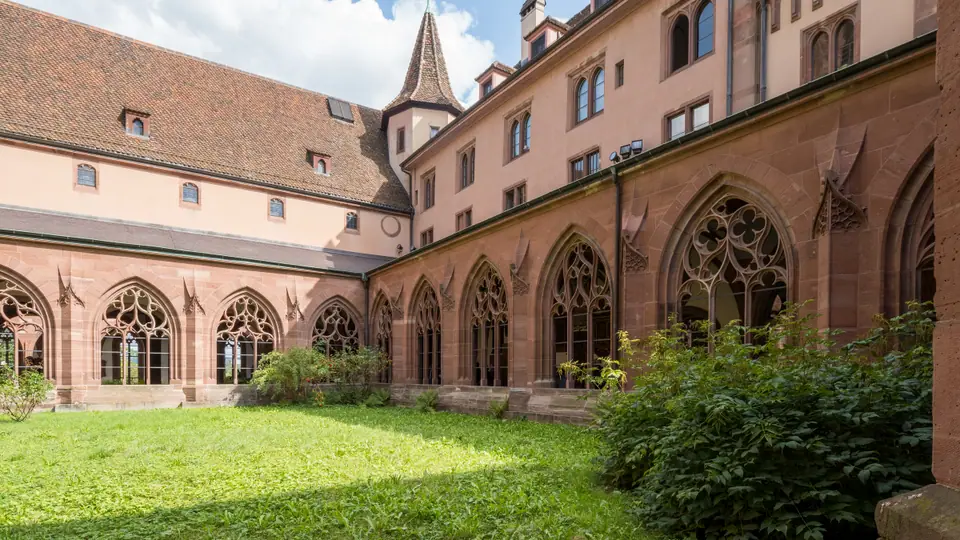
Step through southern nave doors straight into the peaceful fifteenth-century Kreuzgang double cloisters, where leafy enclosed arcades display carved stone epitaphs for Basel mayors, scholars, and reformers. Look inside the quiet courtyard corners for Bettina Eichin's moving bronze Markttische sculpture. Commissioned in 1986 and recast after the 1 November 1986 Schweizerhalle chemical fire, one table stands heaped with fruit and flowers while the second lies bare, permanently installed here in 2010. Quiet stone benches encourage slow reflection underneath tall medieval courtyard vaults.
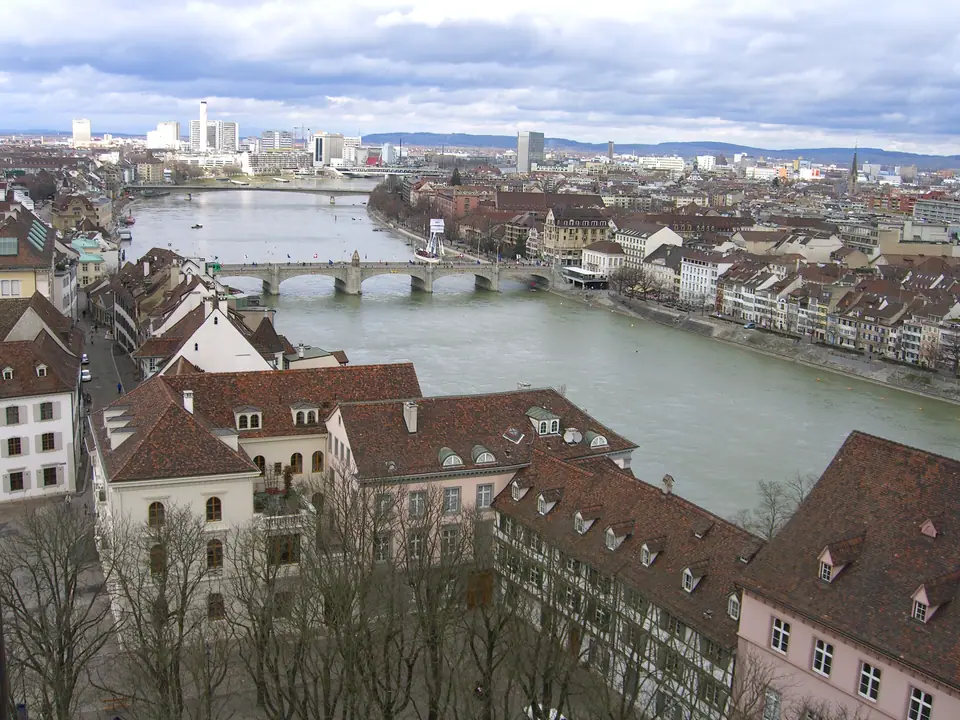
Exit directly behind the eastern choir apse onto the shaded Pfalz bastion terrace, dropping roughly 20 metres sheer above the rushing green Rhine bend. Chestnut trees frame benches looking straight down onto the wooden Münster reaction ferry gliding smoothly without an engine. Walkers pause here watching river barges push upstream against current eddies before descending stone stairs toward St. Alban or Kleinbasel streets. After touring nearby Kunstmuseum wings, linger here near dusk when low western sunlight sets red sandstone glowing warm above dark green water. Calm evening bells sound clearly across river bends below the terrace. Early risers enjoy peaceful flagstones completely free of mid-morning sightseeing groups.
Where it is
- 1Red Sandstone Above the Bend
- EuroAirport Basel–Mulhouse–Freiburg (BSL) · about 7 km from here in a straight line
- Directions in Google Maps
Stations and taxi ranks: OpenStreetMap. Airports: OurAirports. Distances are in a straight line.
Traveller tips
Real advice from people who have been to Basel. Every tip is read by our team before it goes live.
No tips yet. Been here? Yours could be the first.
Thank you! Your tip will appear here after a quick review.
More in Basel
Continue exploring Basel with related neighbourhood, food, and planning guides