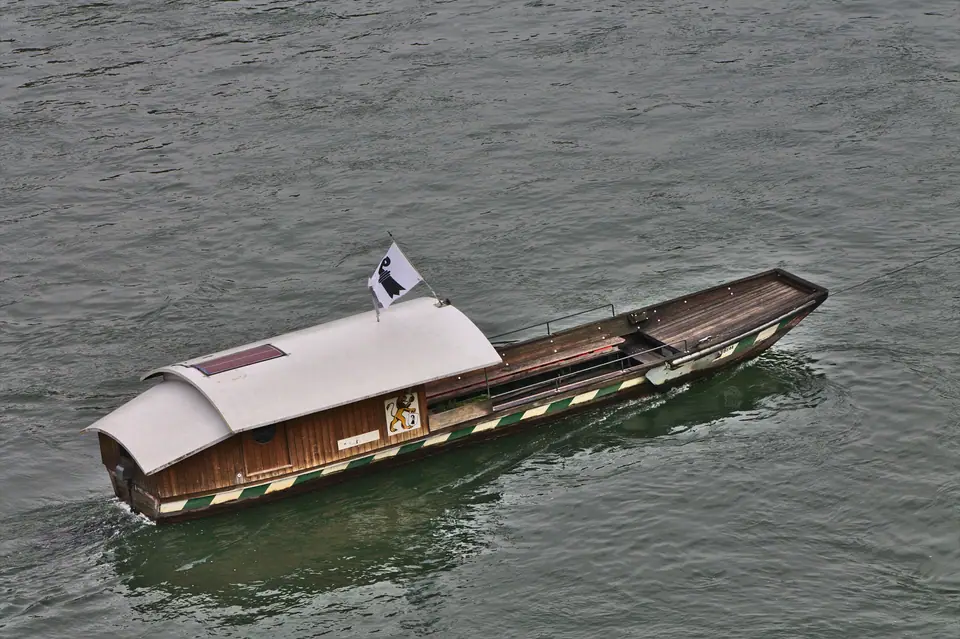
Photo: Jacek Rużyczka · CC BY-SA 4.0
Cable Ferries, Gotthard Granite and Guildhalls
How one 13th-century bridge united two riverbanks, why four wooden boats cross on steel cables without engines, and where Grossbasel lanes climb.
Few European riverfronts stitch daily transit into medieval streets as smoothly as Basel's sharp elbow between Grossbasel and Kleinbasel. One unhurried loop connects Münsterhügel stone terraces with Gotthard granite arches, silent wooden cable ferries, crimson guildhalls, and rushing paper-mill streams. Walking both banks explains physically how a single 13th-century river span merged two opposing settlements into one Swiss city.
Bishop Heinrich's Loan and the 1225 Crossing
Before the 1220s, wooden rowboats offered the sole crossing over fast Alpine water dividing Basel's left-bank bluff from empty right-bank gravel flats. First documented in a 1223 loan charter where Bishop Heinrich pawned cathedral treasure to build wooden piers, the bridge already carried traffic by 1224 and gained 30-silver-mark monastery toll exemptions in 1225. Spanning the water spurred settlement around right-bank Kleinbasel, which formally united with Grossbasel in 1392 ahead of Basel's 1501 Confederation entry. Stone bridge tolls funded riverside repairs steadily through shifting civic fortunes.
Gotthard Granite and the Käppelijoch Shrine
Between 1903 and 1905, architects Emil Faesch and Friedrich von Thiersch rebuilt older piers as today's Mittlere Brücke, opening the 192-metre-long, 18.8-metre-wide crossing on 11 November 1905. Tough grey granite from the north flank of the Saint-Gotthard massif faces its seven arches, six standing in water and one spanning Kleinbasel's footpath. Planners banned private cars in early 2015 and widened bridge pavements in 2017. Above its central river pier perches the stone Käppelijoch replica shrine marking medieval legal sentences.
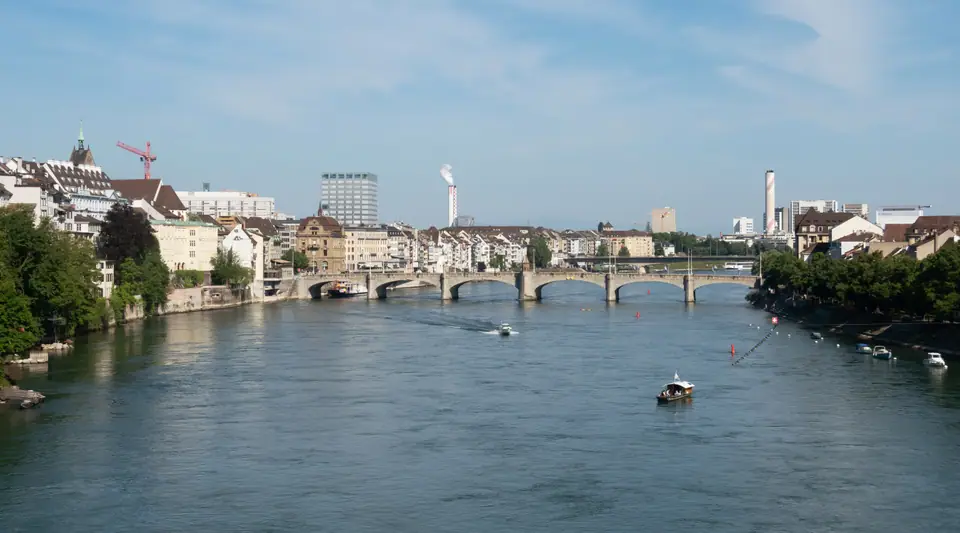
Scan bridge parapets carefully for three distinct public bronzes recalling local civic debates. Near Kleinbasel stands Carl Burckhardt's muscular figure Amazon, left uncast when the sculptor died in 1923. South across the deck, Bettina Eichin's seated suitcase-watching Helvetia auf der Reise has gazed upstream since 1980. Peer below water level near the Kleinbasel abutment in dry months to spot Ludwig Stocker's 1992 submerged stone figure Lagerstätte honouring six centuries of two-bank union. Pedestrians pause easily here watching river traffic steer cleanly between stone piers.
How Four Wooden Ferries Sail Across an Overhead Wire
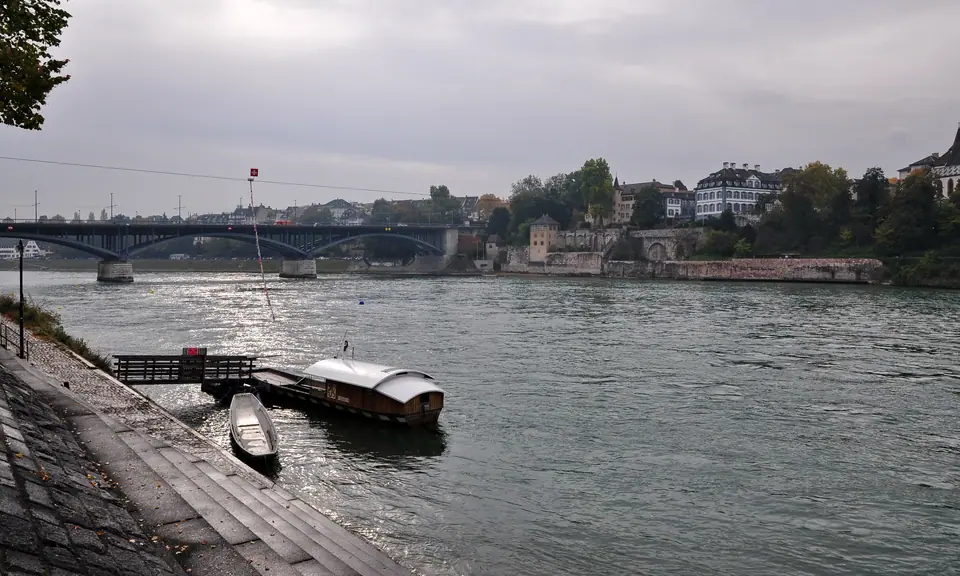
Between five fixed road and rail bridges ply Basel's quietest engineering heirlooms: four wooden motorless reaction ferries run by the Fähri-Verein Basel. Each flat-bottomed hull hangs from a rolling pulley riding along a high steel cable slung bank to bank. Turning the wooden rudder angles the boat diagonally against rushing Alpine water, sailing the craft silently across like a river kite. Four boats cover separate corridors: St. Alban-Fähre (Wild Maa), Münster-Fähre (Leu), Klingental-Fähre (Vogel Gryff), and St. Johann-Fähre (Ueli). Stepping aboard feels gentle and steady even while swift river eddies swirl cleanly beneath timber planks.
Their dialect names honour Kleinbasel's three honourable societies. Each January (13, 20, or 27 January), their heraldic figures (Wild Maa, Leu, and Vogel Gryff) plus jester Ueli dance across Mittlere Brücke with backs turned toward Grossbasel. Floodwaters halt ferry boats temporarily when Alpine snowmelt rises high, so check live flags on faehri.ch before descending river stairs. Daily commuters, schoolchildren, and market shoppers treat those wooden boats as calm shortcuts across the bend.
Reading the Red Sandstone Rathaus on Marktplatz
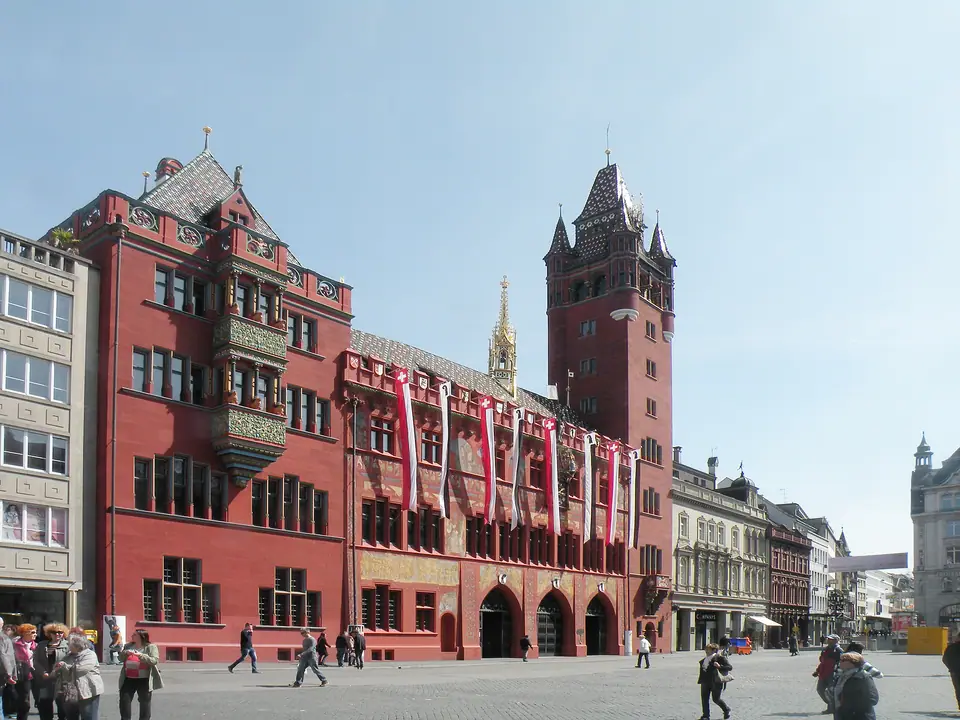
Walk one flat block uphill from Mittlere Brücke onto Marktplatz to inspect Basel's vivid crimson Rathaus. After the 1356 quake destroyed the old court hall, Basel's Grand Council built this dramatic red-sandstone wing from 1504 to 1514, crowning battlements with cantonal shields. Later additions added flanking council halls from 1517 to 1521. Step straight into the shaded arcade courtyard to admire Hans Bock's painted trompe-l'oeil murals and stone traces echoing Hans Holbein the Younger's lost 1522 frescoes, fragments of which hang inside Kunstmuseum Basel. Active cantonal parliament sittings still occupy upper chambers while courtyard flags welcome daytime visitors. Bright heraldic paint glows sharply beneath overcast river skies.
Cobbled Hills from Andreasplatz up to Spalentor
Duck behind Marktplatz retail rows into traffic-free stepped alleys climbing Grossbasel's western ridge. Quiet Andreasplatz frames a shaded neighbourhood fountain beneath tilted shutters before steep Nadelberg and Spalenberg twist past craft bookbinders, hat makers, and Läckerli shops. Guild crests still hang above narrow timber doorways where sixteenth-century printers and artisans traded. At Nadelberg's crest rises the circa-1400 Spalentor tower, guarding the historic Alsatian road beneath patterned roof tiles and stone carvings. Nearby Petersplatz trees shade campus benches where university students read between lectures, while quiet side lanes drop gently back toward Fischmarkt fountains.
St. Alban-Tal and the Water-Powered Paper Mill
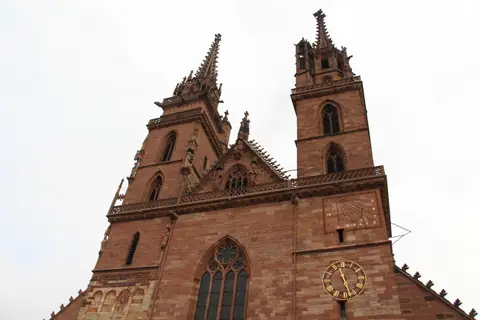
Loop back east past Minster spires down steep stone ramps into medieval St. Alban-Tal. Monks engineered the swift St. Alban-Teich stream channel here so heavy timber waterwheels kept turning smoothly beneath guild cottages. Stepping across wooden canal footbridges passes the 1453 Gallizian Paper Mill and intact city ramparts straight out to the St. Alban ferry landing. Shaded willow paths follow the embankment back toward Wettsteinbrücke with quiet water views, linking centuries-old canal stone directly onto sunny riverside promenades.
Drifting Downstream With a Wickelfisch in Summer
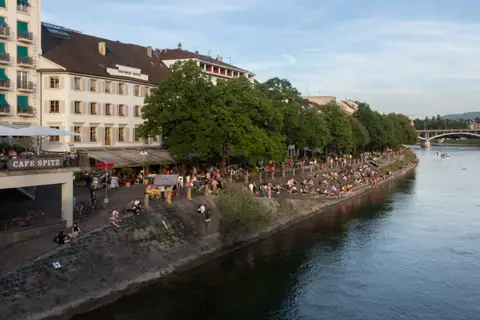
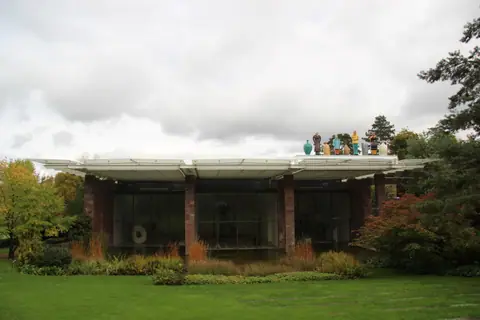
From late June through early September, Kleinbasel's gravel bank from Museum Tinguely past Wettsteinbrücke toward Dreirosenbrücke transforms into Basel's favourite evening commute. Swimmers fold shirts, sandals, and keys inside bright fish-shaped Wickelfisch (VICK-el-fish) dry bags invented in Basel and float calmly downriver on warm summer afternoons. Confirm official gauge thresholds first: water above 18 °C, level under 650 centimetres, and height below 246.5 metres. Keep clear of cargo barges, bridge piers, and ferry cables, and never strap any dry bag around your wrist or waist. Warm summer evenings fill grass slopes peacefully with reading groups and acoustic guitars. Swimmers fold gear cleanly before riding central trams home dry.
Where it is
- 1Cable Ferries, Gotthard Granite and Guildhalls
- EuroAirport Basel–Mulhouse–Freiburg (BSL) · about 7 km from here in a straight line
- Directions in Google Maps
Stations and taxi ranks: OpenStreetMap. Airports: OurAirports. Distances are in a straight line.
Traveller tips
Real advice from people who have been to Basel. Every tip is read by our team before it goes live.
No tips yet. Been here? Yours could be the first.
Thank you! Your tip will appear here after a quick review.
More in Basel
Continue exploring Basel with related neighbourhood, food, and planning guides