


























Photo: CAPTAIN RAJU · CC BY-SA 4.0
St Martin's Cathedral, the Coronation Story & Most SNP
How royal Habsburg pageantry, lost Jewish heritage at Rybné námestie, and 1970s cable-stayed concrete meet within 200 metres.
No block in Bratislava packs sharper historical contrast than the western edge of Staré Mesto. Within roughly 200 metres, travellers walk across Hungarian royal coronation flagstones inside St Martin's Cathedral. Mere steps away, visitors confront the erased outline of an 1893 synagogue beside a busy highway slip road. Just beyond, an angled elevator climbs 95 metres above the Danube inside Most SNP.
Seen together, those adjacent landmarks explain Bratislava more clearly than any polished postcard ever manages. Quiet cobbled Kapitulská Street sits just behind the choir walls, giving a stark acoustic shift before descending into the pedestrian underpass toward the river. Stepping softly from vaulted Gothic shadows onto breezy sunlit river piers compresses royal history, urban renewal, and modern bridge engineering neatly inside an unhurried short walk. Set aside clear morning or late-afternoon daylight to balance solemn nave stillness with open Danube horizons.
Two Centuries of Hungarian Coronations
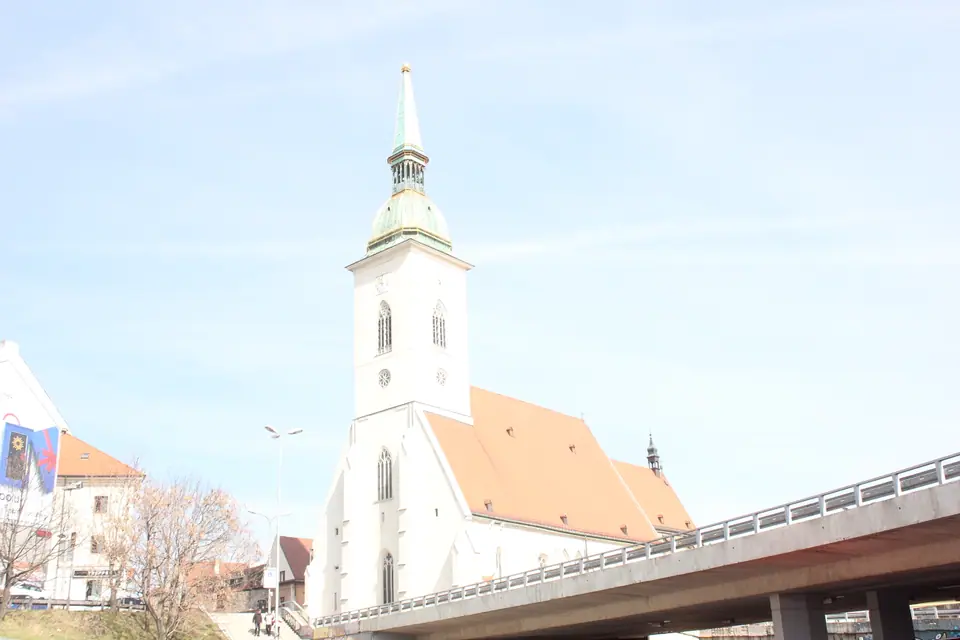
Katedrála svätého Martina (St Martin's Cathedral) began as a Romanesque church consecrated in 1221 against western city fortifications. Builders later shaped its tall three-aisled Gothic nave between 1311 and 1452, before nineteenth-century restorers sharpened stone window tracery from 1869 to 1877. Measuring 69.37 metres long, 22.85 metres wide, and 16.02 metres under stone ribs, the sanctuary assumed royal standing once Ottoman advances drove the Hungarian crown court north to Pressburg.
For 267 years stretching from 1563 to 1830, St Martin's hosted nineteen royal coronations. Eleven kings and ruling queens received the sacred crown inside these stone walls, famously including Empress Maria Theresa in June 1741, plus eight royal consorts. Heraldic crests and historic banners preserve royal Habsburg pageantry high along choir bays. Coronation parades once wound straight from sanctuary doors up steep cobbled approaches toward castle ramparts while townsfolk watched from timber gables. Check cobblestones carefully when strolling back along Kapitulská toward Michael's Gate and Hlavné námestie, where small inlaid brass crowns mark the royal horseback route.
The Gilded Crown Above St Martin's Nave
Look straight up toward the 85-metre western steeple before entering the heavy oak doors. Resting on a 1.2-metre gilded pillow sits a glowing 1.64-metre, 150-kilogram gilded copper replica of St Stephen's Crown. Artisans hoisted the crown into position in 1847 and recoated it in roughly eight kilograms of gold leaf during 2010 conservation works. Golden rays catch the spire clearly from castle bastions, Danube embankments, and narrow Old Town lanes alike.
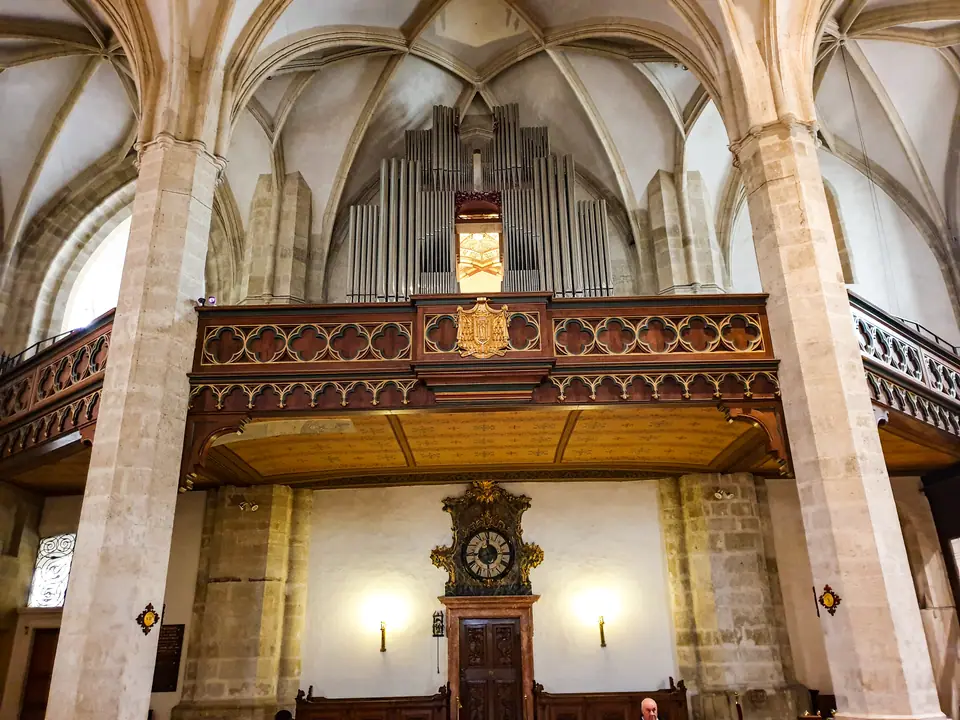
Step quietly inside the cool nave to study Georg Rafael Donner's dynamic 1735 baroque lead sculpture on the north aisle altar. Carved with theatrical motion, St Martin leans from horseback to slice his cloak cleanly for a kneeling beggar. Soft daylight slips past tall stained-glass lancets onto worn red marble slabs marked gently by centuries of footsteps. Pause beneath soaring masonry pillars and carved wooden organ lofts to appreciate gentle stone acoustics away from bridge noise.
Nearby open the Gothic Chapel of St John the Merciful and silent lower masonry crypts housing local archbishops. Check parish worship timetables posted outside the cathedral door so architectural visits avoid active Mass services. Few European coronation churches sit so tightly next to an elevated urban motorway ramp.
Missing Synagogue Footprint at Rybné Námestie
Leaving the cathedral's western threshold delivers sobering architectural contrast as concrete slip roads curve mere yards past medieval limestone buttresses. From 1893 until 1969, Fish Square (Rybné námestie) below the castle hill held Pressburg's twin-domed Moorish-Revival Neolog Synagogue. That landmark anchored dense streets of historic Jewish Podhradie, where timber town houses, bakeries, kosher butcheries, bookshops, and small workshops climbed tightly up the castle slope.
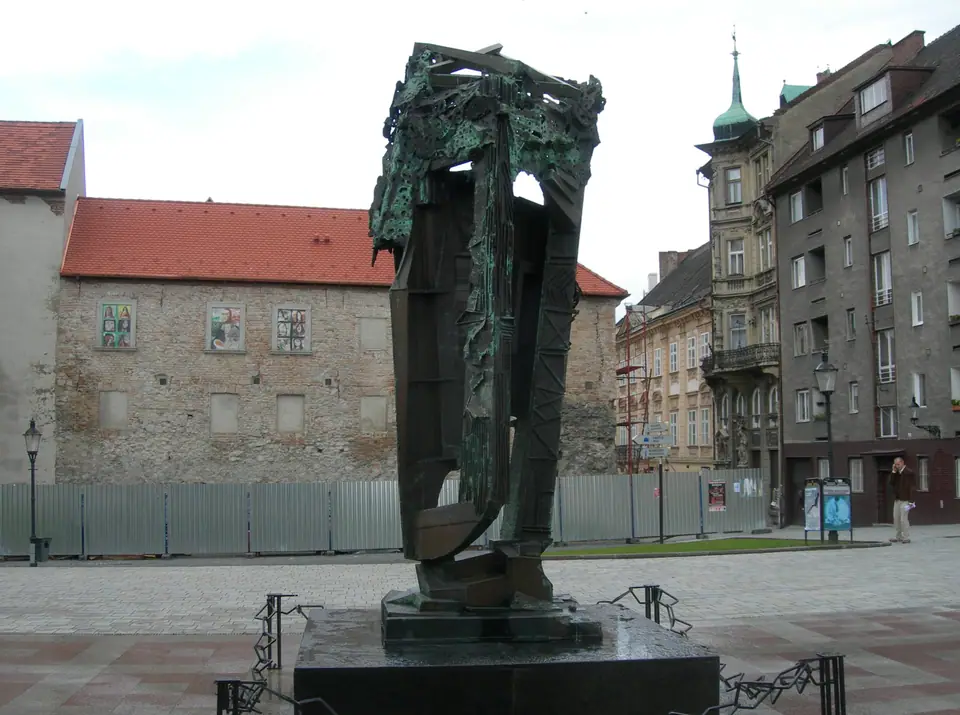
State planners flattened the synagogue and whole surrounding alleys in 1969 to punch heavy road lanes straight onto the new Danube bridge. Today, Milan Lukáč's haunting 1996 bronze monument rises beside an etched black granite wall tracing the vanished twin domes. Brass plaques, carved inscriptions, and dark stone outlines trace vanished doorways where worshippers once crossed cobblestone thresholds. Quiet stone benches beside the dark memorial wall recall roughly 105,000 Slovak Holocaust victims right next to rough-hewn stretches of surviving fourteenth-century defensive wall.
Engineering the Asymmetric Most SNP Pylon
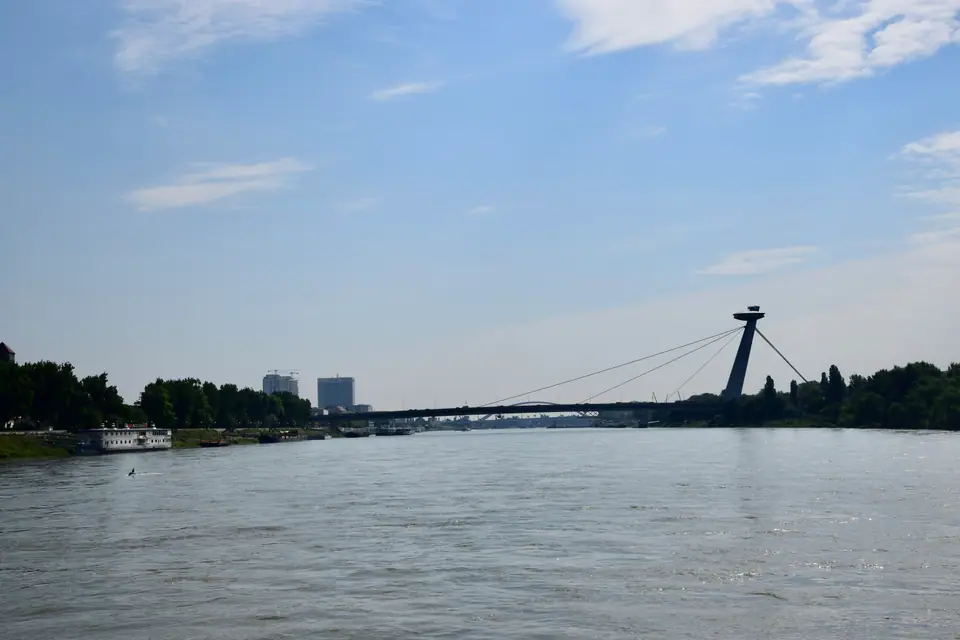
Whatever historic streets vanished below Castle Hill, Most SNP (Bridge of the Slovak National Uprising) stands as an audacious engineering work. Architects Jozef Lacko, Ladislav Kušnír, Ivan Slameň, and Arpád Tesár built the sleek steel crossing between 1967 and August 1972. Its 303-metre main river span clears cleanly across within a 430.8-metre bridge length without dropping any concrete pier into the Danube riverbed.
Diagonal steel harp cables anchor back onto a dramatic backward-slanting A-frame pylon. The twin steel legs rise 84.6 metres above land, 87.2 metres top to ground, and 95 metres above Danube mean water level. Pedestrians and cyclists cross dry and sheltered along breezy walkways hung cleanly beneath the motorway deck. Take time mid-span to watch long river barges glide downstream while clear sightlines frame Bratislava Castle, Old Town spires, and green Petržalka parks.
Inside one tilted leg runs an angled passenger elevator opposite 430 emergency steps climbing toward the saucer-shaped UFO observation terrace. Wind gusts stay brisk atop the open viewing rim, so tuck a lightweight windbreaker into your pack before riding upstairs. Broad tilted windows inside the enclosed lower lounge shelter visitors comfortably on rainy afternoons while framing distant Austrian wind farms and hazy Carpathian woods. Check current lift schedules on the official UFO site before riding up, then trace shady embankments toward Sad Janka Kráľa and Devín routes.
Where it is
- 1St Martin's Cathedral, the Coronation Story & Most SNP
- M. R. Štefánik Airport (BTS) · about 9 km from here in a straight line
- Vienna International Airport (VIE) · about 40 km from here in a straight line
- Directions in Google Maps
Stations and taxi ranks: OpenStreetMap. Airports: OurAirports. Distances are in a straight line.
Traveller tips
Real advice from people who have been to Bratislava. Every tip is read by our team before it goes live.
No tips yet. Been here? Yours could be the first.
Thank you! Your tip will appear here after a quick review.
More in Bratislava
Continue exploring Bratislava with related neighbourhood, food, and planning guides
How to Get to & Around Bratislava: Vienna Rail, BTS & PAAS
Bratislava, Slovakia
Where to Stay in Bratislava: Quiet Streets, Waterfronts & Petržalka
Bratislava, Slovakia
Best Time to Visit Bratislava: Climate, Harvest Wine & Advent
Bratislava, Slovakia
What to Eat in Bratislava: Halušky, Rožky, Stará Tržnica & Wine
Bratislava, Slovakia
